
January 6, 2024 - PBS News Weekend full episode
1/6/2024 | 26m 45sVideo has Closed Captions
January 6, 2024 - PBS News Weekend full episode
January 6, 2024 - PBS News Weekend full episode
Problems playing video? | Closed Captioning Feedback
Problems playing video? | Closed Captioning Feedback
Major corporate funding for the PBS News Hour is provided by BDO, BNSF, Consumer Cellular, American Cruise Lines, and Raymond James. Funding for the PBS NewsHour Weekend is provided by...
January 6, 2024 - PBS News Weekend full episode
1/6/2024 | 26m 45sVideo has Closed Captions
January 6, 2024 - PBS News Weekend full episode
Problems playing video? | Closed Captioning Feedback
How to Watch PBS News Hour
PBS News Hour is available to stream on pbs.org and the free PBS App, available on iPhone, Apple TV, Android TV, Android smartphones, Amazon Fire TV, Amazon Fire Tablet, Roku, Samsung Smart TV, LG TV, and Vizio.
Providing Support for PBS.org
Learn Moreabout PBS online sponsorshipJOHN YANG: Tonight on PBS News Weekend, what's behind the current surge of COVID infections and what it tells us about how we deal with the disease moving forward.
WOMAN: The odds of us completely eliminating and eradicating it is unlikely.
And so in the same way that we see flu kind of continued to reemerge in our community every year.
COVID-19 is here and it's here to stay.
JOHN YANG: Then the latest on massive protests in Serbia, accusing the president who's a strong Putin ally of rigging elections, and how Minnesota launched a redesign of its state flag to update it's complicated composition and culturally insensitive imagery.
(BREAK) JOHN YANG: Good evening, I'm John Yang.
Late today, the FAA ordered the temporary worldwide grounding of about 171 Boeing 737 Max 9s until the planes can be inspected.
It comes after a window blew out of a month old 739 Max 9 last night at about 16,000 feet six minutes after the Alaska Airlines Flight took off from Portland, Oregon.
The rapid depressurization sucked a t shirt off a child.
No one was seriously hurt in the plane made an emergency landing safely back in Portland.
The first weekend of the new year is seeing the first major winter storm of the season that's for millions of people along the East Coast.
This afternoon it's been mostly rain over the Mid Atlantic, but highway crews from the Carolinas to Maine have been treating roads in anticipation of as much as a foot of snow by Monday in Boston in upstate New York.
A separate weather system dropped snow in the Midwest.
In Kansas snow plows cleared roads and runways in Arkansas an icy I-94 became an obstacle course.
Farther south it was heavy rain.
Hezbollah launched more than 60 rockets from southern Lebanon into northern Israel today.
They said it was the initial response to this week's targeted killing of a Hamas commander in Beirut, Israel Senate responded with a drone strike.
Tension along that border is stoking fears of a wider conflict.
And that's what Secretary of State Antony Blinken is working to avoid on a diplomatic mission to the region.
His trip began today in Turkey and his to include several days next week in Israel and the West Bank.
On the third anniversary of the January 6 assault on the capital, the FBI said it's arrested three more defendants in the case.
All were indicted in 2021.
One has been in hiding since shortly after January 6, the other to jump bail last March before they were to go on trial.
Defense Secretary Lloyd Austin has been in Walter Reed Medical Center since Monday but the Pentagon didn't disclose it until last night.
And there are reports that he spent four days in the intensive care unit.
Austin spokesman Major General Pat Ryder said he was admitted for complications from an unspecified minor medical procedure.
Today, Ryder said Austin resumed his full duties last night while still in the hospital, but couldn't say when Austin would be released.
And the date for President Biden's Third State of the Union has been set for Thursday March 7.
That's the latest State of the Union speech has ever been scheduled.
It comes two days after Super Tuesday and a month after a deadline for a potential government shutdown.
Still to come on PBS News Weekend, Serbians take to the streets to claim election fraud, and how states are redesigning their flags to make them more appealing and culturally sensitive.
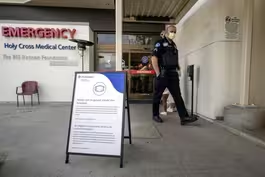
(BREAK) JOHN YANG: The United States is experiencing what's become a familiar pattern, an uptick in COVID after the holidays and the big gatherings that accompany them.
Hospitalizations have risen eight weeks in a row though they're below what they were in the last post-holiday period a year ago.
Hotspots have cropped up across the country as the new dominant variant JN.1 has quickly spread to account for more than 60 percent of cases.
Jessica Malaty Rivera is an infectious disease epidemiologist at De Beaumont Foundation, which is a philanthropy that promotes public health.
Jessica has this surge right now in any way a surprise?
Or is there anything that's unusual about it?
JESSICA MALATY RIVERA, Infectious Disease Epidemiologist, De Beaumont Foundation: To be honest, it's not quite unusual, the virus that causes COVID-19, SARS-CoV-2 continues to evolve as more and more people become infected, and the virus makes copies of itself.
It mutates it changes it gets better at evading our immune systems and making people sick.
What's encouraging is that because of our hybrid immunity in the population between previous infections and vaccination, not as many people are becoming seriously ill and dying, though we are seeing hospitalizations continue to increase as more and more people become infected.
The fact that it's back the fact that we're seeing a surge, though, is not a surprise.
In fact, it doesn't quite actually have the same seasonality as other viruses like flu or RSV, where we kind of see COVID come every few months in these big surges.
JOHN YANG: As an epidemiologist, what does this suggest to you about the future of our relationship with COVID?
JESSICA MALATY RIVERA: Yeah, it's a great question, because I think we need to be preparing ourselves for living with SARS-CoV-2 virus because COVID-19 because it is well established in the human population and among other populations in the animal kingdom.
And because of that, the odds of us getting rid of it completely eliminating and eradicating it is unlikely.
And so in the same way that we see flu kind of continued to reemerge in our community every year, we'll probably have to be dealing with COVID outbreaks a couple times a year, maybe three, four times a year.
But the hope is that between our previous infections and vaccination, we will become better at preventing those serious illnesses and deaths.
JOHN YANG: Talking about sort of getting used to living with COVID.
Does that mean we can sort of forget about it, that we can sort of be a blase about it?
JESSICA MALATY RIVERA: It certainly does not mean that and I think that's a very important point to raise, because COVID is not quite yet in the rearview mirror.
Yes, the state of emergency has ended.
But COVID-19 is here, and it's here to stay.
And so when I say living with COVID, it means understanding that people will continue to get sick, we need to continue to encourage all the mitigation efforts to reduce infections and severe illness that includes masking, staying home when you're sick testing at the appropriate time vaccination when it's updated and available to folks, because this is going to be part of our lives.
JOHN YANG: And as you say, the Federal Public Health Emergency ended in May, a lot of things went away, the public campaigns about masking, about testing, about getting the vaccinations, and also the tracking also winded.
Is that a handicap to an epidemiologist like yourself?
JESSICA MALATY RIVERA: It is a severe handicap, you know, as a alum of the coma tracking project, our work was focused on tracking all of that data at a very granular level from the state level.
We were tracking testing and cases and hospitalizations and deaths.
And we did on a volunteer basis.
And now because the emergency is over, you're not seeing the kind of funding that we need to be funding both the CDC and those state public health departments to get that granular data.
We have many resources.
We have some dashboards, hospitalization data, we have wastewater surveillance, but we are a bit like we're flying blind when it comes to understanding the full scope of what's happening with the virus in our population.
JOHN YANG: And as you say, we don't have it in the rearview mirror yet, but are you concerned that the public may feel like it's in the in the rearview mirror?
JESSICA MALATY RIVERA: I'm very concerned about that.
I think you know, it's difficult to see a lot of people think about COVID Is not that serious.
Think about masking as something that was an artifact of the past.
It is a very, very normal thing to mask when you're sick to mask when other people are immunocompromised.
It was part of our public health infrastructure and health care settings.
So the, you know, how political it's become, how contentious we've become is quite discouraging because these things are effective at helping out reduce harm which is the basis of public health.
JOHN YANG: Jessica, we asked our viewers what they wanted to ask on this topic.
Rebecca Rose in Philadelphia writes, do you think getting back to 2019 normalcy is currently in place or possible?
JESSICA MALATY RIVERA: You know, I would actually like to pivot the question of it because I think the conditions of 2019 and the many years prior to 2019, is how we got here.
For many, many years, we were dealing with the defunding and the de prioritization of public health, which is why we were so unequipped and unprepared for the impact of SARS-CoV-2, and as a result, we are now reactive instead of being proactive to something this destabilizing.
I don't want to go back to 2019.
I want to see a much more well-funded and much more prioritized public health infrastructure in the U.S. and globally so that we can be better prepared and better responding to something as major as a global pandemic.
JOHN YANG: Laura in New Jersey asked, should we be wearing masks?
Should public places like gyms report when their instructors have COVID and tell the public?
JESSICA MALATY RIVERA: You know, I think masks are a very important part of our Swiss cheese model of protection, right?
It's not one thing that's going to completely eliminate risk.
Risk is subjective and it is also additive or prevention is additive.
So will masks help reduce your risk when you're in very publicly crowded places like airports and malls and an indoor theaters?
Yes, it will.
Mandates, I don't think are going to come back anytime soon.
And so as a result, I think it's a very personal choice.
I encourage mask wearing in high risk settings.
I personally continue to mask and I was settings, and I think it should be part of our public health practice moving forward.
JOHN YANG: Jessica Malaty Rivera, an epidemiologist at the De Beaumont Foundation.
Thank you very much.
JESSICA MALATY RIVERA: Thank you for having me.
JOHN YANG: The Balkan nation of Serbia is a flashpoint in Europe struggle between democracy and autocratic leaders.
Russia's war in Ukraine heightened Serbia's importance, as it resists Western pressure to join sanctions on Russia.
Now the nation is being torn apart by protests accusing the government of authoritarian President Aleksandar Vucic, who's a strong Putin ally of widespread voter fraud in last month's elections.
Ali Rogin has more.
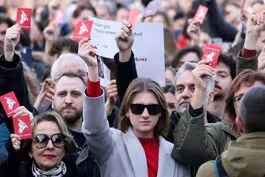
ALI ROGIN (voice-over): In Central Belgrade, chants of Vucic you are a thief, more than two weeks after what protesters say was a stolen election.
Vucic just declared a sweeping mandate for his Serbian Progressive Party following winds in parliamentary and local elections that he called ahead of schedule, but international observers say Vucic's ruling party dominates Serbian media coverage and intimidates independent journalists giving him an unfair advantage.
On election day there were reports of violence, ballot stuffing and allegations of people getting bused into different cities to vote.
Since the vote, protesters have amassed in Belgrade, demanding the results be a null.
They've paused for Orthodox Serbian holidays but will likely resume in mid-January.
MAN (through translator): People are on the street dissatisfied with the election, which is obvious everyone confirmed that.
There has been a serious disruption of the electoral process.
And that is why the elections have to be repeated.
ALI ROGIN (voice-over): Opposition Coalition leader Marinika Tepic has been on a hunger strike since the election.
She addressed the crowds on December 30, just before she was hospitalized.
MARINIKA TEPIC, Serbian Opposition Coalition Leader (through translator): I'm sorry that I can't say much.
The only thing I can say is that I have already said everything and that these elections must be annulled.
ALI ROGIN (voice-over): Vucic has defended the results.
He and Russia say the protests were being controlled by the West.
ALEKSANDAR VUCIC, Serbian President (through translator): We want to steer our own college.
We don't mind paying the price for all the rubbish and lies because we know what the cost is.
The election process will be concluded by the institutions of the Republic of Serbia.
ALI ROGIN: For more on the implications of these election results, I'm joined by Edward P. Joseph.
He teaches at Johns Hopkins School of Advanced International Studies and served for a dozen years in the Balkans, including with the U.S. Army, he has observed and organize numerous elections in the region.
Edward, thank you so much for being here.
First of all, can you tell us a little bit about what sort of leader Aleksandar Vucic has been both internally within Serbia and with regard to other countries?
EDWARD P. JOSEPH, Johns Hopkins School of Advanced International Studies: President Vucic, which is the classic autocratic leader.
He's attempting to establish thorough control of Serbia, with a veneer of democracy and that's what we see in these recent elections.
This is what is known as illiberal democracy, his neighbor and his mentor and patron within the EU of course is Prime Minister Viktor Orban of Hungary and Orban set the model for this where there's a veneer of democracy where you hold elections, but the elections are actually meaningless because the ruling party controls has such dominance over the media landscape, the opposition is weakened.
The media are hugely dominated by the ruling party and independent journalists, activists are intimidated.
And that's what we've seen in Serbia.
ALI ROGIN: And there was nothing requiring these elections to be held at this time.
So why did he call for these elections at this time?
EDWARD P. JOSEPH: Well, that's exactly right.
These are again, early elections.
And the best explanation for them is that President Vucic, as a result, in large part mistaken U.S. policy by the Biden administration was in a crisis in late September.
There was a shocking confrontation in the north of Kosovo.
This is where NATO troops, including U.S. troops are deployed.
And there was this Kosovo police patrol happened upon a Serb militia group heavily armed that could not have entered into Kosovo without Serbian authorities known and of course, that immediately cast suspicion on President Vucic.
And this attack which led to a shootout in the north killing of Kosovo police officer and three Serbs was a huge shock, because it showed in fact that the U.S. policy of trying to supplicate a placate President Vucic and somehow bring him over from autocratic pro-hungry, pro-Russia orientation had failed.
It was that crisis very likely, that President Bush wanted to put behind him, reestablish his authority as the sole preeminent political figure in Serbia and move forward.
But it turns out that that is not going to be quite as simple as he thought.
ALI ROGIN: So let's talk a little bit more about U.S. policy towards Serbia and the different priorities that the United States is balancing.
How have they approached Aleksandar Vucic?
What do you make of their response to this crisis?
EDWARD P. JOSEPH: I would say this about U.S. policy, which is got, again, brought us to the this spring, President Biden has gotten the Balkans right, consistently.
President Biden himself understands the region, and he set off his administration with the words that we are in a challenge of democracy versus autocracy.
So President Biden has gotten it right but as the administration has gotten to completely wrong.
They've abandoned that.
So we have a disparity in the Balkans where the United States treats Serbia's neighbors to a much harsher, higher standard.
And I should point out, we've had two violent confrontations in Kosovo this year.
We've had potential issues in Montenegro, which is a NATO ally.
And now within the government, there are pro-Russian elements within that NATO ally.
And we have a brewing crisis, possibly even beginning this month in Bosnia Herzegovina.
So this is the mistake of the Biden administration has been to treat President Vucic to this different softer standard on the belief that somehow we can bring him over.
Instead, what it has done is it has projected fear, the U.S. basically projecting fear of Belgrade, which President Vucic correctly interprets his weakness, and takes advantage.
And this all goes of course, to the benefit of his ally, which is Russia.
ALI ROGIN: Sure.
And let's talk a little bit more about Russia.
How does this affect his relationships with Putin?
EDWARD P. JOSEPH: Well, we see clearly that Russia and Serbia are aligned.
So we have this what is called a balance, but in fact, the truth is a pro-Russian policy in Belgrade, and we see this openly now.
So we have the absurdity of the United States, which continues to cater to President Vucic.
And we have the absurdity where President Vucic is meeting with his close and favorite ambassador, the Russian ambassador, and the two of them are openly blaming the United States and the European Union for fomenting these protests in Serbian which are legitimate protests.
These are protests by the opposition by democracy activists who believe and with good reason that the election particularly in the capital, Belgrade has been stolen from them.
And again, we see in the communication the United States, particularly the U.S. Embassy in Belgrade.
This posture of avoiding the principles the very principles that President Biden stated are the foundation of his administration.
And instead of sticking to our principles, we again project fear which Vucic interprets as weakness, and for an administration that's in its own election year this year.
This portends very badly.
ALI ROGIN: Fascinating stuff.
Edward Joseph with the Johns Hopkins School of Advanced International Studies.
Thank you so much for breaking this down for us.
EDWARD P. JOSEPH: You're welcome.
JOHN YANG: State flags that become part of the national reckoning of cultural sensitivity and the historic treatment of Native Americans by white settlers.
Ali Rogin is back to tell us how Minnesota is poised to get a new flag in May redesigned to get rid of what one critic called a cluttered, genocidal mess.
ALI ROGIN (voice-over): Atop Minnesota's flag, which has flown over the state for six decades.
The phrase the L'etoile De Nord, the North Star, but critics say this flag needs a new direction.
REP. MIKE FREIBERG (D, Minnesota: That just was kind of a cluttered mess and you couldn't really tell what was going on on it.
ALI ROGIN (voice-over): In 2021, State Representative Mike Freiberg introduced the bill to replace the flag, which depicts a Native American man riding away on a horse as a settler plows the land.
MIKE FREIBERG: The problems with the imagery on the seal are pretty incontrovertibly racially motivated.
SHELLEY BUCK, State Emblems Redesign Commission: For me as a Dakota -- we are Dakota woman I felt the old flag was offensive.
ALI ROGIN (voice-over): Shelly Buck represents the Prairie Island Indian community southeast of Minneapolis.
She was part of a 17-member commission set up by the Democratic majority legislature to choose a new flag and state seal.
SHELLEY BUCK: It was important to see this flag change because this is our ancestral homeland.
A lot of tribes have throughout the country have a migration story to where they are currently.
But for the Dakota people here in Minnesota, this is our place of birth of our creation story tells us we come into human form from the waters here in Minnesota.
ALI ROGIN (voice-over): In fact, Native people have called this region home for more than 10,000 years.
And today there are 11 federally recognized tribes with reservations across the state.
Teacher and historian Anita Gaul, who previously ran for state senate also served on the commission.
ANITA GAUL, Vice Chair, State Emblems Redesign Commission: Minnesota's current flag is what many people call a seal on a blue bedsheet, you know, slap your state seal on top of that sheet, which about 20 other states in the union have basically the exact same design.
ALI ROGIN (voice-over): The Commission received more than 2,100 submissions, ranging from serious and symbolic to just silly.
ANITA GAUL: Somebody submitted a picture of their dog, which went absolutely viral all over the states others had and this is one of my favorites.
So our state bird is the loon.
And so some people submitted a loon but with laser eyes coming at laser eye loons.
MIKE FREIBERG: I remember when some of the funnier flag submissions came in, like the picture of the bag with the word B-A-Y-G written on it or bag for the way apparently people hear Minnesotans pronouncing that word.
If not, oh my god, people are going to think this whole process is just a joke, but I actually think it kind of had the opposite effect and I think it generated a lot of interest and public involvement in the process.
ALI ROGIN (voice-over): Minnesota wasn't the first state to redesign its flag.
There have long been calls for several southern states to scrap flags with ties to the Confederacy, Mississippi changed its flag and 2020.
Other states sought a more distinctive symbol.
Utah's new flag becomes official next year.
Illinois, Maine and Michigan are also considering redesigns also for design purposes.
TEDDY KAYE, North American Vexillological Association: State flags are starting to change for two reasons removing offensive symbolism and improving the branding of the state.
ALI RGOIN (voice-over): Teddy Kaye represents the North American Vexillological Association.
That's the formal way to describe a flag enthusiast.
He also wrote the book "Good Flag, Bad Flag."
Kaye says the winning design by 24-year-old Andrew pecker is a very good flag.
The new design includes a light blue panel representing the state's lakes, a navy one resembling its shape.
And a white eight pointed North Star.
TEDDY KAYE: Minnesota's flag design probably would rate among the top 10 of U.S. state flags.
ANITA GAUL: Now it will be one of those flags that people look at.
And they'll be instantly no, that's Minnesota.
That's Minnesota's flag.
ALI ROGIN (voice-over): At the famous Mall of America.
Some fellow Minnesotans agreed.
Others objected very nicely, of course.
ARIYANA: I mean, it's pretty decent.
They could add some, you know, little sparkler with dads, but it's pretty -- it's pretty decent.
It's not so bad.
LISA TJEPKES: I was hoping that it would really you know, like you'd look at it and be like there's Minnesota and I don't get that from what was decided upon.
BLAKE DAVIS: I think Minnesotans have a bit more personality than that.
I think just the three colors.
I think they could have put a little bit more thought into it.
ALI ROGIN (voice-over): In the statement, Prekker said he hoped his design can finally represent our state and all its people properly.
That was the Commission's goals as commission chair Luis Fitch, a graphic designer who represented the state's Council on Latino Affairs.
LUIS FITCH, Chair, State Emblems Redesign Commission: All of us doesn't matter which party you are socio economic if you are a recent arrival, immigrant.
If you've been here for generations and generations or if you're American Indian We all want the same.
We want our government to be transparent.
We want housing.
We want our kids to have a good education.
ALI ROGIN (voice-over): The new design becomes official on May 11.
Minnesota Statehood Day, a fitting birthday present for the North Star State.
For PBS News Weekend, I'm Ali Rogin.
JOHN YANG: And that is PBS News Weekend for this Saturday.
Tomorrow is Israel's war with Hamas enters its fourth month, we look at the worsening humanitarian crisis facing Gaza's children.
I'm John Yang.
For all of my colleagues, thanks for joining us.
See you tomorrow.
What to know as COVID surges again with new JN.1 variant
Video has Closed Captions
COVID is surging again. Here’s what to know and why experts encourage caution (6m 31s)
The wider implications of Serbia’s disputed election results
Video has Closed Captions
The wider implications of Serbia’s disputed election results and mass protests (8m 13s)
Providing Support for PBS.org
Learn Moreabout PBS online sponsorship
- News and Public Affairs

FRONTLINE is investigative journalism that questions, explains and changes our world.
 New Episode
- News and Public Affairs

Today's top journalists discuss Washington's current political events and public affairs.

 New Episode
 New Episode

 New Episode
 New Episode
 New Episode
 New Episode
Support for PBS provided by:
Major corporate funding for the PBS News Hour is provided by BDO, BNSF, Consumer Cellular, American Cruise Lines, and Raymond James. Funding for the PBS NewsHour Weekend is provided by...