
Apple prepares for new era after Tim Cook
Clip: 4/21/2026 | 5m 30sVideo has Closed Captions
Apple prepares for new era after Tim Cook
Apple is entering a major transition after CEO Tim Cook announced he’s stepping down following 15 years at the helm of one of the world’s most influential tech companies. Cook will hand leadership to John Ternus, the company’s head of hardware engineering. It comes as Apple confronts big questions about its future. William Brangham discussed more with Rolfe Winkler of The Wall Street Journal.
Problems playing video? | Closed Captioning Feedback
Problems playing video? | Closed Captioning Feedback
Major corporate funding for the PBS News Hour is provided by BDO, BNSF, Consumer Cellular, American Cruise Lines, and Raymond James. Funding for the PBS NewsHour Weekend is provided by...
Apple prepares for new era after Tim Cook
Clip: 4/21/2026 | 5m 30sVideo has Closed Captions
Apple is entering a major transition after CEO Tim Cook announced he’s stepping down following 15 years at the helm of one of the world’s most influential tech companies. Cook will hand leadership to John Ternus, the company’s head of hardware engineering. It comes as Apple confronts big questions about its future. William Brangham discussed more with Rolfe Winkler of The Wall Street Journal.
Problems playing video? | Closed Captioning Feedback
How to Watch PBS News Hour
PBS News Hour is available to stream on pbs.org and the free PBS App, available on iPhone, Apple TV, Android TV, Android smartphones, Amazon Fire TV, Amazon Fire Tablet, Roku, Samsung Smart TV, LG TV, and Vizio.
Providing Support for PBS.org
Learn Moreabout PBS online sponsorshipAMNA NAWAZ: Apple is entering a major transition after CEO Tim Cook announced he's stepping down following 15 years at the helm of one of the world's most influential tech companies.
Cook will hand over leadership to John Ternus, the company's head of hardware engineering.
But the handoff comes at a challenging moment for the iPhone and computer giant, as it confronts a series of big questions about its future.
William Brangham has more.
WILLIAM BRANGHAM: During Cook's time at Apple, the company's market value surged by more than 3.6 trillion -- that's trillion with a T -- dollars, thanks in large part to the dominance of the now ubiquitous iPhone.
But starting September 1, John Ternus will step into the top job.
He has spent 25 years leading Apple's engineering team.
That's the one that built products like the iPhone, the iPad and Mac computers.
So, for more on what we can expect from Apple in the coming years, I'm joined by Rolfe Winkler.
He's a technology reporter at The Wall Street Journal who has covered Apple closely.
Rolfe, thank you so much for being here.
Before we get to the new boss, let's talk a little bit about Tim Cook's legacy.
I mean, he took this job arguably handling what was probably the worst -- the hardest succession gig in the tech industry following in the footsteps of the revered visionary Steve Jobs.
How did Tim Cook do?
ROLFE WINKLER, Technology Reporter, The Wall Street Journal: He -- well, it depends on who you ask.
If you ask shareholders, he did pretty well.
You guys mentioned the number, $3.6 trillion of value added during his tenure.
That's pretty impressive.
If you ask others who are looking for innovation, really, truly new products from Apple, they haven't shown us anything certainly as game-changing as the iPhone in certainly ever.
It's, of course, hard to top that.
WILLIAM BRANGHAM: And do we have a sense as to why he's stepping down now?
And he's, I know, staying on as executive chairman.
I take it that's to sort of smooth this transition.
ROLFE WINKLER: Yes, he's going to -- well, first off, why is he stepping down?
He's 65 years old, so it's natural for them to be thinking about succession.
And I think they have been thinking about it for a long time.
Tim Cook, relative to some other CEOs, probably doesn't have as large an ego as some others.
And he cares that Apple is handed off well and smoothly.
And now's a good time.
They're coming off an upgrade cycle.
The iPhone 17 is very popular.
So iPhone sales are good.
Geopolitical issues for the moment have receded, the ones that impact Apple, tariffs, problems with China.
So that's not a big problem.
They have got what they say is a decent product road map.
They're probably referring to things like the foldable iPhone that's coming up, smart glasses that will compete with what Meta's selling.
There's a tabletop robot that is -- they're going to work on that will be powered by a new Siri.
So you put all that together and now's a decent time to be handing the reins to the next guy.
WILLIAM BRANGHAM: And the next guy, John Ternus, is the longtime engineering chief at Apple.
Was he the obvious heir apparent?
And does -- do you have a sense as to how he might steer the company?
ROLFE WINKLER: He led hardware engineering.
He's -- yes, he's -- he makes a lot of sense as a candidate.
There were some others that were interested.
He -- think about what hardware engineering is for this company.
Basically, it's sort of the people who build what the product designers envision.
The hardware engineering team is the one that makes it happen, right?
They're the ones that are responsible for sort of keeping that high-quality bar as high as it is for Apple.
And Ternus has been responsible for doing that for all of its products since 2021.
So he's -- if the future of this company is great devices, and that's the past for this company, it makes sense it's also going to be its future, then Ternus is a natural choice.
WILLIAM BRANGHAM: As you have been describing, we know Apple for the products they make, but so many tech companies are now moving into A.I.
Apple has been slow to do that.
Why is that?
And do you think that that will change under new leadership?
ROLFE WINKLER: I think it has to change under new leadership, because Apple has always led when it comes to the next computing paradigm, whether it was phones or computers before that.
A.I.
is the next shift.
And they're not there.
One reason is because they don't want to spend the money to be there.
These companies are spending hundreds of billions of dollars building large language models.
Apple's not going to spend that.
It prefers buybacks and protecting the bottom line for shareholders.
The other reason that they're struggling there is because they care about privacy, which means they're not using that huge advantage they have, which is all the data on your phone, to build useful A.I.
models.
Now, I think they have got religion on this now, and they're going to try to turn the page and figure out a way to turn their devices into great A.I.
But they really got to move quickly.
WILLIAM BRANGHAM: All right, that is Rolfe Winkler of The Wall Street Journal.
Thank you so much.
ROLFE WINKLER: Thanks for having me.

Gen Z men and women sharply divided reproductive rights
Video has Closed Captions
Gen Z men and women on why they’re sharply divided over reproductive rights (9m 43s)
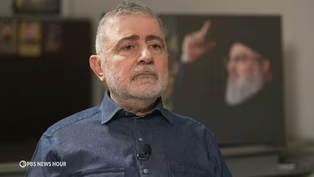
In rare interview, top Hezbollah leader rejects disarmament
Video has Closed Captions
In rare interview, top Hezbollah leader rejects disarmament, calls for Israeli withdrawal (8m 21s)

New growth in logged forests inspires photographer’s hope
Video has Closed Captions
New growth in logged forests inspires photographer’s hope (2m 51s)
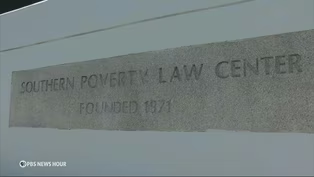
News Wrap: DOJ announces criminal charges against SPLC
Video has Closed Captions
News Wrap: DOJ announces criminal charges against Southern Poverty Law Center (5m 18s)
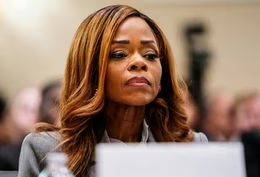
Rep. Cherfilus-McCormick resigns ahead of House ethics probe
Video has Closed Captions
Rep. Cherfilus-McCormick resigns ahead of ethics probe into use of campaign funds (4m 53s)

Trump extends Iran ceasefire as talks to end war stall
Video has Closed Captions
Trump extends Iran ceasefire as talks to end war stall (6m 13s)
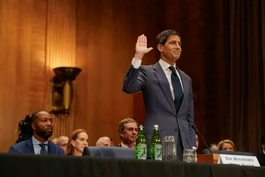
Warsh faces questions on Fed independence, personal wealth
Video has Closed Captions
Fed nominee Warsh questioned on independence from Trump and personal wealth (8m 58s)
Providing Support for PBS.org
Learn Moreabout PBS online sponsorship
- News and Public Affairs

Today's top journalists discuss Washington's current political events and public affairs.

- News and Public Affairs

FRONTLINE is investigative journalism that questions, explains and changes our world.












Support for PBS provided by:
Major corporate funding for the PBS News Hour is provided by BDO, BNSF, Consumer Cellular, American Cruise Lines, and Raymond James. Funding for the PBS NewsHour Weekend is provided by...