
Wisconsin Hometown Stories: Door County
Special | 56m 48sVideo has Closed Captions
Historians, local citizens and experts tell stories capturing the history of Door County.
Historians, local citizens and experts tell stories of tourism, cherries, art, and geology that capture the history of Door County. Viewers will also explore ethnic heritages that still thrive across the land, its art history, and efforts to preserve both the land and the natural beauty that define one of Wisconsin’s most charming places.
Problems playing video? | Closed Captioning Feedback
Problems playing video? | Closed Captioning Feedback
Wisconsin Hometown Stories is a local public television program presented by PBS Wisconsin
Funded in part by leadership support from Phillip J. Hendrickson in memory of Elizabeth B. Hendrickson. Additional support provided by Dwight and Linda Davis Foundation, Bruce and Grace Frudden, John...
Wisconsin Hometown Stories: Door County
Special | 56m 48sVideo has Closed Captions
Historians, local citizens and experts tell stories of tourism, cherries, art, and geology that capture the history of Door County. Viewers will also explore ethnic heritages that still thrive across the land, its art history, and efforts to preserve both the land and the natural beauty that define one of Wisconsin’s most charming places.
Problems playing video? | Closed Captioning Feedback
How to Watch Wisconsin Hometown Stories
Wisconsin Hometown Stories is available to stream on pbs.org and the free PBS App, available on iPhone, Apple TV, Android TV, Android smartphones, Amazon Fire TV, Amazon Fire Tablet, Roku, Samsung Smart TV, and Vizio.
- This program is brought to you by the combined resources of the Wisconsin Historical Society and Wisconsin Public Television.
♪ - On Wisconsin Hometown Stories : A county surrounded by water, and destined to be a tourism hotspot.
Built up by a vast harvest of trees and fish.
A county transformed by cherries, art, and land conservation on Wisconsin Hometown Stories: Door County ♪ - Major funding for Wisconsin Hometown Stories: Door County is provided in part by Phillip J. Hendrickson in memory of his beloved wife, Betsy; with additional support from Dwight and Linda Davis Foundation; Bruce and Grace Frudden, in honor of ancestor Peter Rowley; John and Gisela Brogan; O.C.
and Pat Boldt; John & Nell Herlache Community Impact Fund and the Education Fund of the Door County Community Foundation,Inc.
; Annie and Dick Egan Barb and Mike Madden CastlePierce; Friends of Wisconsin Public Television; and the Wisconsin History Fund, supported in part by the National Endowment for the Humanities.
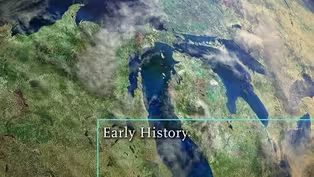
♪ - As seen from space, Wisconsin's thumb of land, Door County, juts out between Lake Michigan and Green Bay, part of a rock formation called the Niagara Escarpment.
- The Niagara Escarpment is about a 1,000-mile long ridge of rock that runs through Door County, all the way up into the Upper Peninsula of Michigan, into Ontario, Canada, and ends around Niagara Falls.
It's actually the rock that Niagara Falls flows over.
And if you look at the rocks here, you'll see there are these really beautiful, tall cliffs on the western side of the peninsula.
The cliff is called an escarpment because it's a steep vertical cliff.
- Glaciers formed the peninsula of Door County during the last ice age.
- When the ice hit that ridge of rock, it actually split it into two different lobes that then actually carved out Lake Michigan and Green Bay because of the Niagara Escarpment.
- As the glaciers retreated, Paleo-Indians arrived in the area now known as Sturgeon Bay, and set up camp sites.
Here, archeologists found spear points and stone tools, used over 10,000 years ago to hunt and process large game.
Archaeologists also found evidence throughout the county of many groups and tribes, drawn for thousands of years, to the rich hunting and fishing grounds of Door County.
Many of the early European settlers came to the remote islands north of the peninsula, taking advantage of waters teeming with fish.
- By 1860, there was close to 200 people on Rock Island, 200 on St.
Martin's.
And, of course, the boats were double-enders, wooden boats, Mackinaw boats.
They were light boats, a lot of them were made of cedar, so with a man on each side, you could pull them right up on any beach, any gravel beach.
And you didn't need a dock, and that was important, because you wanted to be close to your fishery.
After all, you either rowed or you sailed, not easy.
And especially if there wasn't much wind, then you rowed, period.
Of course, with the Mackinaw boats, everything was done by hand, you pulled the nets by hand.
Deadly work, you know.
But that's the history of the fishery.
There was an awful lot of hard work in it.
- Asa Thorp, after a season of making barrels for the fishermen on Rock Island, boarded a steamer bound for Green Bay.
- And the captain was sort of telling him his woes about how difficult it is to run this side of the bay.
There were no villages, there were no docks.
So they would have to anchor, send the men into the shore and collect driftwood to burn for the steamers.
And the captain said, "If a guy were smart, this is where he'd put a dock."
- Thorp took the advice, and built a dock, and eventually a sawmill, at Fish Creek, to take part in the harvest of the heavy forest that covered Door County.
- Very, very deep forest; very mature forest.
North, was largely pine; very good pine.
And then they had hemlocks along on the sandy shores.
And in the swamps, they had the cedar.
And then, they also had maple and birch and tamarack.
A person would buy maybe 2,000 acres and they would get a sawmill into the area.
And the peninsula of Door County doesn't have any navigable streams, so all the logs had to be transported to the shore.
And around the area of Door County, at one time, there were 60 docks and there were about 66 sawmills.
- Using the variety of local woods, local shipbuilders built schooners to carry the lumber to market.
Many of the boats traveled around the tip of the peninsula, through Death's Door, the treacherous passage that gave the county its name.
- When you were going to Chicago, if you could go through Death's Door, instead of coming up to the Rock Island passage, you might save a day of sailing.
And, of course, a lot of these skippers had great confidence in their own ability.
And it didn't always work out so well, because that's a very treacherous water.
When you get strong winds, quite often the current is into the wind very strong, and you can't see it.
When you get into the middle of that and you've got all your sail up and you're not going ahead, you're in big trouble.
Big ships, 150-footers... The Resumption went aground on Plum Island.
Beautiful big ships, you know.
There were three of them went aground on Pilot Island within a couple weeks in one fall.
So there are dozens of shipwrecks on that Death's Door passage.
- As the loggers moved on, families began to settle onto the land, and build farms.
- And it was a tough go.
The hardships are beyond our imagination, really.
There were places they could get enough topsoil to plant crops, and they did-- there was quite a bit of farming up here.
But it was a tough kind of farming.
- First, they had to clear the land, and then pull the stumps, and a huge, labor-intensive-- Terrible, you know.
And then when they put the plow in the ground, all they got was rocks.
(laughing) - So if you drive through the county, in almost any village, you will see beautiful, constructed stone fences, and thrown-together stone fences.
- Those are symbols of hard-gained cropland.
- As farms developed, villages grew up around the loading docks.
The settlers built schools, and churches, and endured long, and often brutal, winters.
- A lot of disease.
A lot of them died of whooping cough, tuberculosis, plague.
But we owe them a tremendous debt of gratitude, and we cannot appreciate what they went through to settle this area.
(fiddle music) - This is our great grandpa and grandma.
Francois.
That's "Francis" of course, but... Francois Evrard.
And her name was Florentine Patris.
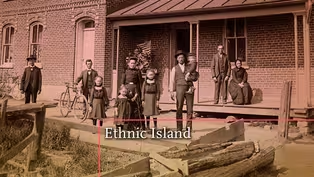
- In 1853, the first of thousands of Belgian immigrants began to settle in southern Door, Brown, and Kewaunee counties.
- And they created an ethnic island, here in northeast Wisconsin.
- They were persuaded to settle in the area by Father Edward Daems, a Catholic priest who spoke the Belgian language of Walloon.
- The reason that they all came here was the language.
It was a cultural element that made it so appealing.
(speaking in Walloon) - Grandma only talked Walloon, so I still talked with her, and I'm glad I did.
And my mother and I talked Walloon.
The day she died, we still had a conversation in Walloon.
- The land had not been settled for good reason.
It was heavily forested, and it was just a very difficult place to make a living.
But they persevered.
(speaking in Walloon) - As the Belgians cleared their land, they also produced wooden shingles to bring in much-needed cash, and built a dock to transport goods.
- Years ago, there was a boat by the name of the Dennessen .
And they'd take their shingles and a cow, or anything they had, to haul it.
They'd take it down to Green Bay.
They'd put it on the boat, and then the people, some people want to come visit their relatives up here.
They'd take the boat and they'd go down over there, and then, vice versa.
(fire roaring) - In 1871, on the same night as the Chicago Fire, the Great Peshtigo Fire swept up both sides of Green Bay.
A dry forest and high winds whipped small fires into an inferno, that spread through the Belgian community.
(horse whinnying frantically) - Wind came up and ignited all of these small fires to become one big fire, and it just kept growing and growing, and it was like a tornado of fire.
(fire roaring) - My great grandfather and great grandmother grabbed woolen blankets, and they were going down into the well.
And the fire went over them and on the side of them.
And they came out of the well, and said they looked around, and all they could see was burned land.
There was nothing-- There was nothing left of what they had worked so hard to do.
- With many killed, and hundreds homeless, the Belgians slowly began to rebuild their farms on the rocky, burned over land, and made the most of the resources that were left.
- Now any forest fire: it will destroy the foliage, it will char the bark, but it won't consume the tree.
And so the Belgians spent winters rescuing timber.
And then, a building boom took place here.
Those are log houses.
They covered them with locally-made brick.
Now, we don't have to go to Quebec, or we don't have to go to Europe to see classic examples of folk architecture.
It's right here in northeast Wisconsin.
♪ - There are small little chapels dotted along the Belgian countryside here.
It is a practice that was brought from the old country.
- The chapels, in their interior, have some characteristics.
A alter at the end of the very small room, and then a number of artifacts on the alter.
Tremendous symmetry.
They were an important part of the religious fabric of the area.
The Belgians are very religious.
A lot of the life then and a lot of life today revolves around the local parishes.
- I lived right next door, so I'd have to come to church... ...a lot.
They'd send me: "Oh, you'd better go to church today."
"It's a good day for you to go to church, or..." - We were all Catholic.
The Lutheran-- You didn't-- You didn't marry a Luth-- outside your religion.
I know when I was in high school, my mother didn't even want me to have a friend that was not Catholic.
As Wisconsinites, we know that we have a plethora of ethnic islands here.
But most of them have eroded, and lost their identity.
The Belgians have not.
- I guess the thing of the people staying together, working together, because they always worked.
The thrashing crew was made up of all your neighbors, everybody came to help.
No matter what, you always had people to help, they helped one other.
- We had a bunch of men come over with big poles, and they put up the barn.
And that night, the rafters are up, and a big storm came, and blew it down.
And all the neighbors came over the following day.
They all pitched in, took all the boards apart, took the nails out of the boards, and two days after, the barn was back up.
All the neighbors came and helped.
- They worked hard, they played hard.
Good times, dances, and maybe when there were weddings or funerals-- Funerals were big things, really big things.
Everyone just seemed to be happy around here.
You could visit with people, and... - The ethnic island that they defined within the area of northeast Wisconsin still exists.
They have retained their ties with each other on this land for that many years.
And that's just remarkable.
♪ - In 1872, work began on clearing the land for a canal that would connect Sturgeon Bay with Lake Michigan.
The canal would create a big shortcut, reducing the need to travel around the peninsula, and through the Death's Door passage.
With the canal, Sturgeon Bay suddenly became a busy Lake Michigan and Green Bay port.
Schooners would tie together, and split the towing fee, in what became known as "a big tow."
The shipbuilding and ship repair industries expanded, and shoreline rock quarries now had a direct route to Lake Michigan markets.
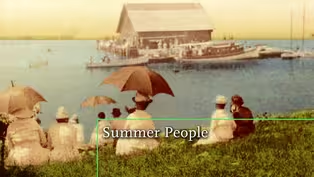
With easier access, a new industry, tourism, began to take hold in Sturgeon Bay and the Green Bay side of the peninsula.
With almost 300 miles of shoreline, much of it considered worthless for farming, it was only a matter of time, before tourists began to discover the cool breezes and beauty of Door County.
In Fish Creek, dockmaster Asa Thorp, sold fuel to steamboats, and also ran a small boardinghouse.
- The lumbermen, the salesmen, anyone that came to the village, he would put up.
And soon, the people wanted to get off of the ship when they came into the village.
So as they were taking on new wood, they would walk up and down the streets, and people loved how cool it was, and how lovely this little village, and the air was clean, and it felt so good... And soon they started asking Asa if they couldn't stay in the boarding house.
I think he must have been a very ingenious guy, and that's the next thing he did.
He built a very fine hotel.
It just seem that that was the way the village was going to go, and so that the fishing and lumbering village of the late 1800s quickly became-- By 1905, 1910, people were building hotels.
They were already up.
- Just to the north, in Ephraim, village residents were amazed when a ship's passenger inquired about staying in the village overnight.
- And asked the dockmaster if there was someplace to stay.
He was told, "No, there were no hotels."
And he suggested that he might run down to the Widow Valentine's house, but he better hurry because the boat was going to leave and he'd be stuck if she said, "No."
She said, "Yes," and he stayed for a couple of days.
- And other villagers noticed that, "Wow, this is a source of money."
- That is when tourism became a thought in the minds of several people.
And after The Advocate published an article-- I believe this is what it said: Ephraim wants a good hotel, and tourists would be plenty.
And Fordel Hogenson, who was a Norwegian immigrant, decided that that would be what he would do.
He was a skilled carpenter, he was a captain of his own schooner, he also fished for a living, and made some money, he also did some lumbering.
Everybody did everything in those days, because they had to.
So he decided that he would add onto his house, and he added a little more, and a little more, until finally, he enough space for 80 people.
The bedrooms were minimal, chamber pots under the bed, but they served three meals a day, and every meal was wonderful.
- And others were adding onto their houses and permitting people to come and stay.
- Soon, new hotels began to spring up all around the peninsula, and Washington Island.
The Goodrich Transportation Company, began to bring in boatloads of tourists, running regular routes from Chicago and Milwaukee.
- And they used the large steamship, the Carolina .
And they had sleeping quarters, a big dining room.
It was really a nice ship.
This big Carolina would lumber in to the dock, and completely overpower the dock.
At the big event, of course, the captain would blow his siren coming around the bend, and villagers would drop what they were doing and rush down to the dock and see who was showing up, what they were wearing.
- And everybody would flock down to the dock, because someone interesting might be on the boat, or some thing that they had ordered might be on the boat, and maybe they wanted to ship something out on the boat.
Big excitement when the boats came in.
- But lots of people came.
And they'd stay two to three weeks, a long time.
Some stayed the whole summer.
And they were escaping the summer heat in Chicago, Milwaukee, and my wife's family's from St.
Louis, and that's why they came up.
It was a place where people could come and lay back and relax and enjoy nature.
You went on picnics, you fished, you spent time on the water doing whatever, and enjoyed good meals at these hotels.
Those were really good times for those people.
And there were some very wealthy people who came up here.
And by 1921, there were 11 major, old-timey hotels in Ephraim.
On the American plan, all your meals were provided.
- Three meals a day for a lot of people; That's a lot of work.
And so, local people had to be hired, women in particular, who didn't have jobs.
People didn't hire women for anything in those days.
So, people who were known to be good cooks would be asked if they would help cook for the summer.
Other people would be asked if they could do housekeeping.
So the man of the family would take care of the outside work, and the ladies would take care of the inside.
There are some who say the women did it all.
The women really were the heart and soul of these old hotels.
Tillie Valentine ran the Anderson Hotel-- I mean really ran it.
Eugenia Smith at the Eagle Inn-- stern taskmaster.
Serena Olson at the Hillside, Augusta Olson at the Pine Grove.
They managed the place, they were cooks, greeted people, did the book-keeping, and managed the kitchen, and managed the help.
It was a big deal.
A lot of money flowed into Door County through tourism, and still does.
- How wonderful that there is such a thing as a tourist.
It gives all of us a livelihood.
(chuckling) ♪ - In 1908, noted landscape architect John Nolen toured Wisconsin, in search of the best places to develop state parks.
- In Door County, Nolen and the new State Parks Board arrived to inspect the land that would eventually become Peninsula State Park.
The board members were struck by the site's possibilities for recreation, and as a place for city people to reconnect with nature.
In his final report, Nolen explained why Wisconsin should move quickly to preserve the land for a state park.
- "It is wild, and as yet, unspoiled, "with alternating interests of woodland and cliff, "bay and land.
"It sweeps from point to point-- "here a beach of fine sand, "there of gravel.
"Then, in contrast, precipitous limestone bluffs, "rising to a height of a hundred feet or more.
"Almost at each step, a new vista is opened, "a new composition afforded.
"The vegetation is rich, and varied.
"Extensive forests cover large tracts.
"With the purest of air, "laden with the fragrance of balsam and pine, "it is no exaggeration to say "that the broad beauty of the scenery "is not surpassed in Wisconsin."
(bird calling) - Jens Jensen, another nationally-known landscape architect, also made his mark on Door County.
After a long career as superintendent and designer of Chicago parks, and as a landscape designer for wealthy clients, Jensen retreated to Ellison Bay, in northern Door County, to start a folk school he called, "The Clearing."
- He intended it to be a clearing of the mind, a place where things would become clear to you out in nature.
He wanted a place... He called it, "On the edge of the wild... somewhere, "high up on a hill or a bluff, "with a view of a large expanse of water, "with a setting sun."
He felt people had to be out in nature in order to be human.
People need this, in an increasingly urbanizing society, they get removed from it, and we still need this.
He was passionate, and he was a visionary.
He envisioned that whole corridor from the Indiana border all the way up past Milwaukee as being one large city someday, and we need to preserve some areas as wild areas.
But he wanted people to be out in them, using them.
- As Jensen continued building "The Clearing," another call for preservation began in Bailey's Harbor.
In 1924, Albert Fuller, a botanist for the Milwaukee Public Museum, visited the Range Light lighthouse station outside of Bailey's Harbor.
- He had gotten reports of rare orchids in that area.
Fuller was astonished by what he found.
The forty acres of land on the lighthouse property teemed with an astounding array of wild orchids and other rare plants.
- He came up with 25 of the 40 native orchids of Wisconsin right here on the original 40 acres.
He really knew this was something special.
- Over time, the waves and currents of Lake Michigan had formed a series of ridges of land.
- And in between are these unique wetlands called swales.
And depending on the soil type and the hydrology and the vegetation, they can be open like this one, like a sedge meadow, or they can be a bog.
And that's what makes it so unique, is that in this small area, you've got one plant community, then another plant community in the swale, and then could be a totally different plant community on the next ridge.
And so the geological formations with the ridges and swales has created this unique setting for a lot of different flora and fauna.
- During the Great Depression of the 1930s, the coast guard turned over the forty acres of land surrounding the Range Lights to the county.
- And up came the idea: let's make a campground out of the ridges.
And they were going to build a road, and they brushed it, they cleared it out, and one by one, people began objecting to what they were seeing.
And probably the loudest objector was Emma Toft.
She hated what they were doing.
The story, which was concocted about her standing or sitting in front of the bulldozers was not true, but she said, "It made a good point.
"I would've done it if I had to."
[chuckling] - And Albert Fuller got wind of that, and started this real grass-roots movement to protect the 40 acres.
He started to work with a lot of the local people like Jens Jensen, who had started "The Clearing."
Through the Bailey's Harbor Woman's Club, they started to have these meetings, and Albert Fuller would come in and present.
"Don't develop this area.
"It's very unique with its orchids, its diversity, "and preserve it, "and make it a destination "that people can come in and appreciate it."
- In a way, he was pleading with them: This place is special, needs preserving.
And they listened to him.
- On October 4th, 1937 The Ridges started, filed articles of incorporation, and worked with the Door County Parks Committee to protect the original 40 acres.
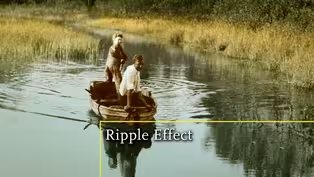
- The volunteer group quickly began a campaign to purchase a buffer of land around the 40 acres, inspiring future preservation efforts in Door County, and beyond... - That vision that they had created a real ripple effect.
- It was one of the first of its kind.
Quite a few groups used The Ridges as the model to copy from.
- Emma Toft went on to become a conservation legend for her decades of work at The Ridges, and her relentless efforts to preserve her family's old growth forest land.
Jens Jensen went on to lead an effort to locate and purchase wild land in Door County, to be preserved as county parks.
- So, we have these special parks in Door County, that are kind of wild.
Ellison Bluff, up the road a bit is Door Bluff Headlands County Park.
Cave Point, down by Whitefish Dunes, is another one.
- Albert Fuller went on to join Aldo Leopold and other UW-Madison biologists to start what would become the State Natural Areas program, protecting Wisconsin's endangered landscapes.
- He took this idea that was started in Bailey's Harbor to protect land for its natural beauty, but also to start preserving land for flora and fauna, and they've protected well over 350,000 acres throughout Wisconsin.
(waves lapping, bird chirping) ♪ - In the 1860s, Door County farmer Joseph Zettel began planting apple trees, and after 30 years, he and his family ran what was then the largest orchard in Wisconsin.
In his decades of growing apples, Zettel never lost a crop to spring frost, due to the effect of Lake Michigan and Green Bay, on the local climate.
His fruit-growing success attracted the attention of Emmett Goff, professor of horticulture at UW-Madison, and Arthur Hatch, a fruit-grower from Richland Center.
They set up an experimental fruit farm, near Sturgeon Bay, and word soon spread of their success in growing cherries.
- My grandfather got interested in some of the trees that were planted down near Sturgeon Bay about 130 years ago.
He made the three day trip down to Sturgeon Bay to see those trees.
He came back all enthused about the possibility of raising cherries up here in northern Door County.
He ordered 700 trees.
- Of course, farmers were looking for something else to do besides milk cows and the things that they were doing.
The farms around our neighborhood, some had five acres, some had ten acres.
Just a little orchard back in the corner somewhere.
And they had then a product that they could sell at a roadside stand.
Years ago, it wasn't uncommon for people to trade at a store.
I'll have some cherries, and maybe I can buy some oatmeal or something with it.
One of the first ways of marketing, of course, was pick your own.
Where a family would come up on a Sunday with their car and pick cherries, take them back home, and they'd can them, preserve them.
Jam and jelly.
Of course, you have to take the pits out, but they found ways of doing that.
Hair pins work for that, in case you want to try it.
Cherries are prone to diseases.
There was bugs that would get in cherries.
The first fungicide to use: blue vitriol or copper sulfate.
That was something that you would mix in with water, along with hydrate lime and arsenate of lead.
You'd stand on top of the sprayer, and as the team of horses pull that thing down the row, you would stand up there and spray the cherries.
Of course, the thing would blow back on the guy that was doing the spraying.
He was as blue as the cherry trees were, when they got done.
Everything was blue from the blue vitriol.
Suddenly, there were a couple of people, a Reynolds and a Martin Orchard Company, that decided to go into it big time.
Finally, the Martin Orchard Company got to be 1,000 acres.
As the market developed it occurred to somebody, maybe we ought to try to commercially can these things.
They used to take the cherries into the factory and they'd go on a belt.
They'd have people sitting along this belt that would pick out the bad cherries, pick out the stems, leaves.
Then they go through the pitters.
The little thing goes down and pokes the pit out.
I remember as a youngster, we'd go to the factory and then we'd have to wait to get unloaded.
The line would be a bend a half a mile long or something.
Waiting, and you'd get all the news in the neighborhood, and all this sort of thing.
These boxes of cherries, they held four pails.
We had two boys.
They'd get on the truck and they would unload the boxes for you.
One guy would pick up the box on the truck and throw it to the guy that dumps it in the tank.
He'd take the box and throw it to the guy that stack it back on the truck again.
There was a box in the air all the time.
The boxes weighed 50 pounds a piece and they could go through 100 boxes in no time.
One of the interesting parts of it was how are you going to get these devils picked once you got them on the tree?
It gets to be a big job picking the cherries off.
It was a great opportunity for the neighbor kids to come over and pick cherries and get paid so much for a ten pound pail.
Not only that, but families would come and pick for just money.
One guy told me one time that the family would pick cherries and it bought the coal for the winter.
Finally, it got to the point where even the local people weren't enough to pick the cherries.
I remember having the Indian families coming from Oneida and so many areas west of here.
Horseshoe Bay Farms needed about a hundred people for three weeks.
So what they did is they started the concept of a cherry camp.
They recruited 13- to 17-year old young boys to come here to pick cherries.
They promoted it as coming to a camp.
You had to pick your room and board every single day, which was seven pails of cherries.
They had baseball fields.
They had boats and canoes.
They had a swimming beach.
The big attraction of cherry camp to the kids was the camp counselors were Green Bay Packers.
- The Mexican families used to travel from one end of the country to the other.
They'd start in Texas and they'd follow the crops up.
They'd work in the sugar beets.
Then they'd go and work in strawberries.
Then they'd end up in cherries.
Then they'd head back to Texas.
The whole family was out picking cherries.
Little kids were climbing up in the trees.
The whole family-- They would actually look at this as being a pretty important opportunity for them to make some money.
Well that went along until the war came along, World War II.
The local people were gone, the people were gone to war.
A lot of people were busy: war plants, and this sort of thing.
One of the first things that happened: we had people from Jamaica, Jamaicans picking cherries.
Probably one of the most interesting groups we had picking cherries was German World War II prisoners.
These were German troops in Rommel's army that got captured in North Africa.
We had camps that had the prisoners in them.
- Back in the early fifties, and so on, was really the heyday of the cherry industry here in Door County.
There were 700 growers growing cherries here in Door County at that time.
We'd raise up to 50 million pounds in Door County.
12,000 migrants would come into the county to harvest that fruit by hand.
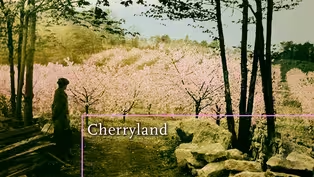
- So, the place kind of got to be known as Cherryland.
We had the Cherry Blossom Festival.
People would drive up from all over, drive around the country and look at the beautiful cherry blossoms.
The whole county was white.
Then there was the Cherry Blossom Queen.
Then we had Cherryland Festival where there would be a celebration, come to Cherryland.
We had a Cherryland airport.
The Cherry Road out at Sturgeon Bay heading north, the whole road was lined with cherry growers.
Door County was Cherryland.
It was!
It was Cherryland.
It was an industry.
It really kept people busy.
♪ After World War I, dozens of returning veterans received federal funding to study art at the Art Institute of Chicago.
Two of their professors, Frederick DeForest Schook and Frederick Victor Poole, decided to start a summer school for the veterans, in Bailey's Harbor.
- There were a number of World War I veterans that came.
First they stayed in tents.
Then later, some of the doughboys stayed at a hotel that was right nearby.
They would go around an paint.
They would paint scenes looking out from the bluff tops, looking out over the lake.
They would paint the old buildings, and some of the interesting elderly people that lived in Door County.
But they would go out in the field a lot because of the area's scenic beauty.
It was great for artists, still is.
They were quite a group.
They would come in to town and go to the dances at Washebek's Hall, where there usually was a polka band.
And they were active in the parades, which were traditional during the 4th of July at Bailey's Harbor.
They would have dances with some of the local gals, and they would dress up in various costumes.
- Both professors, Schook and Poole, built cottages in Bailey's Harbor, and became among the first of many artists to make the move to Door County.
♪ As improved transportation brought more visitors to Door County, it also brought about a need for more things to do.
- There wasn't very much to do.
In fact, we used to laugh about, "What in the world would people do in the summer "if they didn't like sitting on a rocking chair "on the front porch and looking at the water?"
- In 1935, the sister and brother team of Caroline and Richard Fisher started the Peninsula Players, producing plays in the garden behind a Fish Creek cottage.
- They felt people were interested, they had an audience and it was coming, so that when the Wildwood Camp for Boys came for sale, they purchased it.
- The camp would provide housing for the actors and crew, and space to build a stage, designed by C.R.
Fisher, Caroline and Richard's father.
- And the first acting company got out wheelbarrows, axes, and helped the tradesmen build and set up the first stage house that we had here.
"Mama Fisher"... Lydia Fisher was a graduate of the Pratt School of Design, and actually designed most of the costumes that the Peninsula Players produced for most of the first decades.
When Caroline and Richard started, they worked as a team in selecting the casts and the company members.
They were producing ten shows a summer, one a week.
Caroline could convince people to donate things.
She'd knock on the doors and say, "Can I borrow that sofa or that painting?"
And people would do that.
Caroline was really the heart and the energy of the players, and what kept Peninsula Players thriving for so many years.
♪ - In Sturgeon Bay, the late Gerhard Miller developed his skills as a painter, while at the same time, running his family's clothing store.
I'd call myself 'one of the local yokels,' 'cause I think I've sold clean underwear and socks to almost every man in Door County.
I was expected to go into the clothing store and continue on with it.
I went in in 1927 and I was in it until 1959.
And I was painting all the time.
It was a dual career at that time.
And it was a lot of work, because I had to get up early in the morning and paint, and then I'd come home at noon and grab a sandwich, paint until I had to go back to work, and then I'd paint in the evening.
My type of painting is in the field of imaginative realism.
For instance, one of the subjects in one of the reproductions we have is of a buggy in front of an old weathered barn.
Actually, the buggy was from up near Sister Bay, the barn was from down in the southern part of the county, but you put the two of them together, you're creating the picture.
You're not taking a photograph.
- After decades of disciplined effort, Miller began to sell enough of his paintings to make a living.
He opened a gallery, and inspired other artists to make the move to Door County.
- There was a time when I had the only gallery in Door County.
I think he became the major artist of his time in this area.
- I was drawn to this place in part by Gerhard Miller, because he was working in a vocabulary that I understood and appreciated, and which I enjoyed painting in.
So I figured there was a career potential for me here, and that proved to be the case.
So it was beginning to evolve into an art community, though it was the place I think that drew us.
The closeness to nature, living really in nature, is very important to me, almost indispensable.
And I'm also very interested in history, Fortunately, I had at the bottom of the hill Anderson's dock.
Schooners coming in and out was an endless subject for me.
♪ - In the 1960s, artists exploring new approaches to modern art, found a home at the Peninsula School of Arts, started and built by Chicago artist Madeline Tourtelot.
- Madeline took it upon herself to found this school and bring a group of artists in residence here starting in 1965.
- Adopted by a wealthy aunt, who nurtured her artistic talents, Tourtelot was free to dedicate her life to art.
- She had a lifetime connection to the Art Institute in Chicago.
She was able to travel to Paris.
But her family had a home in Ephraim, so she had this ongoing connection throughout her life to Door County.
- Brimming with ability, Tourtelot achieved success in many art forms, including music and painting, designing screen prints on fabric, as well as photography and experimental filmmaking.
- Some of the younger artists that she brought in in the late 60s and early 70s were abstract artists, they were experimental artists, they were large-scale sculptors.
(welding rod arcing) And she encouraged experimentation and exploration.
That was very much part of the philosophy of the time.
And so, it brought the outside world into Door County.
- And she was an outsider, but people accepted her even though she had platinum blonde hair, shapely figure, drove a Jaguar with the top down, and her platinum hair flowing in the wind... ...and maybe a scarf.
- Madeline's mission was to foster an appreciation for the arts, as well as to provide access to education in the arts.
So, right from the beginning, it didn't matter whether you were three years old or 60 years old, there was a place hare at the school for you, and so we began by teaching children's classes, weekly kids' classes.
- She found more creative energy from collecting these creative souls around her, and that fed her creativity, and in turn, it fed their creativity.
- She loved to have dinner parties.
Her delight was in bringing disparate groups of people who she... ...she sensed a thread among them.
So there would be scientists, and musicians and writers and painters.
She would put us all together in a room, and then make these beautiful dinners.
And the conversations were so enlivening, and the things that it would lead to, and... She was fabulous, and I credit her, in my lifetime, with being the spark helping to make Door County an authentically creative place.
♪ (waves crashing) - By the 1970s, Door County's traditional way of life would undergo big changes.
- There was over 400 fishermen at the turn of the 20th century, and it stayed that way until about the 1950s, and then it slowly started to decline due to invasive species entering the Great Lakes.
It's just something that's just a mere shadow of what it once was.
You've got maybe a handful of fishermen left, maybe five in Door County, compared to 400.
It was the main industry at one time, surpassing logging and farming, and it just managed to be part of the essence of Door County.
- In 1969, National Geographic magazine featured Door County in an article called "A Kingdom So Delicious."
- And, of course, with a distribution of National Geographic , it got the word out on what a beautiful and wonderful retreat Door County was.
- "A Kingdom So Delicious?"
Wow.
That brought a lot of people to this kingdom.
- That seemed to open the floodgates for tourism.
- It just brought out all of the attributes of the county, and emphasized them and it-- Well, if I were a developer, that's where I would have gone right then, is to Door County.
- And there was no effective zoning, no land use plan, nothing in place to stifle all this new development.
- At the same time, Manitowoc Shipbuilding bought two Sturgeon Bay shipyards.
The new Bay Shipbuilding Corporation created hundreds of jobs, building freighters and other Great Lakes ships.
With thousands of new year-round residents, and tens of thousands more tourists, local governments began to consider controlling growth, through land use planning and zoning laws.
- And we've grown so fast the last seven years, that we're going to stop and take a good hard look at the progress we've made, and evaluate the things that have been accomplished, and then, do more planning for the future.
- To provide a blueprint of lands needing protection from development, UW-Madison ecologist Jim Zimmerman, and his wife Libby, began an inventory of the vegetation and ecosystems of Door County.
- And he knew everything, it seemed, about the outdoors.
He knew every plant and every tree.
- Unbelievable, that he was able to identify the areas that were ecologically very significant.
Unbelievable!
I don't think there was another person in the world, other than Jim Zimmerman, who could do that.
That really required a knowledge and a discipline and a dedication to do that.
And probably, his greatest single achievement was he developed a map of Door County identifying all the places that were environmentally important.
- We assembled them into township-size maps.
- People could look at those maps and see exactly where they lived, and what their particular area was like, if it was bordering on a wetland, and so forth, and it made them aware of what was going on in their own community, and what needed to be protected.
- We had several meetings with 'Jim Zim,' as we called him, as a presenter.
And there was always a full crowd.
I think Jim was aware that nothing is forever, that things are changing, and once they're gone, they're gone forever.
- A new awareness of lands needing protection led to the formation of the Door County Land Trust, a local group that now protects over 7,000 acres of sensitive and scenic lands.
[bird call] In spite of all the changes, Door County continues to rely upon many of the same resources as generations in the past.
And the county's setting and history continue to provide a lasting identity.
Villages still face the water, built on the sacrifices of the pioneers.
The draw to the land, and the connection to the water continue as they always have.
(children chattering excitedly) Door County remains a place to restore the connection with nature.
- We can put him in by the grasshoppers.
He'll be fine.
- The great diversity of the land, with many of its wild places now protected, will endure for generations to come.
♪ The landscape still inspires artists of all kinds, and the artists, in turn, create another landscape, of art.
And the arts continue to flourish, one thing leading to another, kept afloat by local support.
Not on the way to anywhere else, Door County remains a destination, a getaway, and a place for fun.
(cheers and laughter) But constant through it all, is the beauty that defines Door County.
♪ (birds chirping, boat brushing against dock) ♪ - Major funding for Wisconsin Hometown Stories: Door County is provided in part by Phillip J. Hendrickson in memory of his beloved wife, Betsy; with additional support from Dwight and Linda Davis Foundation; Bruce and Grace Frudden, in honor of ancestor Peter Rowley; John and Gisela Brogan; O.C.
and Pat Boldt; John & Nell Herlache Community Impact Fund and the Education Fund of the Door County Community Foundation,Inc.
; Annie and Dick Egan Barb and Mike Madden CastlePierce; Friends of Wisconsin Public Television; and the Wisconsin History Fund, supported in part by the National Endowment for the Humanities.
Video has Closed Captions
Clip: Special | 7m 25s | Dramatic geology and human resilience forged the early cultural and economic history of Door County. (7m 25s)
Video has Closed Captions
Clip: Special | 7m 20s | Mid-19th century Belgian immigrants settled a still thriving ethnic community in Door County. (7m 20s)
Video has Closed Captions
Clip: Special | 7m 4s | A new canal connecting Sturgeon Bay to Lake Michigan transformed the area into a tourist hub. (7m 4s)
Video has Closed Captions
Clip: Special | 8m 11s | Early conservation in Door County led to parks and inspired broader preservation in Wisconsin. (8m 11s)
Video has Closed Captions
Clip: Special | 7m 35s | Door County's cherry industry grew and thrived, boosting and transforming the local economy. (7m 35s)
Video has Closed Captions
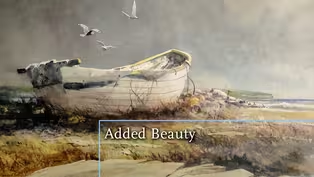
Clip: Special | 9m | Post-WWI, artists thrived in Door County, forging its reputation as a hub for creativity. (9m)
Video has Closed Captions
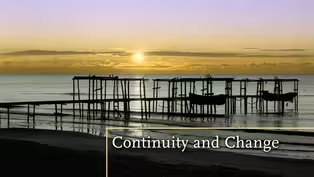
Clip: Special | 6m 52s | From the 1970s, Door County’s fishing industry declined, tourism surged, and conservation emerged. (6m 52s)
Providing Support for PBS.org
Learn Moreabout PBS online sponsorship













Support for PBS provided by:
Wisconsin Hometown Stories is a local public television program presented by PBS Wisconsin
Funded in part by leadership support from Phillip J. Hendrickson in memory of Elizabeth B. Hendrickson. Additional support provided by Dwight and Linda Davis Foundation, Bruce and Grace Frudden, John...