
Wisconsin Hometown Stories: Sauk Prairie
Special | 58m 47sVideo has Closed Captions
The story of two villages in South Central Wisconsin from early beginnings to today.
Get to know the story of two villages formed by the fertile land of South Central Wisconsin and the flowing waters of the Wisconsin River. Film, archival images, and interviews with historians, local citizens, and experts illustrate how their histories were shaped by Native communities who first called the land home, the harnessing of water power, manufacturing, and the creativity of residents.
Problems playing video? | Closed Captioning Feedback
Problems playing video? | Closed Captioning Feedback
Wisconsin Hometown Stories is a local public television program presented by PBS Wisconsin
Wisconsin Hometown Stories: Sauk Prairie was funded by major support from Greg and Carol Griffin, Darlene Ballweg, Culver’s Foundation, and Wollersheim Winery & Distillery, with additional support from Bank of...
Wisconsin Hometown Stories: Sauk Prairie
Special | 58m 47sVideo has Closed Captions
Get to know the story of two villages formed by the fertile land of South Central Wisconsin and the flowing waters of the Wisconsin River. Film, archival images, and interviews with historians, local citizens, and experts illustrate how their histories were shaped by Native communities who first called the land home, the harnessing of water power, manufacturing, and the creativity of residents.
Problems playing video? | Closed Captioning Feedback
How to Watch Wisconsin Hometown Stories
Wisconsin Hometown Stories is available to stream on pbs.org and the free PBS App, available on iPhone, Apple TV, Android TV, Android smartphones, Amazon Fire TV, Amazon Fire Tablet, Roku, Samsung Smart TV, and Vizio.
- Female Narrator: This program is brought to you by the combined resources of the Wisconsin Historical Society and Wisconsin Public Television.
[jaunty piano music] On Wisconsin Hometown Stories , two villages on the Wisconsin River at the edge of a rich prairie landscape built up by the bounty of the land, villages transformed by war, [explosion] ambitious projects, and revealed in the work of local artists on Wisconsin Hometown Stories: Sauk Prairie .
[light upbeat piano music] - Male Announcer: Major funding for Wisconsin Hometown Stories: Sauk Prairie was provided by Greg and Carol Griffin, Darlene Ballweg, Culver's Foundation, Wollersheim Winery and Distillery, with additional support from Bank of Prairie du Sac, Milwaukee Valve Company, Sauk County UW Extension Arts and Culture Committee and Wisconsin Arts Board, Schwarz Insurance, Jim Slattery, Wyttenbach Meats, Focus Fund for Wisconsin History, supported in part by the National Endowment for the Humanities and Friends of Wisconsin Public Television.
[light piano music] - Peter Shrake: The earliest known inhabitants of the Sauk Prairie would have been the Sauk Indians themselves.
And hence the name Sauk Prairie, Prairie du Sac, Sauk City.
And the earliest village as far as is known was a Sauk village that was established around 1740.
Jonathan Carver, the British fur trader and explorer, was coming down through the area, and he provides a fairly detailed description of that village in his journals.
And he describes a community of about 90 buildings, of about 300 warriors, but well-laid-out streets, well-laid-out and constructed buildings.
The buildings are of, as he describes it, hewn timber with very tightly fitted joints, covered with bark.
He describes the prairie full of plantations, as he put it, very well-maintained of corn.
The village lasts until sometime after the Revolutionary War, and the Sauk move out of the area.
- Narrator: The Sauk Village, on the site of today's Sauk City, was located in the center of traditional Ho-Chunk territory.
After ceding much of their land, the Ho-Chunk continued to control the area north of the Wisconsin River, until the Treaty of 1837.
- Peter Shrake: In 1837, the Ho-Chunk were invited to send a delegation to Washington, D.C., to meet with the President of the United States.
And after some very forceful negotiations-- the delegation was told they would not be allowed to return home if they did not sign the agreement-- the leaders did indeed sign the agreement under duress.
And it was as a result of that treaty then that the Ho-Chunk lost all of their remaining lands in Wisconsin.
And within a matter of a year, the earliest settlers crossed the Wisconsin River and start the settlement of what becomes Sauk County, but in the area of Sauk City.
- Narrator: In 1840, Hungarian immigrant Agoston Haraszthy climbed a hill with an expansive view of the Sauk Prairie and the Wisconsin River Valley.
"The view," he later wrote, "Was more beautiful than anything I had seen "in all my travels.
"I was firmly convinced that nowhere in the world could there be a more enchanting place."
- And so, he saw potential here.
He saw potential in that pioneer sense of, "How can I make a buck?
And how can I develop something?"
- Paul Wolter: Well, he was known as The Count.
We do know that he was of kind of middle-class nobility in Hungary.
He kind of added the "Count" business when he got here to impress people, which it did work.
- He could say, "Well, I am of noble family, "and you don't know what that means in the United States, so, you know, it translates as Count."
- So, he's only, like, 27 when he hits the Sauk Prairie for the first time, apparently learning about Wisconsin on the trip over.
- Philip Hasheider: So, in the fall of 1840, he went to Milwaukee to see if he could find anybody to invest in this new, grand area he was trying to open up.
He met a man by the name of Robert Bryant, and Bryant came to this country with $90,000 to invest.
- So, the count, who apparently was quite charming, goes into partnership with Robert Bryant, gets him up here to Sauk Prairie, and they start developing things.
- One thing you have to say about Agoston Haraszthy is that he had plenty of energy.
And so, he comes here, and he files a plat for the village, names it, of course, Haraszthy.
- Paul Wolter: And this is even before the land is federally for sale, but they lay out the village of Haraszthy, named after Haraszthy, but certainly financed by Bryant.
- Goes up to Baraboo, starts a store there.
He gets into lumbering.
- Philip Hasheider: And the Honey Creek had enough water where they could dam it up and then run a really primitive sawmill.
- They have the rights to the ferry crossing.
- He builds a home for his family, because he, of course, has gone back to Hungary and brought his wife and several children and his parents.
And while he was there, in his spare time, he wrote the first guide to Wisconsin in Hungarian in order to stimulate more immigration.
- Paul Wolter: He was definitely flamboyant, colorful, apparently had quite the charisma to get all of these German settlers to come.
They start building buildings.
They eventually open a brickyard.
- Michael Goc: He also convinces the Catholic bishop to build St.
Aloysius Church in Sauk City.
- Julie Coquard: This cave is built out of sandstone, and it was carved out of the bedrock by Agoston Haraszthy, who founded Sauk City.
And we think that he did this to use it as a wine cellar.
He had planted grapevines here on the hillsides.
And so, being right next to the vineyards is the perfect spot to age the wine.
- Philip Hasheider: The last thing that Bryant invested in with Haraszthy was a steamboat.
It was used to transport stuff all the way down to Prairie du Chien and back.
- Narrator: Agoston Haraszthy left Sauk City during the California Gold Rush.
He went on to establish a large winery north of San Francisco and become known as a founder of the California wine industry.
- Peter Shrake: But it is the Great Sauk Prairie itself that is the biggest draw to the area.
This large expanse of land, natural prairie land, exceptionally fertile ground, is perfect for farming.
- Narrator: At the end of the last ice age, a melting glacier deposited thick layers of sand and gravel over a broad outwash plain.
Layers of windblown soil created ideal conditions for the growth of the 14,000-acre Sauk Prairie.
- Michael Goc: All of this stuff coming together to make that patch-- that 14,000-acre patch-- as fertile as it was.
- Narrator: Using oxen, early settlers plowed up the prairie acre by acre and planted the pioneer crop of wheat.
[water flowing] The sawmill on Honey Creek soon became a flour mill.
- Goc: To give you an idea of the quality of the farmland and the farmers, in 1859, flour ground at that mill won the championship at the Wisconsin State Fair.
- Narrator: In Prairie du Sac, entrepreneur Miles Keysar built a 50,000-bushel grain elevator next to the Wisconsin River.
There he could load his steamboat, the Ellen Hardy , to transport the grain to market.
[steamboat paddle wheel churns] - These villages exist because of the prairie, because of that fertile farmland that was there, as farm service communities.
[current rushes powerfully] ♪ - Narrator: The age-old dream of capturing the raw power of Niagara Falls became a reality in 1896 when the Niagara Power Company built a large hydroelectric plant just upstream.
Niagara Power selected the Westinghouse Company to manufacture the electrical generating system, recently invented by visionary scientist Nikola Tesla.
The large plant drew nationwide attention when it sent electricity 11 miles to Buffalo, New York, where it easily powered the city's streetcar system.
[streetcar bell dinging] The success at Niagara Falls triggered a kind of hydro-mania, which swept into Wisconsin.
Catching the fever was Madison entrepreneur Magnus Swenson, who persuaded investors to fund his vision of electrifying Wisconsin by building large hydroelectric plants.
At Kilbourn-- now known as Wisconsin Dells-- Swenson purchased a site and began building a dam and a hydroelectric plant.
And even before he finished that project, Swenson began searching for a bigger site with more drop that would produce more power.
Just north of Prairie du Sac, he found what he was looking for: a site so large that it would be second only to Niagara Falls in size.
But there was a problem.
- It's a location that is not a typical location to build a hydro because it's a very sandy river bottom.
- In that part of the river, the sands extend somewhat beyond 50 feet thick.
And so, if you think of building a dam, you need to typically anchor it or key it into some kind of solid foundation.
In this case, there's nothing there.
It's just sand.
- Narrator: Swenson worked with Daniel Mead, a professor of engineering from the University of Wisconsin, to come up with a solution for the site.
- Amanda Blank: And they designed a very unique one-of-a-kind facility that had never been built before.
- Carson Mettel: Mead would be given the credit for coming up with this idea of building the dam on, essentially, a forest of piles.
- Amanda Blank: Basically, a wooden pile, it's a tree.
[laughs] So what they did is they had to do logging, and they would find a variety of different types of species, and they actually drove them into the ground using steam-driven pile hammers.
[steam-pile hammer has a slow driving vibration] - So, this idea of building a pile foundation required nearly 12,000 trees, and they had to be of the right material and the right diameter, and they had to be nice and straight.
- Amanda Blank: Maybe the top two feet of that pile is there, and then they will pour a concrete cap on top so that whatever weight they put on top of that-- whether it's a wall or part of the dam-- it's then being supported by all those pilings.
- Narrator: Starting at the Prairie du Sac stockyards, crews also used pile drivers to build a rail line north to the construction site.
Contractors then brought in boilers, to build a steam-driven electrical plant.
At a time before earthmovers or dump trucks, the plant's generator powered a remote-controlled electric rail system.
[rail cars move quietly] Tracks extended several miles to a stone quarry and gravel pit.
And while rail cars hauled the raw materials back to a concrete mixing site, much of the excavating work was done with shovels.
- One of the quotes I've heard is that the dam was built with steam power, horsepower, and manpower.
And it took about 400 people to build the dam, and they really seemed to be separated into two different groups.
There were the local laborers, and they had an area on the west side of the river.
And there they had sleeping quarters, and they had a nice dining hall.
And then, immigrant workers were recruited from the Chicago area.
They came from Poland and Serbia, Russia, Italy, and, as it's described, they had more of a tent camp over there.
I do believe they were able to come over for food, but really the two, as I understand it, didn't mix that well.
And I think there was probably some animosity there, but they all did work together, and it took all 400 of them to get the job done.
[drivers pounding steel "bang"] - Narrator: To prepare for building the powerhouse, pile drivers began pounding down sections of a steel wall, or cofferdam , around the worksite, that would then be pumped dry.
But in the fall of 1911, the river rose quickly and soon breached the walls and flooded the site.
- They had a record-breaking flood, six inches higher than had ever been recorded before, and it washed out a lot of the progress they had made.
They had another one in 1912, which did the same thing and wiped out a lot of the progress.
- Amanda Blank: One bad winter where there was-- they call them ice dams, so, large sheets of ice-- that damaged a lot of the construction, and they had to rebuild portions of the dams.
And they continue to press on.
- Narrator: Contractors hired divers to inspect the damaged areas of the cofferdam walls.
[bubbles emerge from deep water] And after replacing damaged sections, and pumping water from the site, workers began shoveling out an area where the powerhouse would take shape.
[shoveling] Train cars brought in tons of concrete and steel.
Steel forms gave shape to the draft tubes, where water would exit the powerhouse.
Workers poured great quantities of concrete using hand carts.
- Amanda Blank: They had masons on-site to do the masonry.
The powerhouse itself is very large by today's standards.
It's an over three-story high building, and the brickwork is just-- it's beautiful.
- Narrator: And as the powerhouse rose up, attention turned toward finishing the floodgates that would regulate the flow of the river.
[light piano music] And once the water turbines were installed and connected to the generators, the plant was finally ready to begin producing electricity.
- Amanda Blank: I like to tell people it's like working in a living museum because our equipment's original.
We've upgraded electronics and controls and safety devices, but mechanically, everything here is running the same.
- Carson Metter: So, since it was completed in 1915, we've been doing additional analyses and refurbishment and looking at it in a lot of different ways.
And today we have a lot more sophisticated tools and can do very sophisticated computer models.
But what we find is that the design is very, very... eloquent, is the way I put it.
It's very perfectly balanced.
Even today, when you look at the loads and the forces on it-- it's wonderfully balanced.
It's actually hollow, which is interesting.
You can walk right through the middle of the dam.
But it's stood the test of time.
It's lasted a hundred years.
- Amanda Blank: To be able to see it every day and to see it's still thriving and offering electricity to the community and being a big part of the community, it's-- it's impressive.
[current rushing, birds calling] [lure splashes, thuds into water] [light orchestral music] [delicate high-pitched chime] ♪ - Narrator: In 1912, the Village of Prairie du Sac turned out for the dedication of a new library and village hall, funded by local philanthropist J.S.
Tripp.
Eighty-five years later, the building became home to the Tripp Heritage Museum.
There, volunteers made a discovery.
Over the years, people had given the library boxes of glass plate negatives, the first photo format used by amateur photographers.
- Jody Kapp Berndt: This is a glass plate negative.
It's a very fragile substrate.
You have the glass, and then you have this layer of chemicals laid down in a thin film on top of the glass.
And when you hold this up and look at it, you can't exactly tell what this is going to bring until you scan it in and can see it on your computer screen.
Suddenly, these images are brought to life in great detail, and it's surprise after surprise.
And after scanning several hundred of these, you start to see patterns.
Here's a woman you've seen before.
Here's a house.
I recognize this place in town.
And our volunteers would see a house that maybe they weren't quite sure of, and they'd go out and get in their cars, and they'd drive around town to see if that house still stood today.
We have in this image the two photographers who are our main photographers for the glass plate negatives.
The gentleman at the far back with the big mustache and the tie, that's F.S.
Eberhart.
He ran his own jewelry store, watch repair shop.
And then, to his left, the gentleman with the big watch chain and the mustache, this is C.C.
Steuber, and he had a farm just outside of the village at the time.
It's now in the village proper.
And this unlikely pair, they became amateur photographers.
I love this image because it really speaks to the fragile nature of the glass plate, that thin substrate that captures the photograph.
It's peeling apart, yet, when you look in the center, you are time-traveling back to the early 1900s here in Sauk Prairie.
The girl on the right-hand side is F.S.
Eberhart's daughter, and you see what everyday life was like, the clothes on the line.
What type of clothing were they wearing?
The photographs allow us to see that intimate look that we can't see through portrait studio work and to see the rural community.
The type of equipment they were using, these steam-powered tractors and threshing machines, yet also, the large teams of horses pulling these very early looking plows.
To have all of that documented in one place, it's just completely perfect.
Coming here into this wide-open landscape of Sauk Prairie, it was a tremendous opportunity to start your own thing, yet, on the other hand, it's not going to be easy.
They have the team of horses in the front and the oxen in the back, and they're getting ready to break the prairie to develop farmland, and this was backbreaking work.
We have two bridges, one in Sauk City and one in Prairie du Sac.
If you were going to walk or have a wagon or take your automobile across that bridge, you were going to pay a toll, and you would encounter the tollkeeper and his family.
And they lived in the tollkeeper's house.
And this really speaks, I think, to a long-standing tradition here in Sauk Prairie of businesses operated by families.
And I think this really shines through in the way this family is grouped together.
You can see they are definitely a team.
What's so captivating about these images is the fact that these were amateur photographers.
They were capturing what was interesting to them, [alarm clock rings] things that made them laugh, events that felt were important in their life, festivals, parades, family, a lot of family laughing, joking.
So you know that this is really capturing what life was like.
Yes, it was hard work, but it was also a lot of fun.
This is the Prairie du Sac train depot.
Every day, trains are running in and out, so Sauk Prairie really had the best of both worlds.
You had this amazing landscape, bluffs, river, prairie, land like you wouldn't believe, and then you also have the ability to connect very quickly to the larger cities.
This photo is a classic because the automobile starts to come into play.
And here you have this young man, Mr.
Steuber.
He is going to teach these three young women how to drive an automobile.
Farm women, of course, were driving teams of horses.
They would have been very much involved in learning how to drive and doing these sorts of things.
I love these glass plate negatives because they allow us to see inside homes and businesses.
You get to see all these details that I think really add the sense of what life was like then.
And in this picture, we have at the very center Anna Gasser Moore.
She had a millinery which made hats for the women of the day.
And not only did she do that for herself, she brought on young women to work with her, and she taught them how to make hats.
Each one of these photos has such a great sense of detail and depth and emotion.
And you have this real sense of being there in that moment.
What they left us, these two photographers, is a true legacy.
[birds chirping] [typewriter keys clicking] - Narrator: In 1937, Sauk City author August Derleth published Still is the Summer Night , a novel set in a place he called "Sac Prairie."
- He signed a contract with Maxwell Perkins in Scribner's, and at that time, Maxwell Perkins was the editor for Hemingway, Fitzgerald, Thomas Wolfe.
And the assumption was that Derleth was in this stable of important American writers and would eventually become as common a name as Ernest Hemingway.
- Narrator: August Derleth was born in 1909, the fourth generation of his family to live in Sauk City.
The son and the grandson of blacksmiths, Derleth grew up in a time of horses and dirt roads and an abundance of nature.
As a boy, he wandered through the village and the river bottoms, getting to know the people and places that would later appear in his books.
[bell ringing] At the St.
Aloysius School, nuns taught him great discipline, and he became an avid reader of pulp fiction.
[recording of August Derlerth] - I was reading pulp magazines, a magazine called Secret Service , and a magazine called Weird Tales .
And I thought I could do as well-- or let's put it this way, I thought I could do as badly as some of those stories in there, and I proved that I could.
- He started working on his first public short story when he was 13 years old, Bat's Belfry , and it was published in Weird Tales when he was about 16 years old.
And if you read it, it's a terrible short story, but it got in print.
And that was the start of his literary career.
- Narrator: In high school, Derleth's teachers and the village librarian encouraged him to explore the great works of American literature, like Walden by Henry David Thoreau, whose work would have a continuing influence on Derleth.
At the same time, H.P.
Lovecraft, a writer of horror fiction for Weird Tales magazine, began a long and steady correspondence with Derleth.
- Lovecraft corresponded with a lot of writers of Weird Tales and Derleth among them.
And he gave uncle-ly advice to Derleth, and, really, in his own way, encouraged Derleth to be a writer of place.
[upbeat jazz music] - Narrator: Derleth attended the University of Wisconsin-Madison, studying under renowned English professor Helen C. White.
To pay for school, he churned out horror stories for Weird Tales and other magazines, often in collaboration with his boyhood friend, Mark Schorer, who would go on to lead the English department at the University of California-Berkeley.
Graduating at the start of the Great Depression, Derleth took a job in Minneapolis as editor of Mystic Magazine but felt confined by both the job and city life.
- He just missed being at home, and so when Mystic Magazine folded, he came back to Sauk City and decided that's where he was going to stay and that was going to be the center of his artistic world.
[ragtime piano music] - Narrator: Moving back into his parents' home, Derleth vowed to do-or-die as a writer.
Back in the place he loved, and with the people he knew best, Derleth revived an ambitious plan he conceived in college.
He would write the story of his hometown villages in what he called The Sac Prairie Saga .
- He wanted to tell the story of Sauk City and Prairie du Sac from the time of European settlement into the 1950s.
- Narrator: Derleth found a publisher for his first work of the saga, Place of Hawks , which won a national award for short story writing.
As his reputation grew, Derleth signed with Scribner's of New York and soon won a prestigious Guggenheim Award to support his work on The Sac Prairie Saga .
- He wrote diaries of his experiences living in the town.
He wrote contemporary histories.
Shield of the Valiant is set in the 1940s, and Derleth is a character in the novel.
He's being encouraged to become a member of the school board by the town librarian, which is precisely what did happen.
And he wrote historical fiction about the early settlers to Sauk City and Prairie du Sac.
- "And in the stone house they built by the river "there still lived in the fall of 1909, three generations of their descendants."
- He published Atmosphere of Houses in about 1940, I think.
And basically, it's a walk around town, and he's looking at the memory of the people who had lived in those houses.
And most of them did not have happy lives.
- "As Celia ventured "once again into the village "she had so long ago renounced, "she felt herself the focus of a hundred concealed eyes, the focus of the vindictive attention."
- Kent Grant: And he'd try and evoke the kind of lives that individuals lived, and the lives of people who were looking for love and were thwarted for one reason or another, and he would try to tell their stories.
[light piano music] - Narrator: Now making a steady income, Derleth built a house on the outskirts of the village.
At the time, Derleth was devastated by the early death of writer H.P.
Lovecraft.
He and writer Donald Wandrei decided to publish Lovecraft's stories in a book form.
But finding no publishing house willing to take it on, they started their own, calling it Arkham House.
- I think that Derleth really saved Lovecraft, and he would not be as well known if it weren't for Derleth's work.
[typewriter clicking] - Narrator: To finance his home and the money-losing publishing house, Derleth churned out work at a furious pace.
He wrote children's stories and books about Wisconsin history as well as hundreds of articles for a wide variety of magazines.
- He had to work really hard and publish far more than his publisher, Scribner's, and his editor, Perkins, would want him to publish.
- Narrator: While spread thin, Derleth always managed to fit in long walks through the nearby marshes and hills.
A lifelong observer of nature, he filled hundreds of small notebooks with ideas for poetry and his most serious work about the place where he lived.
- He is Wisconsin's most important writer of place, writer about Wisconsin.
He was inspired by Thoreau, and that's why he called what many people say is his best book Walden West because he saw Sauk City and Prairie du Sac as his own Walden.
[Recording of August Derlerth] - These are character sketches of people I've known or places I've known, and I've known them most of my life.
And for that reason, they're important to me and I feel I know them well, and I feel that the lives I've seen lived around me have profound lessons to impart.
[gentle piano music] [children chattering] - Kern's Corners was a one-room school, all eight grades.
[school bell ringing] It was the small Methodist church down the road from us, but... the neighbors were all very nice.
We would have things going on at the school, and everybody would come, and it was a nice community.
We milked cows and had horses, and some pigs, and chickens.
[geese honking] And we had some geese, too.
[chuckles] My mother liked geese.
My great-grandparents started it, and they're buried in the Pioneer Cemetery, and then my grandfather took it, and then my dad took it over.
And that's where I was born.
[birds chirping] We always went to town.
That was a big thing.
We banked in Prairie, and we went grocery shopping.
Drugstore was there.
My mother would sell eggs.
I do remember if there was a little bit leftover, I got an ice cream cone.
And that lasted me all the way home.
♪ - Narrator: With the coming of World War II in Europe and Asia, farm families on the Sauk Prairie would soon be called upon to make huge sacrifices.
As Nazi air forces continued the bombing of English cities, President Roosevelt vowed to stay out of the war but called for massive amounts of military aid.
[recording of Pres.
Roosevelt] - The people of Europe who are defending themselves do not ask us to do their fighting.
They ask us for the implements of war, the planes, the tanks, the guns, the freighters, which will enable them to fight for their liberty and our security.
We must be the great arsenal of democracy.
For us, this is an emergency as serious as war itself.
- Michael Goc: The announcement of the coming of the Badger Ordnance Works takes place on October 29, 1941.
Ten thousand five hundred acres-- most of it is on the Sauk Prairie-- is going to be taken for the-- for the new plant.
- One hundred nine landowners, seventy four of those were farms, twenty six were cottages and residences in Weigand's Bay, three churches, three schools, three cemeteries, and a town hall.
- Shirley Bass Hasheider: All the farmers around, they got together, and they wrote to the congressmen, and they were trying to urge the government to move it further north where there was more sand, instead of taking that good land.
- President Roosevelt: December 7, 1941... [whistling sound] [loud explosion] A date which will live in infamy.
- When the Japanese attacked Pearl Harbor, everything changes.
- And at that point then everybody's attitude changed 180 degrees.
You know, we know-- we know it's needed.
And just give us a fair price.
- Shirley Bass Hasheider: So they came in, and they gave my dad a dollar to look over the land.
- As near as I can tell, I think they got reasonably close to market value.
But market value was depression value.
So, bottom line, they got nothing.
And that hurts.
[somber music] But you really don't know what's going to happen until you get that letter that you have to be off.
And that letter came in early January, and they had to be off by March 1st.
So basically, they had a month and a half to clear their land-- to clear and move.
And if they're going to continue farming, buy a new farm without money, because none of them had been paid.
And to move hay and their equipment and the livestock.
In spite of some of the bitterness, and there is-- there is bitterness even to the third generation-- those families should also be very proud of what their-- what their people did.
You know, that was an impossible task, and they did it.
[film projector reel clicking] - Goc: The process of construction starts in the spring of 1942.
First there's a couple thousand workers.
Summer goes on, and there's 5,000, then there's 8,000.
By the end of August into September, there's almost 12,000 construction workers out there.
- Verlyn Mueller: By June, this is full of buildings, roads and buildings and railroad track.
It just went up like mushrooms.
[hammers pounding] Everything had to be done yesterday.
So as soon as a building was ready to run, it was running.
The principle reason for building the plant initially was smokeless propellant, which was used in ammunition for everything from the 30-caliber all the way up to propellant for the 8-inch howitzers.
[howitzer firing] [shell clangs] - Narrator: With thousands of workers, the huge plant operated day and night, and brought about big changes in Sauk Prairie.
At the edge of Prairie du Sac, the government purchased more farmland and built a trailer park to house hundreds of workers.
- Michael Goc: The coming of the powder plant is bittersweet, kind of glad and sad.
That plant ended the Depression, what was left of it in this area, not just here, but maybe for a 50-mile radius, because workers came from all over, a lot of people who need a place to live and a lot of people who are going to spend money.
They're going to eat dinner somewhere.
But if you're any kind of merchant doing-- providing any kind of service in this village, you can do pretty well.
You can do well if you're working at the plant because the wages are multiple times what you could make doing anything else comparable.
- Newsreel Announcer: Eighteen million women aren't enough.
As more men are called for military service, their places must be taken by women.
- Goc: World War II is the "Great Patriotic War," and the powder plant really brings that war home, obviously, literally, out the back door here.
And it gives people who otherwise might not participate in that war an opportunity to take part.
So, if you're a woman, you know you're not going to hit the beach at Normandy, but you're going to be able to provide the ammunition for that invasion.
- WOWs were Women Ordinance Workers.
During World War II, they had over 200,000 civilians working in the Ordnance Department, and of those over 80,000 were women.
Some of them were here producing propellant.
Just about all of the processes, there were women working in there.
[gentle piano music] - I worked in the employment office there because I could type.
There was a row of us sitting there.
It was an interesting job, but it was mixed feelings, that's for sure.
["Goodtime Charlie Polka" Uncle Julius] [inaudible German], eins, zwei.
- Jim Kirchstein: Right around '46, '47, which found me still in high school, I went over to Fish Lake Dance Hall one night, and on the stage was Uncle Julius.
And he was dressed as Charlie Chaplin, that kind of gear.
He put together all the best musicians he could find.
And they sounded fantastic.
I kind of got hooked on Old Time music right then.
When I did get into the music business a few years later, I realized that that music will never grow old.
- Narrator: After serving four years in the Navy, Jim Kirchstein came home to study electrical engineering at UW-Madison.
- I arranged to have all my classes in the morning so I could go back to Sauk City.
My brother built a toy shop in Sauk City, and he let me use the basement to set up a record store.
I got my degree in '58.
And I kind of stayed with the music business rather than go to work, so to speak.
["Midnight Express" Willie Tremaine's Thunderbirds] - Narrator: Buying some used recording equipment and a machine to cut the grooves of a master disc, Kirchstein produced his first record for a local band.
- I used a German sign on the record as a way my little way of discrediting the military in Germany of using that sign.
And I got a call from RCA in Chicago, our contact there.
He said that we can't use that German sign anymore.
We're getting too many raised eyebrows.
He said, "I got you a re-order here.
What label should I use?
What name?"
[projector hums and clicks] And I often admired a cousin of my wife's from New Mexico, who was a teacher.
Her name was Cuca.
♪ - Narrator: A big break came when Kirchstein recorded a song by a Madison band called the Fendermen.
- And it was called "Mule Skinner Blues."
- You mean to tell me that you haven't heard it?
- No, I haven't heard it.
Here, play it.
It's really terrific, Suzy.
Wait'll you hear it.
- And I had a little room-- not a very big room-- but that was the first studio-- and re-recorded the "Mule Skinner Blues."
I had 300 records made and circulated them through all radio stations that I could find.
In those days, they would play your record.
- Excuse me, ladies.
I have a special request.
["Mule Skinner Blues" the Fendermen] - ♪ Good morning, Captain ♪ Good morning to you ♪ Hah-ha-ha, ha-ha-ha ♪ ♪ Do you need another mule skinner ♪ ♪ ♪ Down on your new mud run ♪ Ha-ha, ha-ha, ha-ha-ha-ha ♪ - And I got a call from Lincoln, Nebraska.
Disc jockey, he said, "I'm getting so many requests I'm getting sick of it."
- ♪ Hee, hee, hee, hee, hee - And then when all of a sudden Lindy Shannon from the La Crosse radio station called, and he said, "I think you've got something here."
- ♪ Well, I'm an old... - Narrator: News of the song reached a music promoter with national connections, who leased it from Cuca Records.
- And all of a sudden, the boys appeared on Dick Clark .
That helped a lot because the record broke.
It started climbing the charts, and I think it was around 2 million sales is when we were kind of wondering where our royalties were.
- You promised you'd let me look at the books tonight.
- Why, Proctor, you know I wouldn't cheat you out of a penny.
The books are right here.
Come back sometime when I'm not so busy.
- Kirchstein: We had to litigate in order to get our money.
Out of the $50,000 I had coming, after I'd paid the attorney, I had $9,000 left.
But I used that $9,000 to build a studio, and Cuca Records was off and running.
Doc DeHaven was our first album.
["Just Off State Street" Doc DeHaven] [upbeat Dixieland jazz music] Every little town in Wisconsin had a rock band.
Every little town had a polka band.
And we recorded them both.
["Broken Wine Glass Polka" Verne Meisner] ["Sidewinder" Vibra-Tones] ♪ It was one thing after another.
We had bands coming in from all over.
["Sneeky Pete Polka" Verne Meisner] - Narrator: To deliver records faster, Kirchstein set up his own record-pressing plant in Sauk City.
- We had an open-door policy where we didn't charge for recording.
- He would let bands come into his studio, and he would donate the studio and his time as an engineer to record them for free because he would make his money on the back end through pressing.
There's a lot of people that traveled from every corner of Wisconsin to take advantage of that.
- Toward the end of the '60s, we had released over a thousand records, mostly rock 'n roll.
["Gonna Take My Guitar" B Hodge] - I'm gonna take my guitar and leave this town ♪ ♪ I'm gonna find me a new place to hang around ♪ ♪ Baby, I ain't comin' back for a long long spell ♪ ["Slippin' And Slidin'" The Citations] [surfer rock] - And then, of course, there's bluegrass.
["Bluegrass Breakdown" Bluegrass Hoppers] - He was recording blues from Chicago.
["Dust My Broom" Earl Hooker] [the Blues] - Narrator: Cuca became well-known for recording the "Old Time Music" of Wisconsin's polka and ethnic musicians.
["Lovers Waltz" The Jolly Swiss Boys] - Nate Gibson: He was recording Czech bands, German, Polish, Slovenian, Norwegian, Swiss.
All these different groups were coming through.
["Herdsman's Dream" Edelweiss Stars] ♪ Yodel-oh-ee-dee Diddly-odel-oh-ee-dee ♪ ♪ Diddly-odel-oh-ee-dee Yodel-oh-ee-dee-yodel-oh-dee ♪ ♪ Yodel-oh-ee-dee Diddly-odel-oh-ee-dee ♪ - Nate Gibson: He was recording a snapshot of what Wisconsin sounded like in the 1960s and a lot of it.
["Long Hot Summer" Betty Moore vocalizing] ♪ Oh, hot summer - Chorus: ♪ Too much to pay - ♪ My own way ["Do Lord" Chieftones] - ♪ Lord, oh, good lord ♪ Oh, do you remember me?
♪ Look away beyond the blue ["Home Style Polka" Roger Bright] [energetic polka] ["Spring" Birdlegs and Pauline] - both: ♪ I feel that spring is coming on ♪ ♪ I feel it all in my bones ♪ ["Little Miss Brown Eyes" Vilas Craig] ♪ Little Miss Brown Eyes ♪ I really do believe ♪ You don't care for me at all ♪ ["Saxophone Schottische" Dick Rogers] [slow polka] ["Little Dobro Polka" Goose Island Ramblers] ♪ ["Old German Polka" Syl Groeschl] - Narrator: In the 1970s, people began copying vinyl records [needle scratches LP) onto audio cassettes.
And as record sales fell, Cuca-- like many independent labels-- began to fade away.
Eventually, Jim Kirchstein donated master recordings-- and the Wisconsin music they preserve-- to the Mills Music Library at UW-Madison.
- Kirchstein: I liked the idea of having these recordings of all these bands-- they were almost all from Wisconsin-- that I could make sure would never get lost.
["Swiss Echoes" Betty Vetterli & Martha Bernet] And the music I don't think will ever grow old.
♪ [birds chirping] - Narrator: The Badger Army Ammunition Plant, reactivated for the Korean War, continued to run at high capacity during the war in Vietnam.
Thousands of workers made the propellant that powered weapons of various kinds.
For more than two decades after Vietnam, the staff maintained Badger in a state of readiness, until the Department of Defense made a shocking announcement.
- Department of Defense has said to Congress and to General Services Administration, "Defense does not need Badger anymore for its purposes."
- Narrator: The closing of Badger set off a debate about the future uses of the plant and its seven and a half thousand acres, over 1,400 buildings, and its roads and railroads and pipelines.
- Curt Meine: A lot of us who lived in this area, especially those of us involved in the conservation community-- and Sauk County is extraordinarily rich in conservation-minded citizens and organizations-- a lot of us began to think, this is an amazing opportunity.
It may look daunting, and it was not an attractive place in a conventional sense, but we also recognized that it was a once-in-a-lifetime opportunity to take a large landscape and to envision a whole different opportunity involving conservation.
[somber piano music] - Narrator: As the Army began the slow process of dismantling the plant and cleaning up the polluted site, the discussions about Badger's future uses-- and its past-- continued.
- Curt Meine: There was a lot of controversy about what would happen here.
There was a lot of pain.
There were all kinds of conflicts that were playing out.
We had, of course, the loss from the Native American perspective of land 170 years ago.
We had the farm families who were removed from this landscape at the outset of World War II.
We had the army workers, who had devoted their lives to working here, who were no longer employed here.
But we began to say maybe we have an opportunity to turn the page and create a new and more positive future that could recognize those historical episodes and chapters, but also create a new chapter.
So, we brought together as many different people as we could, and organizations, and began to create a dialogue in our community.
With no set plan, we just said, "Let's come together."
And a couple friends of ours commissioned Victor Bakhtin, an extraordinarily talented artist, to do a painting, and we called it "Sauk Prairie Remembered: A Vision for the Future."
We took it around, we brought it to schools and churches and town halls, and we held discussions about it.
And that painting inspired a lot of people.
It planted in people's imaginations what this place could be and look like and hold.
[crickets chirping] - Narrator: Most of the Badger lands were signed over to three entities: the U.S.
Department of Agriculture, for its Dairy Forage Research Center, the Wisconsin DNR, to create the Sauk Prairie Recreation Area, and the Ho-Chunk Nation, which received 1,500 acres of its ancestral land.
A formal planning process, involving all levels of government, the Ho-Chunk Nation, and local citizens groups, provided a roadmap for the reuse of the land.
- Curt Meine: And lo and behold, after a long hard year, we actually found that we came together.
We shared a vision, and it was all but unanimous.
We saw that this landscape had amazing opportunities for several different uses.
In fact, we identified them.
Opportunities for education and research, both the natural and cultural history of this site, large scale ecological restoration of the Sauk Prairie and the other ecosystems on this land.
The Ho-Chunk Nation has been very actively undertaking ecological restoration work, primarily through burning, and a little bit of cropping in the interim, before reintroducing native prairie vegetation.
The U.S.
Department of Agriculture is doing really fascinating research trying to get some baseline information about how agriculture could be undertaken in new and different ways that would be more sustainable and healthy for the land.
We had opportunities for recreation.
It's a large area.
It's right next to the most visited state park in the state.
You have the Wisconsin River on its southern border.
So it's a positive story of environmental restoration that can bring people together again, behind a positive new chapter in this land's story.
["Wokixete Naawa" in Ho-Chunk ("Love One Another" song)] - ♪ Wokixete wire, aireno, aireno ♪ ♪ Herusga ra Wazagusra ewino, aireno ♪ ♪ (Love one another, they say, they say, The good people, The Creator said that, they say) - Narrator: In 2018, the Sauk Prairie community celebrated the completion of a new section [clapping] of the Great Sauk Trail.
Bikers can now wind their way through the wide-open spaces of the former ammunition plant.
Future sections will connect the trail to Devil's Lake State Park to the north.
To the south, the trail runs along the Wisconsin River, through the villages of Sauk City and Prairie du Sac.
The trail runs by the Prairie du Sac dam, which, in the winter, created an unplanned tourist attraction.
After Wisconsin banned the pesticide DDT, the endangered bald eagle made a remarkable comeback, and the churning, open water below the dam, created a perfect spot for winter feeding.
During the yearly Eagle Watching Days, visitors can often take in the sight of a rehabilitated eagle, and experience its release back into the wild.
[all cheering] Each Labor Day weekend, the villages celebrate their agricultural heritage with the Wisconsin State Cow Chip Throw.
[crowd cheers excitedly] Other community ties to the farm include a century-old farm service business and others not quite that old, all relying on the bounty of the land and the hard work of the farmer.
And the former prairie lands provide the setting for the growth of many other local businesses.
To serve a growing number of residents, a new hospital on the edge of both villages provides care for the whole Sauk Prairie region.
Drawing on the beauty that once inspired Agoston Haraszthy to create a settlement here, the two villages continue to find creative ways to flourish in their remarkable place on the river.
["Goodtime Charlie Polka" Uncle Julius] - Male Announcer: Major funding for Wisconsin Hometown Stories: Sauk Prairie was provided by Greg and Carol Griffin, Darlene Ballweg, Culver's Foundation, Wollersheim Winery & Distillery, with additional support from Bank of Prairie du Sac, Milwaukee Valve Company, Sauk County UW Extension, Arts and Culture Committee and Wisconsin Arts Board, Schwarz Insurance, Jim Slattery, Wyttenbach Meats, Focus Fund for Wisconsin History, supported in part by the National Endowment for the Humanities and Friends of Wisconsin Public Television.
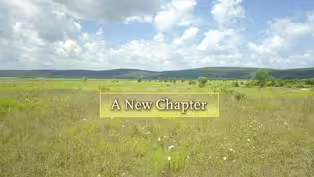
Video has Closed Captions
Clip: Special | 8m | The closing of Badger Army Ammunition led to plans for future uses of Sauk Prairie lands. (8m)
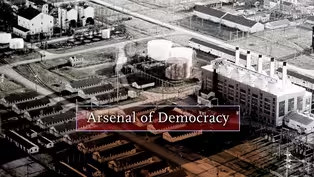
Sauk Prairie: Arsenal of Democracy
Video has Closed Captions
Clip: Special | 7m 47s | During World War II a large ammunition plant was built on the Sauk Prairie. (7m 47s)
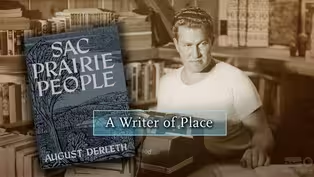
Sauk Prairie: A Writer of Place
Video has Closed Captions
Clip: Special | 8m 37s | August Derleth wrote about the people and places of Sauk Prairie. (8m 37s)
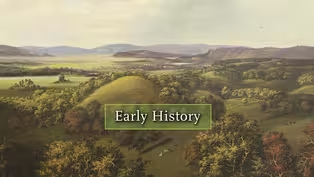
Video has Closed Captions
Clip: Special | 7m 24s | The Sauk Prairie area was first inhabited by the Sauk, long before European settlement. (7m 24s)
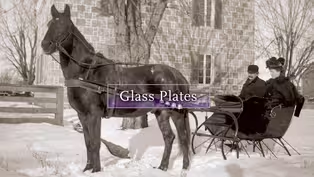
Video has Closed Captions
Clip: Special | 7m 17s | Glass plate negatives provide a window into the lives of past residents of the area. (7m 17s)
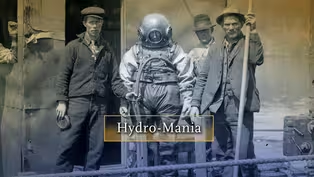
Video has Closed Captions
Clip: Special | 8m 13s | The Prairie du Sac dam was a massive building project, and is still in use today. (8m 13s)
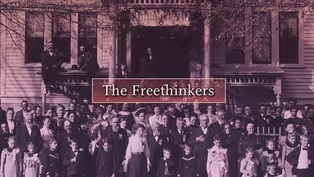
Sauk Prairie: The Freethinkers
Clip: Special | 2m 27s | Political and religious refugees established a Free-thinking Congregation in Sauk City. (2m 27s)
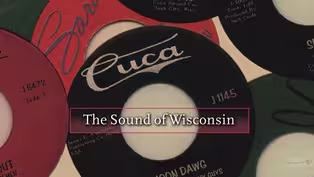
Sauk Prairie: The Sound of Wisconsin
Video has Closed Captions
Clip: Special | 8m 18s | Jim Kirchstein’s music recording studio captured the sound of Wisconsin in the 1960s. (8m 18s)
Providing Support for PBS.org
Learn Moreabout PBS online sponsorship













Support for PBS provided by:
Wisconsin Hometown Stories is a local public television program presented by PBS Wisconsin
Wisconsin Hometown Stories: Sauk Prairie was funded by major support from Greg and Carol Griffin, Darlene Ballweg, Culver’s Foundation, and Wollersheim Winery & Distillery, with additional support from Bank of...