
A look at Hegseth's attempts to reshape the Pentagon
Clip: 10/1/2026 | 6m 22sVideo has Closed Captions
A look at Hegseth's attempts to reshape the Pentagon
Defense Secretary Pete Hegseth says he is fundamentally reshaping the culture of the U.S. military. He's removing senior officers, dismantling diversity initiatives and putting a new emphasis on religious faith and what he calls a "warrior ethos." Beyond the cultural changes, Hegseth is accelerating autonomous weapons and other emerging technologies. Geoff Bennett discussed more with Peter Feaver.
Problems playing video? | Closed Captioning Feedback
Problems playing video? | Closed Captioning Feedback
Major corporate funding for the PBS News Hour is provided by BDO, BNSF, Consumer Cellular, American Cruise Lines, and Raymond James. Funding for the PBS NewsHour Weekend is provided by...
A look at Hegseth's attempts to reshape the Pentagon
Clip: 10/1/2026 | 6m 22sVideo has Closed Captions
Defense Secretary Pete Hegseth says he is fundamentally reshaping the culture of the U.S. military. He's removing senior officers, dismantling diversity initiatives and putting a new emphasis on religious faith and what he calls a "warrior ethos." Beyond the cultural changes, Hegseth is accelerating autonomous weapons and other emerging technologies. Geoff Bennett discussed more with Peter Feaver.
Problems playing video? | Closed Captioning Feedback
Where to Watch PBS News Hour
PBS News Hour is available to stream on pbs.org and the PBS app.
Providing Support for PBS.org
Learn Moreabout PBS online sponsorshipGEOFF BENNETT: Defense Secretary Pete Hegseth says he is fundamentally reshaping the culture of the U.S.
military, removing senior officers, dismantling diversity initiatives, and putting a new emphasis on religious faith and what he calls a warrior ethos.
In a speech to military leaders yesterday, Hegseth offered a blunt description of the Pentagon he says he's building.
PETE HEGSETH, U.S.
Defense Secretary: We are no longer the woke department or the weak department.
Simple translation of that, no fanny -- no fatties, no trannies, no beardos, no weirdos, no wimps, no radicals, just warriors, just tough, ready, committed troops.
The War Department, as you know, is colorblind, gender-neutral, and merit-based.
The ideological clowns are out.
The patriotic cowboys are in with testosterone testing on top.
GEOFF BENNETT: Beyond the cultural changes, Hegseth is pushing a broader effort to prepare the military for the wars of the future with autonomous weapons and other technologies.
He's also changing how the Pentagon develops its next generation of officers.
For insight and analysis, I spoke earlier with Peter Feaver, a professor of political science and public policy at Duke University.
He's also a specialist in civil-military relations.
Peter Feaver, welcome to the "News Hour."
PETER FEAVER, Duke University: Thanks for having me.
GEOFF BENNETT: Let's start with what we just heard.
Secretary Hegseth says he's building a military that is colorblind, gender-neutral, and merit-based.
But he's describing that vision with explicitly political and culture war language.
What happens when a defense secretary brings that kind of rhetoric into an institution that has traditionally tried to remain above partisan politics?
PETER FEAVER: Well, it presents a test to the audience.
They have to listen respectfully.
He is their boss, of course, just like you see at a State of the Union address where the president's giving comments and the members of Congress cheer, but the Supreme Court and the chairman of the Joint Chiefs of Staff sit quietly.
That's what the audience needed to do, and that's what they did do.
GEOFF BENNETT: Hegseth has also moved aggressively against the senior officer corps.
He wants to cut the number of generals and admirals by 20 percent.
He's already removed a number of senior levels.
And there is an argument that the military has become too top-heavy.
Is there merit to what he's doing, in your view?
PETER FEAVER: I think that a lot of experts would agree that you could reduce the number of senior military three- and four-stars, and still maintain military effectiveness, provided that those reductions were done carefully, transparently, so people knew why the billets were going away and it was done gradually over time.
That's really the test, not whether there's a reduction, but whether it's being done wisely and transparently and with congressional buy-in.
GEOFF BENNETT: Is that presently happening?
PETER FEAVER: Well, it's not transparent enough, I think.
There's a lot of questions that were raised about the 30 or so senior military officers that have already been relieved.
Many of them were considered the finest in the force, including some that were most aggressive about modernizing and doing the kinds of initiatives that the secretary announced later on in his speech.
And so it was hard to square what he was advocating in the second part of the speech with his claim that he got rid of the poor performers in the first part of the speech.
GEOFF BENNETT: And for all of the attention on Hegseth's rhetoric, there is part of his agenda that you could argue is ultimately more consequential than that.
He's creating a new four-star autonomous warfare command focused on drones, robotics, artificial intelligence.
Is that the kind of structural change the Pentagon really needs?
PETER FEAVER: Well, once you got past the partisan part of the speech, he announced six policy initiatives, and each one of those is debatable, but is part of the kind of change that a transformational secretary would aim for.
You mentioned the Autonomous Warfare Command.
Ironically, that will be creating a new four-star billet, so that's going to be adding, rather than subtracting.
And I do think there needs to be a national debate about autonomous warfare.
I think the secretary's announcement will help move that debate along, maybe make it a little more prominent than it has been.
A lot of questions about whether we want to fight fully autonomously.
That would be an ethical challenge.
GEOFF BENNETT: Secretary Hegseth says he wants to broaden the officer pipeline through these new partnerships with LSU, Liberty University, Tuskegee, Mississippi State, Hillsdale.
Is there a legitimate argument that the military should recruit officers from a wider range of institutions?
PETER FEAVER: Yes, that's absolutely a concern.
That's what's known as the gap problem, the gap between the 1 percent who serve and the 99 percent who do not serve.
I think it's very important that you recruit from elite universities.
Harvard, the Ivies, Duke, my own university, not just because you're getting high-caliber men and women in uniform, but because you're buying into different friend networks.
The more people who have friends who serve in the military, the better it is for America, the more that they will have -- feel like they have skin in the game.
GEOFF BENNETT: So put all of this together for us.
We have got the personnel changes, the religious emphasis and evangelical Christian emphasis coming from Hegseth, the overhaul of military education, the push toward autonomous warfare.
Is there one coherent theory of how to make the military more effective, or do you see several different agendas being pursued simultaneously?
PETER FEAVER: I see a secretary who wants to be very transformative and who has launched quite a large number of initiatives, but what I don't see is the secretary who has worked closely with Congress to make those initiatives last.
And so that's the real challenge.
He made six bold announcements yesterday, but does he have the relations with Congress to turn those aspirations into reality?
Because every single one of them will require strong congressional buy-in.
GEOFF BENNETT: Peter Feaver, thanks so much for being with us.
Great to speak with you.
PETER FEAVER: My pleasure.
Thank you.

Cornell's handling of rape allegations faces more scrutiny
Video has Closed Captions
New details intensify scrutiny of Cornell's handling of gang rape allegations (6m 12s)
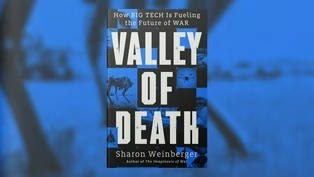
How tech firms are replacing traditional defense contractors
Video has Closed Captions
'Valley of Death' reveals how tech companies are replacing traditional defense contractors (7m 32s)

Inside the UN peacekeeping mission on Lebanon-Israel border
Video has Closed Captions
On the ground with UN peacekeepers as Lebanon-Israel mission nears its end (7m 39s)

Investigators search for motive after pilot's alleged attack
Video has Closed Captions
Investigators search for motive after alleged attack by FlyDubai co-pilot (5m 58s)
Karl Rove and David Axelrod give their midterm predictions
Video has Closed Captions
Karl Rove and David Axelrod give their midterm predictions (5m 52s)

News Wrap: SCOTUS to review mandatory detention for migrants
Video has Closed Captions
News Wrap: Supreme Court to review mandatory detention policy for migrants (6m 6s)

What we know about the botched execution of Christa Pike
Video has Closed Captions
What we know about Tennessee's botched execution of Christa Pike (6m 27s)
Providing Support for PBS.org
Learn Moreabout PBS online sponsorship New Episode
- News and Public Affairs

FRONTLINE is investigative journalism that questions, explains and changes our world.
 New Episode
- News and Public Affairs

Today's top journalists discuss Washington's current political events and public affairs.

 New Episode
 New Episode
 New Episode
 New Episode
 New Episode
 New Episode
 New Episode
Support for PBS provided by:
Major corporate funding for the PBS News Hour is provided by BDO, BNSF, Consumer Cellular, American Cruise Lines, and Raymond James. Funding for the PBS NewsHour Weekend is provided by...