
October 17, 2024 - PBS News Hour full episode
10/17/2024 | 57m 46sVideo has Closed Captions
October 17, 2024 - PBS News Hour full episode
October 17, 2024 - PBS News Hour full episode
Problems playing video? | Closed Captioning Feedback
Problems playing video? | Closed Captioning Feedback
Major corporate funding for the PBS News Hour is provided by BDO, BNSF, Consumer Cellular, American Cruise Lines, and Raymond James. Funding for the PBS NewsHour Weekend is provided by...
October 17, 2024 - PBS News Hour full episode
10/17/2024 | 57m 46sVideo has Closed Captions
October 17, 2024 - PBS News Hour full episode
Problems playing video? | Closed Captioning Feedback
How to Watch PBS News Hour
PBS News Hour is available to stream on pbs.org and the free PBS App, available on iPhone, Apple TV, Android TV, Android smartphones, Amazon Fire TV, Amazon Fire Tablet, Roku, Samsung Smart TV, and Vizio.
Providing Support for PBS.org
Learn Moreabout PBS online sponsorshipAMNA NAWAZ: Good evening.
I'm Amna Nawaz.
GEOFF BENNETT: And I'm Geoff Bennett.
On the "News Hour" tonight: The leader of Hamas and architect of the October 7 attacks is killed by Israel's military.
The ramifications for the war in Gaza.
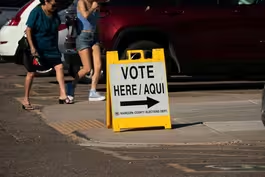
AMNA NAWAZ: How abortion measures on the ballot in the critical swing states of Nevada and Arizona could tip the balance in the presidential race.
CRYSTAL PRICE, Arizona Voter: I don't necessarily support all abortion.
I feel like there are exceptions, though, that need to be available, especially for people like me who have unexpected complications in pregnancy.
GEOFF BENNETT: And we examine the stark differences between Kamala Harris and Donald Trump's promises and policies on climate change.
(BREAK) GEOFF BENNETT: Welcome to the "News Hour."
One of the world's most hunted men is dead.
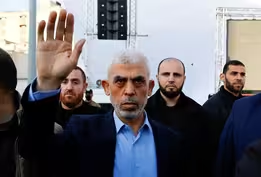
Hamas military leader Yahya Sinwar was killed by Israeli troops yesterday in Southern Gaza.
The news of his killing came today, and, after DNA testing, Israel confirmed the mastermind of the October 7 attacks on Israel was indeed dead.
AMNA NAWAZ: Those terror attacks just over a year ago killed more than 1,200 Israelis, the deadliest single day for Jews since the Holocaust.
The war Sinwar launched led to a brutal military response by Israel to destroy Hamas, killing tens of thousands of Palestinians in Gaza, mostly women and children.
Nick Schifrin is here now with the latest -- Nick.
NICK SCHIFRIN: Amna, for months the U.S. and Israel have dedicated vast resources to try and find Sinwar, who they believed was hiding in tunnels.
But, in the end, Sinwar died posing as a regular fighter, not in a tunnel, not surrounded by hostages, not wearing a suicide vest.
And the Israeli soldiers who killed him had no idea he was there.
And a warning: This story contains disturbing images.
The death of one of the world's most wanted men was, in the end, by chance.
Yesterday, soldiers from tank and infantry training units operating in Rafah got in a firefight.
The Israeli military released this drone video as it searched a house.
They saw an unidentified fighter still alive.
And they fired again.
That's when they entered the house and realized they recognized him and found documents and money.
They took his body and confirmed with DNA tests it was Yahya Sinwar, the military and political leader of Hamas and the architect of the October 7 terrorist attack.
Israel's top general, Herzi Halevi, visited the area and credited Israel's plan to push through Rafah despite international resistance.
LT. GEN. HERZI HALEVI, Chief of Staff, Israeli Defense Forces (through translator): We conducted many special operations in this war where we had excellent information and pinpoint accuracy.
Here, we didn't have that.
And yet the response was very, very strong.
NICK SCHIFRIN: Today is a religious holiday in Israel.
And across the country, they celebrated Sinwar's death.
MAN: Bye-bye, Sinwar.
NICK SCHIFRIN: But Israelis and senior U.S. officials say their immediate concern is the 100 remaining hostages believed to be held in Gaza by mid-level Hamas leadership in tunnels.
Israeli Prime Minister Benjamin Netanyahu: BENJAMIN NETANYAHU, Israeli Prime Minister (through translator): Today, evil has suffered a heavy blow.
But the task before us is not yet complete.
To the dear families of the abductees, I say, this is an important moment in the war.
We will continue with all our strength until the return home of all your loved ones, who are our loved ones.
NICK SCHIFRIN: But Israeli and American officials also hope Sinwar's death is the beginning of the end of the war.
Pockets of Hamas fighters still attack and release videos showing targeting of Israeli tanks.
Today, Netanyahu made them an offer.
BENJAMIN NETANYAHU (through translator): Whoever lays down his weapon and returns our hostages, we will allow him to go out and live.
The return of our hostages is an opportunity to achieve all our goals, and it brings the end of the war closer.
NICK SCHIFRIN: The U.S. hopes the end of the war, including a hostage release, can launch reconstruction and larger diplomatic efforts to provide Gaza new leadership.
President Biden this afternoon in Berlin: JOE BIDEN, President of the United States: Now is the time to move on, move on -- move toward a cease-fire in Gaza, make sure that we're moving in the direction that we're going to be in a position to make things better for the whole world.
It's time for this war to end and bring these hostages home.
NICK SCHIFRIN: Sinwar grew up in Khan Yunis and helped found Hamas as its chief enforcer.
In 1998, Israel arrested him.
In over 23 years in detention, he learned Hebrew, studied Israeli society, and even received lifesaving surgery in an Israeli hospital.
In 2011, in exchange for a single Israeli soldier, Israel released Sinwar and more than 1,000 Palestinian prisoners.
He was welcomed back to Gaza a hero.
He became Hamas' Gaza chief in 2017, a disciplined and dictatorial leader.
He always described himself as a soldier who will die amongst his fighters.
But he also convinced Israel he wanted a long-term status quo.
That was a bluff.
He helped design the deadliest attack in Israeli history to be so violent, so brutal, and involve so many hostages it would help ignite regional war.
The fighting has spread to Lebanon and between Israel and Iran.
He believed Palestinian and Israeli deaths were a necessary tool in reigniting the Palestinian cause.
But the war he helped launch has destroyed Gaza and the lives of its people.
He also defined victory as his and the group's survival.
And today, Geoff, Sinwar and nearly all of Hamas' leadership is dead.
GEOFF BENNETT: Nick, we know that the U.S. secretary of state, Tony Blinken, is heading to the region.
What's his goal for this trip?
NICK SCHIFRIN: Try and make progress on hostages and the day after.
On hostages, he hopes that new leadership in Hamas would be willing to make a deal that Sinwar is not, but it's not clear Hamas will have new leadership in time to even make that decision.
And on the day after, the U.S. has been negotiating with Arab partners to take over security in Gaza as a transition to Palestinian Authority governance.
But there's no agreement between Arab partners or with Benjamin Netanyahu.
And so the U.S. does see this as an opportunity, but knows it will be difficult to translate it into diplomatic and political progress.
GEOFF BENNETT: Nick Schifrin, our thanks to you, as always.
NICK SCHIFRIN: Thanks, Geoff.
AMNA NAWAZ: For perspective on the killing of Hamas' leader and what lies ahead, we get two perspectives.
Retired Major General Yaacov Ayish retired in 2016 after a 36-year career in the Israel Defense Forces.
He's now at the Jewish Institute for National Security of America, a nonprofit that advocates for closer U.S.-Israeli relations.
And Hussein Ibish is a senior resident scholar at the Arab Gulf States Institute in Washington, which advocates for closer relations between the U.S. and countries in the Persian Gulf.
Gentlemen, welcome to you both.
Hussein, I will begin with you.
HUSSEIN IBISH, Senior Resident Scholar, Arab Gulf States Institute: Yes.
AMNA NAWAZ: And just start with the reaction to Yahya Sinwar's death among Palestinians.
How is that news resonating on the ground?
And does this mean the end of Hamas?
HUSSEIN IBISH: It certainly doesn't mean the end of Hamas.
It doesn't even mean the end of the insurrection that has been taking place in Gaza since the end of the Rafah campaign, which is, I believe, the war that Hamas actually wanted to fight.
Palestinians are having a mixed reaction here.
There's a lot of anger against Israel.
I think there's a lot of sympathy for Hamas in the West Bank, where people are more removed from the consequences of the October 7 blowback and Israel's savage war of vengeance in Gaza, which has taken at least 42,000, probably many, many more lives and displaced virtually everyone in Gaza, produced endemic hunger and all kinds of suffering.
In Gaza, interestingly, there's a significant group of people who appear to be delighted with his passing, because they blame him rightly for having volunteered the entire population for martyrdom.
AMNA NAWAZ: General Ayish, let me bring you in here, because we heard earlier, Prime Minister Netanyahu said that Sinwar's death is the beginning of the end, but he also said that Israel will not stop this war in Gaza.
What's your reaction to that?
Should he take this moment to end military operations there?
MAJ. GEN. YAACOV AYISH (RET.
), Israeli Defense Forces: I think we should look at the broad picture.
The strategic goal of Israel after the attack that have happened by Hamas in October 7 was very simple, to bring back the hostages and to restore security to allow the residents of the south back to their villages.
And in order to do that, one of the major important terms was to eliminate the threat of Hamas.
And, for that, you have to eliminate the 24 battalions of Hamas.
For that, you have to eliminate Hamas infrastructure.
For that, you have to eliminate Hamas military leadership.
We have no interest in Gaza otherwise whatsoever.
AMNA NAWAZ: Hussein, let me ask you about Hamas moving forward from here.
HUSSEIN IBISH: Yes.
AMNA NAWAZ: What does Sinwar's death mean?
Who steps up for him?
Could it be a more moderate voice?
HUSSEIN IBISH: Possible.
AMNA NAWAZ: And, also, does this change Iran's support?
HUSSEIN IBISH: No, I don't think it'll do anything to Iran's relationship with Hamas, which is a marriage of convenience.
Hamas doesn't fit well in the Iranian alliance.
Now, as for who's next, there is a slight chance that the hotel guys, as he used to call the former political leaders in -- mainly in Qatar and Turkey, could try to get control back.
But it's more likely that leadership will fall to either an armed person in Gaza or perhaps even a diverse set of armed leaders.
The insurgency that's developed after the Rafah campaign was basically completed and the formal organized battalions of Hamas were crushed doesn't require extensive command-and-control.
It doesn't require a single charismatic leader.
AMNA NAWAZ: General Ayish, what about the hostages you mentioned as one of the main goals of this war, right?
Previously, they were supposed to be brought home as the result of some kind of cease-fire negotiations, never materialized to get that across the finish line.
How do you see the hostages coming home at this point?
MAJ. GEN. YAACOV AYISH (RET.
): Well, we can look at the last 12 months.
With the Sinwar as a leader, definitely, he was a tough negotiator, and we couldn't really succeed to bring back the hostages unless it was a rescue operation, as we have seen every now and then.
But, basically, 101 hostages are still at the other side.
And for that, the Israeli prime minister came out today after Sinwar was eliminated calling to those who are holding the hostages there to send them back to Israel, and then they will be given free pass either outside of Gaza or elsewhere.
So the option is there.
I'd like to go back for a second to the future leadership of Hamas.
I think it's a very important point.
Definitely, Iran, Hamas and Hezbollah have suffered in the last, I would say, two months a severe blow when it comes to leadership.
Hamas have lost today, practically speaking, all of its leadership.
And now we are seeing how whatever the Iranians were preparing to surprise Israel, to attack Israel, that ring of fire that will surround Israel, how suddenly it cracks.
So I think the future leader of Hamas is a very important element here.
At least the voices that I hear is that Hamas already decided that Khaled Mashal, who have more, I would say, orientation towards Qatar, he's going to be the temporary leader.
And I'm not sure that the Iranians are going to enjoy that.
AMNA NAWAZ: Go ahead.
HUSSEIN IBISH: Yes, no, no, I think that's right.
The only question is, if Mashal is the obvious person to take over as the titular leader now, I'm just doubtful that people on the ground are going to be listening to him.
If he says release hostages in a deal, they might.
But if he tries to get them to give up on the insurgency that's taking place, I think that's a bigger ask.
The gunmen on the ground control Hamas.
And I'm not sure power, real power on the ground goes back to what Sinwar called the hotel guys in Qatar, even if they become again the titular leaders.
AMNA NAWAZ: I'd love to get both of your takes on this bigger picture issue, if we pull back just a bit, because there's also been the point that's come up that some have said this is the moment for the U.S. to lean in, for the U.S. to apply pressure on the Netanyahu government to try to get back to some kind of talks, which everyone agrees is the only chance for long-term peace in the region.
Hussein, what's your take on that?
HUSSEIN IBISH: Oh, I think it's absolutely essential for the United States to put heavy pressure on Israel, as well as keep up pressure on Hamas and its supporters outside, including Iran and others, to kind of put the case that they're all harming themselves.
So when you fight counterinsurgencies, the difficulty of ending them is very great.
And I think the Israelis are sort of stuck.
Hamas, too, has brought terrible damage not just to the people of Gaza and Gaza, but to their own political standing.
People are -- especially in Gaza, they're angry with Hamas, and for good reason.
AMNA NAWAZ: General Ayish, I will give you the final word here.
MAJ. GEN. YAACOV AYISH (RET.
): I must admit that I'm surprised here.
Israel was attacked by Hamas in October 7, and I won't describe all the atrocities that they have done.
Hamas was joined by Hezbollah a day after, with no reason.
And then the Iranians decided to join to that attack together with the Shia militia from Iraq and the Houthis from Yemen.
And Israel should now show restraint?
This is ridiculous.
This is unbelievable.
(CROSSTALK) HUSSEIN IBISH: You haven't killed enough?
Forty-two thousand dead Palestinians is not enough?
(CROSSTALK) HUSSEIN IBISH: It's enough.
MAJ. GEN. YAACOV AYISH (RET.
): Let me finish for a second.
HUSSEIN IBISH: Go ahead.
MAJ. GEN. YAACOV AYISH (RET.
): I think what is really important is not the number of Hamas terrorists that were killed.
What really matter is to see the hostages back in Israel and the threat conducted by Hamas from Gaza and by Hezbollah at the north eliminated and the security restored.
Bear in mind that, until today, in the north and in the south, Israelis are not back to their villages.
Why?
Because of that threat.
So, at the end of the day, I think we will have first and foremost to eliminate the threat, and then we will be able to discuss all the security arrangements that we will follow, that basically we have had them.
We had cease-fire with the Hamas and we had a cease-fire with Hezbollah.
They decided to surprise us.
They decided to attack us.
They decided to conduct those atrocities.
(CROSSTALK) AMNA NAWAZ: General Ayish, if I may, if I may, to Hussein's earlier point, this idea that Hamas will continue to fight whether they're organized and supported or not, the question is, is this a missed opportunity for Netanyahu to begin to have some kind of long-term peace talks that haven't happened before?
MAJ. GEN. YAACOV AYISH (RET.
): The opportunity was given to Sinwar and his militants for that negotiation.
And after 12 months, we have seen nothing from them.
(CROSSTALK) AMNA NAWAZ: With Sinwar dead, does that change Netanyahu's calculation?
MAJ. GEN. YAACOV AYISH (RET.
): I think the fact that Netanyahu came out today with a very clear offer to allow a free pass to those who are going to release the hostages is a very good start.
Now we have to wait and see who is the leader, if he is effective, because, at the same time that we are talking about leadership, certain gangs are holding hostages inside the Gaza.
It's a decentralized system today.
It's not the system that we have seen in the past.
So it's really a challenge.
We will have to wait and see to what effect this offer is influencing the situation on the ground.
AMNA NAWAZ: Gentlemen, we will have to leave it there.
HUSSEIN IBISH: OK. Hamas would love to hear all of that, yes.
AMNA NAWAZ: I thank you both for joining in this conversation.
Retired Major General Yaacov Ayish and Hussein Ibish, thank you to you both.
HUSSEIN IBISH: You're welcome.
Thank you.
MAJ. GEN. YAACOV AYISH (RET.
): Thank you very much.
GEOFF BENNETT: And we start the day's other headlines in Brussels, where Ukraine's President Volodymyr Zelenskyy is making the case for his victory plan to European leaders and NATO officials.
Zelenskyy urged an E.U.
leaders summit to increase support for Ukraine's military and claimed Ukraine has intelligence that 10,000 troops from North Korea are coming to join Russia on the battlefield.
Zelenskyy told reporters that Ukraine either needs NATO membership or nuclear weapons.
VOLODYMYR ZELENSKYY, Ukrainian President (through translator): Either Ukraine will have nuclear weapons, and then this is defense for us, or we should have some kind of an alliance.
Today, we do not know any effective alliances other than NATO.
This is why we choose NATO, not nuclear weapons.
We are choosing NATO.
GEOFF BENNETT: After the E.U.
meetings, Zelenskyy made his way across Brussels to a meeting of NATO defense ministers.
It was the first such gathering under new NATO Chief Mark Rutte, who said that Ukraine will indeed become a NATO member, but did not specify when that will be.
The U.S. military says it carried out a series of strikes in Yemen targeting five underground bunkers used by Houthi rebels.
It's the first time the U.S. has used long-range B-2 stealth bombers against the Iran-backed group.
The strikes are an apparent warning to Iran, with Pentagon officials saying they demonstrate the abilities of the U.S. military to strike hard-to-reach targets.
MAJ. GEN. PATRICK RYDER, Pentagon Press Secretary: We can strike targets of this nature any time, anywhere from around the world.
To my knowledge, this was a -- this not a repeat strike.
Again, this was to go after very specific capabilities that the Houthis were storing deep underground.
GEOFF BENNETT: The Iran-backed Houthi rebels have been attacking ships in the Red Sea for months in a show of solidarity with the Palestinian people over the war in Gaza.
In Georgia, a grand jury has indicted a father and son for the mass shooting at Apalachee High School last month that killed four people.
Colin Gray faces 29 counts, which include second-degree murder, manslaughter and reckless conduct.
His son, the 14-year-old accused shooter, faces 55 charges, including felony murder and malice murder.
Their next court appearance is set for late November.
It's the latest example of authorities trying to hold the parents of mass shooting suspects accountable for their children's alleged crimes.
The Biden administration has now canceled student loans for one million public service workers.
Officials crossed that milestone today with their latest $4.5 billion debt relief installment.
That was provided to 60,000 teachers, firefighters, nurses and other public servants.
All told, the administration has forgiven more than $175 billion for about five million borrowers.
Those efforts come even as President Biden's broader student loan forgiveness plan faces legal challenges from some Republican-led states.
Americans ramped up their shopping last month, as low unemployment and steady pay gains offset worries about high prices.
Retail sales jumped 0.4 percent in September when compared to the month before.
That's a third straight monthly increase and signals ongoing consumer confidence heading into the vital holiday period.
Separately, the number of Americans filing for unemployment benefits fell unexpectedly last week by 19,000.
Claims had spiked the week before due to the impact of recent hurricanes in the Southeast.
The economic data gave Wall Street a bit of a lift today, but not much.
The Dow Jones industrial average rose about 160 points to reach a new all-time high.
The Nasdaq added about six points, so a tiny gain there.
The S&P 500 slipped by a single point, so basically flat on the day.
And Liam Payne's former One Direction bandmates say they're completely devastated by the singer's sudden death.
The four issued a joint statement today, saying: "Our thoughts are with his family, his friends, and the fans who loved him alongside us."
An official autopsy confirmed Payne suffered multiple traumas after falling from his hotel balcony in Buenos Aires yesterday.
The hotel had called 911 about a guest overwhelmed with drugs and alcohol.
Payne saw massive fame in the 2010s as a member of the British boy band One Direction.
They split in 2016, and Payne pursued a solo career.
Overnight, loyal fans, known as Directioners, gathered to sing his music and to process their loss.
LUCIA GONZALEZ, Liam Payne Fan (through translator): I started listening to One Direction when I was 11 years old.
I was never able to see them live.
They broke up.
There was always talk about the return, the reunion, at least symbolically.
But it won't be able to happen anymore.
GEOFF BENNETT: In recent years, Payne spoke openly on social media about his struggles with fame and sobriety.
He was 31 years old.
And Mitzi Gaynor, the acting, singing and dancing triple threat of Hollywood's golden age of musicals, has died.
(SINGING) GEOFF BENNETT: Her portrayal of Nellie Forbush in the 1958 film "South Pacific" earned a Golden Globe nomination.
It was a highlight in a glittering career that spanned eight decades across film, television and stage.
For years, she appeared in TV variety specials alongside stars like Frank Sinatra, Bing Crosby and Dean Martin.
And at one point, she was the highest paid female entertainer in Las Vegas.
Mitzi Gaynor died of natural causes in Los Angeles.
She was 93 years old.
Still to come on the "News Hour": Kamala Harris and Donald Trump continue their push for undecided voters; a bipartisan commission recommends the Secret Service seek new leadership outside of its ranks after multiple security failures; and we examine the presidential candidate's stark differences on climate change policy.
AMNA NAWAZ: Early in-person voting started in the battleground state of North Carolina today, a reminder that Election Day is just around the corner.
Both candidates are trying to broaden their appeal to different groups of voters in these crucial final days.
We begin tonight in Wisconsin, where Vice President Harris' campaign schedule was briefly interrupted by news out of the Middle East.
Lisa Desjardins has our coverage.
LISA DESJARDINS: On the campaign trail, a moment of world significance.
KAMALA HARRIS, Vice President of the United States (D) and U.S. Presidential Candidate: Today, Israel confirmed that Yahya Sinwar, the leader of Hamas, is dead.
LISA DESJARDINS: Vice President Harris spoke on the sidelines of a stop in Milwaukee today after Israel announced it had killed the head of Hamas.
KAMALA HARRIS: This moment gives us an opportunity to finally end the war in Gaza.
And it must end such that Israel is secure, the hostages are released, the suffering in Gaza ends, and the Palestinian people can realize their right to dignity, security, freedom, and self-determination.
LISA DESJARDINS: This comes on the heels of a contentious FOX News appearance last night.
BRET BAIER, FOX News Anchor: Eighty-five percent of apprehensions.
KAMALA HARRIS: But I'm not finished.
I'm not finished.
LISA DESJARDINS: The interview with host Bret Baier was heated from the start, when Harris defended the Biden administration's record on immigration.
KAMALA HARRIS: The first bill, practically within hours of taking the oath, was a bill to fix our immigration system.
BRET BAIER: Yes, ma'am.
It was called the U.S.
Citizenship Act of 2021.
KAMALA HARRIS: And exactly.
And -- so -- but I... BRET BAIER: It was essentially a pathway to citizenship for the... KAMALA HARRIS: May I please finish?
BRET BAIER: Yes, ma'am.
KAMALA HARRIS: May I finish -- may I finish responding, please?
BRET BAIER: But here -- but this... KAMALA HARRIS: But you have to let me finish, please.
BRET BAIER: You had the White House... LISA DESJARDINS: Later, Harris distanced herself from the president when asked what she would do differently in the White House.
KAMALA HARRIS: Let me be very clear.
My presidency will not be a continuation of Joe Biden's presidency.
LISA DESJARDINS: She did not give specifics, saying that she represents a new generation.
Her most passionate moment came in response to former President Trump's recent threats to turn the military against -- quote -- "enemies within."
KAMALA HARRIS: This is a democracy.
And in a democracy, the president of the United States in the United States of America should be willing to be able to handle criticism without saying he'd lock people up for doing it.
LISA DESJARDINS: For his part, Mr. Trump reached out to Latino voters in a Noticias Univision town hall last night near Miami.
Audience members posed questions, including on immigration.
Trump has recently said he wants to limit some legal immigration, but here he stressed it.
DONALD TRUMP, Former President of the United States (R) and Current U.S. Presidential Candidate: We have to have a lot of people come into our country.
We just want them to come in legally through a system, because they have released hundreds of thousands of people that are murderers, drug dealers, terrorists.
They're coming in totally -- nobody knows who they are, where they come from.
MAN: I want to give you the opportunity to try to win back my vote.
LISA DESJARDINS: Later, a voter said he was disturbed by Trump's inaction January 6.
Trump defended his supporters... DONALD TRUMP: But that was a day of love.
LISA DESJARDINS: ... and his inaction.
DONALD TRUMP: They didn't come because of me.
They came because of the election.
They thought the election was a rigged election, and that's why they came.
Some of those people went down to the Capitol.
I said peacefully and patriotically, nothing done wrong at all, nothing done wrong.
LISA DESJARDINS: This as we have learned about scathing words about Trump from another GOP leader.
According to an upcoming biography, Senate Minority Leader Mitch McConnell privately called Trump stupid, as well as being ill-tempered and "a despicable human being" back in 2020 as the former president was trying to overturn the election.
Publicly, McConnell endorsed Trump this year.
In a statement today, he pointed out others, Lindsey Graham and J.D.
Vance, have criticized Trump in the past too, but -- quote -- "We are all on the same team now."
SEN. J.D.
VANCE (R-OH), Vice Presidential Candidate: We're sure as hell not giving Kamala Harris a promotion to president of the United States.
LISA DESJARDINS: Speaking of V.P.
candidate J.D.
Vance, he was back on the trail in battleground, Pennsylvania today.
Farther down the East Coast, Harris' running mate, Tim Walz, campaigned with former President Bill Clinton in North Carolina, where early voting started today.
He also stopped at a campaign office turned collection site for supplies in the aftermath of Hurricane Helene.
Nearly all planned voting sites are up and running just three weeks after the hurricane devastated parts of the state.
For the "PBS News Hour," I'm Lisa Desjardins.
GEOFF BENNETT: Abortion access is a top issue this election season at both the state and federal levels.
A number of states will have measures to protect reproductive rights on their ballots this November.
And in key battlegrounds like Arizona and Nevada, these measures could have an impact on the presidential race.
Our White House correspondent, Laura Barron-Lopez,spent time in both states recently and filed this report.
CRYSTAL PRICE, Arizona Voter: You know, I think he's going to love these flowers, huh?
They're kind of fall colors.
LAURA BARRON-LOPEZ: Crystal Price comes to this cemetery in Mesa, Arizona almost once a month.
It's where her son Noble is buried.
CRYSTAL PRICE: He's Noble.
He's great, and he's part of our family.
LAURA BARRON-LOPEZ: At Noble's grave, she and her family leave flowers, write messages and take a moment of silence.
Almost six years ago, Crystal had an abortion in her 22nd week of pregnancy, when complications threatened her life.
CRYSTAL PRICE: I was coming in and out of consciousness, losing -- I had lost so much blood, and it was a really scary -- it was just really scary.
LAURA BARRON-LOPEZ: What was going through your mind when you heard the doctor say that you needed to terminate the pregnancy?
CRYSTAL PRICE: It was just excruciatingly hard to know that I was choosing to end the life of my son, but also knowing that it was the right choice for me and for my circumstances, that my life was important, my family needed me, and I wanted to live.
I didn't want to associate my experience with my child with the word abortion.
But that's what it was.
LAURA BARRON-LOPEZ: Arizona law only allows abortions for medical emergencies.
After the Supreme Court struck down Roe v. Wade in 2022, the state banned abortion after 15 weeks, with no exceptions for rape or incest.
But this year, voters like Crystal will weigh in on Proposition 139, which would enshrine abortion rights in the state's constitution until fetal viability, generally considered to be around 24 weeks.
Arizona is one of 10 states with measures protecting reproductive rights on the ballot this November.
How do you plan on voting on that ballot measure?
CRYSTAL PRICE: I will be supporting and voting yes on Proposition 139.
Just reading the language, I became very emotional and I was brought to tears as I considered the views that I have had in the past where I thought abortion was completely wrong, and then having had personal experiences and realizing it's not so black and white.
LAURA BARRON-LOPEZ: In neighboring Nevada, abortion is currently allowed until 24 weeks under state law, but a yes-vote for the ballot measure, Proposition 6, would protect it in the state's constitution.
Vice President Harris has made reproductive rights a key part of her campaign.
And Democrats are hopeful that ballot measures protecting abortion access in Arizona and here in Nevada could boost turnout.
On the trail, Harris is drawing sharp contrasts between herself and Republican rival Donald Trump when it comes to abortion access.
KAMALA HARRIS, Vice President of the United States (D) and U.S. Presidential Candidate: This is the same guy who said that women should be punished for having abortions.
LAURA BARRON-LOPEZ: The former president has offered a more conflicted message, taking credit for appointing three Supreme Court justices who voted to overturn the constitutional right to an abortion, but claiming that he'd veto a national 15-week abortion ban, then saying he'd allow states to restrict reproductive rights.
DONALD TRUMP, Former President of the United States (R) and Current U.S. Presidential Candidate: You will be protected, and I will be your protector.
(CHEERING) DONALD TRUMP: You will no longer be thinking about abortion.
LAURA BARRON-LOPEZ: Still, anti-abortion activists like Melissa Clement with Nevada Right to Life are confident that Donald Trump is the best conduit for their cause.
MELISSA CLEMENT, Nevada Right to Life: I don't think we have time to worry about whether or not it's a 15-week ban or anything like that.
Even if he's pro-choice, which he may or may not be, he's not pro-abortion like Harris and Walz are.
They're completely pro-abortion.
And that's the only thing they care about.
And when the choice is so stark I have got to say that President Trump is the best choice for every pro-life voter, for every pro-choice voter, for every pro-woman voter.
LAURA BARRON-LOPEZ: For decades, Republicans have used abortion to motivate voters, helping lead to the fall of Roe.
WOMAN: People want to talk about protecting the right to abortion.
LAURA BARRON-LOPEZ: Now, as states take matters into their own hands, Clement sees ballot measures like Nevada's as a -- quote -- "political move" by Democrats to juice turnout.
MELISSA CLEMENT: Given the fact that were up against tens of millions of dollars, and, quite honestly, a media that is that is biased towards abortion, we have a high mountain to climb.
LAURA BARRON-LOPEZ: The fate of these two abortion measures in the Southwest battlegrounds could be determined by Latino voters, who make up 25 percent of eligible voters in Arizona and 22 percent in Nevada, the majority of whom are Mexican-American.
Canvassers like Liliana Trejo Vanegas, who works with Reproductive Freedom for All, say engaging with people who come from the same background is helpful to make abortion care feel accessible.
While canvassing in Las Vegas, Liliana often shares her own abortion story, as a 19-year-old who wasn't ready to have a child.
LILIANA TREJO VANEGAS, Reproductive Freedom for All: They are able to humanize this often very taboo subject and see I now know one of the one in four people who has had an abortion.
And, suddenly, it's not so easy to vilify these folks for the decisions that they took.
LAURA BARRON-LOPEZ: For other Latinas, like Etelvina Zamora-Esquivel, a 60-year-old former casino worker who was born and raised in a Catholic household, supporting access to abortion is new.
ETELVINA ZAMORA-ESQUIVEL, Nevada Voter: It is probably the way that my mother always told us.
You know, your body is your temple.
LAURA BARRON-LOPEZ: Then, about three months ago, Etelvina began attending conversations held by Make the Road Nevada and abortion rights groups meant to mobilize Latino voters.
There, she heard women share their experiences with abortion.
How did you feel when you heard those stories?
ETELVINA ZAMORA-ESQUIVEL: To be honest, I started crying.
If they are sick and the doctor tell them their life is at risk and they have to do it, that's when my mind changed.
And I says, now I'm going to vote yes.
LAURA BARRON-LOPEZ: Still, abortion ballot measures may not be enough to convince Latinos to stick with Democrats, according to local strategist Viridiana Vidal.
VIRIDIANA VIDAL, Democratic Media Strategist: I am not sure that that will translate into specific votes for Harris.
Usually, Latinos, they go to the vote with their pockets and their hearts, which means that they want to hear solutions about economy, jobs, if they can afford rent, if they can afford food at the table.
And then they want to protect their -- the health care of their loved ones.
So abortion usually comes lower if you don't explain how is this related to health care.
CRYSTAL PRICE: He was able to get a name and a blessing right before he passed.
LAURA BARRON-LOPEZ: But back in Arizona, Crystal, who supported Donald Trump in 2020, is about to vote for a Democratic presidential candidate for the first time.
CRYSTAL PRICE: There are so many of us that are politically homeless, I guess, and there are just so many people who want to have dialogue and who want moderate policies.
I want to be clear that I don't necessarily support all abortion.
I feel like there are exceptions, though, that need to be available, especially for people like me who have unexpected complications in pregnancy.
LAURA BARRON-LOPEZ: Crystal's own experiences are motivating her to back Harris.
And the country's post-Roe landscape could lead more voters like her to cross the aisle this November.
For the "PBS News Hour," I'm Laura Barron-Lopez in Arizona.
AMNA NAWAZ: A bipartisan independent panel is calling for an overhaul of the Secret Service in a blistering new report out today.
The panel was commissioned by President Biden after the July assassination attempt on former President Trump, and was comprised of four former senior government officials, including former homeland security leaders Janet Napolitano and Frances Townsend.
For more on the report's findings and recommendations, we're joined by Carol Leonnig, investigative reporter at The Washington Post and author of "Zero Fail: The Rise and Fall of the Secret Service."
Carol, welcome back.
It's good to see you.
CAROL LEONNIG, The Washington Post: Thanks for having me.
AMNA NAWAZ: Carol, it's a pretty blunt assessment of the Secret Service failures that led to a gunman being able to take eight shots at former President Trump at that Pennsylvania rally.
In the report, they list an absence of critical thinking, a lack of ownership.
Do the findings in this report line up with your reporting on that day?
CAROL LEONNIG: I have to say I'm pretty proud of the Washington post's reporting.
My colleagues and I worked on a lot of stories in the hours after 6:00 p.m., roughly 6:11 p.m., on Saturday July 13, trying to understand what had gone so colossally wrong.
And this report from this independent panel basically confirms all of our reporting in the days and hours immediately after the assassination attempt and shooting by Thomas Matthew Crooks.
There was no real plan for preventing a person from being able to have a clear line of sight, in essence, a clear shot at Donald Trump from a building only 150 yards away.
There were major problems in communications, no ability for the local police to directly tell the Secret Service in a clear and direct way and an instantaneous way that they were chasing a suspicious person and having reports of someone clambering onto a roof with a long gun.
But it is really interesting what else the report and the investigation concluded, this larger pattern of complacency and a lack of critical thinking, and a deeper examination of whether or not the Service really tries to own its problems and fix them and a real concern that they don't.
AMNA NAWAZ: Among the recommendations is one that the next director of the Secret Service come from outside the agency.
How big a shift would that be for the Secret Service?
CAROL LEONNIG: It's something the Secret Service has resisted for decades.
There have been -- 10 years ago, nine years ago, when I ran a series -- The Washington Post ran a series of stories, investigative pieces that I wrote about huge security breaches, not an assassination attempt, but near-misses and other efforts to kill President Obama.
When we wrote those pieces, an independent panel commissioned by President Obama and a congressional investigative panel both urged outside leadership to shake up the Secret Service at that time.
This is not a new recommendation, but there's a lot of more urgency for it because former President Trump was almost killed.
He came within millimeters of being killed.
AMNA NAWAZ: Carol, you have long reported on the lack of resources and funding that the Secret Service has been navigating.
This one line from the report did stick out.
They wrote: "The failures of July 13 are not primarily tied to budgetary deficiencies at the Service.
Put otherwise, even an unlimited budget would not by itself remediate many of the failures of July 13."
I mean, correct me if I'm wrong.
They seem to be calling for a complete cultural overhaul.
Is that possible?
CAROL LEONNIG: It is going to require outside leadership, new eyes, fresh eyes on an agency that, let's be honest, has a ton of patriots in its fold, a group of people who are willing to give up their Christmas Eves, their wife's anniversary, their own birthdays to be at the side of the president, the vice president, or the presidential candidate, and secure that person's life, people that are willing to take a bullet.
But it's also an agency that has become more interested in covering up problems than in identifying them and fixing them, a culture that doesn't like to let anybody inside, for fear that somebody will discover how much of a sort of hall of mirrors and smoke it is.
There is a lot of duct tape holding the Secret Service together and a lot of heart on the part of these patriots.
And it's going to require somebody coming in fresh and saying, we need to start over about what we value here at this agency.
We don't just value you being tough and giving every hour you possibly have and sweating through all your clothes and standing in the ice for hours.
We don't just want that.
We also want this other piece, which is a willingness to learn, to use technology and to call out problems, to call them out loud.
AMNA NAWAZ: That is investigative reporter for The Washington Post Carol Leonnig joining us tonight.
Carol, thank you so much.
CAROL LEONNIG: Thank you.
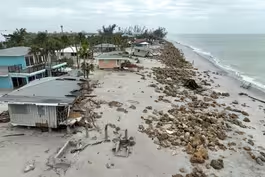
GEOFF BENNETT: Over the past few weeks, we have seen a series of punishing hurricanes once again illustrate the consequences of climate change.
Climate policy is one of the many issues we're covering in our Promises and Policy segments in the run-up to Election Day.
The divide between Donald Trump and Kamala Harris on climate change is as stark as any issue the country is facing.
William Brangham has been covering this closely, and I spoke with him about it earlier this week.
William, it's great to see you.
So, as Vice President Kamala Harris helped pass the largest government investment in clean energy and climate initiatives, on the trail, she often talks about climate change as a pocketbook issue, like the soaring insurance costs many homeowners face due to extreme weather.
Help us understand her approach.
WILLIAM BRANGHAM: I think, on one level, she sees the polls that says the economy is the most important thing, hence that focus.
Secondarily, I think, on the issue of climate change and why she doesn't drill into it that much, is that I think her campaign believes that, if you're a climate change voter and that really matters to you, you're already in her camp because of the things you mentioned, historic legislation, first of its kind in American history.
And her opponent has said climate change is a hoax and we don't have to really deal with that.
So, as you mentioned, she does talk about it.
But, for instance, in her DNC speech, climate change was one clause in one sentence, and that was it.
She often talks about it, as you say, as an economic issue.
She has said it's a crisis.
She has said it is urgent that we deal with it, but let's take a listen to how she coaches this issue.
KAMALA HARRIS, Vice President of the United States (D) and U.S. Presidential Candidate: We have invested a trillion dollars in a clean energy economy, while we have also increased domestic gas production to historic levels.
GEOFF BENNETT: So she's merging clean energy and fossil fuels there into one answer.
You mentioned Donald Trump, who has famously said that climate change is a hoax.
How is he approaching this on the campaign trail?
WILLIAM BRANGHAM: Trump talks about climate change almost always as a means to attack Democrats for the policies they have enacted to address it.
And so he says those things drive up costs for consumers at the gas pump.
He says they hurt the economy.
He calls them lunacy.
I mean, these are things like E.V., electric vehicle, mandates or promotions of wind or solar or battery manufacturing.
Here's how he often talks about the issue.
DONALD TRUMP, Former President of the United States (R) and Current U.S. Presidential Candidate: When people talk about global warming, I say the ocean is going to go down 100th of an inch within the next 400 years.
That's not our problem.
Our problem is nuclear warming.
WILLIAM BRANGHAM: Trump regularly dismisses the threat from sea level rise.
I mean, he nonsensically says it will just create more oceanfront property.
He says this is really a nonexistent threat.
So I just wanted to fact-check this one issue.
The latest U.S. National Climate Assessment, on just the issue of sea level rise, I'm going to read you a little bit about what it says.
It says -- quote -- "Sea level rise threatens permanent inundation of infrastructure, including roadways, railways, ports, tunnels, and bridges, water treatment facilities, and power plants, and hospitals, schools, and military bases."
That is trillions of dollars at risk from just one byproduct of a warming world.
And as for this issue of nuclear winter, I'm not exactly sure what he's talking about.
There is no such thing as nuclear warming.
That does not happen.
If he's talking about nuclear war, yes, that would have an enormous impact on the climate, but it would actually be likely a cooling effect because of the projected nuclear winter.
GEOFF BENNETT: Let's hope that doesn't happen.
WILLIAM BRANGHAM: Exactly.
So Trump does say climate change is an issue, but only because Democrats are obsessing over it.
GEOFF BENNETT: So what would a potential Harris administration do as it relates to climate change?
WILLIAM BRANGHAM: Harris has not really laid out concrete policy.
As you mentioned, she is coming off an administration that passed the most historic attempts to address climate change in American history, and she seems to imply there will be more of the same.
But, as you noted, Geoff, she keeps promoting all of the U.S. government's attempts to boost energy production, green energy, at the same time that she brags about America's oil and gas production.
And there is an inherent tension there.
The way we address climate change is to bring our emissions down, and the U.S. increasingly becoming the world's gas station is not the way to do that.
And Harris, likely because she doesn't want to be seen as attacking domestic energy production, doesn't really reckon with this.
She doesn't really reconcile how those two competing motives will be reconciled in her administration.
GEOFF BENNETT: And what about Donald Trump?
If he's saying climate change doesn't exist, it doesn't pose a threat.
I mean, what is he proposing to do about it, if anything?
WILLIAM BRANGHAM: Trump says on energy policy that he's going to bring energy prices in half, cut them in half.
It's very difficult to do that.
Global energy prices are set on the global market.
He has repeatedly said he is up for more and more oil and gas drilling, the famous "Drill, baby, drill," although the U.S., as we mentioned, is already pumping out record amounts of oil and gas.
Trump does not believe that addressing greenhouse gas emissions is an issue.
He has said he will roll back environmental rules on the oil and gas industry.
This is why he said to oil and gas executives, you ought to give me a billion dollars for my campaign because I'm going to help you guys out.
The Project 2025, the famous Heritage Foundation project, which Trump has said, I'm not a part of, that's not me, even though it was written largely by people from his administration, they have laid out a very detailed energy and climate plan.
And it is basically to abolish all climate-related actions by the federal government.
It will roll back the incentives within the Inflation Reduction Act.
How much of that Trump could do if he was elected is unclear.
He would need Congress and the Senate to do that.
And, interestingly, in the Inflation Reduction Act, a lot of money has been seeded into Republican districts, into Republican states, and a lot of those local leaders love federal funding for a new battery manufacturing plant and all the jobs that that comes.
And they don't want to see those things go away.
So it's unclear how far a Trump administration could really go.
The promise he has made, though, is a whole-scale reversal of any action by the federal government to deal with the climate crisis.
GEOFF BENNETT: William Brangham, thanks so much for walking us through this.
We appreciate it.
WILLIAM BRANGHAM: Thanks, Geoff.
AMNA NAWAZ: Well, as climate change continues to stir a debate in the election, we take a look at the on-the-ground reality for those dealing with its consequences.
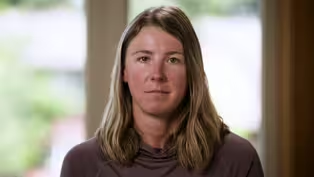
Sarah Jakober is a U.S. Forest Service wildland firefighter who serves on the Grande Ronde Rappel Crew based in La Grande, Oregon.
In her Brief But Spectacular take, she offers a window into a day on the job, as climate change lengthens wildfire seasons and intensifies their impact.
SARAH JAKOBER, U.S. Forest Service: People think of a stereotypical Firefighter as someone working for a city department, driving in a red truck, paramedic-type folks, and that is not what we do.
We fight fire in the natural landscape.
I work on a rappel crew, which means that I have staff a helicopter.
We arrive at the fire, we size it up, and then we rappel out and ideally put the fire out.
I remember the first time I rappelled out of the helicopter.
I don't remember consciously feeling fear.
There's a very analytical process behind everything, and it cuts the fear out or works around things in a more logical way.
When I was 18, I took a job fighting wildland fire to help pay for college.
By the time I graduated undergrad, I had done four or five years of firefighting and I had really enjoyed it.
And I could do what I wanted in the winter and always return to work in the summer.
It's physically and emotionally adventurous.
You're working in these complex and risky environments with a small team of people.
And so it's all about enduring things together.
I am one of three women on my module.
I primarily work with men.
Peak fire season for us in the Pacific Northwest is generally July, August, September.
Fires that I'm responding to are becoming harder to control.
They're getting bigger faster.
From my perspective as a firefighter, the link between climate change and the fires that I'm fighting is pretty common knowledge.
Anyone with a smartphone can figure this out.
My biggest concern is what we may encounter in the future.
I don't know if we know what that is and I don't know if we know how that is going to tax us as firefighters.
Are we today able to go out and do our jobs and how is that going to look for us?
We will respond to fires that will get big quickly.
We will see fire behavior shift from a relatively benign and active fire to all of a sudden it's running and we're no longer able to physically do anything with our hands.
We're just having to adopt different strategies quickly.
I will probably stay in this job longer than I'm willing to admit.
I do wonder about having a family later.
I don't know how I would make that work with this job.
My favorite part of the job is just being in the woods, we're putting the fire out, and we're just getting the work done.
Normally, when we're out there doing our jobs, nobody even knows that we're there.
My name is Sarah Jakober, and this is my Brief But Spectacular take on being a wildland firefighter.
AMNA NAWAZ: And, as always, you can see more of our Brief But Spectacular videos at PBS.org/NewsHour/brief.
And join us again here tomorrow night, when we report from on the ground in North Carolina, where residents are still reeling from Hurricane Helene's floodwaters that inundated the state.
In the meantime, that is the "News Hour" for tonight.
I'm Amna Nawaz.
GEOFF BENNETT: And I'm Geoff Bennett.
For all of us here at the "News Hour," thanks for spending part of your evening with us.
Abortion measures could help tip the presidential race
Video has Closed Captions
Abortion measures on Nevada and Arizona ballots could help tip the presidential race (8m 45s)
A Brief But Spectacular take on being a wildland firefighter
Video has Closed Captions
A Brief But Spectacular take on being a wildland firefighter amid climate change (3m 27s)

Harris, Trump continue push for undecided voters
Video has Closed Captions
Harris and Trump continue push for undecided voters in battleground states (4m 42s)
How Israel found and killed Hamas leader Yahya Sinwar
Video has Closed Captions
How Israel's military found and killed Hamas leader Yahya Sinwar (5m 43s)

Review urges Secret Service shake-up after security failures
Video has Closed Captions
Independent review urges Secret Service shake-up after security failures (5m 39s)

What's next for Israel and Hamas after Sinwar's killing?
Video has Closed Captions
What's next for Israel and Hamas after Sinwar's killing? Experts weigh in (10m 8s)
Where Harris and Trump stand on climate change policies
Video has Closed Captions
Where Harris and Trump stand on climate change policies (6m 23s)
Providing Support for PBS.org
Learn Moreabout PBS online sponsorship
- News and Public Affairs

FRONTLINE is investigative journalism that questions, explains and changes our world.

- News and Public Affairs

Today's top journalists discuss Washington's current political events and public affairs.












Support for PBS provided by:
Major corporate funding for the PBS News Hour is provided by BDO, BNSF, Consumer Cellular, American Cruise Lines, and Raymond James. Funding for the PBS NewsHour Weekend is provided by...