
November 23, 2024 - PBS News Weekend full episode
11/23/2024 | 26m 45sVideo has Closed Captions
November 23, 2024 - PBS News Weekend full episode
Saturday on PBS News Weekend, what President-elect Trump’s latest picks could mean for health policy in the United States. Then, why contaminated water from a former Michigan military base is still seeping into local waterways, decades after the site was closed. Plus, the impact hurricanes and other disasters have on children’s mental health and learning.
Problems playing video? | Closed Captioning Feedback
Problems playing video? | Closed Captioning Feedback
Major corporate funding for the PBS News Hour is provided by BDO, BNSF, Consumer Cellular, American Cruise Lines, and Raymond James. Funding for the PBS NewsHour Weekend is provided by...
November 23, 2024 - PBS News Weekend full episode
11/23/2024 | 26m 45sVideo has Closed Captions
Saturday on PBS News Weekend, what President-elect Trump’s latest picks could mean for health policy in the United States. Then, why contaminated water from a former Michigan military base is still seeping into local waterways, decades after the site was closed. Plus, the impact hurricanes and other disasters have on children’s mental health and learning.
Problems playing video? | Closed Captioning Feedback
How to Watch PBS News Hour
PBS News Hour is available to stream on pbs.org and the free PBS App, available on iPhone, Apple TV, Android TV, Android smartphones, Amazon Fire TV, Amazon Fire Tablet, Roku, Samsung Smart TV, and Vizio.
Providing Support for PBS.org
Learn Moreabout PBS online sponsorshipLAURA BARRON-LOPEZ: Tonight on PBS News Weekend, what President-elect Trump's latest picks could mean for health policy in the US.
Then why contaminated water from a former Michigan military base is still into local waterways decades after the site was closed.
MAN: We can't afford to allow this land, this natural resource, to be poisonous for years and years to come.
And it's got to stop.
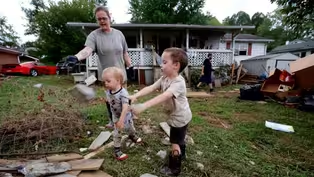
LAURA BARRON-LOPEZ: And the impact hurricanes and other disasters have on children's mental health and learning.
(BREAK) LAURA BARRON-LOPEZ: Good evening.
I'm Laura Barron-Lopez.
John Yang is away.
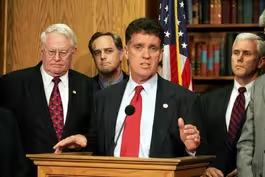
President-elect Donald Trump has named three doctors to key public health roles that oversee the U.S. vaccine supply, disease response and food safety.
He's nominating Dr. Janette Nesheiwat, a family medicine doctor and Fox News contributor, to be the next surgeon general.
Trump is also tapping Johns Hopkins surgeon Marty Makary to lead the Food and Drug Administration, and Dr. Dave Weldon, a former congressman from Florida, to be the director of the Centers for Disease Control and Prevention.
For more on what the picks say about the administration's approach to public health and science, we turn to Politico reporter Alice Miranda Ollstein.
Alice, thanks so much for joining us.
The surgeon general is often called the nation doctor, and they have one of the biggest public health pulpits.
I want to read for you a post by Jerome Adams, who served as Donald Trump's first surgeon general during that first administration.
And he posted today that whooping cough cases are up five times this year, measles deaths have gone up globally, and that the new administration had better have a strong infectious disease response plan and had better ensure public health and vaccine confidence stays high or they'll be distracted with outbreaks for years.
Where does Jeanette Nesheiwat stand when it comes to her history with infectious diseases and the other duties this role carries?
ALICE MIRANDA OLLSTEIN, POLITICO: Yeah.
So I think that we are seeing the healthcare world express some cautious optimism about her nomination compared with some of the other health officials that have been nominated recently by Donald Trump.
She has expressed support for vaccines, unlike some of these other folks, but she has been critical of some vaccine mandates, and so that could have endeared her to the Trump and Robert F. Kennedy, Jr. wing right here.
Also, in that quote from Jerome Adams, you really see this tension because both Trump and Kennedy have expressed interest in moving away from focusing on infectious diseases and focusing more on chronic diseases.
Of course, there's a lot of overlap.
Infectious diseases can cause chronic diseases.
And there's just a lot of alarm given the public health threats we see right now, not only whooping cough, which you mentioned, and measles, but also we're seeing outbreaks of bird flu.
And so there is a concern that these officials with the priorities they have voiced in the past and since being nominated will sort of take the foot off the gas of both research and, you know, promotion of measures that could halt the spread of infectious diseases.
LAURA BARRON-LOPEZ: Let's talk about some of those other officials.
So to lead the Food and Drug Administration, Donald Trump nominated Marty Makary.
He's a surgical oncologist with Johns Hopkins University.
What do we know about him and how he might approach that job?
ALICE MIRANDA OLLSTEIN: Right.
So he was sort of seen as a more establishment friendly pick, less out of the blue.
We've been reporting that he was under consideration for a while now.
But I think same as the surgeon general pick, you're hearing some cautious optimism from the public health world based on things he said in the past, based on his support, he is self-identified as being pro vaccine.
And so there is, you know, sort of hope from the public health community that he will be somewhat of a, you know, counter to the Robert F. Kennedy Jr. vaccine skepticism wing that is emerging in this administration.
But again, everyone serves at the pleasure of the president.
And so it'll really be what the tone is coming from the top that will dictate a lot of things going forward.
LAURA BARRON-LOPEZ: Then there's Dave Weldon, the former Republican congressman.
He's staunchly anti-abortion, skeptical of vaccines, has pushed the debunked idea that preservatives and vaccines cause autism.
And he's going to potentially soon be leading the CDC, which is now has to be confirmed by the Senate.
Does he fit into a pattern here when it comes to Trump's picks to shape the country's health policy and public health?
ALICE MIRANDA OLLSTEIN: Yeah.
So I think, you know, even though these folks are ideologically a little bit all over the place, there are some themes that are emerging.
And one of themes that is alarming people is that these folks don't have experience running big bureaucracies, which, of course, there are tens of thousands of employees at these different agencies.
And so that's why in the past, you know, you've had governors or people with previous federal government experience doing this.
It's not an easy job.
And so even though you have medical experience or like Weldon, you have served on committees that oversee these agencies, you know, that is important.
But they're alarmed not only by some of the views he has expressed.
I mean, he's not only questioned vaccine safety when it comes to things like COVID, but also, you know, regular childhood vaccines, the MMR vaccines.
He's questioned the HPV vaccine.
And so this is really alarming lawmakers and people in the public health world, in addition to this sort of lack of executive experience.
LAURA BARRON-LOPEZ: Speaking of MMR disease, all three of these nominees will be big figures informing Americans about public health.
Trump's picks have spread vaccine misinformation, even though the data is overwhelming here in terms of the effectiveness, when you compare the cases of major disease annually in the US before measles, mumps, whooping cough vaccines to now, when they're more widely available, almost, in some cases, 99 to 100 percent drop in terms of cases annually.
So what impact will all three of these people potentially have on public health?
ALICE MIRANDA OLLSTEIN: It could be huge.
I mean, we already have public health experts worried about the worst case scenario, which is basically what we saw during COVID 19, which was a lot of people who didn't need to get sick and die, getting sick and dying.
And so I mean, that could happen in terms of a new outbreak.
Like we're seeing these cases of bird flu that are very troubling, but that could also happen with a resurgence of some of these diseases that we made so much progress on over the past several decades.
We could really see that backtrack.
LAURA BARRON-LOPEZ: Alice Miranda Ollstein, thank you for your time.
ALICE MIRANDA OLLSTEIN: Thank you.
LAURA BARRON-LOPEZ: Outside of those top public health roles, a flurry of new nominees are rounding out Trump's administration.
Today, President-elect Trump named Brooke Rawlins as his pick for agriculture sector secretary.
Rollins is the president and CEO of the America First Policy Institute, a Trump aligned think tank.
In the first Trump administration, she served on his domestic policy council.
The president-elect's choice for the Office of Management and Budget is a familiar name.
Russell Vogt led the budget office during the first Trump term.
Vogt was one of the lead authors of Project 2025, the conservative playbook that proposed dramatic plans to overhaul and gut parts of the government.
Vogt has said the U.S. is living in a post constitutional time and he crafted plans for Trump to deploy the military during civil unrest.
Sebastian Gorka has been named White House senior director for counterterrorism.
Gorka became a Fox News contributor after an abrupt end to his brief stint in the White House during Trump's first administration.
In response to the announcement, Trump's former national security adviser John Bolton told CNN, he's a dangerous choice.
JOHN BOLTON, Former National Security Adviser: Well, Sebastian Gorka is a con man.
I wouldn't have him in any U.S. government.
Fortunately, it's not the highest position he had been mentioned for, but I don't think it's going to bode well for counterterrorism efforts.
LAURA BARRON-LOPEZ: President elect Trump also announced his picks for the Departments of Labor and Housing and Urban Development.
Labor secretary nominee Lori Chavez DeRemer, who recently lost her reelection bid to the House, is backed by labor unions, including the head of the Teamsters and former Texas state representative, professional football player and Trump White House alum Scott Turner has been tapped for HUD secretary.
In the Middle East, deadly airstrikes killed six people, mostly women and children, in the southern area of Khan Younis.
Gaza's health ministry said the death toll from the 13th month long war has ticked past 44,000.
The health ministry does not distinguish between fighters and civilians.
And in Lebanon, an Israeli airstrike killed more than a dozen people in Beirut.
Lebanese health officials say the strikes hit the central part of the capital, killing 15 and wounding more than 60 others when an eight-story building came crashing down.
And in California, the CDC is investigating the country's first case of bird flu diagnosed in a child.
The health agency says the child has mild symptoms and is recovering.
An investigation into how they contracted the virus is underway, but officials say the child may have had contact with wild birds.
No other cases involving children have been announced.
Still to come on PBS News Weekend, why decades old toxic foam is still contaminating waterways in northern Michigan and the long term impact major storms can have on children's mental health.
(BREAK) LAURA BARRON-LOPEZ: Earlier this fall, the Defense Department missed a deadline to stop using a firefighting foam that has caused widespread contamination across the country.
While the military continues its transition away from the toxic foam, it's also beginning a massive cleanup that will take decades and billions of dollars.
In the small town of Oscoda, Michigan, a group of citizens has been fighting to hold the Air Force accountable for contaminating their waterways.
In the first of our two-part series, special correspondent Megan Thompson brings us their story.
MEGAN THOMPSON (voice-over): Tony Spaniola and his family have been coming to their vacation home on Van Etten Lake for decades, a relaxing getaway in the wilds of northern Michigan.
But in 2016, Spaniola received a troubling letter from the state.
TONY SPANIOLA, OSCODA MICHIGAN RESIDENT: I got a letter in the mail from the Michigan Department of Health and Human Services saying, don't drink your water.
MEGAN THOMPSON (voice-over): About a year later, Spaniola began noticing something strange on the lake.
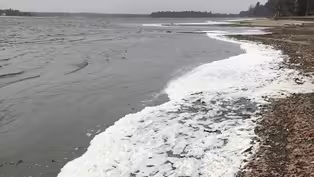
TONY SPANIOLA: It was in December and my wife woke up and she said, I think it snowed last night.
There was foam piled up all along the shoreline.
You could see it for miles.
All along -- MEGAN THOMPSON (voice-over): Spaniola had learned his tap water, the lake and this bright white foam were all contaminated with toxic manmade chemicals.
TONY SPANIOLA: It sends you into a different place.
It's a shocking kind of thing.
So the base is right across the lake?
Yeah.
You can see the buildings.
MEGAN THOMPSON (voice-over): It turned out the chemicals were coming from the old Wortsmith Air Force Base.
MARK HENRY, RETIRED ENVIRONMENTAL ENGINEER: This was a fire training area.
MEGAN THOMPSON (voice-over): Mark Henry is a retired environmental engineer for the state of Michigan who worked at the base after it closed in 1993.
MARK HENRY: There used to be a big concrete bowl out here with a simulated aircraft on it.
And then they would bring the fire trucks in and let the people practice.
MEGAN THOMPSON (voice-over): They were practicing putting out jet fuel fires, dousing the burning planes with a special foam that's been used by the military since the 1970s.
It's made from a chemical called PFAS.
COURTNEY CARIGNAN, Michigan State University: PFAS is an acronym that stands for PER and polyfluoroalkyl substances.
MEGAN THOMPSON (voice-over): Courtney Carignan is an environmental epidemiologist at Michigan State University.
She studies human exposure to chemicals.
COURTNEY CARIGNAN: PFAS are characterized by a chain of carbons with fluorine bonds and a functional group.
One end likes water and the other does not and repels it.
MEGAN THOMPSON (voice-over): Those useful properties mean they're contained in all kinds of common products like nonstick pans, stain resistant carpet, and food packaging.
There are around 15,000 types of PFAS, and increasingly research shows they can cause a range of health problems from liver damage to heart disease and cancer.
COURTNEY CARIGNAN: PFAS are often called forever chemicals because they're so persistent in the environment.
They don't break down naturally.
They move very easily into water and groundwater, and so they end up in our fish and our drinking water.
MEGAN THOMPSON (voice-over): Today, about half the nation's drinking water supply has PFAS in it.
And nearly every American has some level of PFAS in their blood.
The military is one of the biggest PFAS polluters in the U.S. but the scale of the problem has only recently become widely known, thanks in large part to Wordsmith, one of the first bases where PFAS contamination was publicly exposed.
In 2010, a colleague of Mark Henry's made the discovery and began sounding the alarm.
Today, the Pentagon has confirmed or suspects PFAS contamination at more than 700 other sites.
MARK HENRY: There is almost no place you can dig a hole here on the base and not find the PFAS in the groundwater even to this day, 50 years after the release.
MEGAN THOMPSON (voice-over): But that polluted groundwater hasn't been staying on the base.
CATHY WUSTERBARTH: So these are the plumes of PFAS that are flowing from the former base.
MEGAN THOMPSON (voice-over): Seeping for years into nearby streams and lakes and the tap water of some homeowners like Tony Spaniola.
TONY SPANIOLA: I'm right there.
Right there.
MEGAN THOMPSON (voice-over): Spaniola, a politically connected attorney was so alarmed, he teamed up with Oscoda resident Cathy Wusterbarth to launch Need Our Water to call attention to the environmental calamity.
They gave PBS News Weekend a tour of the areas most affected by those PFAS plumes.
TONY SPANIOLA: So this is a youth camp.
It's owned by the YMCA of Detroit.
And there is a PFAS plume that flows right underneath the camp in comes out right here at the shore.
CATHY WUSTERBARTH: This is an area we call three Pipes.
The water is coming off of the base from the storm sewers, flowing uninterrupted into the Au Sable River.
MEGAN THOMPSON (voice-over): Tests found PFAS levels more than 50 times higher than what's allowed by Michigan law.
On the day we visited, dozens of people were swimming and boating nearby, about a mile away is a wildlife area called Clark's Marsh, where birds have been found with some of the highest levels of PFAS contamination ever documented.
The state has issued five separate health advisories for the area warning, do not eat any fish you catch or animals you hunt.
CATHY WUSTERBARTH: So this lake is highly contaminated on the surface.
And when the wind agitates the surface of the water, the foam can build up.
MEGAN THOMPSON (voice-over): Tests conducted by the state have found PFAS levels in the foam as high as 220,000 parts per trillion.
The EPA's new standard for drinking water only allows for 4 parts per trillion.
What's more, Van Eten Lake and the other contaminated streams drain into Lake Huron, one of the Great Lakes and a source of drinking water for around 3 million people in the U.S. and Canada.
PFAS contaminated foam has been found on its shores, too.
TONY SPANIOLA: We can't afford to allow this land, this natural resource, to be poisonous for years and years to come.
And it's got to stop.
MEGAN THOMPSON (voice-over): Spaniola and Wusterbarth have spent the last seven years lobbying Congress and the Pentagon to clean up the mess.
CATHY WUSTERBARTH: They can stop the flow of all of these plumes off of the property right now.
MEGAN THOMPSON (voice-over): Wordsmith is one of the first bases in the country where the Air Force has begun installing PFAS treatment systems, pumping groundwater into huge vats where the contamination is removed.
But 14 years after the PFAS discovery, only a fraction of the pollution is being treated, and the Air Force recently announced delays in cleaning up the rest.
Some systems won't start operating for another four or five years.
TIM CUMMINGS: It's just slow motion.
This is molasses on a cold winter day.
MEGAN THOMPSON (voice-over): A citizens' advisory board meets with the Air Force every three months to provide input meetings that have become increasingly contentious.
MAN: We feel abandoned.
MAN: It's like you're cooking the books.
MEGAN THOMPSON (voice-over): At a meeting in August, board members vented frustrations about the delays and said the cleanup was mismanaged, accusing the military of not conducting enough testing before it started building the latest treatment system this summer.
MARK HENRY: The Air Force did an extremely minimal amount of work to demonstrate that the wells they were planning on putting in were actually in the right place.
So they're only treating a quarter of the known problem, and they have no idea really what exists beyond.
MEGAN THOMPSON (voice-over): Under pressure, the Air Force released the results of an independent review at the latest community meeting this week, confirming concerns about the new system and saying more testing is needed to make sure all the PFAS will be captured.
BRENDA ROESCH, Air Force Civil Engineer Center: We are looking at a reorganization.
MEGAN THOMPSON: Air Force official Brenda Rush also announced a shakeup in the management of the Wortsmith cleanup and promise the new leadership will do better.
BRENDA ROESCH: So I commit to you that we are going to increase the transparency.
We're going to really work hard on accelerating timelines.
MEGAN THOMPSON (voice-over): Tony Spaniola appreciates the new direction, but doesn't plan to let up the pressure because he says Wurtsmith needs to set the example for the rest of the nation.
TONY SPANIOLA: If our government doesn't do it right, what does that say to all the other communities that are impacted?
It's a very critical battle we're fighting here.
MEGAN THOMPSON (voice-over): For PBS News Weekend, I'm Megan Thompson in Oscoda, Michigan.
LAURA BARRON-LOPEZ: It's been nearly two months since Hurricane Helene devastated communities across the Southeast, and experts say the storm's effects on children might last for years to come.
Ali Rogan has more.
ALI ROGIN: Tens of thousands of children and young adults have dealt with disruptions at home and school following Hurricanes Helene and Milton.
Researchers from Boston College found up to 70 percent of students could show symptoms of PTSD in the first three months following such disasters.
Lori Peek is the director of the Natural Hazard Center at the University of Colorado Boulder.
She studies how children and socially marginalized populations fare after disasters.
Lori, thank you so much for being here.
What are the recovery processes for children after they've gone through a hurricane like this?
LORI PEEK, NATURAL HAZARD CENTER, UNIVERSITY OF COLORADO BOULDER: There is actually no one single trajectory that children follow after a disaster.
Their recovery is influenced by multiple factors.
How much damage their community, their school, their home sustained, how disrupted their lives are in the afterburners aftermath of the disaster, how much social support they receive.
But the good news is that we do have good information about what can help children to recover after a disaster and to get them back into a stable routine, back into school, back into a better situation, even after a catastrophic event like Helene or Milton.
ALI RORGIN: And what are some of those strategies that can help children get back on track?
LORI PEEK: So some of the things that really help children in the aftermath of disaster include getting back into a routine, and that can be a really hard thing when a home is damaged or destroyed, when a school is closed for a period of time, when parents have lost work, or when there's other disruption around the children.
Also providing social support to children and ensuring that support comes from multiple angles in their lives and so that the support comes from trusted loved ones in the family, that peers are available.
Peer support networks can be very important, especially to adolescents and teens.
And also that children are receiving support through their schools is of the utmost importance.
ALI ROGIN: What are some signs of distress that young people might show in the wake of a natural disaster that adults might miss?
LORI PEEK: Our research after Hurricane Katrina really revealed that sometimes children, and especially adolescents and teens, they may help hide that distress from the adults in their lives.
And we learned after Katrina that a lot of young people were doing this because they saw how distressed and how disrupted their parents, their teachers, other trusted adults in their lives, how much of a struggle they were having.
And so we learned from the kids themselves that oftentimes they were trying not to talk about that distress and to suppress it so they wouldn't be a burden to the adults in their lives.
And so the lesson from that is, if you're an adult out there listening is to do everything you can to listen to your child and to really try to ask them how they're doing and not just sort of a one and done, but to regularly check in with your child or with the children who you teach or who you care for to make sure that they are doing okay.
Because again, children, just like adults, they don't follow sort of one straight path after a disaster.
They may be feeling okay one day and another day, have a really hard day.
Very young children, sometimes they may regress, they may start engaging in bedwetting, or they may sort of become really clingy as children get older.
They might start acting out or they might kind of turn inwards.
A previously very outgoing child might stop behaving in that way if things seem really serious.
Doing everything you can to try to get your child to the school counselor or to another mental health professional to make sure that they are doing okay and getting the support they need.
ALI ROGIN: You know, we talk a lot about investments that are needed infrastructure to better protect our communities from massive weather events.
But what about on the mental health side?
Is this something that communities should be investing more in as a preventative measure as we see more and more of these intense weather events?
LORI PEEK: Absolutely.
And every investment that we can make before a disaster, that investment can pay off multiple times, many times over after the disaster.
Weather, as you're suggesting, it's in hardening our infrastructure to make sure that all of the schools and homes and businesses and all the things that make up a child's community that they're not so badly damaged or even destroyed in a disaster.
So those infrastructure investments, they do matter and they do make a difference.
It's also important to make sure that we're investing in the social infrastructure, the various aspects that make up a child's life, making sure that we are properly funding mental health services, ensuring that there are spaces for children to be involved before a disaster even happens, to be involved in their community, to be involved in their schools, to make sure that they have those strong social networks around them.
Having somebody that the child can turn to after the disaster can be absolutely critical in terms of mitigating those negative mental health impacts.
And so anything we can do before the disaster is of utmost importance.
ALI ROGIN: Lori Peek, Director of the Natural Hazard center at the University of Colorado, Boulder, thank you so much for being here.
LORI PEEK: Thank you so much for having me, Ali.
LAURA BARRON-LOPEZ: And that's our program for tonight.
I'm Laura Barron-Lopez.
For all of my colleagues, thanks for joining us.
See you tomorrow.
The long-term effects of major storms on kids’ mental health
Video has Closed Captions
Clip: 11/23/2024 | 5m 58s | The long-term effects of hurricanes and major disasters on children’s mental health (5m 58s)
What Trump’s picks mean for the future of U.S. health policy
Video has Closed Captions
Clip: 11/23/2024 | 6m 22s | What Trump’s latest picks mean for the future of U.S. public health policy (6m 22s)
Why decades-old PFAS is still contaminating Michigan waters
Video has Closed Captions
Clip: 11/23/2024 | 8m 20s | Why decades-old, toxic PFAS foam is still contaminating northern Michigan waterways (8m 20s)
Providing Support for PBS.org
Learn Moreabout PBS online sponsorship
- News and Public Affairs

FRONTLINE is investigative journalism that questions, explains and changes our world.

- News and Public Affairs

Amanpour and Company features conversations with leaders and decision makers.












Support for PBS provided by:
Major corporate funding for the PBS News Hour is provided by BDO, BNSF, Consumer Cellular, American Cruise Lines, and Raymond James. Funding for the PBS NewsHour Weekend is provided by...