
May 26, 2024 - PBS News Weekend full episode
5/26/2024 | 26m 45sVideo has Closed Captions
May 26, 2024 - PBS News Weekend full episode
Sunday on PBS News Weekend, a science advocacy group says one of the world’s biggest meat and poultry producers is pouring pollutants into U.S. waterways. Then, how the federal government’s food assistance program isn’t keeping up with rising prices at grocery stores. Plus, Grammy-winning teacher Annie Ray discusses her inclusive approach to music education.
Problems playing video? | Closed Captioning Feedback
Problems playing video? | Closed Captioning Feedback
Major corporate funding for the PBS News Hour is provided by BDO, BNSF, Consumer Cellular, American Cruise Lines, and Raymond James. Funding for the PBS NewsHour Weekend is provided by...
Support provided by:

May 26, 2024 - PBS News Weekend full episode
5/26/2024 | 26m 45sVideo has Closed Captions
Sunday on PBS News Weekend, a science advocacy group says one of the world’s biggest meat and poultry producers is pouring pollutants into U.S. waterways. Then, how the federal government’s food assistance program isn’t keeping up with rising prices at grocery stores. Plus, Grammy-winning teacher Annie Ray discusses her inclusive approach to music education.
Problems playing video? | Closed Captioning Feedback
How to Watch PBS News Hour
PBS News Hour is available to stream on pbs.org and the free PBS App, available on iPhone, Apple TV, Android TV, Android smartphones, Amazon Fire TV, Amazon Fire Tablet, Roku, Samsung Smart TV, and Vizio.
Providing Support for PBS.org
Learn Moreabout PBS online sponsorshipJOHN YANG: Tonight on PBS News Weekend, the pollutants a scientist group says one of the world's biggest meat and poultry producers is pouring into us waterways.
Then, how the government's food assistance program isn't keeping up with rising prices at the grocery store.
And Grammy Award winning teacher Annie Ray on her inclusive approach to music education.
ANNIE RAY, Grammy Award winning teacher: I've gotten so many kind emails from these parents or spoken with them where they're like, my child seems so unhappy all the time.
And let's put here he's not or there's might be a student who struggles in different aspects of the day but here so incredibly successful, and flourishing.
(BREAK) JOHN YANG: Good evening, I'm John Yang.
Powerful storms have killed at least 14 people including two children and left a trail of destruction across Texas, Oklahoma and Arkansas.
The storms crossed Texas highways tossing trucks and demolishing roadside structures in small towns.
A local sheriff assess the damage in his community.
RAY SAPPINGTON, Sheriff, Cooke County: We can rebuild property and you know, as horrible as this looks.
Probably in two, three months, it won't look like this.
It'll be better but the loss of life is just tragic.
It's always tragic and that's what hurts most.
JONH YANG: At least seven of the dead were in Cooke County, Texas near the Oklahoma border.
In Arkansas massive trees were uprooted across the region hundreds of thousands of people remain without power.
Severe storms delay the start of today's Indianapolis 500 race officials evacuated about 125,000 people who had gathered for the annual Memorial Day weekend event.
The National Weather Service says there's a high risk of severe thunderstorms tonight from the Ozarks into the Ohio Valley region.
In the Middle East, tonight an exchange of fire between Israel and Hamas.
Palestinian medics say 22 people were killed and an Israeli airstrike in Rafah that hit tents full of displaced people that followed a barrage of rockets that Hamas militants launched from Gaza at Central Israel.
In Tel Aviv air raid siren sounded for the first time in months, frightened residents rushed to underground shelters.
The Israeli military said it shot down a number of the rockets.
There were no reports of casualties.
In Papua New Guinea, the UN estimates that the bodies of more than 670 people are buried beneath the massive landslide that devastated the island nation on Friday.
Crews have recovered only five bodies and the part of a six.
They've been flooded by shifting ground.
More than 1200 people are homeless.
And the man who co-wrote the soundtrack for generations of childhood memories is dead.
Richard Sherman and his late brother Robert composed the music for films like Jungle Book and "Chitty Chitty Bang Bang."
They won two Academy Awards for Mary Poppins, Best Score and Best Song for "Chim Chim Cher-ee."
In all, the Sherman Brothers wrote more than 200 songs and won three Grammys.
In 2008 President George W. Bush awarded them The National Medal of the Arts.
The commendation said their music helped bring joy to millions.
Richard Sherman was 95 years old.
Still to come on PBS News Weekend why food assistance benefits aren't keeping up with inflation.
And a Grammy Award winning teacher on the importance of music for all.
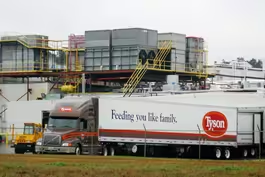
(BREAK) JOHN YANG: Tyson Foods is one of the world's biggest meat and poultry producers and according to the Union of Concerned Scientists, it's also a major polluter in the United States.
A report entitled waist deep says that in the five years between 2018 and 2022, Tyson plants dumped more than 371 million pounds of pollutants into U.S. waterways.
More than half of that was in three states, Nebraska, Illinois and Missouri.
In response, Tyson defends its wastewater treatment program, which it says complies with regulations.
Stacy Woods is Research Director for the Union of Concerned Scientists and one of the authors of the report.
Stacy, what pollutants are we talking about here?
And what effect do they have on the environment on wildlife and on humans.
STACY WOODS, Union Of Concerned Scientists: Our report found that Tyson Foods dumped over 25 different pollutants into waterways in 17 states.
This pollution included nitrogen, including ammonia, and phosphorus.
And we're particularly concerned about those because when there's too much nitrogen and phosphorus in our waterways, it can cause harmful algal blooms that can kill fish and other aquatic wildlife.
And also, when people live close to these harmful algal blooms, they can experience things like asthma attacks, and bronchitis.
JOHN YANG: And these are all byproducts of meat processing?
STACY WOODS: It comes from the wastewater in the meat processing.
Wastewater is produced in these meat processing plants, when folks working in these plants rinse off dead animal carcasses when they clean meat products, and when they rinse down these industrial equipment, and so that wastewater contains things like blood and feces and in bacteria like E. coli.
So there's a lot of wastewater that is produced when meat processing plants create meat and poultry products.
The Tyson Foods plants that we looked at produced over 87 billion gallons of wastewater in those five years.
JOHN YANG: I want to read you part of a statement that a Tyson spokesperson gave us about your report.
It says Tyson Foods uses a robust management system to mitigate environmental risks and impact.
This report does not acknowledge our ongoing compliance with EPA regulations and certification by the Water Alliance where our strong water management practices.
What do you say to that?
STACY WOODS: The most shocking thing that we found in our investigation was that when Tyson Foods dumped these millions and millions of pounds of pollutants directly into our waterways, they were pretty much following the rules.
Now, there were a few instances where a couple of plants exceeded the rules for a few pollutants some of the time.
But by and large, they were in fact following the rules.
And we think that's a problem.
Those rules need to change.
Luckily, the EPA is actually right now working on updating those rules.
The Union of Concerned Scientists and other groups, along with other citizens submitted comments in support of strengthening those rules so that these industrial polluters, like Tyson Foods, will be forced to clean up their act and stop dumping so much pollution directly into our waterways.
JOHN YANG: Why is it that the these levels would sound high when you describe them are within the APS regulations?
STACY WOODS: That's a great question.
And I can't speak to the reasons why EPA has the regulation set right now.
But I can tell you is that the regulations that are in effect right now and during our study period, were enacted over 20 years ago.
In that time, there's been tremendous gains and technologies that can allow these polluters to clean up their wastewater before releasing it out into our environment, which is why it's definitely time for updated regulations that will reduce the amount of water pollution that's allowed to come from these kinds of plants.
JOHN YANG: The report said that Tyson operates 123 plants in the United States, but that the data you analyze, only came from 41.
So could this actually be low?
STACY WOODS: Yes, our estimate is indeed an under estimate.
And the reason is that the current regulations only apply to a small sliver of the meat and poultry plants in the United States.
The EPA estimates that under the current regulations, only about 500 of the roughly 5,000 meat and poultry plants are required to report their water pollution.
So, for Tyson Foods, we had reportable water pollution for only 41 of their 123 plants.
And we would assume that the remaining plants are also creating wastewater.
JOHN YANG: Is this a problem specifically to Tyson?
Or is this a problem industry wide for meat and chicken processing?
STACY WOODS: The meat and chicken processing industry is a known water polluter across the United States.
This is not specific to Tyson Foods, but we decided to investigate Tyson Foods because they are one of the largest meat and poultry processors in the US.
So we anticipate that their influence in the overall industry pollution would be pretty high.
JOHN YANG: Stacy Woods of the Union of Concerned Scientists.
Thank you very much.
STACY WOODS: Thank you so much for this opportunity to talk about our report.
JOHN YANG: The five-year farm bill is working its way through Congress.
The one and a half trillion dollar measure covers a sweeping set of agricultural and food policies covering everything from crop insurance to conservation programs.
As Ali Rogin reports one major sticking point this year is funding for the federal program that helps low income people buy food.
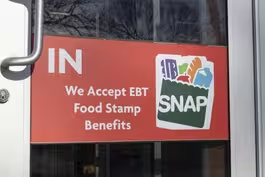
ALI ROGIN: The legislative package known as the Farm Bill is moving slowly through the house in part because of party line disagreement over the Supplemental Nutrition Assistance Program, or SNAP formerly known as food stamps.
It's a federal program that addresses hunger by helping people with low incomes buy food.
But an analysis by the Urban Institute, a left leaning research organization found that SNAP benefits in 2023 did not cover the rising cost of groceries in 98% of us counties.
Elaine Waxman is a senior fellow at the Urban Institute and is one of the report's authors.
Elaine, thank you so much for being here.
Tell us a little bit more about SNAP and how levels for it are set.
ELAINE WAXMAN, Urban Institute: Absolutely.
So SNAP is really the first line of defense we have in federal nutrition programs to address food insecurity.
And we have a solid evidence base that suggests that it not only improves food outcomes, but it reduces poverty.
It provides economic benefits to the economy, it may even reduce healthcare expenditures.
So it's really vital.
It provides monthly benefits on an electronic card.
Those benefits are set according to a market basket of goods that the government refers to as the Thrifty Food Plan.
That food plan, the assumptions underneath it had not been updated for decades until 2021.
There was some improvement in SNAP benefit adequacy, then, but we've lost that ground.
And as you said, it does not cover the cost of a moderately priced meal in most U.S. counties.
ALI ROGIN: And how great was that disparity?
You mentioned that the gap had gotten a lot smaller for a little while.
But now its way back up to a very disproportionate level.
How did it get there?
ELAINE WAXMAN: Sure.
So after the adjustment in 2021, we actually saw that the benefits were adequate to the price of a moderate meal in all but about one in five counties in the US.
So for short term, we had significant improvement.
We've had a number of shifts, obviously, in terms of inflation.
And even though SNAP is updated for inflation, it hasn't been sufficient, because the underlying benefit is really not adequate to purchase a meal that would be meaningful in terms of health and nutrition.
So where we're at now, after a couple of cost of living increases is really just about back to where we started before that original update happened in 2021.
ALI ROGIN: And where are the parts of the country where these disparities are the greatest.
ELAINE WAXMAN: So some of the counties with the greatest disparities are would not be surprising to us, like in New York, or on the coasts, but in the top five counties with the largest gaps.
Several of them are actually rural counties, for example, Lila Knox County, Michigan, Teton County, Idaho Nantucket County, Massachusetts.
These are all places that are more rural and have higher transportation costs, but they also tend to be near first locations.
And then tends to drive up prices.
ALI ROGIN: We mentioned earlier, the congressional debate that's underway.
What are the main disagreements there?
Walk us through that?
ELAINE WAXMAN: Sure.
So I think the biggest point of debate around snap has been on a requirement that was actually put in place in 2018, by Congress in the last part of bill.
And that requires the SNAP benefit to be updated or reviewed at least every five years.
But people were not expecting the size of the update in 2021.
And that's caused some conflict.
And so the current house bill that was passed out of committee this week, calls for cost neutrality, that basically means that freeze on SNAP benefits going forward.
So they will be updated for inflation.
But we won't have the ability to act on any improvements in nutritional guidance, in the ways that people are purchasing and preparing food.
And we started with an inadequate base.
So as a result, the estimate is really that it reduces snap cost over time, and the adequacy problem will only get worse.
What does that mean, it's already insufficient in the majority of counties, but that gap will get larger.
ALI ROGIN: In terms of the SNAP program more generally, there are studies that show that participation in the SNAP program is associated with lower nutritional quality of the food and household poor health in children.
Is that an issue with snap?
Or is that an issue with some of the other underlying factors that might indicate why a family why a household needs SNAP benefits?
ELAINE WAXMAN: That's a great question.
The fact of the matter is, when we look at the patterns of purchases between people who are on SNAP, and people who have low incomes and are not on SNAP, then there are not very significant differences.
The truth of the matter is, is as a country, we don't eat very well.
And particularly if you're stretching a budget on a low income, you tend to go for those things that are cheap and calorie dense, as opposed to things that are perishable and better for us, but are a bigger risk in terms of purchases.
So what we're seeing is choices that people have to make because they don't have sufficient funds for food.
The other thing I think is worth noting is that we have an epidemic of diabetes and other diet sensitive conditions in this country.
Those are not confined to people with low income or participating in snap that covers across the income continuum.
And so that's a larger issue that we need to deal with as a community.
ALI ROGIN: Elaine Waxman, Senior Fellow at the Urban Institute, thank you so much for joining us.
ELAINE WAXMAN: Thanks for inviting me.
JOHN YANG: The end of the school year often means year on concerts for student orchestras and choirs for high school music educator Annie Ray, it's a time to look back on a year that included a Grammy Award and ahead at her vision of what education should be.
Ali Rogan's back with the latest installment of our series Weekend Spotlight.
ALI ROGIN (voice-over): The orchestra program at Annandale High School in Virginia is expansive.
ANNIE RAY: Put your bow on the purple string.
ALI ROGIN (voice-over): And inclusive.
It's been around for more than 50 years, and has grown to more than 130 participants, many of whom speak a different language at home.
ANNIE RAY: I'll give you three and then we're in.
ALI ROGIN (voice-over): It's all conducted under the encouraging baton of director Annie Ray.
ANNIE RAY: Have literally been brought into their communities are like fed by these families tradition, traditional Korean meals when I'm pregnant, whether like you need to be eating, or like taking care of me.
And it's been the most humbling thing to be educated by these communities of diversity not just in countries but backgrounds.
And perspectives.
ALI ROGIN: I have found that language and music tend to go hand in hand.
And so I just wonder if that's something that you've experienced because I know many of your students don't speak English at home.
ANNIE RAY: Yes, it's so interesting because there are a bunch of students who I will see try to play by ear.
And a lot of maybe music in their country is like played by ear or like that's just something that they have more of an ear to when picking up languages.
It's interesting I've actually seen a correlation with with some of my ESL learners or English language learners who are try to learn like through that oral tradition the by ear a lot of ways.
Yeah, cello.
ALI ROGIN (voice-over): We sat in on the symphony orchestras final practice before their end of your concert designed to embrace the multicultural backgrounds of its participants.
ANNIE RAY: They have a student named Sosan, who had so much joy with teaching our class like about music from like her country and Arabic music.
And I heard Sosan over and over again, encouraging other students.
I was like, well, I need more student speakers tonight.
They're like, No, no.
And she was like, why aren't you proud of your culture?
Like, aren't you proud and you want to show everybody and then they're like, We can I'm proud of it.
She was then tell everyone about it.
And so much of like her and a bunch of other students who are like that, have set the tone for what our program is of like, be proud of who you are and what you bring to the table.
Don't be afraid of it.
One, two, DZ.
Yeah, Isaac rock it out.
ALI ROGIN (voice-over): That theme of pride is evident in the crescendo orchestra as well.
Formed somewhat fortuitously during the pandemic.
It's for students with significant and severe disabilities.
ANNIE RAY: I was lucky enough to be able to start it in this kind of like weird this time during the pandemic, during COVID.
Nobody was here and except for our students in our category B Special Education Department.
So, I invited them down to make some music with me because I was just wanting to make music with anybody who was around me instead of just online, we started playing together and the students inspired me, then walked down to my principal and say, hey, I want to make this an actual class like these students have the right to a quality music education.
And the only reason it's to the point that it is now is because of my special education team, my instructional assistants that occupational therapists who really taught me everything that they know and we just applied it to music.
It really takes a village you can see that when you all are working together like we did this morning.
We as music educators can't do things alone.
ALI ROGIN (voice-over): One student in particular, Kevin Hadamio (ph) was the spark that lit the crescendo orchestra's fire.
ANNIE RAY: Kevin was one of those kids who came down that first day I brought them all down.
And he was so unhappy to be there.
He was mad at us pull it out of his routine that we sat down and I started playing the cello for him.
And he repeatedly started saying, meet me and he doesn't verbalize much.
And so I was like, okay, well, here you here we go check, Kevin, you can try playing and he pulled the ball out of my hand and started going back and forth.
And tears started welling up in his eyes.
And it was this moment where I was like, wow, he is -- we're connecting so much here right now.
I've gotten so many kind emails from these parents or spoken with them where they're like, my child seems so unhappy all the time.
And let's put here he's not, or there's might be a student who struggles in different aspects of the day.
But here, she's so incredibly successful, and flourishing.
But that looks different for every kid and every kid's learning and their process looks different.
And so we need to meet everyone where they're at.
But then, besides that, pull them along further than they ever thought possible, have high expectations for them know that they can get to these high places of learning.
ALI ROGIN (voice-over): Ray holds all of her students to those high standards.
It's part of why her colleagues nominated her for the Music Educator of the Year Grammy Award.
She won and got to attend the award show in February, snapping selfies with stars who were excited to meet her.
But the main thing her win delivered is a new audience and platform for raise message that Music and Performing Arts should be a core subject in schools, not just an option.
ANNIE RAY: When we're talking about social emotional learning right now, this is this huge buzzword social emotional learning is happening so authentically through the performing arts, through the arts, through creativity and tapping into these kids.
I watch kids who might come from very challenging backgrounds or very challenging situations, who stepped through the door and they might be a little bit opposed to it.
But then they come in a little bit more and a little bit more next.
I know they're running the whole program, the orchestra leadership and making it what it is not just a music education issue.
It's an education issue of not funding enough for all teachers.
And so, I do call for like music education to become more of a fundamental right to a student's education a fundamental part of who they are.
ALI ROGIN (voice-over): For the Annandale class of 2024 orchestra members, it was time for one final performance.
One final bow and one final exam.
ANNIE RAY: I'm saying goodbye to close to 40 seniors who are the reason that ended up orchestra is the way that it is they set the tone for what orchestra is or for what we do here, the purpose of us here.
And so, I sent out their final exam which one of the questions was like can you describe orchestra and one word and so many of them said community and home.
And the fact that they did say scales or anything like that I was like yes they got it.
But to read their messages has been again one of the most humbling things of my life.
ALI ROGIN: And as those seniors embark on new journeys, they know they can always come home to their orchestra family and to Annie Ray.
For PBS News Weekend in Annandale, Virginia, I'm Ali Rogin.
JOHN YANG: And finally, on this Memorial Day weekend amid the cookouts and the trips to the beach, I hope you find time to remember America's more than 1 million war dead and reflect on the values and principles they fought to protect.
I am John Yang.
For all of my colleagues, thanks for joining us.
Have a good week.

Grammy-winning teacher Annie Ray on music education for all
Video has Closed Captions
Clip: 5/26/2024 | 7m 27s | Grammy-winning teacher Annie Ray on the importance of music education for all (7m 27s)
Tyson Foods is polluting U.S. waterways, report says
Video has Closed Captions
Clip: 5/26/2024 | 5m 46s | Wastewater from Tyson meat processing plants is polluting U.S. waterways, report says (5m 46s)
Why SNAP benefits aren’t keeping up with rising food costs
Video has Closed Captions
Clip: 5/26/2024 | 6m 43s | Why SNAP benefits aren’t keeping up with the rising cost of food (6m 43s)
Providing Support for PBS.org
Learn Moreabout PBS online sponsorship
- News and Public Affairs

FRONTLINE is investigative journalism that questions, explains and changes our world.

- News and Public Affairs

Amanpour and Company features conversations with leaders and decision makers.












Support for PBS provided by:
Major corporate funding for the PBS News Hour is provided by BDO, BNSF, Consumer Cellular, American Cruise Lines, and Raymond James. Funding for the PBS NewsHour Weekend is provided by...