
May 25, 2024 - PBS News Weekend full episode
5/25/2024 | 26m 45sVideo has Closed Captions
May 25, 2024 - PBS News Weekend full episode
Saturday on PBS News Weekend, how the lasting effects of George Floyd’s death continue to shape the city of Minneapolis four years later. Then, a front-line report as depleted Ukrainian forces struggle to contain Russia’s advances. Plus, the hidden history of Anna May Wong, considered to be the first Asian American movie star, and her struggles with Hollywood’s racism.
Problems playing video? | Closed Captioning Feedback
Problems playing video? | Closed Captioning Feedback
Major corporate funding for the PBS News Hour is provided by BDO, BNSF, Consumer Cellular, American Cruise Lines, and Raymond James. Funding for the PBS NewsHour Weekend is provided by...
Support provided by:

May 25, 2024 - PBS News Weekend full episode
5/25/2024 | 26m 45sVideo has Closed Captions
Saturday on PBS News Weekend, how the lasting effects of George Floyd’s death continue to shape the city of Minneapolis four years later. Then, a front-line report as depleted Ukrainian forces struggle to contain Russia’s advances. Plus, the hidden history of Anna May Wong, considered to be the first Asian American movie star, and her struggles with Hollywood’s racism.
Problems playing video? | Closed Captioning Feedback
How to Watch PBS News Hour
PBS News Hour is available to stream on pbs.org and the free PBS App, available on iPhone, Apple TV, Android TV, Android smartphones, Amazon Fire TV, Amazon Fire Tablet, Roku, Samsung Smart TV, and Vizio.
Providing Support for PBS.org
Learn Moreabout PBS online sponsorshipJOHN YANG: Tonight on PBS News Weekend, four years later, how the lasting effects of George Floyd's death continue to shape the City of Minneapolis.
MAN: I think for a lot of people, they're still waiting for the outcome of, you know, all these promised reforms to see if they can actually feel like they trust what the city has been doing as far as policing in the last few years.
JOHN YANG: Then a frontline report is depleted Ukrainian forces struggle to contain Russia's advances, and the Hidden History of Anna May Wong, considered to be the first Asian American movie star and her struggles with Hollywood's racism.
(BREAK) JOHN YANG: Good evening, I'm John Yang.
Despite international criticism, Israel is pressing ahead with its assault on Rafah.
Medical personnel in Gaza said today that new Israeli attacks killed more than 40 Palestinians across Gaza.
In Gaza City, a school being used as a shelter for displaced people was hit, children are among the dead.
At the same time increased diplomatic activity is raising the prospect of restarting stalled talks aimed at a ceasefire and the release of Israeli hostages.
A Russian strike on a residential area of Kharkiv damaged a shopping center and killed at least two people.
Russia and Ukraine are battling for control of territory along the border.
Ukraine says it's taken back villages north of Kharkiv that Russia had captured in recent weeks.
Russia claims it still controls at least one of those villages.
Secretary of Defense Lloyd Austin has resumed his duties after undergoing a non-surgical procedure for a bladder related issue last night.
During the two and a half hour treatment at Walter Reed Medical Center, he transferred his powers to the Deputy Secretary.
On Monday, Austin is expected to take part in Memorial Day ceremonies at Arlington National Cemetery as scheduled.
And the TSA says it screened nearly 3 million passengers at airports on Friday ahead of the Memorial Day weekend.
That's the most ever on a single day.
The AAA estimates that nearly 44 million Americans will travel at least 50 miles from home between Thursday and Monday 38 million of them by car.
Still come on PBS News Weekend exhausted troops fight to fend off Russian forces in eastern Ukraine.
And the story of enemy Hwang, one of the first Asian American actresses in Hollywood.
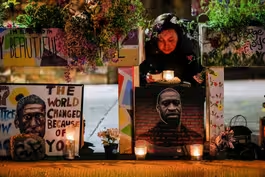
(BREAK) JOHN YANG: It was four years ago today that George Floyd died while three Minneapolis Police Officers pinned him face down on the pavement.
One of them pressing his knee on Floyd's neck.
Cellphone video the incident recorded by a teenage witness was seen around the world.
It ignited international protests over racism and police abuse and calls for police reforms.
Despite that global reach for Minneapolis, it is still very much a local trauma.
Jon Collins is a senior reporter at Minneapolis Public Radio, he covers the future of policing.
John four years on how much is this still part of daily life in Minneapolis?
How present is it?
JON COLLINS, Senior Reporter, Minneapolis Public Radio: Yeah, it's very present.
You can walk down the streets and you see signs in people's yards still you see murals of George Floyd.
You know, if you go 10 blocks away from here, you'll see George Floyd square, which is where activists have kind of set up, you know, a Mecca to memorialize Floyd.
And then on top of that this reform of the Minneapolis Police Department has been at the very forefront of what's been happening in the city for many years now you know folks are still very aware of what happened George Floyd and thinking about how they might be able to avoid that happening in the future again.
JOHN YANG: When it comes to policing and public safety.
Has anything changed?
JON COLLINS: Yeah, lots of change.
I mean, the City of Minneapolis is -- was investigated by the Minnesota Department of Human Rights, as well as the U.S. Department of Justice.
And both of them found glaring problems with the Minneapolis Police Department.
So the Minnesota Department of Human Rights has a court enforced agreement with the City of Minneapolis requiring all sorts of changes.
You know, for instance, you know, one of the things they did right away, was ban chokeholds.
And we also expect a federal consent decree to be coming down at some point here, which will make other requirements for the City of Minneapolis that they need to change with Minneapolis Police.
So that would make Minneapolis the first city to really experience both a state and a federal consent decree on policing at the same time.
So there's a lot happening right now.
JOHN YANG: Has any of this helped rebuild the trust of the of the residents of Minneapolis in the police department?
JON COLLINS: Yeah, I think that's a long journey, John.
I think for a lot of people, they're still waiting for the outcome of, you know, all these promised reforms.
And this does not come very quickly.
You know, it comes very slowly.
And it's many small steps.
So people are waiting to see if they can actually feel like they trust what the city has been doing as far as policing in the last few years.
JOHN YANG: I mean, I know there's a push on to change the civilian oversight board of the police, is that sort of an indication that they're still working to rebuild that trust?
JON COLLINS: Yeah, that's part of their process of just kind of, I think learning exactly what does work, the new civilian oversight board, it was created just a year ago, you know, has had a ton of trouble, you know, coming up with new policies for the police department, or, you know, they're supposed to go through police complaints, but there's a huge backlog.
So, yeah, that's totally a part of it.
And it's something the city needs to resolve, because it's required under the court enforced agreement.
So it's going to be something they need to figure out that at this point, you know, it's not clear yet how they're going to do that, or when that's going to actually come together, because it's quite dysfunctional at this point.
JOHN YANG: And on Minneapolis has also been sort of in the forefront of alternative policing, and responding to people who are in a mental health crisis.
How successful is that been?
JON COLLINS: I think one thing that people in the city of Minneapolis maybe don't hear enough about or understand is all the different changes that have been made to public safety, that don't involve armed police.
So one thing that they did is they really created and boosted this behavioral crisis response team.
So in the city of Minneapolis, at this point, if you want to call 911 and there's a nonviolent, you know, crisis or situation happening, you can ask for these folks to show up.
And it's in their nature to deescalate.
So I mean, there's been quite an investment in the city of Minneapolis, on these sorts of unarmed public safety responses, and people maybe don't directly experience them right away.
But the people that I've spoken to who have partaken of these services, you know, appreciate it.
And in that particular case, I would say, you know, from the evidence that we have that that has been a success, and then there are quite a few other programs that they're also exploring, or just launching right now.
JOHN YANG: Is you say that people in Minneapolis may or may not be seeing this or haven't seen a lot of it.
How long do you think it's going to take for the city to truly heal from this incident?
Or will there always be scar tissue?
JON COLLINS: So I think there's going to be remnants of 2020.
And what happened in George Floyd in Minneapolis' DNA forever.
You know, it's changed the nature of the city.
It's changed how the city thought about itself.
But I also think there is a process that's happening right now.
And it's actually thanks to the state governments and the federal government for doing these investigations.
And then the eventual consent decrees that require changes in the Minneapolis Police.
And we know from other cities and their experiences, that these consent decrees can take many, many years to resolve, you know, they don't lift the consent decree until Minneapolis meets the requirements.
So we are certainly going to be dealing with this in the city of Minneapolis for many years.
If not, you know, a decade or more.
JOHN YANG: Jon Collins of Minnesota Public Radio.
Thank you very much.
JON COLLINS: Thank you.
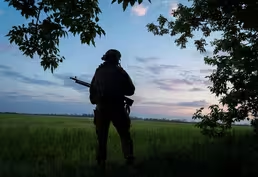
JOHN YANG: Along the Russia-Ukraine border badly stretched Ukrainian forces are struggling to deny Russia a foothold.
The town of Vovchansk just three miles inside the border has seen some of the fiercest fighting since Russia launched its offensive.
That's where John Ray of Independent Television News joined soldiers from Ukraine's 57th Brigade.
JOHN RAY, Independent Television News (voice-over): These are anxious times for Ukraine the specially for the better the 57th Brigade.
The shooting starts the moment we arrive.
It turns out they're hunting a drone that's hunting them.
There's danger from every direction at any time.
OLEG, 57th Brigade: They are striking everything.
Everything they can, they strike.
JOHN RAY (voice-over): Oleg is a new recruit.
And already an exhausted veteran.
OLEG: Everything is very difficult.
Very hard.
JOHN RAY: A lot of rockets a lot of drones.
OLEG: This is drones.
Drones like bees, like everywhere.
Only you hear -- what's frightening it's like rain.
Like rain.
JOHN RAY: Have you had any rest?
OLEG: No.
No.
JOHN RAY (voice-over): Then suddenly, his unit is called back to the action.
These men have been stretched to the limit.
The battlefield is a wasteland of streets by street fighting.
Vovchansk one soldier tells us exists now in name only.
This was a hospital leveled by Ukrainian missiles after Russian soldiers took up positions inside.
JOHN RAY: That is the sound of outgoing artillery.
The Russians have conquered this land once before.
And now Ukraine is having to fight for it a second time.
JOHN RAY (voice-over): Little more than a week ago.
This was a border now it's a battlefield.
The men here have been rushed to this new frontline leaving defenses elsewhere thin.
Deep in his bunker it's a fear shared by their commander.
DYMTRO, 57th Brigade, Ukraine (through translator): Yes, I really worry about that.
There are a lot of Russians, we need more of everything.
The front line was already very long.
Now it's even longer.
JOHN RAY: The Russians have punched a deep hole in Ukraine's defenses and these men are doing their best to fill it.
But they have been fighting almost without a break for more than two years.
And right now it's the Russians who are recovering their strength.
JOHN RAY (voice-over): Lives lost and lives abandoned.
This village has been hit four times.
They're just finished rebuilding the school after the last Russian occupation two years ago.
Now Roman is one of the very few civilians left.
JOHN RAY: They know what Russian rule means.
ROMAN SHVIGAL, Bugaivka Resident (through translator): Yes, yes.
We can see the Russians know how they still (inaudible) everything.
They take everything they can, but they're really shocked.
JOHN RAY (voice-over): They know there are more Russian troops further along this border ready to move along summer of fighting lies ahead.
JOHN YANG: That was John Ray of Independent Television News.
What constitutes sex education and the grade in which it's taught varies greatly in America, and this year is shaping up to set a record for legislative proposals that are mostly aimed at restricting the teaching of the subject in schools.
Ali Rogin has more on the increasingly complicated nature of sex education.
ALI ROGIN: The Centers for Disease Control defines quality sexual education as medically accurate developmentally appropriate culturally relevant content that promotes healthy development but only three states require comprehensive education to be taught in all schools.
17 states provide abstinence only sex education.
And so far this year at least 135 bills pertaining to sexual education have been introduced, or are in place nationally, a majority of which would place restrictions on sexual education in public schools.
That's according to an analysis by the nonprofit organization, Sexuality Information and Education Council of the United States.
Sara Flowers is Vice President of Education at Planned Parenthood Federation of America, a nonprofit organization that provides reproductive and sexual health care and sexual education in the United States and globally.
Dr.
Flowers, thank you so much for being here.
First of all, when we think about comprehensive sex education, what does that look like?
SARA C. FLOWERS, Planned Parenthood Federation of America: Comprehensive sex education means teaching a wide variety of topics in grades K through 12, including topics like consent, understanding what boundaries are and how to decide where your personal boundaries are self-esteem, anti-bullying, healthy relationships, how to stay safe online.
And of course, the things that most people usually think of when they think of sex education, which is like puberty, contraception, and STI prevention.
There's also a wealth of research that shows that kids who get this sort of comprehensive sex education and start in elementary school build on those skills through middle and high school are more likely to foster healthy relationships, have better social emotional skills, respect sexual and gender diversity, and prevent unintended pregnancy and STI transmission when they do become sexually active.
That's education works like building blocks.
So it's incredibly important to start these conversations at home and in school, and to have them early.
And often.
What I mean by building blocks is this.
When we teach math, we start with the basics.
Kids learn to count zero, one, two, three.
Eventually, we move into addition and subtraction.
We don't start with calculus.
So for topic like consent, if you're a small child, you understand that you don't want someone to take your truck without asking.
An elementary school consent covers topics like how to ask before taking a snack from someone else's lunchbox, or how to respect another person's decision not to want to be hugged.
In middle school, learning about consent includes talking about peer pressure, learning assertive communication skills, thinking about your own boundaries, and learning to respect the boundaries of others.
In high school, we talk about consent during sex, we talk about thinking about what we ourselves would like getting clear on our own wants and dislikes and being a good listener making space for a partner to communicate their wants and needs, and being able to say no, and also to respect someone else's.
Now, it also talks about how to continually check in to make sure that everyone feels safe as the relationship evolves.
ALI ROGIN: There's a wide variety of sexual education curricula that really varies based on the state.
And as I mentioned, 17 of them are abstinence only.
But what is behind the varied nature of sexual education state by state?
And what is the effect of having such different regimens available, depending on where you live?
SARA C. FLOWERS: It's really important for parents to understand that in the U.S., there is no law or national program that dictates if sex education is going to be taught in schools and how sex education was going to be taught in schools.
We have a patchwork of sex education laws and policies across the country.
So instead, decisions about sex education are left up to states and school districts.
This means that the quality of sex education including the curriculum who is teaching and whether or not it's medically accurate, as well as whether or not you receive it at all, all of that depends on where you live, and who makes decisions about sex education in your area or school or school districts.
ALI ROGIN: There is a effort happening on the federal level in Congress to pass a bill that would establish grants for comprehensive sexual education.
Is that what you see as a necessary step here?
And how would that potentially change things?
SARA C. FLOWERS: It would absolutely be a necessary step if all young people got the sex education that they deserve, sex education that is comprehensive, inclusive, culturally congruent and age appropriate, then we, as a society have the potential to raise a generation of young people who not only know how to love and take care of their own bodies, but we'd work towards a world where all people including people who are in power making decisions for others.
Everyone would understand the importance of things like respecting bodily autonomy respecting people's differences and the basic understanding of how pregnancy happens and how it works.
ALI ROGIN: Some of these bills that we mentioned would ban discussions around gender identity and sexual orientation.
Some would remove instruction on contraception, and emphasize abstinence.
Some lawmakers who are in favor of these bills would say these are to protect the age appropriate nature of the sex education content that's in the classrooms.
What do you see as the impact of those steps that are limiting the topics that can be discussed?
SARA C. FLOWERS: It's really important to understand that sex education is under attack.
And it is under attack by the same groups that are trying to ban books stop trans youth from being able to play sports or use the bathroom that they need, and the same groups that are trying to ban teaching accurate history.
The bands are all connected, and which tells us that these groups are actually working to exert power and control our kids.
They are not trying to keep kids safe and healthy.
Parents can do something about these bands.
You can start by finding out what's currently taught in your kids school.
And if it's not sufficient, ask for better.
Now we did mention that there are people who live in states and communities where sex education is not permitted to be taught in schools.
In those areas, parents and families can reach out to their local Planned Parenthood to find out if their education department can connect you with sex education programs, sex education can happen on after school programs and on weekends.
It doesn't have to happen in schools.
ALI ROGIN: Sara Flowers, Vice President of Education at Planned Parenthood Federation of America, thank you so much for being here.
SARA C. FLOWERS: Thank you so much for having me.
JOHN YANG: As this year's Asian American Native Hawaiian and Pacific Islander Heritage Month draws to a close, we bring you the story of a pioneering actress considered to be the first major Asian American star despite the limits imposed by Hollywood's racism.
JOHN YANG (voice-over): Before there was Lucy Liu, Awkwafina.
AWKWAFINA: She will make that check.
They do that around here.
JOHN YANG (voice-over): Or Michelle Yeoh.
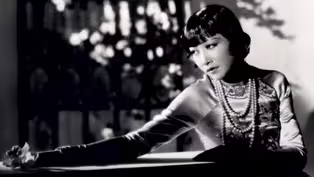
There was Anna May Wong considered Hollywood's first Asian American film star.
She appeared in more than 60 movies beginning of the silent era.
But racism meant that in most of them she played stereotyped supporting roles while white actresses in yellow face got top billing.
It wasn't until she went to Europe in the late 1920s that she was cast as a leading lady starring in British French and German films.
Wong Liu Tsong was born in Los Angeles in 1905, one of seven children of American born owners and operators have a laundry business.
As a teenager she skipped school to go to the movies and to watch scenes being shot on the streets of Chinatown.
She landed a role as an extra and quickly rose through the ranks.
Over her parents objections she dropped out of high school to pursue an acting career.
When she was 17, Wong landed her first major role was in a largely forgotten silent retelling of Puccini's Madame Butterfly called the Toll of the Sea.
That's one of the first films made using an early version of Technicolor.
Her big breakthrough came when Douglas Fairbanks the biggest matinee idol of the day, cast her in the classic swashbuckling film The Thief of Baghdad.
But after that the roles Hollywood gave her were limited to exotic dragon ladies or stereotypically submissive characters.
Off screen, Wong was nothing like those roles.
She was an all American 1920s flapper right down to her signature banks, but on screen limitations led her to abandon Hollywood for Europe where her race didn't matter.
Despite her success overseas, Wong returned home to find that little had changed.
During the planning for the 1937 film version of pearl bucks novel The Good Earth, which is set in China, Wong was mentioned for the lead, but the role went to German actress Louise Reiner who won an Oscar for her performance in Yellow Face.
She left Hollywood for a year-long tour of China, but she found herself criticized there for her stereotype roles rejected in Hollywood for being too Asian she later lamented, and in China for being too American.
She returned to the United States and found modest success in the infancy of television starring as a crime solving art gallery owner in The Gallery of Madame Liu-Tsong, the first show to star an Asian American woman that lasted one season.
She found more work in television but years of heavy drinking had led to poor health.
She was about to appear in the movie version of Rodgers and Hammerstein Flower Drum Song when she died of a heart attack at age 56.
Today, Wong is largely forgotten beyond her image on a quarter and a star on the Hollywood Walk of Fame, both first for an Asian American woman.
But her refusal to accept a career of stereotype supporting roles laid the groundwork for today's Asian American actors and the push for representation in Hollywood films.
JOHN YANG: And that is PBS News Weekend for this Saturday.
I'm John Yang.
For all of my colleagues, thanks for joining us.
See you tomorrow.
Exhausted Ukrainian forces fight to contain Russian advances
Video has Closed Captions
Exhausted Ukrainian forces fight to contain Russian advances on the eastern front (4m 24s)
How George Floyd’s death changed Minneapolis, 4 years later
Video has Closed Captions
What’s changed in Minneapolis four years after George Floyd’s death (6m 12s)
The story of Chinese American movie star Anna May Wong
Video has Closed Captions
The struggles and breakthroughs of Chinese American movie star Anna May Wong (3m 46s)
Why a wave of legislation seeks to restrict sex education
Video has Closed Captions
Sex education ‘is under attack’ by a wave of proposed legislation, advocate warns (7m 26s)
Providing Support for PBS.org
Learn Moreabout PBS online sponsorship
- News and Public Affairs

FRONTLINE is investigative journalism that questions, explains and changes our world.

- News and Public Affairs

Amanpour and Company features conversations with leaders and decision makers.












Support for PBS provided by:
Major corporate funding for the PBS News Hour is provided by BDO, BNSF, Consumer Cellular, American Cruise Lines, and Raymond James. Funding for the PBS NewsHour Weekend is provided by...