
March 12, 2024 - PBS NewsHour full episode
3/12/2024 | 57m 46sVideo has Closed Captions
March 12, 2024 - PBS NewsHour full episode
March 12, 2024 - PBS NewsHour full episode
Problems playing video? | Closed Captioning Feedback
Problems playing video? | Closed Captioning Feedback
Major corporate funding for the PBS News Hour is provided by BDO, BNSF, Consumer Cellular, American Cruise Lines, and Raymond James. Funding for the PBS NewsHour Weekend is provided by...
March 12, 2024 - PBS NewsHour full episode
3/12/2024 | 57m 46sVideo has Closed Captions
March 12, 2024 - PBS NewsHour full episode
Problems playing video? | Closed Captioning Feedback
How to Watch PBS News Hour
PBS News Hour is available to stream on pbs.org and the free PBS App, available on iPhone, Apple TV, Android TV, Android smartphones, Amazon Fire TV, Amazon Fire Tablet, Roku, Samsung Smart TV, and Vizio.
Providing Support for PBS.org
Learn Moreabout PBS online sponsorshipGEOFF BENNETT: Good evening.
I'm Geoff Bennett.
AMNA NAWAZ: And I'm Amna Nawaz in Sasabe, Arizona, on the U.S.-Mexico border.
On the "NewsHour" tonight: A surge in migrant arrivals from around the world strains immigration resources and divides local communities on how to respond.
GEOFF BENNETT: The bipartisan legislation that could force TikTok's Chinese parent company to sell or face a nationwide ban.
And how the illegal trafficking of high-caliber guns from the U.S. is helping fuel the gang violence and political upheaval in Haiti.
(BREAK) GEOFF BENNETT: Welcome to the "NewsHour."
The special counsel who said President Biden's age and memory factored into his decision not to charge the president for his retention of classified documents testified on Capitol Hill today.
As William Brangham reports, Republicans sought answers as to why the president wasn't charged, while former President Donald Trump faces 40 charges for his handling of classified materials and obstructing justice.
REP. JIM JORDAN (R-OH): Joe Biden broke the law.
WILLIAM BRANGHAM: Republicans called special counsel Robert Hur, who in his report released last month said evidence suggested President Biden had willfully retained classified documents at his home and offices, but wrote -- quote - - "We conclude that no charges are warranted in this matter."
ROBERT HUR, Former Department of Justice Special Counsel: What my report reflects is my judgment that, based on the evidence, I would not be able to prove beyond a reasonable doubt to a jury that that intent element had been met.
MAN: Right, but the reason... WILLIAM BRANGHAM: Hur's report said making that case would be difficult because the president - - quote -- "would likely present himself to a jury, as he did during our interview of him, as a sympathetic, well-meaning, elderly man with a poor memory."
ROBERT HUR: My assessment in the report about the relevance of the president's memory was necessary and accurate and fair.
I did not sanitize my explanation, nor did I disparage the president.
REP. JIM JORDAN: He knew the rules, but he broke them for $8 million in a book advance.
WILLIAM BRANGHAM: Republicans criticized Hur for not bringing charges, alleging Biden's deal for an autobiography was why he kept the classified documents.
REP. JIM JORDAN: It wasn't just the money.
It wasn't just $8 million.
It was also his ego.
Pride and money is why he knowingly violated the rules.
WILLIAM BRANGHAM: According to the transcript of the president's five-hour interview with the special counsel last year, Biden at times spoke in great detail about decades-old events, but in other cases struggled to recall dates, like when he left the vice presidency or when his son died.
JOE BIDEN, President of the United States: How in the hell dare he raise that?
WILLIAM BRANGHAM: Democrats accused Hur of partisanship by inserting what they described as inflammatory language about the president's age and memory.
REP. ADAM SCHIFF: You chose a general pejorative reference to the president.
You understood when you made that decision, didn't you, Mr. Hur, that you would ignite a political firestorm with that language, didn't you?
ROBERT HUR: Congressman, politics played no part whatsoever in my investigative steps, my decision, or the words that I put in my report.
REP. ADAM SCHIFF: But you understood nevertheless, didn't you, Mr. Hur -- Mr. Hur, you cannot tell me you're so naive as to think your words would not have created a political firestorm.
You understood that, didn't you?
WILLIAM BRANGHAM: But with the 2024 presidential election looming, partisanship was on full display.
Republicans pointed to a perceived double standard, with Donald Trump facing 40 criminal charges for his handling of classified documents in a case brought by special counsel Jack Smith.
REP. TOM MCCLINTOCK (R-CA): The fact that the only person being prosecuted for this offense happens to be the president's political opponent makes this an unprecedented assault on our democracy.
WILLIAM BRANGHAM: In his report, Hur lays out clear distinctions between the two cases.
While Biden returned the documents and fully cooperated, Mr. Trump -- quote -- "did the opposite" and allegedly obstructed justice.
REP. JERROLD NADLER (D-NY): President Trump was fundamentally incapable of taking advantage of even one of the many, many chances he was given to avoid those charges.
WILLIAM BRANGHAM: Trump's trial is currently scheduled to begin in May, but his attorneys will argue later this week for a delay.
For the "PBS NewsHour," I'm William Brangham.
GEOFF BENNETT: In the day's other headlines: President Biden and former President Trump are set to clinch their party's nominations in the latest batch of primaries.
Voters in Georgia cast ballots today, and both parties also held primaries in Mississippi and Washington state.
Hawaii held its GOP caucus.
President Biden needs 96 delegates to claim the Democratic nomination.
Mr. Trump needs 137 on the Republican side.
Inflation isn't going away just yet.
In fact, it inched higher in February.
The Labor Department reports prices were up four-tenth of a percent last month, slightly more than analysts expected.
That's a 3.2 percent rise on a year-over-year basis, again, more than expected.
The increase was driven by higher gas prices and housing costs.
The Biden administration announced today it's found 300 million more dollars to pay for new weapons for Ukraine.
That's after House Republicans had blocked President Biden's request for $60 billion since December.
White House officials said the money comes from cost savings at the Pentagon, but it's a temporary fix, at best.
JAKE SULLIVAN, U.S. National Security Adviser: This ammunition will keep Ukraine's guns firing for a period, but only a short period.
It is nowhere near enough to meet Ukraine's battlefield needs, and it will not prevent Ukraine from running out of ammunition in the weeks to come.
GEOFF BENNETT: The arms package will include anti-aircraft munitions, artillery, and small-arms ammunition and anti-armor systems.
Shortly after the announcement, President Biden met with Poland's president and prime minister at the White House.
He said the new aid is not enough, and he called on Congress again to act.
Colorado Congressman Ken Buck made it official today.
He's resigning his office next week.
His departure leaves Republicans with 218 seats to 213 for Democrats.
That's a working majority of just two votes.
Buck belongs to the hard right Freedom Caucus, but he's criticized efforts to impeach President Biden.
An aid ship carrying 200 tons of food is on its way to Gaza tonight.
It's meant to open a sea corridor that could feed hundreds of thousands of Palestinians.
The ship set sail from Cyprus and is expected to arrive off Northern Gaza in a few days.
The Spanish aid group Open Arms arranged the transport.
LAURA LANUZA, Spokesperson, Open Arms: We don't know when the next boat will depart, but, hopefully, if this first mission goes OK, there will be others coming.
And, hopefully, there will be other boats and there will be other entities or maybe European Union or other states joining this corridor.
GEOFF BENNETT: Meantime, Israel and the Lebanese group Hezbollah had one of their heaviest cross-border exchanges yet.
Israeli airstrikes hit military sites in Lebanon's Beqaa Valley overnight, killing one person, and Hezbollah fired more than 100 rockets into Northern Israel.
Later, new Israeli strikes killed two more people.
Back in this country, Boeing says it's adding extra inspections and audits in the production of its 737 planes to address quality problems.
The company's president announced it today to employees.
It comes amid reports that the FAA identified dozens of issues with 737 MAX jets after a door panel flew off one of the planes back in January.
And on Wall Street, big tech stocks led a rally as traders shrugged off the news that inflation in February was worse than expected.
The Dow Jones industrial average gained 235 points to close at 39005.
The Nasdaq rose 246 points.
The S&P 500 added 57.
Still to come on the "NewsHour": why violent crime rates in most American cities are trending down, but Americans still think it's on the rise; a former White House lawyer starts over by forging a new musical path; and the U.S. surgeon general discusses teen mental health with our Student Reporting Labs.
Migrant crossings on the Arizona-Mexico border have remained high this year.
It's where people from all over the world come to enter the U.S. Amna Nawaz joins us now from Pima County.
Amna, what's the situation the Arizona border, where you are?
AMNA NAWAZ: You know, Geoff, it's interesting.
For all the focus on Texas when it comes to our immigration conversations, it's actually been Arizona that's had one of the busiest border sections across the country so far this year.
Along just this 262 miles of border that's stretched in what's known as the Tucson Sector that we're in right now, Border Patrol here logged some 50,000 apprehensions last year.
That is up from what they have seen previously as well.
And that's, of course, when we say apprehensions, people crossing without authorization between ports of entry.
Just last week, in fact, the sector said they logged some 17,000 apprehensions.
That's more than 1,700 a day.
Now, the numbers across the entire stretch of the southern border are down slightly from those record highs we were reporting on at the end of last year.
But it's worth noting that even those numbers are still nearly double what they saw about a year ago.
We're also seeing geographic shifts from hearing from officials and sources here, meaning there are more migrants trying to make more remote and therefore more dangerous crossings.
That further stretches resources here, because the U.S. Border Patrol has to deploy more people further afield and often carry out rescue operations to bring those migrants in safely -- Geoff.
GEOFF BENNETT: And you reported yesterday on how diverse the migrant population is in Southern Mexico.
You spoke to people from all over the world.
Is the same true along the U.S. border, the southern U.S. border?
AMNA NAWAZ: Geoff, I have to tell you never in my life did I think all my language skills would come to play on the U.S. southern border in this way.
In just the last hour or so, we have been driving around maybe a two-mile stretch of border.
I have met people from Bangladesh, from Guinea, from Mauritania, from Guatemala, from Ecuador, from Nepal, from Mali.
Because I'm able to communicate with them both in Urdu and in French, I was able to get some details.
Many of them share horrifying travels of over weeks or months at a time.
They have arrived here with nothing but the shirts on their back.
All of them share stories about being robbed and assaulted along the way.
They say Mexican officials in particular took their money, in some cases, took their passports and phones, and they all want to know, what happens next?
Where can we go?
Well, one of the people here to answer those questions is a man named Pastor Randy Mayer.
He is with the Good Shepherd United Church of Christ.
It's about 90 minutes away from here.
He brought us out here because he comes here regularly.
Once a week or so, he brings out water.
He brings out food.
He drives this stretch of the border, interacts with the migrants who've arrived and lets them know that Border Patrol is here, they will be able to help them, and then tries to communicate with Border Patrol to come pick people up.
But he's also shared he's seeing larger and larger groups, yesterday alone groups of 150 or 200 people.
It stretches Border Patrol's resources.
It stretches his.
It's also stretching the local officials in Pima County -- Geoff.
GEOFF BENNETT: And, Amna, this all reflects shifts and increases we have been seeing for months now.
Is this, based on your reporting, indicative of what's ahead?
AMNA NAWAZ: You know, what's interesting is Pastor Mayer said that it wasn't until the last few months they started seeing people from this many countries arriving here in Arizona.
That is definitely new.
And the numbers, as we have seen and have been reporting, have been increasing dramatically.
That is certainly new.
The big question is whether this is a blip or whether this is indicative of what's to come.
What we do know is that, despite the drop we have seen over the last couple of months, we're starting to see that tick back up.
Spring is ahead.
Seasonally, that is when numbers also start to go up.
The most worrying thing for people here that we talk to is that the resources to match those needs and support those migrants has also not gone up.
So there's concern ahead about how to meet what is clearly a growing need without the resources to help them -- Geoff.
GEOFF BENNETT: Amna Nawaz in Pima County, Arizona, tonight along the U.S.-Mexico border.
Amna, thanks, as always.
Great to see you.
AMNA NAWAZ: Thanks, Geoff.
GEOFF BENNETT: TikTok is once again in the crosshairs of Congress, as the House of Representatives weighs a bill that would either require it to divest from its Chinese owner or face a ban nationwide.
Congressional correspondent Lisa Desjardins takes a deeper look at the brewing battle over the nation's fastest growing social media platform.
WOMAN: Hey, we're going to call United States Congress.
LISA DESJARDINS: A young medium using an old method.
WOMAN: Hi.
I heard that you're trying to shut down TikTok.
LISA DESJARDINS: TikTokers have besieged Congress with calls... MAN: This is just a request for her to vote no.
LISA DESJARDINS: ... on a sweeping bill that suddenly is on the fast track, unanimous in committee last week.
WOMAN: There were 50 ayes and zero no's.
REP. CATHY MCMORRIS RODGERS (R-WA): The bill is adopted.
LISA DESJARDINS: The bill would force TikTok's Chinese parent company to either sell it or face a U.S. ban.
Today's closed-door briefing about TikTok produced strong sentiment.
REP. CHIP ROY (R-TX): You have got a privately held company that is heavily owned by the Chinese Communist Party, so that's a problem.
REP. NANCY PELOSI (D-CA): We want to make it something that is a -- not a fearful social media platform, but one that is very positive.
And in order to do that, we have to see the divesting of it from the Chinese government.
LISA DESJARDINS: Here's the crux of the debate.
TikTok's U.S. headquarters is in California, but it is controlled by a larger company, ByteDance, headquartered in Beijing.
ByteDance also owns a separate but parallel Chinese version of TikTok called Douyin.
The Communist Party has a small stake in that, and a big voice, with a Communist Party official sitting on the board.
A ByteDance whistle-blower has charged that the Communist Party uses Douyin for spying on protesters and others.
The concern is that there's a path for the Communist Party to access U.S. data.
TikTok claims, no, that it has walled off U.S. data.
Adding to this turbulence is another force, former President Donald Trump, who's been up and down, but mostly does not like a TikTok ban.
DONALD TRUMP, Former President of the United States (R) and Current U.S. Presidential Candidate: There's a lot of good and there's a lot of bad with TikTok.
But the thing I don't like is that, without TikTok, you are going to make Facebook bigger.
MAN: Just put it in my little ring mount and hit record.
LISA DESJARDINS: Caught in the crosswinds are TikTok creators like renovator Alex D'Alessio, who first spoke to "NewsHour" last year.
ALEX D'ALESSIO, TikTok Creator: I just wish they would try and exhaust all other options prior to potentially canceling it.
LISA DESJARDINS: We asked him what he thinks of this latest bill and what it would mean for him.
ALEX D'ALESSIO: It's just frustrating that the people voting on this bill are not the people that are using this app or really understand what it means to us.
I'm currently -- like, behind me is our new fixer-upper, which we just bought with the money I have been earning from my business, which is from TikTok.
And we have a baby on the way, a month away, our first baby, which we're super excited for.
So I'm quite literally supporting my family, all of my business that is surrounded around this app.
LISA DESJARDINS: President Biden has said he would sign the bill, but its fate in the Senate is unclear.
And, of course, before any of that, it must pass the House, which is possible tomorrow.
To discuss are the House sponsors, Congressman Mike Gallagher and Raja Krishnamoorthi, chair and ranking member, respectively of the Select Committee on the Chinese Communist Party.
Let me ask right at the top, what is the danger of TikTok that you see?
REP. MIKE GALLAGHER (R-WI): The fundamental danger is that TikTok is owned by ByteDance, and ByteDance is beholden to the Chinese Communist Party.
So, from this flow two concerns, one being the security of Americans' data on the platform, but the other, and I think broader concern, is the potential for this platform to be used for the propaganda purposes of the Chinese Communist Party.
And, there, we got a preview of what could happen in that scenario last week, when TikTok pushed a push notification to all its users, asking them for their zip code, and then having them call members of Congress.
It was based on a completely inaccurate message to their users, and you had teenagers calling Congress, saying, if you ban TikTok, I will kill myself.
Imagine what could happen the closer we get to an election.
The unclassified director of national intelligence assessment released yesterday said, TikTok is already being used to target members of Congress in both parties politically.
LISA DESJARDINS: I know both of you probably forgot those phone calls, including today.
And I know this is a carefully targeted bill, but, still, today, we saw on the Hill TikTok creators and other members of Congress speaking out, saying they think that this is a violation of basic rights.
I wonder how you approach the First Amendment issues.
Do you understand the First Amendment issues at play, the business issues at play, and why is this worth it?
REP. RAJA KRISHNAMOORTHI (D-IL): Sure.
Well, first of all, there's no First Amendment right to espionage.
There's no First Amendment right to harm our national security.
Basically, we commonly have foreign ownership laws with regard to broadcast outlets, telecoms, railroads, banks, and so forth.
So this is not unusual.
What we're saying is that an establishment such as Tik -- this platform can basically engage in free speech as it is.
We are not trying to ban the content or trying to discriminate between one type of speech versus another.
What we're concerned about is the conduct of the platform and being used in the ways that Mike alluded to, for instance, weaponizing data against people, endangering our national security in other ways, interfering in our elections, basically doing the things that go against our national security.
So we want this platform to continue to operate.
We don't want to ban it, but we are calling for a divestment of TikTok by ByteDance, so that we can continue to have this platform operate but without the control of the CCP.
LISA DESJARDINS: But, realistically, Congressman Gallagher, wouldn't a possible effect be the loss of this content and the banning of this platform?
REP. MIKE GALLAGHER: It doesn't need to be.
The TikTok user experience can continue and even improve as long as ByteDance decides to sell TikTok.
That is the obvious solution that everybody wants.
Even those who are invested in ByteDance should want that outcome, because if TikTok is ever going to go public in an American market, it's simply not going to happen under the current ownership structure.
And I would say the greatest threat to expression on TikTok, which this bill doesn't say anything about, is continued CCP manipulation of the algorithm and the lack of transparency surrounding TikTok's algorithm.
So if you want the platform to continue and improve going forward, the only solution, the most responsible and prudent solution is a separation.
LISA DESJARDINS: There was a Montana ban against TikTok, which was struck down.
And that's not what you -- I know it's not a ban that you have in the same way.
But the judge took on some of your arguments in that case.
The judge did not see a national security argument there, also felt that users are agreeing to give out their data.
So I wonder how you respond to that idea from TikTok and ByteDance that there really isn't proof that they have maliciously harmed U.S. citizens?
REP. RAJA KRISHNAMOORTHI: Well, first of all, in that particular Montana case, the judge basically said that Montana was not in a position to judge the national security interests of the country.
In this case, the Biden administration is actually asking for this legislation.
The Biden administration actually helped to fashion the legislation and is able to assert its authority in a way that the Montana legislature was not.
The other thing I would just say is, again, what we know that TikTok has said about its own platform is untrue.
TikTok said that its user data, American user data, is stored here in America or Singapore.
That's false.
Some of the data has been stored on PRC servers in China.
Secondly, TikTok says that its data is not accessible to people in China.
Again, false.
Published reports show that Chinese-based ByteDance employees have routinely accessed this data, unbeknownst to American users.
And then, third, TikTok says this data has not been weaponized in any way.
Again, false.
Published reports, including by journalists who were targeted by TikTok for reporting on these data access issues, have repeatedly said that their user location data was used against them.
And so we can't abide a situation where the company that says that it's not doing X, Y, and Z is actually doing it and then just look away, pretending there's no national security concern.
LISA DESJARDINS: In the last-minute or so we have here, you have both seen classified information about this situation that most Americans don't have access to.
But I wonder, considering that, what do you say to kids, perhaps Congressman Krishnamoorthi, your kids, who are TikTok age, about whether they should be using it and to those content providers about why you're making this pretty profound move by the U.S. government?
REP. RAJA KRISHNAMOORTHI: Well, Mike has kids too.
They're a little younger, but I have got an 18, 14, and 7, so I'm ready for anything in Congress.
But, in all seriousness, my kids don't use it, although they have talked to me about it in the past, because of the issues that I alluded to before.
I will just say -- and Mike and I have mentioned this before -- the content that you see on TikTok in the United States is so different than the content that you see on Douyin, which is the TikTok equivalent in China.
In China, it's -- they promote content about healthy living, about STEM education, about calisthenics and exercise, even for young adults.
Here in the United States, it's about drug paraphernalia, oversexualization of teenagers, and it's constant content about suicidal ideation.
That's wrong.
We can't have that situation where the algorithm is manipulated in that way.
With regard to legitimate content providers and others, we want you to be able to continue doing what you're doing.
We just don't want to have this platform that's controlled by the CCP.
I expect that, just as before, when we required the Chinese to divest Grindr, which was then controlled by a Chinese company, they quickly did it.
There was no disruption of service to the users.
And that's what we will see with TikTok as well.
REP. MIKE GALLAGHER: And my message to my 3.5-year-old and 1.5-old is that they should do whatever Raja's kids are doing, because I have met them.
They're extremely smart, and I want my kids to grow up and be as responsible and smart as Raja's kids.
So I have outsourced my parents -- my parenting to Raja in this case.
REP. RAJA KRISHNAMOORTHI: I approve that message.
LISA DESJARDINS: Well, we appreciate both of you talking to us.
And I'm sure your kids will be watching this on the show tonight.
REP. RAJA KRISHNAMOORTHI: Thank you.
LISA DESJARDINS: Congressman Mike Gallagher and Raja Krishnamoorthi.
GEOFF BENNETT: Months of chaos and raging gang violence came to a head today in Haiti.
The prime minister, stranded in Puerto Rico and unable to return to his nation, announced late last night that he would resign as soon as a transitional government is in place and a new leader chosen.
Meantime, Kenya reportedly delayed the deployment of a police force to Haiti under a U.N. flag pending the selection of that new government.
That force would help bolster depleted and beaten Haitian security services that have been fighting heavily armed gangs for years.
But that violence has recently been made worse by an influx of more and more powerful weapons.
And, as special correspondent Marcia Biggs tells us, the weapons fueling the violence mostly come from the U.S. MARCIA BIGGS: This is where the majority of weapons in Haiti come from, Miami, Florida, but not from the giant containers leaving the Port of Miami, but from this five-mile stretch up the Miami River, where officials say they're nearly impossible to find.
We went to one of several small shipping terminals along the Miami River, which specialize in what's called breakbulk cargo.
There, we met Anthony Salisbury, the special agent in charge of homeland security investigations in Miami.
ANTHONY SALISBURY, Homeland Security Investigations, Miami: When you go to a major modernized port like the Port of Miami, you're going to see containers stacked up, very modernized, giant cranes loading them onto cargo ships, lots of access control, lots of security, formalized paperwork, declarations.
What you have here is a bunch of loosely packed goods, very informal shipping mechanism, very informal on who it's going to, what the commodity is, and how much of it is going down.
MARCIA BIGGS: Hard to police.
ANTHONY SALISBURY: Very hard to police.
MARCIA BIGGS: Wow.
This is a typical warehouse filled with packages all bound for Haiti.
ANTHONY SALISBURY: The Department of Homeland Security has some of the best interdictors in the world and the best inspectors in the world, right?
But this is daunting.
There's no way anybody can do all this.
This is one warehouse on this river.
MARCIA BIGGS: Packages are already sealed and, according to Salisbury, lacking proper documentation, since anything claimed to be worth less than $2,500 doesn't have to be declared.
ANTHONY SALISBURY: Usually a paper manifest, handwritten, you know?
MARCIA BIGGS: Right, so very bare-bones.
ANTHONY SALISBURY: And if -- potentially, if somebody didn't want that to make a manifest, very easy to make that happen.
MARCIA BIGGS: Just last year, Homeland Security announced a crackdown after Haiti's customs agency found a shipment of arms in a container labeled as church donations.
But this breakbulk cargo can only be searched one by one with mobile X-ray units.
Salisbury says it could take a month just to go through this warehouse.
ANTHONY SALISBURY: We'd have to break apart these pallets, hand-load them through the X-ray things.
MARCIA BIGGS: You would have to break apart this pallet in order to X-ray it?
ANTHONY SALISBURY: Yes, one pallet.
MARCIA BIGGS: Oh, wow.
In addition to bags of food, we saw batteries, construction equipment, even entire cars.
But, mostly, we saw sealed-up drums and cardboard boxes, packages sent by Haitian Americans to families back in Haiti, where poverty and hunger are rampant.
ANTHONY SALISBURY: There is a humanitarian need knowing what the people of Haiti are dealing with right now.
And the Department of Homeland Security has to balance that on the whole.
How do we balance inspection and enforcement, while not unnecessarily slowing down the flow of commerce?
But can you hide guns on that?
Sure.
MARCIA BIGGS: A recent U.N. report states that the principal source of guns in Haiti is Florida, guns bought through individual or straw man purchases in U.S. states where gun laws are lax.
Handguns sold at Florida gun shows for $400 to $500 draw as much as 20 times more in Haiti.
Are you seeing any sort of thread among these straw purchasers?
Is there any indication that there may be some sort of organized, centralized structure that is leading this?
ANTHONY SALISBURY: Yes, absolutely.
Our entire goal is always to look for the network behind the individual gun, the individual kilo, whatever it is.
That's what HSI's goal is, is to identify the entire criminal network surrounding that illicit movement.
We have increased our partnerships with our international operations and our foreign partner counterparts, where these weapons are heading.
MARCIA BIGGS: While law enforcement officials are focused on gun trafficking along the Miami River, members of Congress are focused on new legislation to determine who's actually buying those guns.
REP. SHEILA CHERFILUS-MCCORMICK (D-FL): When it comes to Haiti, we know gangs, the gang members, if you look at them, some of them aren't wearing shoes.
Their clothes are ripped.
They have blood from the day before.
These aren't people who can afford to do this.
These people are actually hired.
They are trained.
They're given guns, and they're carrying out a mission.
The real question is, what is the mission?
Who is benefiting from instability?
MARCIA BIGGS: Before this latest round of violence, we sat down with Florida Democratic Congresswoman and Haitian-American Sheila Cherfilus-McCormick.
She's co-sponsored the Haiti Criminal Collusion Transparency Act, now on its way to the Senate.
It requires the State Department to present annual reports to Congress on ties between criminal gangs and political and economic elites in Haiti, information it doesn't routinely share.
REP. SHEILA CHERFILUS-MCCORMICK: The State Department would have to report to the public any actors who participated either funding the gangs contributing to the gang, sending guns, so we can all know who these people are and be able to levy sanctions against them.
MARCIA BIGGS: In addition to sanctions, last year, the U.N. authorized a multinational security support mission in Haiti to be led by Kenyan forces with funding from the U.S. After a deal was finally reached last week to send 1,000 police officers, today, Kenya put a hold on the deal until a new government is formed.
And back in the U.S., Congress has only released a small portion of the funding.
Yesterday, in light of the recent violence, Cherfilus-McCormick reiterated support for the mission.
REP. SHEILA CHERFILUS-MCCORMICK: Every day that we are waiting on appropriate funding, every moment that we're waiting on this mission is every single day that we are actively losing lives of Haitian people and Americans who are in Haiti.
MARCIA BIGGS: But the mission has raised eyebrows among those familiar with Haiti's history and dark legacy of foreign intervention.
The U.S. led a brutal occupation of Haiti in 1915 that lasted for almost two decades.
And, in 2010, U.N. peacekeepers brought cholera to the country, which killed almost 10,000 people and remains an epidemic to this day.
Cherfilus-McCormick is the only Haitian-American member of Congress, and her district has one of the highest Haitian-American populations in the country.
For her, this is personal.
REP. SHEILA CHERFILUS-MCCORMICK: We have to stop the torture.
We have to stop kids from being recruited every single day.
This is why I got elected.
The reason why the Haitian people came together and said we need to have a Haitian-American in Congress is for this time and this moment for me to speak against people who are saying, no, don't intervene, let Haitians die.
MARCIA BIGGS: A major lifeline has been the humanitarian parole program, which allows vetted Haitians to legally live and work in the U.S. for two years.
It's come under attack by Republicans who last month blocked a bipartisan border security bill.
REP. SHEILA CHERFILUS-MCCORMICK: There are no visas coming out of Haiti.
The only way out of Haiti right now is the parole program.
If you remove the parole program, that is a death sentence for every Haitian living in Haiti, eight million people we will condemn to a death sentence because you cannot leave.
The only way you would get out is on the boats when you come to my borders in Miami.
And I have gone to the detention centers.
I look them in their eyes.
I have seen their pain, or I have seen them at the border.
So how do we tell them no?
I'm sorry.
MARCIA BIGGS: While violence rages and humanitarian disaster looms, a pipeline to Haiti is vital for so many in need.
But it's also a perfect way for gun smugglers to move the weapons that keep the conflict going.
So this is where all those items that we just saw are going to end up, on a cargo hold on its way to Haiti.
You can see how impossible it would be to investigate all these items.
Any one of them could be filled with guns.
PHILOME CHARLES, God is Able Shipping: If you have a gun, weapon inside, $1 million, U.S. dollar, and you got 20 years in jail.
MARCIA BIGGS: But shipper Philome Charles says his company, God Is Able Shipping, has been sending packages to Haiti for the last decade.
And his customers know not to send weapons.
PHILOME CHARLES: If you have a gun to send it to Haiti, keep it for yourself, no God Is Able.
MARCIA BIGGS: While agents do make random inspections, often with mobile X-rays, Charles says they have never found anything.
He says it's because he documents every package that comes in, and he trusts his system.
So it looks very informal to us, to our eye, but what you're telling me is that you have information on each and every package, you know who is sending what?
PHILOME CHARLES: Yes.
You're the customer.
You bring the boxes to send it to Haiti for your family.
First, I'm going to ask you your driver license, and, second, your passport with a U.S. visa, how you come into the United States.
If you do find something, we already know who bring it to me.
ANTHONY SALISBURY: Well, like I said, relationships with you guys are important.
MARCIA BIGGS: Originally Haitian, Charles has lived in the U.S. for 38 years.
And he says he has an allegiance to both countries.
PHILOME CHARLES: I have to protect both my business, United States and Haiti, my reputation.
So far, I'm happy.
So far, I'm -- sleep good.
MARCIA BIGGS: But do you worry about those stories giving people like yourself a bad name?
PHILOME CHARLES: We make sure we (INAUDIBLE) every piece of paper for each customer.
Every mistake they have in the paper, we're not going to send nothing for you.
MARCIA BIGGS: Yet, somehow, guns make it through.
Whether it's the flow of weapons or the power of the gangs who wield them, shutting down either seems next to impossible.
And it is the Haitians who suffer.
For the "PBS NewsHour," I'm Marcia Biggs in Miami, Florida.
GEOFF BENNETT: There's been a good deal of attention recently on violent crimes in the U.S., especially in many big cities and metro areas.
But data suggests the reality may be different from the past few years and different than the perception of how safe many people feel in their communities.
Stephanie Sy has our update.
STEPHANIE SY: Geoff, several headlines recently have put a spotlight on murders and violent crime.
That includes the death of Laken Riley, a 22-year-old nursing student in Georgia who was allegedly killed by a Venezuelan immigrant who entered the U.S. illegally.
Her murder was front and center during last week's State of the Union.
And, in New York, Governor Kathy Hochul recently began deploying the National Guard to patrol the New York City subway.
Homicides did surge in a number of places, including rural areas, during the pandemic.
But recent data points to an overall drop in killings from 2022 to 2023.
For a closer look at what the data tells us about crime in the U.S., I'm joined by Jeff Asher, a crime analyst and co-founder of AH Datalytics.
Jeff, thank you so much for joining the "NewsHour."
I realize that every city has a different level of crime, but is it possible to make a broad assessment of where violent crime is overall right now, compared to, say, five years ago?
And I'm not just talking about homicides, but also crimes like rape, assaults and carjacking.
JEFF ASHER, Crime Analyst: So, it's a lot easier to do with homicide and murder than it is for other violent crimes.
For the most part, violent crime has been largely steady for the last 10 to 15 or so years.
It's something that, in the pandemic, violent crime kind of fell.
It rose a little bit and fell a little bit, because a lot of violent crime is reliant on people being out and about.
And so, if people aren't out and walking around, it's harder to do random robberies.
You see things like aggravated assaults fall.
Murder makes up about 0.2 percent of all major crimes, as counted by the FBI, and has a -- is a completely different set of rules behind it.
It has a much easier time of tracking it, and agencies report it a lot more often.
So we're able to see, with a lot more confidence, that murder surged enormously in 2020, seems to have stayed about that level, maybe rose a little bit in 2021, and then fell in 2022.
And all of the data that we have available to us shows that there was a sizable decline in 2023.
STEPHANIE SY: Can you say in which places violent crime or murders has not dropped and maybe even gotten worse?
JEFF ASHER: So there are certainly outliers.
Any time you're going to have 75 or 80 percent of the nation's big cities go one way, there's going to be 15 to 20 percent of the nation's big cities going the other way.
And, certainly, places like Washington, D.C., Memphis, even Seattle have seen large increases in murder, and haven't necessarily seen the decreases, although, in 2024, especially in D.C., the early evidence suggests that we may be in for a decline in 2024, though it's too early in the year to say quite for sure, with respect to D.C., at least.
STEPHANIE SY: With what you're saying, it doesn't sound like most places are going through a violent crime wave.
What about nonviolent crimes, for example, car thefts, which are reportedly surging in San Francisco and other property crimes?
JEFF ASHER: So, nationally, the long-term trend has been sharply declining property crime for most of the last 25 or 30 years.
That continued and accelerated through the pandemic.
Again, if nobody's shopping, nobody's going to be shoplifting.
In 2022, there was a bit of a rebound.
And then, in 2023, there was a -- probably, overall, property crime fell, but auto theft surged.
And you saw this because of posts on TikTok that showed certain models of certain cars are easier to steal and showed people essentially how to steal them, led to these enormous surges in auto thefts in a lot of cities.
Not everywhere.
It seems like it was more of a big city issue than small town or rural county.
But you saw places that had just kind of overnight doubling of auto thefts or tripling of auto thefts.
And it's very rare for a crime trend, one, to have such an obvious cause and, two, to just have a switch turn on and to see this enormous increase in or decrease in that type of crime.
STEPHANIE SY: Jeff, a Gallup poll from late last year shows 63 percent of adults see the U.S. crime problem as very or extremely serious.
So, broadly speaking, do you see a disconnect between how people perceive crime levels and what you found in the data?
JEFF ASHER: So, I would never say that people should not be concerned or find the number of crimes, the level of crime necessarily to not be troubling or something that we shouldn't be striving to decrease.
I think, with that Gallup poll, what's more concerning to me is that 77 percent of Americans think that crime rose in the last year.
And all of the evidence that we have show that murder declined, and declined significantly, possibly the largest one-year decline ever.
The preliminary data shows that violent crime and property crime likely fell.
And so I think the real issue here is that we have created a situation where people either think crime is on the rise because the data shows it, or crime is on the rise, but the data must be wrong, the data that's showing it's declining.
And so I think that if we want to have effective policy solutions and effective response to crime, we have to be in a position to acknowledge when it's going down.
And I think that that requires people to have some level of trust and understanding in the data and be willing to approach the question honestly, because all we want to -- we all want to see crime and gun violence declining nationally.
It's a question of, what does the data show and how can we continue those trends?
STEPHANIE SY: Jeff Asher with AH Datalytics, thanks for joining the "NewsHour."
JEFF ASHER: Thanks for having me.
GEOFF BENNETT: Second act, it's a common phrase that for some people means loving your first career, but wanting to pursue something else in a new chapter.
Special correspondent Mike Cerre looks at how one seasoned lawyer is now forging a musical path for our arts and culture series, Canvas.
PAULA BOGGS, Singer: Good evening.
everyone.
We are Paula Boggs Band out of Seattle, Washington.
And we're about to serve up some Seattle-brewed soul grass.
MIKE CERRE: Paula Boggs' mix of bluegrass, folk, gospel and jazz, the diversity for many life experiences before starting a new career in her late 50s as a singer-songwriter.
PAULA BOGGS: My life is not a straight line, and often in my life journey, things have come at me from left field, and that has been the impetus for whatever came next.
MIKE CERRE: She learned to sing and play guitar in church choirs while growing up in Virginia and Europe, but had to put her music ambitions on hold when she joined the Army to pay for law school.
That led to her first career in government as a White House staff attorney, a federal prosecutor and adviser to four presidents.
After another major career change to corporate America, she eventually became Starbucks' chief counsel.
HOWARD SCHULTZ, Former CEO, Starbucks: One of our most beloved leaders, Paula Boggs, has decided to retire.
MIKE CERRE: A family tragedy prompted her to leave Starbucks and the law at the height of her career to get back to her music as a way to grieve and to reset her priorities.
PAULA BOGGS: It was a way to try to feel better about something very painful.
Not long after my sister-in-law's death, I came to know about a one-year songwriting course offered by the University of Washington.
And so, for a year, while still Starbucks' general counsel, I took this course.
And, once a week, for three hours, I was part of the community of songwriters.
MIKE CERRE: What's it like being at the top of one profession, in your case, the law, corporate law, to start at the bottom, virtually, with recording, touring, songwriting?
PAULA BOGGS: It's humbling.
It's really, really humbling.
The good thing for me, though, is, this is not the first time I have been thrown into something where I was a rookie.
MIKE CERRE: She started her band in Seattle, which included another lawyer, and had to learn how to arrange and self-record her music compositions with different variations of the band.
The corporate jets and limos of her business where are long gone.
When she tours with the band now, mostly on the West Coast and mostly at small clubs to middle-aged audiences her band is cultivating through public radio stations' airplay and music streaming channels.
PAULA BOGGS: The bias in music is, it's a young person's thing.
So there is suspicion or doubt or whatever when someone like me is clawing to try to make a name for herself.
The music I write, we make isn't going to be everybody's tea.
What I own is for us to be the best at what we do, and whether the audience is one or two or many more than that.
MIKE CERRE: Some of her music addresses issues she thinks the country should be more concerned about, like racial disparities, especially for young Black men.
She believes the richness of her personal history and life experiences, which all songwriters ultimately rely on, can compensate for her late start in the business.
PAULA BOGGS: Whoever receives your music, it becomes theirs.
And whatever story they want to build around this song, they can do that.
The inspiration for a new song and how that unfolds, all of those things are part of this experience.
MIKE CERRE: You have had such success in all your other careers.
What are the metrics for success now as a singer-songwriter starting out a little bit late in life?
PAULA BOGGS: Oh, news flash, I will never be Beyonce, right?
But there's also the measure of, how are you doing compared with how you were doing last year?
MIKE CERRE: Their latest album is probably called "Janus," named after the Greek god for beginnings and endings, which pretty much sums up Paula Boggs' very diverse professional career and her constant search for more meaning in her work.
PAULA BOGGS: I'm not here to tell you I have figured it out.
I'm here to tell you and share with you some of those milestones in my life that have led to what I hope is a more authentic life.
MIKE CERRE: Is the real Paula Boggs now standing on stage?
PAULA BOGGS: Absolutely, and in technicolor.
(LAUGHTER) (MUSIC) (CHEERING AND APPLAUSE) PAULA BOGGS: Thank you.
MIKE CERRE: For the "PBS NewsHour," I'm Mike Cerre in Mill Valley, California.
GEOFF BENNETT: Teen mental health is one of the U.S. surgeon general's top priorities.
Our Student Reporting Labs "On Our Minds" podcast from our teenage hosts Bree and James talked recently with the surgeon general, Dr. Vivek Murthy, about his mental health as a teenager, tips for combating loneliness and isolation, and how to create tech-free zones to limit time on social media.
JAMES KIM: Hi, Dr. Murthy.
Thank you so much for speaking with us today.
DR. VIVEK MURTHY, U.S.
Surgeon General: Oh, I'm so glad to be with you, James and Bree, excited for having this conversation.
BREE CAMPBELL: One of your top priorities for our country is youth mental health.
Most of us struggle in some way, but what did you struggle with when you were our age?
And did you ever ask for help?
DR. VIVEK MURTHY: I struggled a lot as a teenager, but I don't think a lot of people knew that.
I put a lot of pressure on myself to sort of excel in certain sort of areas of academia, in terms of schoolwork and stuff like that.
And I think it's probably safe to say that, in some places, my standards were unreasonable.
I was also struggling a lot with loneliness as a kid.
I was really shy and I was very introverted.
I actually really wanted to hang out with other kids, but it took me longer to make friends.
To your question, Bree, I didn't talk to people about it, because I was ashamed.
And also I just -- it wasn't something I heard other people talking about either.
So I kept it all bottled up inside.
And I can tell you from experience that that was not a good strategy.
BREE CAMPBELL: Social media sometimes connects us, but oftentimes doesn't feel deep, and it could also sometimes be harmful.
So how can teenagers best use social media?
DR. VIVEK MURTHY: I don't even met a single person who's figured it all out with social media.
Like -- and I don't think people are having these struggles because somehow your generation is deficient in willpower.
I don't think that's what's going on.
I think you have just as much willpower and strength as prior generations.
But I think what's different is the technology that you're surrounded by.
There are large numbers of adolescents who say that they are being bullied and harassed.
Six in 10 adolescent girls are being approached by strangers on social media in ways that make them feel uncomfortable.
I got bullied at times when I was in middle school, but maybe once every now and -- not at the volume and the severity the kids are experiencing online now.
So that's really concerning.
The third thing that I will mention that concerns me is, what is being displaced by social media?
Like, what's -- what are you not doing because you're spending a lot of time on social media?
That's sort of the question, right?
BREE CAMPBELL: I was always on social media, to the point where I needed a detox.
It was like the algorithms and the likes and just my own time management kind of just like drew me in more and more.
JAMES KIM: I found that a really good solution for me in tackling that was like keeping my phone somewhere I couldn't even see it in the first place.
So I would charge it somewhere else.
DR. VIVEK MURTHY: A few things that are to be mindful of.
Number one is to create tech-free zones, like, in your day, saying, OK, you know what, I'm going to put my phone away a half-hour before I go to sleep.
And I'm actually not going to keep it with me at night.
You can do what James did, which is, I'm going to charge it another room, like, entirely, so I'm not tempted to go at it.
That will positively impact the quality of your sleep.
You could also say, hey, whenever I'm having a meal, whenever I'm catching up with friends, I'm actually -- we're all going to put our phones away, right?
Like, I heard of a common practice that some young people do where, when they all go out to dinner, they will put their phones in the middle and whoever picks it up first to try to look at it or something, they pick up the tab for the group.
It's much more likely that you will be able to sustain that practice than if you try to do it alone.
JAMES KIM: That is awesome advice.
BREE CAMPBELL: Thank you so much for your time.
DR. VIVEK MURTHY: I'm so glad that we talked.
JAMES KIM: Thank you, Dr. Murthy.
GEOFF BENNETT: Season four of "On Our Minds" runs through May, with episodes every two weeks, wherever you listen to your podcasts.
And, as always, there's more online, including a look at how the revival of a sugar maple harvest in Detroit is connecting young people of color to the outdoors.
That's at PBS.org/NewsHour.
That is the "NewsHour" for tonight.
I'm Geoff Bennett.
AMNA NAWAZ: And I'm Amna Nawaz on the U.S.-Mexico border.
On behalf of the entire "NewsHour" team, thank you for joining us.
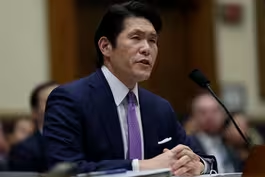
Biden classified docs special counsel testifies to House
Video has Closed Captions
Biden classified documents special counsel testifies in House hearing (3m 48s)
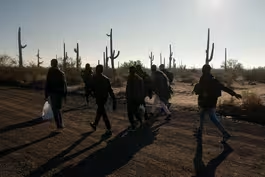
Global migrants make their way to Arizona’s southern border
Video has Closed Captions
Migrants from all over the world make their way to Arizona’s southern border (4m 15s)

Haiti gang violence bolstered by trafficked U.S. weapons
Video has Closed Captions
Widespread gang violence in Haiti continues bolstered by weapons trafficked from the U.S. (10m 17s)

How a seasoned lawyer is forging a new musical path
Video has Closed Captions
How a seasoned White House lawyer is forging a new musical path (6m 32s)

A look at data as concerns grow around surging violent crime
Video has Closed Captions
As concerns grow around surging violent crime, the numbers tell a different story (6m 24s)

SRL speaks with surgeon general on youth mental health
Video has Closed Captions
Student Reporting Labs speaks with the U.S. surgeon general on youth mental health (3m 53s)

Why TikTok's parent company may face divestment or U.S. ban
Video has Closed Captions
Why TikTok's parent company could face divestment or U.S. ban of the platform (11m 6s)
Providing Support for PBS.org
Learn Moreabout PBS online sponsorship
- News and Public Affairs

FRONTLINE is investigative journalism that questions, explains and changes our world.

- News and Public Affairs

Today's top journalists discuss Washington's current political events and public affairs.












Support for PBS provided by:
Major corporate funding for the PBS News Hour is provided by BDO, BNSF, Consumer Cellular, American Cruise Lines, and Raymond James. Funding for the PBS NewsHour Weekend is provided by...