
June 24, 2024 - PBS NewsHour full episode
6/24/2024 | 57m 46sVideo has Closed Captions
June 24, 2024 - PBS NewsHour full episode
Monday on the News Hour, Israel's Prime Minister says the intense phase of the war in Gaza will end soon as Israel and the U.S. argue over weapons deliveries. A cyberattack on a software provider disrupts operations at thousands of car dealerships. Plus, from vaccine mandates to the role of religion in schools, we spotlight former President Trump's plans for education if he wins in November.
Problems playing video? | Closed Captioning Feedback
Problems playing video? | Closed Captioning Feedback
Major corporate funding for the PBS News Hour is provided by BDO, BNSF, Consumer Cellular, American Cruise Lines, and Raymond James. Funding for the PBS NewsHour Weekend is provided by...
Support provided by:

June 24, 2024 - PBS NewsHour full episode
6/24/2024 | 57m 46sVideo has Closed Captions
Monday on the News Hour, Israel's Prime Minister says the intense phase of the war in Gaza will end soon as Israel and the U.S. argue over weapons deliveries. A cyberattack on a software provider disrupts operations at thousands of car dealerships. Plus, from vaccine mandates to the role of religion in schools, we spotlight former President Trump's plans for education if he wins in November.
Problems playing video? | Closed Captioning Feedback
How to Watch PBS News Hour
PBS News Hour is available to stream on pbs.org and the free PBS App, available on iPhone, Apple TV, Android TV, Android smartphones, Amazon Fire TV, Amazon Fire Tablet, Roku, Samsung Smart TV, and Vizio.
Providing Support for PBS.org
Learn Moreabout PBS online sponsorshipGEOFF BENNETT: Good evening.
I'm Geoff Bennett.
Amna Nawaz is away.
On the "News Hour" tonight: Israel's prime minister says the intense phase of the war in Gaza will end soon, as Israel and the U.S. argue over weapons deliveries.
A cyberattack on a software provider disrupts operations at thousands of car dealerships in the U.S. and Canada.
And from vaccine mandates to the role of religion in schools, we explore former President Trump's plans for education if he wins in November.
DR. PAUL OFFIT, Children's Hospital of Philadelphia: Claiming that vaccines are in any way unsafe or harmful, he has a platform, and he misuses that platform, and he scares people unnecessarily, thus putting them or putting their children in harm's way.
(BREAK) GEOFF BENNETT: Welcome to the "News Hour."
Israel today indicated it's close to ending what it called the intense phase of its operations in Gaza and would soon transition to a new stage of the war.
That word came as Israel's defense minister met with senior U.S. officials here in Washington today and as the U.S. and Israel continued a public spat over weapons deliveries.
Nick Schifrin joins us now.
Nick, it's good to see you.
So what did Israel say about the future of the war?
NICK SCHIFRIN: Geoff, for months, Israel has described its operation in Rafah as targeting the final four Hamas battalions.
And, today, Israel's chief of the general staff said that Israeli soldiers in Rafah were -- quote -- "approaching the point" where Hamas' Rafah brigade was -- quote -- "defeated."
And, as you said, Geoff, just now, Netanyahu described that as a transition from the intense phase of combat, allowing Israel to shift its focus to the north, to Lebanon.
There has been an extraordinary amount of U.S. concern in the last few weeks about cross-border fire between Israel and Hezbollah in Lebanon becoming a full-scale war.
And, this weekend, C.Q.
Brown, the chairman and the Joint Chiefs of Staff, warned that Iran could come to Hezbollah's aid if there were a war between Israel and Hezbollah and that the U.S. could not defend Israel like it did against Iran's attack in April if Hezbollah actually opened fire against Israel, a warning sign, another warning sign, by U.S. officials, who are really concerned about escalation, but U.S. officials insist that they will help Israel defend against all enemies.
GEOFF BENNETT: On the point of escalation, the U.S. has said that the best way to prevent an expansion of the war is to get a cease-fire in Gaza.
So where do things stand on that front?
NICK SCHIFRIN: Regional officials tell me that they are still trying to bridge the gaps between Israel and Hamas, but there's been no public progress.
There's also been public doubts, as you and I have talked about, Geoff, about whether Israel, whether Prime Minister Netanyahu would actually endorse the deal that President Biden laid out that he said was actually created by Israel.
And in the last 24 hours, Netanyahu has made no fewer than three contradictory statements about the hostage negotiation, including on Israeli TV last night.
BENJAMIN NETANYAHU, Israeli Prime Minister (through translator): I am not willing to stop the war and leave Hamas intact.
I am prepared to make a partial deal, this is no secret, that will return to us some of the people, but we are committed to continuing the war after a pause in order to complete the goal of eliminating Hamas.
NICK SCHIFRIN: That is the first time the Netanyahu used the phrases partial deal or some hostages, suggesting he was walking back his own plan, which calls for the release of all 120 hostages currently held in Gaza and the negotiation toward a permanent cease-fire.
Now, last night, after his interview on TV, he walked that statement back, saying -- quote -- "It is Hamas which opposes a deal, not Israel.
Prime Minister Netanyahu has made it clear he will not leave Gaza until we return all 120 of our hostages, living and deceased."
That was last night.
And, today, he further walked his Sunday comments back.
We BENJAMIN NETANYAHU (through translator): We are committed to the Israeli proposal that President Biden welcomed.
Our position has not changed.
NICK SCHIFRIN: So, three statements, all in all, in 24 hours.
That left a rather bemused State Department spokesman, Matt Miller, to respond this way today.
MATTHEW MILLER, State Department Spokesman: I think all of us that speak publicly at times make mistakes and misspeak.
And when we do so, we have an obligation to come clarify, and we're glad he did.
NICK SCHIFRIN: So, at the end of the day, Geoff, I guess we are where we were, which is that a hostage deal endorsed by Israel, made public by President Biden, negotiators continue to try and figure out the gaps since Hamas proposed changes.
Hamas itself said that Netanyahu's Sunday comments means he doesn't want this deal.
And the hostage families, I should add, said that those Sunday comments indicated Netanyahu was -- quote -- "abandoning the hostages."
GEOFF BENNETT: Wow.
Well, meantime, he has accused the U.S. on multiple occasions of withholding weapon deliveries.
Is that the case?
NICK SCHIFRIN: Well, look, U.S. officials insist they have frozen only one weapon delivery, 3,500 bombs that are unguided, and that was back in May.
But a U.S. official does describe this process, that, after October the 7th, Israel and the United States worked together, and they went back and found many Israeli weapons purchases, some of them many years old, that hadn't yet actually been delivered.
And what they did is, they worked to actually deliver all of those previous purchases, and that did increase the pace of weapons deliveries to Israel to an unprecedented level for, frankly, an unprecedented level of munitions that Israel was asking for in order to prosecute their war in Gaza.
But once those orders were fulfilled, they had to create new orders through the U.S. government or through the defense contractors, and that takes time between the administration, between those defense contractors, and the notifications to Congress.
And so the pace of delivery, according to this U.S. official who works on this, is slower than it was after October the 7th.
But the U.S. strongly denies it is withholding weapons, and it believes that Netanyahu knows that.
And so most analysts I talk to say that Netanyahu is playing domestic politics here with this accusation, including with Defense Minister Yoav Gallant, who happens to be in Washington now.
And you see them -- you see him meeting Secretary of State Antony Blinken.
Today, he later met with CIA Director Bill Burns.
Now, Gallant is a political rival to Netanyahu, and the two could fight over taking credit for any weapons deliveries that do come out of the U.S. in the coming weeks.
And Netanyahu, as we have talked about before, has a right-wing coalition.
He needs to stay in power, and doing so, or at least the political decision-making that he's been making with this right-wing coalition since October the 7th, is, he works with the right-wing, and he criticizes President Biden publicly.
And that has been a winning formula, he believes, that could keep in power -- keep him in power, especially as he continues to face years-old corruption cases, Geoff, including one today.
A panel accused him of undermining Israeli national security in a case involving submarines.
That is a charge that he denied yet again today.
GEOFF BENNETT: Nick Schifrin, got to say, thank you for walking us through all of this.
We deeply appreciate it.
NICK SCHIFRIN: Thanks very much.
GEOFF BENNETT: In the day's other headlines: Ukraine and Russia have been carrying out deadly strikes on each other's territory.
Today, two Russian ballistic missiles destroyed homes and left a huge crater in Eastern Ukraine.
At least five people were killed and 41 others were wounded.
And in Russian-annexed Crimea, memorials after Ukrainian drone and missile attacks yesterday killed six and wounded more than 150 others.
Russia says the Ukrainians used American-made weapons in the attack.
That claim has not been verified.
The State Department said Russia summoned the U.S. ambassador to discuss the incident.
MATTHEW MILLER, State Department Spokesman: I will just tell you what the ambassador said when she met with the Russian Foreign Ministry.
And that is, of course, that we lament any civilian loss of life in this war.
We provide weapons to Ukraine so it can defend its sovereign territory against armed aggression.
That includes in Crimea, which, of course, is part of Ukraine.
And Russia could stop this war today.
GEOFF BENNETT: Meantime, European Union nations today agreed to send an initial $1.5 billion in profits from frozen Russian assets to help Ukraine.
E.U.
members had agreed on the plan last month, but objections from Hungary held up the process.
The Russian region of Dagestan has started three days of mourning after gunmen killed at least 20 people at both Christian and Jewish houses of worship on Sunday.
Investigators scoured an Orthodox church and a synagogue that were among the sites where the coordinated shootings took place.
There's been no claim of responsibility, but local officials have blamed the attacks on Islamic extremists.
Here at home, flooding from torrential rain has hit parts of the Midwest, leading to evacuations and adding misery to a region already dealing with an oppressive heat wave.
Over the weekend, violent floodwaters rushed through Sioux Falls, South Dakota.
In Iowa, officials say water levels rose above record set in 1993.
The swelling caused a railroad bridge connecting Iowa and South Dakota to collapse.
South Dakota's governor warned of a long road ahead to recover from all the damage caused by the rain.
GOV.
KRISTI NOEM (R-SD): We have damaged roads.
We have damaged bridges.
We did lose a Burlington Northern Santa Fe railroad bridge.
That is the main bridge going into Iowa that a lot of commodities and different materials move on throughout the stage.
And between us and those that river collapsing and going down the Big Sioux last night was a big loss for us.
That will impact us for many, many months to come.
GEOFF BENNETT: National weather officials say parts of Nebraska, South Dakota, Minnesota and Iowa have received eight times the typical average rainfall.
And more rain is in the forecast.
In Maryland, the ship that lost power and rammed into the Francis Scott Key Bridge in March finally left Baltimore today.
The Dali had been stuck under bridge debris until it was refloated last month and guided back to port.
The ship started moving again this morning under its own power, accompanied by a Coast Guard escort.
Its destination was Norfolk, Virginia, where the Dali's remaining containers will be removed and where it will undergo repairs.
The Supreme Court said today it will hear its first case involving medical care for transgender youth, taking up what has become a politically polarizing issue across the country.
The case involves a Biden administration appeal of a Tennessee law that restricts gender-affirming care for minors.
Lawyers for the teens involved told the justices that -- quote -- "Without this court's prompt intervention, transgender youth and their families will remain in limbo."
Arguments will take place in the fall.
Today marks two years since the U.S. Supreme Court overturned Roe v. Wade, ending the constitutional right to an abortion.
PROTESTERS: My body, my choice!
GEOFF BENNETT: Abortion rights advocates gathered on the steps of the Supreme Court to mark the anniversary and criticize the ruling.
They exchanged verbal clashes with anti-abortion activists.
Vice President Kamala Harris also weighed in today.
She condemned former President Donald Trump for his record on reproductive rights during a campaign stop in Maryland.
KAMALA HARRIS, Vice President of the United States: Today our daughters know fewer rights than their grandmothers.
This is a health care crisis, and we all know who was to blame, Donald Trump.
GEOFF BENNETT: The former president nominated three conservative justices to the Supreme Court prior to the overturning of Roe.
On the campaign trail, Mr. Trump has repeatedly claimed credit for the decision.
Civil liberties groups filed a lawsuit today to block a Louisiana law that requires the Ten Commandments to be displayed in every public school classroom.
The suit filed in federal court says that the state's main interest in passing the measure is -- quote -- "to impose religious beliefs on public school children regardless of the harm to students and families."
The language of the law insists that the commandments are -- quote -- "foundational documents of our state and national government."
They're due to be in classrooms by the start of next year.
And on Wall Street today, the Dow Jones industrial average added 260 points to close above 39,400.
The Nasdaq dropped nearly 200 points after hitting records last week.
The S&P 500 also ended lower.
Still to come on the "News Hour": Amy Walter and Francesca Chambers break down the latest political headlines; the loss of one of the world's largest sources of groundwater threatens farming on America's Great Plains; and LaToya Ruby Frazier's activist approach to making art comes together in her first retrospective.
Thousands of car dealers across North America have been forced to revert to pen and paper after a software company they rely on was hit by several cyberattacks last week.
The outage has not only caused delays and inconveniences for customers, but has also raised major questions about whether sensitive data was compromised.
William Brangham joins us now.
William, tell us more about this company.
WILLIAM BRANGHAM: Geoff, the company that was hit was called CDK Global, and they provide internal software systems for about 15,000 different car dealerships in America and Canada for all their internal computer systems.
We spoke with one dealer in the greater Philadelphia area.
DREW PEARLMAN, General Manager, O'Neil Nissan: We're writing everything by pen and paper and by hand, but we can't go into our back end systems and see what the actual warranty costs are on things or what things are actually going to cost.
And we -- it just -- it's a manual process now that takes a lot longer, especially in service.
And then, when we talk about the sales part of it, that gets even crazier, because that has a lot of compliance components, such as credit, your red flags, your OFACs, and all of those things which integrate into CDK.
WILLIAM BRANGHAM: Since very little has been publicly said about who hacked this system, whether the attackers are demanding a ransom and when the system might return to normal, we thought it's a good idea to check in with someone who could help us understand what is going on.
Chris Krebs used to run the federal government's lead cybersecurity agency, and he is now chief intelligence and public policy officer at SentinelOne.
Chris Krebs, welcome back to the "News Hour."
Can you give us your best understanding of what's actually going on here?
CHRISTOPHER KREBS, Former Director, U.S. Cybersecurity and Infrastructure Security Agency: William, thanks for having me on.
So this is, unfortunately, part of a larger surge in ransomware attacks on U.S. businesses that we have seen recently.
You might remember, a couple months ago, we had UnitedHealthcare and Change Healthcare hit by a ransomware event.
This is just another string in this Eastern European and Russian criminal gangs that are hitting U.S. businesses.
My understanding is that CDK was hit last week.
They tried to restore operations.
They were subsequently hit by a second attack.
That is not unusual.
In fact, we see that quite often as organizations try to rush back and hurry back to getting operations back up and running.
So now they are in the process of containing, which means trying to get the ransomware operators out of their network, and get safe, secure operations back up to support their customers.
WILLIAM BRANGHAM: So this is not an attack on what we would call critical infrastructure.
I mean, car dealerships -- if car sales are slow, it's bad for the economy, but they will eventually pick back up again.
So this, as you're indicating, suggests that these are criminals who have done this because they're trying to squeeze money out of the company.
Is that right?
CHRISTOPHER KREBS: Absolutely.
And the unfortunate part of all of this is that the amounts that are being demanded by these cyber-criminals is only increasing.
We're seeing millions, if not tens of million dollars of demands.
Now, we don't have official numbers on what this group may have demanded from CDK just yet, but it has been $20 million to $30 million in the average lately.
And, yes, you know what?
This might not be critical infrastructure, but it sure does affect us.
It affects someone that's trying to go out there and get a new vehicle, if their old vehicle broke down.
So it's unfortunately part of a kind of a bigger mental attack on the United States and our people.
WILLIAM BRANGHAM: I know that there's a lot of debate over whether or not paying these ransoms is a good idea.
Where do you come down on that argument?
CHRISTOPHER KREBS: I think the unfortunate reality is that paying only benefits the attacker.
It rewards them and that's why the United States is getting disproportionately affected by ransomware.
Yes, you have cybersecurity incidents in Europe and the United Kingdom and elsewhere, but because we pay at a higher clip here in the U.S., the bad guys are coming here and they're hitting our businesses pretty hard.
I would suggest, though, that we think about this at a higher level, where this is not just some random cyber criminals.
There is a geopolitical element to ransomware as well, where it fits into Russia and the Kremlin's bigger strategy to attack the West, to attack the United States, so that we're talking about this tonight on TV, so that we're experiencing this, we're being inconvenienced, we're scared of more and more cyberattacks.
So, ultimately, this does, I believe, play into Putin's overall strategy.
WILLIAM BRANGHAM: Given the amount of these ransomware attacks, as you have been describing, what is going on here?
Is it just that this is a very hard thing to defend against, or are our companies not taking this that seriously?
Like, what is the weak link here?
CHRISTOPHER KREBS: Well, it's a combination of factors.
I talk about the three-legged stool of ransomware.
First is that businesses continue to manage their enterprise, their networks in a way that's unfortunately not entirely secure, that gives the bad guys an opportunity to come in.
And, sometimes, it's not their own fault.
It's the products or services that companies are using that are vulnerable and, therefore, subject to exploitation.
The second really is the monetization of these vulnerable and misconfigured networks.
The bad guys have figured out that they can use cryptocurrency to hold at ransom American and other companies.
They can pull value out and take it to places where -- the third leg of the stool, where they can't be held accountable, and that's, many times, Eastern Europe and Russia.
So what are we going to do about this?
We need more aggressive responses by law enforcement and by the national security apparatus, which we have seen an uptick.
We have seen the U.S. government and the United Kingdom government go after a group known as LockBit and take them offline.
We need more and more of that.
WILLIAM BRANGHAM: All right, Chris Krebs of SentinelOne, always good to see you.
Thanks so much.
CHRISTOPHER KREBS: Thanks so much, William.
GEOFF BENNETT: On the campaign trail this weekend, Donald Trump again vowed to shut down the Education Department if he's reelected.
He also endorsed a recent Louisiana law mandating the display of the Ten Commandments in public schools.
But those are just two of the multiple changes to public education that Mr. Trump is proposing, including when it comes to vaccinations.
Laura Barron-Lopez has more -- Laura.
LAURA BARRON-LOPEZ: Thanks, Geoff.
Former President Trump has increasingly employed anti-vaccine rhetoric at his rallies, and this weekend was no different.
Here he is at an event organized by the conservative Christian Faith and Freedom Coalition Saturday.
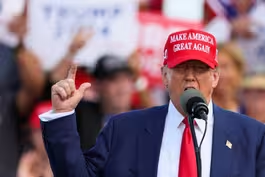
DONALD TRUMP, Former President of the United States (R) and Current U.S. Presidential Candidate: And on day one, I will sign a new executive order to cut federal funding for any school pushing Critical Race Theory, and I will not give one penny to any school that has a vaccine mandate or a mask mandate.
LAURA BARRON-LOPEZ: Medical experts say that implications for schools and for public health across the country could be enormous.
For more, we're joined by Dr. Paul Offit.
He's a pediatrician and a professor of vaccinology at the University of Pennsylvania.
Dr. Offit, thank you so much for joining the "News Hour."
I want to start.
First, Donald Trump's campaign claimed that this was about COVID mandates.
Later on, they became a bit vague.
They refused to specify to the press, and they pointed to the former president's comments.
Trump has made this proposal a regular part of his campaign stump speech, saying any school with a vaccine mandate will not get federal funding.
What is the public health impact of rhetoric that attacks childhood vaccinations in this way?
DR. PAUL OFFIT, Children's Hospital of Philadelphia: Well, we eliminated measles in this country by the year 2000.
The reason was school vaccine mandates and the enforcement of school vaccine mandates.
Prior to that, certainly prior to a vaccine, measles would cause 48,000 hospitalizations and 500 deaths a year.
But we eliminated measles because of that.
Now what's happened, and I think in large part because of the COVID vaccine mandates, there's been enormous pushback against school vaccine mandates, so much so that we have had more than 300 cases of measles in the last few years.
And I think, if we continue to do this, continue to try and push back on school vaccine mandates, as former President Trump is doing, you're going to get to the point where we will see 1,000 or 2000 cases of measles a year, at which point children will start once again to die from measles.
LAURA BARRON-LOPEZ: If Trump is elected, some of his allies and some of the former officials that served in his administration are advising him to split the Centers for Disease Control and Prevention into two agencies.
But what could Trump actually do that impacts whether or not children get vaccines, and what tools would he have to implement an anti-vaccine agenda?
DR. PAUL OFFIT: There's a program which was launched in 1994 called the Vaccine for Children's Program, which pays for all vaccines for children who are either uninsured or underinsured, which can be as many as 50 to 55 percent of children in this country.
It's something that would require a congressional act to overturn, so I can't imagine that ever happening.
But I think what former President Trump does is, by sort of damning vaccines, by claiming that vaccines are in any way unsafe or harmful, he has a platform, and he misuses that platform, and he scares people unnecessarily, thus putting their children in harm's way.
LAURA BARRON-LOPEZ: In terms of a second Trump administration, what about the potential people that he appoints to public health office?
DR. PAUL OFFIT: Of course.
I mean, if you look at the CDC or the FDA, you have an enormous amount of institutional memory.
These are our long-term advisers, federal advisers, both in the case of the FDA and the CDC, that have served us well.
I worry that those people could lose their jobs and just be replaced by people who simply express their loyalty to Trump, independent of their degree of expertise or experience.
LAURA BARRON-LOPEZ: How damaging could it be if an anti-vaxxer is ultimately put in a position of power like that?
DR. PAUL OFFIT: It would be devastating.
I mean, these are agencies that have served us well.
I mean, the FDA and the CDC have served us well.
Look at how we virtually eliminated many of these diseases because of that.
And we're starting to step back.
It's very hard to watch.
LAURA BARRON-LOPEZ: Vaccine mandates are left up to the states.
And, historically, state public school mandates have been the biggest driver of early childhood vaccination.
How important are vaccines for diseases like polio and measles?
And what are the implications if kids don't get these shots?
DR. PAUL OFFIT: Before vaccines, diphtheria was the most common killer of teenagers.
Before vaccines, pertussis, or whooping cough, killed 8,000 people, mostly children, every year.
Polio before vaccines would cause 30,000 people, mostly children, to be paralyzed every year and kill as many as 1,500.
Rubella, or German measles, when it infected pregnant women, would cause 20,000 cases of birth defects every year.
Is that what we want?
Do we want to go back to that time, before vaccines saved our lives and prevented all this suffering and hospitalization and death?
LAURA BARRON-LOPEZ: Bottom line, you're concerned that even just the rhetoric could lead to an uptick in deaths amongst children when it comes to measles, correct?
DR. PAUL OFFIT: Right.
I think what happened over the last few years, with the masking mandates and with the vaccine mandates is, we leaned into this libertarian left hook.
And now for the last few years, every year, there's been hundreds of pieces of legislation pushing back on mandates.
And so we have been pushing and pushing and pushing, to the point that now we're starting to see measles again.
And, in 2022, there was a case of polio in Rockland County, New York, in an area where the immunization rates were only 30 percent.
This is a man who never left this country.
So these are not diseases that you want to see come back.
LAURA BARRON-LOPEZ: Given your perspective, Doctor, what do you think is driving this large breakdown of the public's trust in public health officials and health agencies like the CDC and the National Institutes of Health?
DR. PAUL OFFIT: Right.
I think there's a general backlash against all federal agencies, not just the FDA and CDC, but the Department of Justice, the FBI.
And so I think there's just a general distrust.
And also I think, in terms of the -- this being largely a sort of conservative phenomenon, is this notion of individual freedoms, personal freedoms.
And so, in this case, it's the freedom to catch and transmit potentially fatal infections.
LAURA BARRON-LOPEZ: Dr. Paul Offit, thank you so much for your time.
DR. PAUL OFFIT: Thank you.
GEOFF BENNETT: As voters head to the polls in three states tomorrow, the Israel-Hamas war has become a key issue in one New York congressional primary.
It's a race that reflects the divide in the party over U.S. support for Israel.
New York Democratic Congressman Jamaal Bowman is in a fight for his political future, a fight that's also testing the strength of progressive stances on the Israel-Hamas war.
REP. JAMAAL BOWMAN (D-NY): Really appreciate the support.
MAN: Thank you so much.
REP. JAMAAL BOWMAN: They don't want our money going to war.
They can't afford food and utilities and transportation.
They want that money coming back here in some form of reparations to help us survive.
GEOFF BENNETT: Bowman is facing a primary challenge from a familiar face in the district.
GEORGE LATIMER (D), New York Congressional Candidate: I'm George Latimer.
GEOFF BENNETT: Westchester County Executive George Latimer.
GEORGE LATIMER: I'm afraid that the more we focus on identity politics, the less we focus on the substance.
So, what I have offered is a slogan that says results, not rhetoric.
MAN: Give you 30 seconds, Mr. Latimer, to respond to that.
GEOFF BENNETT: And while the two have battled over local issues, the race has largely centered on the war.
Bowman has faced scrutiny from pro-Israel groups for his call for a cease-fire in the early days of the war and what critics say is anti-Israel rhetoric.
REP. JAMAAL BOWMAN: Collective punishment and targeting civilians, that is not self-defense.
That goes beyond self-defense.
And what we want is peace.
GEOFF BENNETT: Interest groups such as AIPAC and Democratic Majority for Israel have spent more than $14 million opposing Bowman.
NARRATOR: He supported a resolution calling the founding of Israel a catastrophe, and Jamaal Bowman repeated Hamas lies, denying that women were raped and babies were butchered.
GEOFF BENNETT: Latimer entered the race after being recruited to run by local Jewish leaders.
GEORGE LATIMER: Most people want to see an end to the hostilities, but they don't want the end of the hostilities to come with hostages still being remained -- remaining in Hamas control, because Hamas is a terrorist organization.
GEOFF BENNETT: Bowman also faced criticism after he was charged with a misdemeanor for falsely pulling a fire alarm in the U.S. Capitol.
He disputed accusations he was trying to delay a vote on a spending bill.
Meantime, polls have shown Latimer taking an early lead in the race, with 48 percent support to Bowman's 31 percent.
Bowman's progressive allies have continued to rally behind him, including at a Saturday rally featuring Senator Bernie Sanders and New York Congresswoman Alexandria Ocasio-Cortez.
SEN. BERNIE SANDERS (I-VT): This election is about whether or not the billionaire class and the oligarchs will control the United States government.
And our view is, no, they won't.
GEOFF BENNETT: Bowman is not the only progressive member facing a primary challenger backed by pro-Israel groups.
Missouri Congresswoman Cori Bush also faces a similar primary challenge in August.
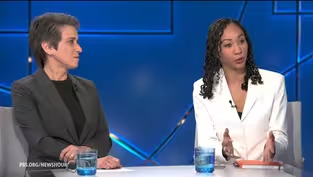
For a closer look at tomorrow's primaries, as well as a look ahead to this week's presidential debate in Georgia, we turn to the Politics Monday analysis of Amy Walter of The Cook Political Report With Amy Walter and Francesca Chambers of USA Today.
Tamara Keith is away this evening.
It's great to see you both.
AMY WALTER, The Cook Political Report: Thank you.
FRANCESCA CHAMBERS, USA Today: Thank you.
GEOFF BENNETT: So let's start with this New York primary race, because New York Democrats are no strangers to hard-nosed and sometimes super expensive campaigns, but this Bowman-Latimer race has really opened a rift in the party, in the liberal wing of the party, over the war in Gaza.
Amy, help us understand what's happening here, because incumbents typically have an advantage in elections it would appear, except for Jamaal Bowman.
AMY WALTER: Well, and this is also unique and that it's now officially the most expensive House primary in history, and this coming really from outside groups more than the candidates themselves.
Interestingly enough, while the rift is about Israel, there is also a lot of talk in advertising about other things, namely, Bowman, who is pretty new to the -- to Congress, accusing him of not being supportive enough of Joe Biden on some of Biden's key issues.
And I think fundamentally what this really, what this really -- what this race really is about, it was an opportunity, I think, for folks who were supportive of Israel to have an opportunity to find a person within the Democratic Party who wasn't as supportive.
And it works in this case.
The reason that he is more vulnerable,one, he's pretty new.
He was just elected in 2020.
And, two, these lines were redrawn after he was elected.
Remember '22 redistricting?
This district used to have a bigger portion of the Bronx, where Jamaal Bowman is from.
It is now a much smaller portion.
George Latimer represents the part of the district that is now, it's like 93 percent of the district.
GEOFF BENNETT: That's a great point.
And, Francesca, without reading too much into any one race, I mean, how much will this tell us about the strength of the Democrats' left-wing faction?
FRANCESCA CHAMBERS: Well, I do think it is emblematic of a conversation that's taking place right now in the Democratic Party over what it means to be a progressive, especially in the post-Bernie Sanders campaign era, because Latimer on his Web site claims that he's a progressive champion in this race.
And so as progressives have gotten successful with their agenda and they have had the effect that they have had on President Joe Biden and his agenda, there's now this debate over what it means to be a progressive.
Now, in this election, the way that it could have ramifications outside of this race is when you look at states like Michigan and Wisconsin and the percentage of the vote that got uncommitted or undeclared in the Democratic presidential primary.
That's a problem for President Joe Biden heading into the November election if those Democrats do not feel compelled to come out and vote for him because of his policies on Israel.
GEOFF BENNETT: Let's shift our focus to the big political event of the week.
That's the debate.
President Biden, former President Trump are set to face off in Thursday's presidential debate hosted by CNN.
This is a real opportunity for both men to highlight their competing visions for the country.
Amy, the campaign tells me that President Biden intends to focus on a couple of things, three things, in fact.
Roe v. Wade, the overturning of that, attacks on democracy, and both candidates' economic plans.
What does that tell us, big picture, about his strategy?
AMY WALTER: These are the issues that he's been wanting to talk about for a while now, because they are some of the places where he actually is the strongest, especially when it comes to the debate over abortion.
It's one of the few places where he has an advantage in terms of trust of voters over Donald Trump.
The other thing I think will be key for Biden in this debate -- look, it's early.
We have never had a debate this early.
I think a lot of people who are checked out of the election right now are not going to necessarily check in, in June.
They may do so as we get closer to the election.
I think the group of people he's really trying to move right now are those voters who voted for Biden in 2020, but are now sitting on the fence or saying maybe they're voting for third party.
We did some polling in battleground states.
About 18 percent of Biden voters in those battleground states are not supporting Biden this time around.
Those are people that theoretically should be the easiest for him to get back into his camp.
So I think talking about the issues that would appeal to those voters, many of them are younger, voters of color, who will agree with his positions on issues like democracy and on abortion rights, and even on the economy, talking to them, not so much about what the economy is like now, but what it will look like in four years from now and who's fighting for those voters.
GEOFF BENNETT: And, Francesca, meantime, the Trump campaign is trying to recalibrate... FRANCESCA CHAMBERS: Yes.
GEOFF BENNETT: ... and raise expectations for Joe Biden on this debate.
I mean, how tall of an order is that, given that President Trump has spent the better part of the year saying that Joe Biden is cognitively impaired and not up to the job?
FRANCESCA CHAMBERS: Right.
Now they're trying to raise expectations and say he's going to show up and be very highly alert, that what you should expect is more like his State of the Union performance or his 2012 debate performance against Paul Ryan.
At the same time, the Biden campaign has also in a way lowered expectations for Trump by suggesting that he would come out there and perhaps had the debate performance that he had in 2020 in the first debate performance, rather than maybe the one that he had in the second debate.
So, a tall order for both candidates to clear the expectations their own campaigns have set for the other one.
GEOFF BENNETT: And as we wrap up this conversation, we should note this is the second anniversary of the Supreme Court ending decades of nationwide abortion protections in the overturning Roe.
Amy, how resonant an issue is this heading into November?
AMY WALTER: Listen, the Biden campaign wants to make this a focal point.
And, thus far, we have seen that it is important to - - certainly for many, many voters.
But, again, this is going back to our own polling when we asked voters in these battleground states, all right, you have the choice.
If you had to choose between Joe Biden setting economic policy for the next four years or Donald Trump setting abortion policy for the next four years, which one would make you more uncomfortable?
And a majority, about 55 percent, picked they were more worried about Biden and the economy than Trump and abortion.
There's also been a great deal of polling out there, another one by KFF, looking at women specifically and how they see this issue.
In states where there's an abortion initiative on the ballot, those voters say not only are they more interested in voting, but they are more supportive of Biden.
So if you're the Biden campaign, at least the suggests that for those states like Arizona, where there is an abortion initiative on the ballot, that may help get you some more votes in the bank.
GEOFF BENNETT: Francesca, you cover the White House and the campaign.
How are both really leaning in on this issue, the White House and the campaign separately?
FRANCESCA CHAMBERS: Well, President Biden's campaign is actually sending surrogates like Elizabeth Warren to Wisconsin to talk about this issue, which will hopefully, they think, help them with suburban voters, suburban women as well.
And so you would expect President Biden to focus on this heavily.
They have released several ads this week on this and also really tying it to their argument that Donald Trump is a threat to democracy.
In their latest ad, they actually showed footage from January 6 in their latest abortion rights ad.
GEOFF BENNETT: Francesca Chambers, Amy Walters, thanks so much.
We appreciate it.
AMY WALTER: You're welcome.
GEOFF BENNETT: And be sure to tune in to PBS on Thursday at 9:00 p.m. Eastern for our simulcast of the CNN presidential debate with analysis to follow.
In the heart of the country, Great Plains farmers and ranchers produce a quarter of all U.S. crops and 40 percent of our beef.
But they rely on a resource that has been slowly drying up, water.
Stephanie Sy reports from Kansas for our ongoing series on climate change and water, Tipping Point.
BRANT PETERSON, Kansas Farmer: So this is a small glimpse of what the Dust Bowl-type situation was.
STEPHANIE SY: Brant Peterson farms grain in dry Southwestern Kansas, where erratic winds can whip dust into the sky at a moment's notice.
It's difficult land to farm, but Peterson is committed.
BRANT PETERSON: My wife and I are both fifth-generation farmers raising the sixth generation.
We have been to a lot of droughts.
I won't say that it's any worse than anybody else had, but I just do know that what I have had to deal with has been tough.
STEPHANIE SY: Farms like Peterson's are a vital part of the global food system.
Much of the grain he grows heads to the massive cattle feedlots that surround him in Western Kansas, powering the state's multibillion-dollar beef industry.
Nearly a quarter of all the steaks on our dinner plates come from Kansas.
KATIE DURHAM, Kansas Groundwater Management District 1: We are completely dependent on agriculture.
It is the lifeblood of our communities.
STEPHANIE SY: Katie Durham runs the Groundwater Management District in West Central Kansas.
KATIE DURHAM: You just drive around town and anything from our banks to the implement dealers, anything that you see in town is all tightly related to agriculture.
STEPHANIE SY: And the agricultural industry here relies on one increasingly scarce resource.
KATIE DURHAM: Without groundwater, we would really cease to exist.
STEPHANIE SY: Nearly all the groundwater in Western Kansas is tapped from the Ogallala Aquifer, a massive reservoir that runs under parts of eight states from South Dakota to Texas.
But as the darker color on this map shows, parts of the aquifer, especially in Texas, Oklahoma and Western Kansas, are in deep decline.
That's a problem because the economy here relies on water-intensive crops, namely corn.
BROWNIE WILSON, Kansas Geological Survey: We don't have the streams.
It's raining right now a little bit, and that's kind of a little bit unusual.
But what we do have is the Ogallala Aquifer underneath our feet.
STEPHANIE SY: Brownie Wilson of the Kansas Geological Survey regularly measures the water levels at wells like this one throughout Kansas.
He's seen some wells drop more than 100 feet since 2001.
BROWNIE WILSON: What we're doing now is not sustainable.
We track every year the water levels are dropping.
I have seen more places where the aquifer just physically cannot support the pumping demands anymore.
KATIE DURHAM: Depletion between the different layers of the aquifer.
STEPHANIE SY: The depletion isn't uniform.
Durham describes the aquifer's topography as an egg carton.
KATIE DURHAM: You have these pits and valleys, and it's very, very dynamic, and that's why we call it saturated thickness.
And so some areas are going to have more saturated thickness than others.
Likewise, some areas are going to have more decline.
STEPHANIE SY: Unfortunately, Peterson is in one of those areas in Southwest Kansas seeing the state's steepest declines in groundwater.
BRANT PETERSON: I have abandoned over half the wells on my farm.
They're not feasible to pump anymore.
Now, if I wanted to be a water baron, yes, I could pump all year long and make something happen out of it, but I can't sleep at night doing that.
STEPHANIE SY: Because you know how that ends.
BRANT PETERSON: I know where it ends.
STEPHANIE SY: Does that end with the end of livelihoods?
BRANT PETERSON: Yes, but what worries me more is the communities and the people.
That's what you see suffering.
You see the communities drying up with the water.
PETER GLEICK, Co-Founder, Pacific Institute: The overdraft of the Ogallala Aquifer is the result of a whole series of factors.
STEPHANIE SY: Climate scientist Peter Gleick co-founded the Pacific Institute, a global water think tank based in California.
PETER GLEICK: In part, it's because farmers have brought a tremendous amount of land into production and that requires a lot of water.
In part, it's because climate change is reducing the amount of water going to recharge those aquifers.
STEPHANIE SY: According to Gleick, rising temperatures mean crops require more water to grow, even while more intense heat causes rainfall to evaporate before it can reach the ground.
There's also a long established link between climate change and drought, like the one Kansas experienced in 2022, causing record low precipitation in seven Western communities.
PETER GLEICK: A lot of what we're seeing in the Ogallala Aquifer, the depletion of groundwater, we also see, for example, in the Central Valley of California, where every year we see massive overdraft of groundwater.
And in southern part of the San Joaquin Valley in California, we're going to see a lot of land come out of production.
We have to bring groundwater back into balance, or there's going to be serious disruptions of our food system.
STEPHANIE SY: While past generations of farmers saw heavy water use as key to success, attitudes are changing.
STEVE COMPTON, Kansas Farmer: The green zone is the optimal range for the moisture ought to be for this crop.
STEPHANIE SY: Steve Compton grows weed and other grains on thousands of acres in Scott County, Kansas, using a tablet to carefully manage his sprinklers.
STEVE COMPTON: In years past, when it would rain, everybody would just leave their systems on and let them run.
And now, everybody's so conscious of that, when we can get supplemental rain, there's no reason to keep them running.
I like the way those spin around and all the nature just drops around.
STEPHANIE SY: Compton, who became a quadriplegic after a car accident, has always relied on technology to run the farm with his father, Ted.
STEVE COMPTON: We can look at that thing on the Internet and we know instantly what the level of moisture is within that ground out there.
So we know, after a rain, whether we can turn off for a while and conserve some water.
STEPHANIE SY: Even though none of the wells on his farm have run dry, Compton, along with all the other farmers in his county and three neighboring counties, have committed to cutting their water use by up to 25 percent.
Katie Durham worked with farmers to pass local agreements to manage and implement water use reductions in her district following success with them in Northwestern Kansas.
KATIE DURHAM: People really saw this as an opportunity to take local control.
I probably sat with a few hundred people just having conversations about what this meant, how it would affect them.
And I think really the big question was, what is going to happen if we don't do something?
STEPHANIE SY: For Compton, it's about being a good steward of the land and resources.
STEVE COMPTON: The farmer loves the land and he loves what he does.
And we're going to do whatever we can to maintain that type of life and to be able to pass that on.
STEPHANIE SY: Back down in Southwest Kansas, which has seen the steepest declines, no restrictions are in place to control overpumping.
BRANT PETERSON: Everybody has a right to drive themselves into bankruptcy, but somebody's got to stop, somebody's got to back off.
And so that's what I did.
And I have sought other technologies to help me be more efficient.
The challenge is the fun part.
The sadness of, yes, we're losing the water, that's what stinks.
STEPHANIE SY: He's invested in a new irrigation system that uses water more efficiently, and he's begun to replace thirsty corn crops with fields of sorghum, a resilient grain that can be used to feed cattle and people.
Overall, Peterson has reduced his water use by 15 percent.
And for him, that means his sons may have a shot at carrying on the family business.
BRANT PETERSON: Conserving the water is a big part of them having the opportunity to be successful here, to have a sound economy around them to support the operation.
And that would be fantastic.
STEPHANIE SY: Whether or not the voluntary conservation efforts of farmers will be enough to preserve the way of life here remains as uncertain as any given day's weather in Western Kansas.
For the PBS "News Hour," I'm Stephanie Sy.
GEOFF BENNETT: Artist,activist, community builder, teacher.
LaToya Ruby Frazier's ideas of art making come together in her first retrospective exhibition.
Jeffrey Brown has the story for Art in Action, our ongoing look at the intersection of arts and democracy and part of our series Canvas.
JEFFREY BROWN: They are monuments of a kind we're not used to seeing, artworks intended to honor workers, document and address economic and social ills, and bring about small-D democratic action.
LaToya Ruby Frazier calls her exhibition at New York's Museum of Modern Art Monuments of Solidarity, tapping the power of photography.
LATOYA RUBY FRAZIER, Artist: We live in a world where we're pretty desensitized, right?
And we just want to keep swiping through images, and we're not really pausing and slowing down and thinking about what the power of images actually are, right?
I believe in the power of photography, the power of photography to reshape how we see ourselves in our families, in our communities, in the world, how we relate to other people.
JEFFREY BROWN: Frazier first gained notice in a 2015 MacArthur genius award for a series she titled The Notion of Family, portraying herself, her mother and grandmother within the larger context of America's industrial decline.
She grew up in Braddock, Pennsylvania, a once thriving town where Andrew Carnegie built his first steel mill, now in economic distress.
Her museum retrospective begins there, enhanced with silent videos, and a wall installation, a kind of poem listing various toxins found in Braddock's air.
She shows the closing of a major medical center, and her response through art to a Levi Strauss ad campaign that used her town as a setting for so-called urban pioneers and featured a tagline that read, "Go forth."
Frazier asked, "Go forth where?"
LATOYA RUBY FRAZIER: I'm very interested in that as an artist and as a citizen, ways that we're able to show up for other people, especially people who may not be able to give us anything in return.
JEFFREY BROWN: If one wants to explore those issues in our culture and society and politics, there are different ways to do it.
Why is the camera your way in?
LATOYA RUBY FRAZIER: Because that's how I got my start.
So I view myself at this point as someone who is living a life of purpose that has chosen to live my life taking my creative gifts in service to people in the industrial heartland of America.
It's where I'm born and raised from, and I have always felt and I actually witnessed how people were forgotten and became invisible, and people weren't telling those stories anymore.
JEFFREY BROWN: Another series, Flint Is Family in three acts, centered on the water crisis in Flint, Michigan, that began in 2014, and its impact on specific individuals, notably, Shea Cobb and her daughter Zion.
It's told through photographs, texts written by residents, and a video in which Cobb tells her own story.
SHEA COBB, Mother: I said: "Do you drink that water?"
And she said: "No, I don't, but my friends do."
And I was like: "If you see them drinking it, and you're thirsty, you go get a bottle of water, because my daughter will follow people.
I can't afford that."
So she's aware.
I hate that she's aware.
JEFFREY BROWN: Frazier is the artist, but her work is always a collaboration, a collective approach that empowers people normally seen only as subjects.
LATOYA RUBY FRAZIER: So really embedding myself into their lives, into the social fabric of that community, and then that's when we start to really make the portraits together.
So, in my case, the people that I'm collaborating with, they are the ones choosing to present themselves how they would like to be seen.
They are choosing the time when they want to be photographed.
They choose the location.
And then they also choose to say what it is that they want to say.
And so I work directly with them.
So, in a lot of ways, I wear many hats in order to create this robust series of images and voices and storytelling.
JEFFREY BROWN: She's also now bringing us into the work in an unusual way, here an installation of photographs and texts of Baltimore health workers mounted on hospital I.V.
stands set six feet apart.
LATOYA RUBY FRAZIER: It becomes very sculptural.
JEFFREY BROWN: I mean, and then these are like I.V.... LATOYA RUBY FRAZIER: Yes, the intravenous pole stands.
So here's what you start to realize is, like, wait a minute, I recognize this.
This is universal medical equipment, right?
And so,again... JEFFREY BROWN: Which you have transformed.
LATOYA RUBY FRAZIER: I have modified it so that it holds the artwork.
JEFFREY BROWN: Again, this is artwork as monument to workers she sees as undervalued and little known heroes who choose how they want to be photographed and are given their own voices through the text.
LATOYA RUBY FRAZIER: So this exhibition Monuments of Solidarity literally democratizes the arts.
And it also, room after room, as you see the way that we're collectively making the photographs together, it puts forth new ideas about different ways that we could dream about our economy, different ways that we can dream about labor.
JEFFREY BROWN: The largest installation here, The Last Cruze, as in the Chevrolet Cruze, photographs and texts hung on a structure that replicates an actual assembly line at an auto plant in Lordstown, Ohio, the story told of workers fighting a losing battle to prevent its closure in 2018.
LATOYA RUBY FRAZIER: And, in this case, instead of seeing the white Cruze car, you see the men and the women who actually were the laborers who were building that car.
And that's where that connection is made between the products and the workers themselves.
JEFFREY BROWN: The most recent work is titled A Pilgrimage to Dolores Huerta, an homage to the famed labor leader, co-founder with Cesar Chavez of the National Farm Workers Association in 1962.
Throughout the exhibition, Frazier says, she's showing how everyday citizens have power to make their lives better and how artists and museums can expand their purview to capture and show that.
LATOYA RUBY FRAZIER: And I truly believe, as an artist, it's important to be a witness in your time.
It's important to mirror what is actually happening in your society.
But it is also equally important to inspire people and to let them know that they already have the power and can bring about that change.
And what better way than to do it than through photography and storytelling, considering that we all have apparatuses in our hands and in our pocket that can do it?
JEFFREY BROWN: LaToya Ruby Frazier's Monuments of Solidarity is on view through September 7.
For the PBS "News Hour," I'm Jeffrey Brown at the Museum of Modern Art in New York.
GEOFF BENNETT: Join us again here tomorrow night for a look at why a growing number of young men are choosing not to go to college.
And that is the "News Hour" for tonight.
I'm Geoff Bennett.
For all of us here at the PBS "News Hour," thanks for spending part of your evening with us.
Amy Walter and Francesca Chambers on debate expectations
Video has Closed Captions
Clip: 6/24/2024 | 8m 8s | Amy Walter and Francesca Chambers on expectations for the Biden-Trump debate (8m 8s)

Cyberattack disrupts business at thousands of car dealers
Video has Closed Captions
Clip: 6/24/2024 | 6m 25s | Cyberattack on software company disrupts business at thousands of car dealerships (6m 25s)

Loss of major water source threatens Great Plains farming
Video has Closed Captions
Clip: 6/24/2024 | 8m 16s | Depletion of major groundwater source threatens Great Plains farming (8m 16s)

'Monuments of Solidarity' highlights activism in art
Video has Closed Captions
Clip: 6/24/2024 | 7m 11s | 'Monuments of Solidarity' exhibition highlights an activist's approach to making art (7m 11s)

Netanyahu says 'intense' phase of Gaza war will end soon
Video has Closed Captions
Clip: 6/24/2024 | 6m 38s | Netanyahu says Israel may shift focus to Hezbollah in Lebanon after Gaza war ends (6m 38s)

N.Y. primary reflects Democratic divide over Israel support
Video has Closed Captions
Clip: 6/24/2024 | 2m 49s | New York primary race reflects Democratic Party divide over Israel support (2m 49s)
Trump vows to defund schools requiring vaccines for students
Video has Closed Captions
Clip: 6/24/2024 | 6m 28s | Trump vows to defund schools requiring vaccines for students if he's reelected (6m 28s)
Providing Support for PBS.org
Learn Moreabout PBS online sponsorship
- News and Public Affairs

FRONTLINE is investigative journalism that questions, explains and changes our world.

- News and Public Affairs

Amanpour and Company features conversations with leaders and decision makers.












Support for PBS provided by:
Major corporate funding for the PBS News Hour is provided by BDO, BNSF, Consumer Cellular, American Cruise Lines, and Raymond James. Funding for the PBS NewsHour Weekend is provided by...