
June 13, 2024 - PBS NewsHour full episode
6/13/2024 | 57m 46sVideo has Closed Captions
June 13, 2024 - PBS NewsHour full episode
Thursday on the News Hour, in a win for reproductive rights advocates, the Supreme Court unanimously votes to protect access to the abortion pill mifepristone. G7 leaders meet in Italy and announce a deal to use frozen Russian assets to support Ukraine. Plus, a look at the debate surrounding arming teachers as more states pass legislation allowing educators to carry guns on school grounds.
Problems playing video? | Closed Captioning Feedback
Problems playing video? | Closed Captioning Feedback
Major corporate funding for the PBS News Hour is provided by BDO, BNSF, Consumer Cellular, American Cruise Lines, and Raymond James. Funding for the PBS NewsHour Weekend is provided by...
June 13, 2024 - PBS NewsHour full episode
6/13/2024 | 57m 46sVideo has Closed Captions
Thursday on the News Hour, in a win for reproductive rights advocates, the Supreme Court unanimously votes to protect access to the abortion pill mifepristone. G7 leaders meet in Italy and announce a deal to use frozen Russian assets to support Ukraine. Plus, a look at the debate surrounding arming teachers as more states pass legislation allowing educators to carry guns on school grounds.
Problems playing video? | Closed Captioning Feedback
How to Watch PBS News Hour
PBS News Hour is available to stream on pbs.org and the free PBS App, available on iPhone, Apple TV, Android TV, Android smartphones, Amazon Fire TV, Amazon Fire Tablet, Roku, Samsung Smart TV, and Vizio.
Providing Support for PBS.org
Learn Moreabout PBS online sponsorshipGEOFF BENNETT: Good evening.
I'm Geoff Bennett.
AMNA NAWAZ: And I'm Amna Nawaz.
On the "NewsHour" tonight: In a win for reproductive rights advocates, the Supreme Court unanimously votes to protect access to the abortion pill mifepristone.
GEOFF BENNETT: The latest on the war in Ukraine, as G7 leaders meet in Italy, and announce a deal to use frozen Russian assets to support the war-torn country.
AMNA NAWAZ: And a look at the debate surrounding arming teachers, as more states pass legislation allowing educators to carry guns on school grounds.
(BREAK) AMNA NAWAZ: Welcome to the "NewsHour."
There was major news out of the Supreme Court today, as a decision came down in a highly anticipated reproductive rights case where the justices protected access to widely used abortion pills.
GEOFF BENNETT: In a unanimous decision, the court ruled that a group of anti-abortion doctors does not have any legal basis to challenge access to mifepristone.
That's one of the two common drugs used in medication abortion.
As a result, access to mifepristone will not change.
Let's bring in our John Yang.
John, it's great to have you here.
So this ruling did not address the underlying issues that the plaintiffs raised, instead deciding the case only on standing.
That this decision was unanimous, was that surprising?
JOHN YANG: Not entirely.
The oral arguments back in March really focused on this question of standing.
Did the doctors have the legal right to sue?
And in his opinion, the unanimous opinion today, Justice Kavanaugh essentially said, no, they don't have a direct personal stake in this.
Because they're anti-abortion doctors, because they are morally opposed to abortion, they don't prescribe mifepristone.
They don't perform abortion procedures.
So what they were challenging was the regulation of other doctors who did.
And you can't do that in our system.
GEOFF BENNETT: There's another big abortion-related case that we're waiting on.
It has to do with abortion law in Idaho.
Does this ruling in any way give an indication of what might be to come out of the Idaho case?
JOHN YANG: I don't think so, not really, because it's a totally different question.
The question in Idaho is whether their essentially total ban on abortion -- the only exception is to save the life of the mother -- whether that violates the federal law that says that hospitals have to provide emergency treatment to stabilize the patient, even if it's not saving their life.
And in that oral argument, there were all sorts of real-world examples of doctors airlifting patients out of Idaho, so they could get the medical treatment that they thought they needed.
GEOFF BENNETT: So mifepristone remains available to women up to the 10th week of pregnancy.
It's still available through the mail.
What's next?
Does this case resolve any of the debate, the lingering fight around abortion pills?
JOHN YANG: Well, as you said, Geoff, they didn't get to the merits on this one.
And there are three Republican-led states, Missouri, Kansas, and Idaho, that want to press this case, this fight against mifepristone.
That's going to be going on at the district court level.
It may take a little while to reach the Supreme Court.
And then, of course, there's the Comstock Act.
That's that 19th century law that makes it illegal to send materials that could lead to an abortion through the mail.
And the Justice Department currently says that does not apply to prescriptions for mifepristone, but anti-abortion activists are already talking about trying to use that law to ban medicinal abortions if there's a new Trump administration.
GEOFF BENNETT: All right, John Yang, thanks so much for walking us through all of this.
We appreciate it.
JOHN YANG: Thank you.
AMNA NAWAZ: In the day's other news: Evan Gershkovich will stand trial in the Russian city of Yekaterinburg, where he was arrested more than a year ago.
For the first time, Russian prosecutors specified the allegations against The Wall Street Journal reporter, accusing him of spying on a military factory for the CIA with -- quote -- "painstaking conspiratorial methods."
Gershkovich, his employer and the U.S. government have denied any wrongdoing.
It's not clear when the trial will begin.
The Justice Department has found a pattern of civil rights abuse at the Phoenix Police Department.
This includes discrimination against Black, Hispanic, and Native American people and the use of excessive force.
In its 126-page report, the department found that officers used -- quote -- "dangerous tactics that lead to force that is unnecessary and unreasonable."
The findings come after a nearly three-year investigation into complaints of brutality by city law enforcement.
The head of the Federal Aviation Administration said today that his agency was -- quote -- "too hands-off" with Boeing leading up to a mid-flight incident in January.
Administrator Michael Whitaker was referring to the door plug blowout aboard an Alaska Airlines flight.
Testifying to a Senate committee today, Whitaker admitted that the FAA was too focused on paperwork audits and not on actual inspections.
MICHAEL WHITAKER, Administrator, Federal Aviation Administration: We have changed that approach over the last several months and those changes are permanent.
We have now moved to a more active, comprehensive oversight model, the audit plus inspection approach, which allows the FAA to have much better insight into Boeing's operations.
AMNA NAWAZ: Also on Capitol Hill today, lawmakers in the House grilled Microsoft president Brad Smith on his company's plan to improve its security.
That comes after China-linked hackers stole 60,000 State Department e-mails by breaking into Microsoft systems last summer.
Smith took responsibility for the attack and said the company is working on reducing its engineering presence in China.
U.S. officials granted the Makah Tribe in Washington state a waiver to hunt gray whales today.
The decision paves the way for what would be the tribe's first permitted hunt since 1999.
The Makah had hunted whales for hundreds of years, but quit in the early 20th century after commercial whaling shrank populations.
The tribe has spent more than two decades trying to resume the practice.
Even with the waiver, the Makah will still need a permit, which could take months, and animal rights groups could challenge the decision in court.
Tropical downpours pounded Southern Florida for a third day in a row today, adding to the already life-threatening floods in the area.
Parts of Miami have seen more than 20 inches of rain since Tuesday.
The nonstop precipitation has turned roads into rivers, submerging vehicles and stranding drivers.
Aerial footage early today showed entire neighborhoods underwater.
Longtime residents of Hallandale Beach, north of Miami, say they have never seen anything like it.
LUIS GARCIA INFANTE, Hallandale Beach, Florida, Resident: Thirteen years, there's been storms, there's been rain, heavy rain, but never, never like this.
This is extreme.
This is a little bit too much.
We was not expecting this.
AMNA NAWAZ: The severe weather comes at the start of what's expected to be an extraordinary hurricane season.
Weather officials say La Nina conditions are likely to form this summer, which typically lead to more hurricanes forming in the Atlantic.
The head of the Senate Judiciary Committee said today that Supreme Court Justice Clarence Thomas took three undisclosed trips on a private jet provided by a Republican megadonor.
The fights took place between 2017 and 2021.
The committee notes that these trips were not included in an amendment filed last week to Thomas' 2019 financial disclosure.
In a statement, Committee Chairman Dick Durbin said this new information -- quote -- "makes it crystal clear that the highest court needs an enforceable code of conduct because its members continue to choose not to meet the moment."
President Biden will nominate Christy Goldsmith Romero as the new head of the Federal Deposit Insurance Corporation, or FDIC.
Goldsmith Romero is a long time federal financial regulator who currently serves at the Commodity Futures Trading Commission.
If confirmed by the Senate Banking Committee, she would replace Martin Gruenberg, who agreed to resign last month after reports of workplace harassment and abuse at the agency.
New data out today shows signs of cooling in the U.S. economy.
The Producer Price Index, which monitors prices before they reach consumers, dropped last month by its largest amount since October, and the number of Americans filing for unemployment benefits climbed to a 10-month high.
Treasury Secretary Janet Yellen said on CNBC this morning that this latest data shows this economy is settling into a more natural rhythm.
JANET YELLEN, U.S. Treasury Secretary: The labor market has become a little less hot, a little bit more normal.
And so the labor market now is resembling what it looked like pre-pandemic.
Wages are increasing, but at a slower rate.
And so that doesn't really look like it's a threat to inflation.
AMNA NAWAZ: The latest readings come a day after the Fed signaled it would only lower interest rates once this year.
That's down from an earlier projection of three cuts.
And on Wall Street today, stocks were largely unchanged.
The Dow Jones industrial average lost 65 points to close at 38647.
The Nasdaq notched its fourth straight record close, adding 59 points.
The S&P 500 also ended at a new high.
Still to come on the "NewsHour": former President Trump returns to Capitol Hill for the first time since the January 6 insurrection to meet with Republican lawmakers; lifelong GOP supporters use a downballot race in Pennsylvania to voice disapproval of the extremism they see in their party; and Oscar-winning director and artist Steve McQueen discusses his new immersive exhibit.
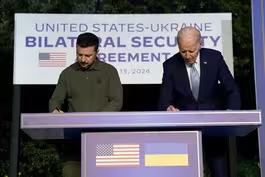
GEOFF BENNETT: President Biden signed a defense pact today with Ukraine on the sidelines of the G7 meeting in Italy.
The Group of Seven major industrialized powers also agreed on a plan to take Russian assets held in Europe and use that money to aid Ukraine in its fight against Russia's invasion.
Here's Nick Schifrin.
NICK SCHIFRIN: Another day, another direct Russian hit on a Ukrainian apartment in Kharkiv.
But this day proved different.
A man buried alive was saved, providing hope to a country struggling to hold the line.
MAN: An historic new bilateral security agreement.
NICK SCHIFRIN: And so it was 2,000 miles away.
A security agreement gave Ukraine's leader hope U.S. support would hold.
JOE BIDEN, President of the United States: Our goal is to strengthen Ukraine's credible defense and deterrence capabilities for the long term.
VOLODYMYR ZELENSKYY, Ukrainian President: It is truly a historic day.
And we have signed the strongest agreement within Ukraine and the U.S. since our independence.
NICK SCHIFRIN: Today's U.S.-Ukraine bilateral security agreement commits the U.S. for 10 years to -- quote - - "support Ukraine's efforts to win today's war and deter future Russian military aggression" with weapons, intelligence sharing and long-term training, as well as joint weapons production.
Nowhere has the risk to Ukraine and the importance of Western support been more pronounced than in Kharkiv.
Just a few weeks ago, the center of Vovchansk along the Kharkiv-Russia border had been gutted, at risk of occupation.
Now U.S. and Ukrainian officials say newly arrived Western ammunition and permissions to fire U.S. weapons into Russia allowed Ukraine to hold the line.
Secretary of Defense Lloyd Austin at NATO today.
LLOYD AUSTIN, U.S. Secretary of Defense: But what I see is a slowing of the Russians' advance and a stabilizing of the - - of that particular piece of the front.
NICK SCHIFRIN: Above the summit today, skydivers leaped to the waiting leaders of the world's largest democracies.
They are collectively supporting Ukraine today, but they know long-term U.S. support could be a leap of faith, because former and would-be President Trump has vowed to end the war in Ukraine and question ongoing U.S. military assistance.
Today, Zelenskyy said, no matter the president, he had faith in the American people.
VOLODYMYR ZELENSKYY (through translator): It seems, to me, that no matter who the nation chooses, if the people are with us, any leader will be with us in the struggle for our freedom.
NICK SCHIFRIN: Today, the world's leading democracies also agreed to an unprecedented step, convert the interest on $280 billion of frozen Russian assets currently held in Europe into a loan to help Ukraine buy weapons and repair nearly half-a-trillion dollars of damage.
European Commission President Ursula von der Leyen.
URSULA VON DER LEYEN, President, European Commission: It's not the European taxpayers that are paying for the damage that Putin is causing with this war of aggression, but it is Putin.
NICK SCHIFRIN: And to discuss that part of the story, how the West is converting frozen Russian assets into a loan for Ukraine, I turn to Adam Smith, a partner at Gibson, Dunn & Crutcher and a former senior adviser in the Treasury Department in the Obama administration.
Adam Smith, thanks very much.
Welcome back to the "NewsHour."
NICK SCHIFRIN: How significant is this announcement today?
ADAM SMITH: It's a watershed.
Quite simply, it could change the nature of sanctions.
This could change the nature of the way sovereign powers around the world think about their own assets.
This was a significant issue.
It's been thought about since the day after Russia invaded Ukraine back in 2022.
And the fact that they have done it now two years hence suggests how difficult it was, I think, for all parties to get around the idea of going after sovereign assets.
NICK SCHIFRIN: So explain more how exactly it is so existential or so significant.
And I guess take us through some of the concerns that European countries had and, in fact, some U.S. officials had initially about making this move.
ADAM SMITH: Yes, I think there are two concerns.
One is perhaps a little less significant than the other.
The first is retaliation.
What that means is that, if we can do that to Russia, Russia can do that to us.
And that's true, and it's definitely a concern for the Europeans, because there's a lot more engagement between Russia and Europe.
It's much less of a concern for the U.S., but it's not a zero-sum concern.
But, of course, if Russia can do it, then others can do it as well, be it China, India, what have you, any other jurisdiction that sort of wants to.
The other issue, of course, is, what does it mean systemically?
I mean, one of the linchpins of global finance is the fact that sovereign assets have historically been essentially inviolable, right?
You can't go after them.
And if we're undoing that, so the fact that anyone who keeps their assets in the United States, for example, which many, many countries do, because they're invested in Treasury bills or otherwise, and if all of a sudden that's a risk because they could theoretically be seized, taken or otherwise immobilized, that's a significant risk for the way global finance has been structured here before.
NICK SCHIFRIN: So the risks presumably still exist today after the announcement.
How were those concerns overcome?
ADAM SMITH: Well, they were overcome, I think, through a little bit of legal trickery.
So for the Europeans and the U.S. alone, the U.S. as well, they actually have -- they're actually not going to be seizing Russian assets, per se.
The $300 billion worth of assets, two-thirds of which are in Europe, a tiny portion of which were in the United States, what they're actually going to do is they're basically going to use the interest on those assets.
So the $180 billion worth of Russian assets sitting in Europe obviously creates interest, and the smaller amount in the U.S. also has interest, much like a savings account.
And what they're going to do is use that interest, not the principal, rather, but the interest, to collateralize a $50 billion loan to Ukraine.
So it's not only removed from the perspective of the principal, so the underlying asset of Russia is not going to be touched, just the interest.
But, on top of that, they're actually only going to sort of take that if -- quote, unquote -- "the loan" that they're giving to Ukraine is not repaid.
So it's just collateral, essentially, rather than going after a direct seizing of Russian assets by either the Europeans or the Americans.
NICK SCHIFRIN: And so there's been a lot of discussion politically in this country whether the U.S. should continue to send money to Ukraine or whether it should be structured as a loan.
The language today is a $50 billion loan.
Is that the kind of loan that the U.S. and the West expects to be paid back?
ADAM SMITH: I don't think so.
I mean, who knows?
But I certainly don't think that's the idea.
I haven't seen what the terms of the loan are.
They are very, very long terms for repayment.
Then it becomes sort of a null issue.
So, in other words, the loan may not be repaid, but it may not ever be due also.
But I don't think anyone thinks this is anything other than, frankly, Russia paying for some of the funds that the West is trying to send to Ukraine.
NICK SCHIFRIN: Jake Sullivan has made this point in the last 24 hours, that this is the political agreement by the leaders of the seven largest democracies in the world.
What comes next?
What technicalities have to be worked out?
ADAM SMITH: Just how to move the assets and how to sort of engage with the interest payments.
Now, the Europeans have already done this in a way.
So they have got $100 billion -- $180 billion sitting in an account.
They actually have established a separate account or separate accounts for those interest payments.
The U.S. has not done that, but they will need to do that.
And I think they can do that fairly simply with sort of an administrative action.
But then we need to structure a loan that's sort of -- that is approved, of course, by all parties, including the Ukrainians.
And then you would figure out how to collateralize it by virtue of those assets that are now sort of separated.
In other words, the interest payment assets just need to be separated and tied to whatever loan agreement is finalized with Kyiv.
NICK SCHIFRIN: And, finally, another major economic move by the U.S. this week has been additional sanctions, including secondary sanctions on any country or entity that is helping Russia's defense industrial base.
That is pointed at China.
U.S. officials say China have sent a lot of dual-use items that have really propped up Russia's industrial base.
How significant is it that the U.S. is finally, after many people called for this, instituting secondary sanctions really pointed at China and Chinese companies?
ADAM SMITH: Potentially very significant.
This is a continuation of activity that began at Christmas last year with the new executive order.
Secondary sanctions that were issued yesterday -- or -- sorry, yesterday -- are very meaningful with respect to who they're targeting.
But, as always is the case, we need to figure out enforcement.
So it's one thing to put someone on a sanctions list.
It's another thing to make sure parties are not dealing with those persons on the sanctions list.
And that's where enforcement comes to bear.
And that's where the Europeans and the U.S. and others need to really gear up activity.
NICK SCHIFRIN: Adam Smith, thank you very much.
ADAM SMITH: Thank you.
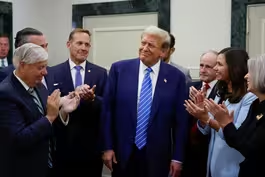
AMNA NAWAZ: In his first trip to Capitol Hill since the January 6 attack, former President Trump today met behind closed doors with congressional Republicans.
Republicans aimed to use the visit as a display of unity following Mr. Trump's conviction in his New York hush money case last month.
DONALD TRUMP, Former President of the United States (R) and Current U.S. Presidential Candidate: We have great unity.
We have great common sense, a lot of very smart people in this room and a lot of people that love our country.
AMNA NAWAZ: Following the meetings and a busy day on Capitol Hill is John Bresnahan, co-founder of Punchbowl News.
So, Bres, this is a former president who helped to incite a violent insurrection.
Last time he was on Capitol Hill, many other Republican lawmakers he was meeting with today were there that day running for safety.
How did they receive him today back on Capitol Hill?
JOHN BRESNAHAN, Punchbowl News: Well, it was interesting because there were two different meetings.
He met with House Republicans in the morning.
And that was kind of a -- more of a raucous meeting.
And then after there were some news stories about what happened, what he said there, he -- Trump seemed to take a more sober, serious approach when he met with Senate Republicans later in the day.
It was fascinating, because you did have, for instance, Senate Minority Leader Mitch McConnell, who was one of -- who fell out with Trump after the election in 2020, he made the serious sin of saying that Biden -- President Joe Biden actually won the election.
Trump went on to attack McConnell for a long time in really derisive terms.
He attacked McConnell's wife, former Transportation Secretary Elaine Chao, in racist terms.
But, today, McConnell and Trump shook hands and had a nice conversation.
You had on the House side -- you had -- for instance, you had Dan Newhouse, a member from Washington state.
He voted to impeach Trump after the January 6 insurrection.
Today, he attended the Trump event.
So this was bowing to reality.
Trump is the nominee.
He's the head of the party.
His stranglehold on the party remains.
And they -- Republicans -- if you want to get along in the Republican Party, you have to bow to Trump.
And that's the reality that they face today.
AMNA NAWAZ: There was a lot happening among lawmakers today.
I want to ask you, too, about Republican Senator J.D.
Vance's move today, pledging to block President Biden's judicial nominees and U.S. attorney nominations in what he called his response to the current administration's persecution of former President Trump.
We have seen previous Republican senators, Senator Tuberville, for example, block military nominations for months at a time.
Is this a path Republicans want to and are willing to go down again?
JOHN BRESNAHAN: Well, this is -- this is a little bit different.
What Vance and several other senators were saying today, they were going to expand their blockade against Biden nominations.
They already -- all judicial nominations and all U.S. attorney -- or almost nearly all U.S. attorney nominations, they already -- they already have to go through a -- they're already filibustered by Republicans.
But those are high-stakes nominations, and the Senate Democrats are willing to go to the floor and plow through those, go through the process.
It takes time, but they can do it.
What Vance said today was, we're going after even ceremonial nominations, like Barbara Lee to be on the U.N. -- Barbara Lee, a Democrat from California, to be on a U.N. advisory council.
I mean, this is ceremonial position.
This is a member of Congress.
These are usually things they give deference to each other on, and this should sail through unanimously.
But they're saying, if the Democrats want to do this, they're going to have to spend time on it.
And the right betting is that Democrats won't because they're going to try and focus on judicial nominations and other more important nominations.
What it is, is just another sign that they - - again, this is J.D.
Vance, who's of Ohio, the Republican senator from Ohio.
He is very interested in being vice president, and he is doing this to help himself with Trump, to help raise his status with Trump.
And so this is an important -- this was an important thing where he's trying to raise his own profile.
So that's what he was trying to do here.
Again, this just shows you how partisan things have gotten on Capitol Hill in an election year, a presidential election year, where the White House is up for grabs, the Senate and the Congress -- the House is up for grabs.
So everything is just a slugfest.
AMNA NAWAZ: Bres, I have less than a minute left, but I have to ask you about this other move.
A Democratic bill moved forward to protect IVF nationwide.
Republicans blocked it, except for two Republicans, who voted in favor of it, Senators Murkowski and Collins.
Senate Republicans then went on to sign a letter saying that they support IVF, that this bill was just too broad.
In short, is this still a politically vulnerable issue for them?
JOHN BRESNAHAN: Oh, yes, this is a very serious issue.
I mean, there was a vote on a contraception last week.
There's a vote on IVF today.
This is an issue that millions of Americans have.
And probably every American knows somebody who's -- have used IVF to help have a kid or have children.
And so there's a lot of support for this.
Republicans have said that they want to enshrine this in the law, but they don't want to do what the Democrats did.
So Republicans -- Democrats are using this to raise the issue on abortion and contraception and women's rights and that they -- that Republicans are -- want to march the country backwards.
And that's why these show votes, they're symbolic, but they're important.
That's why this is an important issue.
AMNA NAWAZ: John Bresnahan, co-founder of Punchbowl News, always good to see you.
Thank you.
JOHN BRESNAHAN: Thanks.
GEOFF BENNETT: In 2020, President Biden won Pennsylvania by less than two points.
For the president and his Republican rival, Donald Trump, winning Pennsylvania in November is key to winning the White House.
But some lifelong Republicans, frustrated by their party's embrace of Donald Trump, are getting involved downballot.
Our White House correspondent, Laura Barron-Lopez, has more -- Laura.
LAURA BARRON-LOPEZ: Thanks, Geoff.
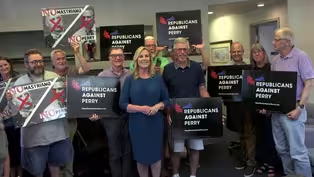
In South Central Pennsylvania, the "NewsHour" met up with GOP voters ready to make a point about the direction of their party.
Their focus?
The race for the 10th Congressional District.
In an election year, it is not unusual for a group of local Republicans to meet up.
But these Republicans are meeting to help elect a Democrat.
CRAIG SNYDER, Republicans Against Perry: We can't lose our ability to be outraged.
We need to be outraged.
LAURA BARRON-LOPEZ: Craig Snyder, a Republican political organizer in Pennsylvania, is gathering other like-minded conservatives in the state.
They are fed up with the 2020 election conspiracies and the unwavering loyalty to Donald Trump that have become defining features of their party.
To counter the former president, they are focusing their sites downballot.
The target?
Six-term Pennsylvania Congressman Scott Perry, a faithful Trump ally who spread lies that the 2020 election was stolen.
CRAIG SNYDER: How can he say that the conviction, the lawful due process conviction of Donald Trump, was worse for American democracy than the violent mob that stormed our Capitol, defecated in our Capitol?
LAURA BARRON-LOPEZ: Their group, Republicans Against Perry, is hoping to encourage moderate Republicans to back the Democratic contender.
JANELLE STELSON (D), Pennsylvania Congressional Candidate: The nation is watching this seat.
LAURA BARRON-LOPEZ: Janelle Stelson, who until this election cycle was a registered Republican and local news anchor.
JANELLE STELSON: When you pay attention to what Scott Perry has been doing, he is so extreme, he doesn't even vote with his Republican colleagues most of the time.
LAURA BARRON-LOPEZ: Perry, these Republicans argue, is an extremist who did much more than just vote to overturn the 2020 election results.
REP. SCOTT PERRY (R-PA): When votes are accepted under unconstitutional means without fair and equal protection for all, the only result can be an illegitimate outcome, illegitimate.
LAURA BARRON-LOPEZ: In the lead-up to January 6, Perry repeatedly pushed for Trump to install fellow election denier Jeffrey Clark as acting attorney general and was investigated for his efforts to subvert the 2020 election.
FMR.
REP. LIZ CHENEY (R-WY): As you will see, representative Perry contacted the White House in the weeks after January 6 to seek a presidential pardon.
Multiple other Republican congressmen also sought presidential pardons for their roles in attempting to overturn the 2020 election.
LAURA BARRON-LOPEZ: Last December, Perry was ordered to turn over more than 1,600 text messages, e-mails, and other communications to federal prosecutors investigating Trump's attempt to block the peaceful transfer of power.
Snyder hopes that voters see Stelson as a level-headed alternative to Perry, who didn't make himself available to "NewsHour" for this piece.
Voters in this district voted for Donald Trump in 2020.
They consistently have voted for Scott Perry.
So what makes you think that this time could be any different?
CRAIG SNYDER: This is not some member of the AOC Squad coming in to sort of impose progressivism on Central Pennsylvania.
This is a moderate who easily, in an earlier time, not that long ago, could have run as a Republican.
We know that there are enough Republicans in this district to split their tickets, because Josh Shapiro, our governor, carried this district against Doug Mastriano, another extremist MAGA candidate like Scott Perry.
Shapiro carried this district by 12 percent.
CHARLIE GEROW, Republican Strategist: Well, I began my career with Ronald Reagan.
LAURA BARRON-LOPEZ: But in a district that leans red, Perry supporters, like longtime Republican operative Charlie Gerow, are confident Perry will survive the challenge.
CHARLIE GEROW: He does a great job with constituent service, but he also mirrors the attitudes and opinions of the district.
His military service is something that people respect, and his conservative values all really work in that district.
LAURA BARRON-LOPEZ: We have encountered people who call themselves lifelong Republicans who say that part of why they're not supporting Scott Perry this time around is because of his efforts to overturn the 2020 election, his involvement in January 6 and around January 6.
What's your response to that?
CHARLIE GEROW: Well, the whole thing around January 6 is, in my judgment, merely a talking point, not anything that has real grounding in the district, because, if it was a significant factor, it would have shown two years ago, and it clearly didn't.
There have been folks that have said we're not for the Republican candidate who are Republicans for as long as I can remember.
They were against Ronald Reagan.
They were against George Bush.
Now they're against Donald Trump and Scott Perry.
But I'm going to tell you that, in the 10th District, Donald Trump's going to do very well, and Scott Perry's going to do exceedingly well.
LAURA BARRON-LOPEZ: Trump loyalists like Charlie might have history on their side, but ground in this competitive district could be shifting.
According to a recent poll conducted between late May and early June, Perry and Trump were leading their respective races, until a jury convicted the former president on 34 felony counts of falsifying business records.
Support for both candidates dropped in the district.
Perry's seven-point lead over Stelson fell to one point, a statistical dead heat.
The Republicans we spoke to voted for Perry in the past, but now see him as an extension of pro-Trump extremism.
Beyond January 6, some criticized Perry's votes against funding for Ukraine, Israel, and keeping the government open.
TIM SHOLLENBERGER, Republicans Against Perry: They're tired of people that won't cross the aisle to work with the other people, and they're tired of people that are so far one way or the other that they can't see any other point of view.
And that sums up Scott Perry's politics.
RON RUMAN, Pennsylvania Voter: Those extreme positions, I feel, are out of step with where I am and I think with many people in this area.
And I don't see that changing in the future.
So I think we need to have a change in our representative.
CRAIG SNYDER: We're trying to get 20,000 votes.
LAURA BARRON-LOPEZ: In the end, Snyder hopes his fight against Perry convinces more Republicans to reject the man who he feels made his party unrecognizable.
CRAIG SNYDER: Sometimes, if you can draw people to the ballot to vote for somebody in a lower office, a downballot office, that, once they have made that decision, they will carry the same sort of principles up the ballot as well.
If we can highly motivate people to vote against Perry, they may well decide that they can't at the same time vote for Trump.
We just have to give them a permission structure, tell them that other Republicans are doing this, that they are not becoming progressive Democrats by casting this vote.
LAURA BARRON-LOPEZ: But in a district that voted for Trump by four points in 2020, that could be a tall order.
Despite various attempts, Scott Perry did not sit down with us for an interview.
But we asked his campaign about the concerns raised by some Republican voters in his district.
His campaign spokesperson said in a statement to "NewsHour" that -- quote -- "Despite being targeted by D.C.'s radical left groups time and time again, the voters will again support him this November because they know his track record and that Scott Perry is working tirelessly for them."
GEOFF BENNETT: Laura, thank you for that reporting.
I want to shift our focus now and ask you about some news you broke earlier today about an executive action that President Biden is expected to take very soon.
Tell us about it.
LAURA BARRON-LOPEZ: So, next Tuesday, Geoff, the White House is going to hold an event that is marking the 12th anniversary of the Obama era Deferred Action for Childhood Arrivals, which protected migrants that were brought to the U.S. as children.
And six sources familiar told me, you, as well as our colleague Amna Nawaz, that they expect that the White House, that the president is going to announce an executive action that is going to shield certain undocumented migrants at that event.
And that expected executive action is going to specifically apply to undocumented spouses of U.S. citizens, will protect them from deportation, give them access to work permits, and likely ease their pathway to citizenship.
Now, sources also told me that those undocumented spouses that this executive action is expected to apply to would have to have been in the U.S. for roughly five to 10 years to receive this benefit.
And this action could also potentially protect some dreamers, those DACA recipients we just talked about, providing some of them some work visas.
GEOFF BENNETT: So how many people overall would potentially be affected by this?
LAURA BARRON-LOPEZ: Immigrant advocate groups have estimated about 1.1 million people could benefit from this, but sources close to the White House expect this executive action to be much more narrow in scope and it could affect around 500,000, instead of that 1.1 million.
And I should add that the White House, a White House official told me that there's no final decision has been made that this is still fluid.
But sources close to the White House really expect that, Tuesday, come Tuesday, the president is going to announce some protections for undocumented spouses of U.S. citizens.
GEOFF BENNETT: And, Laura, this could be -- have to underscore and emphasize the word could because it's still taking shape -- this could be the biggest relief program since DACA.
What's the expected political impact here?
LAURA BARRON-LOPEZ: And mentioning DACA, Geoff, that came out in June of 2012, President Barack Obama's reelection year.
He went on to win reelection that year.
But multiple Democratic polling firms told me that their polling shows that a majority of voters, some 74 percent, support this type of relief for undocumented spouses of U.S. citizens.
And Latino voters in battleground states, who are currently not supporting President Biden, move toward supporting him by double digits when they find out that he's considering this type of relief for undocumented spouses.
And, again, multiple sources also told me that President Biden's campaign and the White House is well aware of this data.
So this is something that they're clearly keeping in mind when they're looking towards this new potential executive action.
GEOFF BENNETT: Laura Barron-Lopez, thanks so much for this terrific reporting.
We appreciate it.
LAURA BARRON-LOPEZ: Thank you.
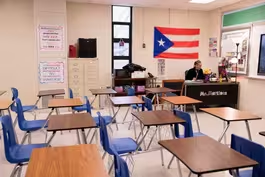
AMNA NAWAZ: Over the past decade, the number of school mass shootings has increased, leaving school officials across the country struggling with questions of how to best protect students and staff and secure campuses.
This past year, a number of states have either approved or are considering new measures that would allow a teacher to carry a gun in the classroom.
Polls show that the majority of Americans don't favor arming teachers, but there are varying views among parents, teachers and educators.
We're going to hear from some of them now before Stephanie Sy talks to an expert on school security.
ILEANA GONZALEZ, Teacher: I'm Ileana Gonzalez, and I live in Austin, Texas.
I have been a teacher for 22 years.
Thinking that people charged with loving and caring and guiding children would also be the people charged with shooting and killing the same child who might walk into their classroom one day, it's ludicrous.
I can't begin to imagine the day that I would be prepared to kill one of my own students.
I just can't.
JAN HUBLER, Retired Bus Driver: My name is Jan Hubler, and I live here in Oregon.
With all the school shootings that are going on, I think that it would just -- to have armed staff, trained armed staff, I should say, it would be an additional layer of protection for the kids.
ASDRUBAL QUINTERO, Teacher: My name is Asdrubal Quintero, and I live in New Orleans, Louisiana.
I do know that arming staff makes me extremely nervous.
That seems counter, like, productive for the goal of making sure that schools feel safe, especially considering that, like, statistics around people using guns and self-defense are very underwhelming.
AMY ATLAS, High School Parent: I am Amy Atlas, and I live in Valatie, New York.
My son is 16, goes to public school.
I don't think it should be required.
I think that's really an unfair thing to ask a teacher to take on.
But setting that aside, if you're a teacher, an administrator, and as long as you have the board's approval, I think it should be OK. ILEANA GONZALEZ: If we're going to pull out a wand, yes, I want legislation that improves the conditions around gun ownership and accessibility to gun ownership, period, end of story.
Teaching is a crazy hard profession.
It is super stressful.
It's underpaid, it's taxing.
It's -- you're emotionally exhausted.
You are physically exhausted at the end of the day.
I can't imagine also being combat-trained and, like, having to find the wherewithal to manage yourself in a combat setting.
JAN HUBLER: There are procedures and protocols in schools right now that, since we live in a rural area, where we have no local police force, we have to call and get a dispatch to come down.
So it's half-hour before we have anybody here.
I mean, there are state police in the area too, but it's going to take a while.
They are about a half-hour away to the other end.
And so I think it would be a good thing for us to have in our schools.
ASDRUBAL QUINTERO: So many of view, like, students as our own kids.
Like, the very idea of having to shoot a child is like - - I really -- I would be very, very shocked to see the teacher, or even a shooter, who'd be willing to do that.
AMY ATLAS: Maybe a license isn't enough.
Maybe they need to go through another sort of training that's specific to school and when you should, when you shouldn't, that kind of thing.
ILEANA GONZALEZ: There's also the logistical component involved in what it would take to actually arm teachers.
It would be an expense, not just in terms of the firearm, but the amount of training that would also need to be paid for, but also just the time investment.
ASDRUBAL QUINTERO: I do feel like most people, staff, students, families, would be extremely uncomfortable with the idea of admin or staff at school being armed and being the first line of defense against a school shooter.
The reckoning that a lot of us have kind of come to terms with as teachers is, like, we don't really know what the solution is, like, at all.
And that's kind of what makes it really scary.
STEPHANIE SY: In recent months, Tennessee and Iowa have joined more than two-thirds of states that allow teachers to carry guns in public schools when permitted by their school districts.
There are 16 states, plus the District of Columbia, that have laws that prohibit teachers from carrying guns at school.
For more on the implications of these policies, I'm by Kenneth Trump, president of national school safety and security services.
Ken, you're a school safety consultant.
You have testified before Congress.
Putting aside the fact that the powerful NRA lobby is behind arming teachers at schools, is there a valid argument that arming teachers may deter school shootings?
KENNETH TRUMP, President, National School Safety and Security Services: Well, we find that the vast majority of teachers want to be armed with technology and textbooks, but not firearms.
And in those states that have authorized it, there's a big difference between authorizing it, making it legal to do it, versus those that have actually taken up the law and decided to actually do so.
We're finding a very small number of school districts and states are allowing that to happen.
It's just not something that's on their agenda.
Look, if we're talking about arming teachers and support staff, we're talking about tasking them with performing a public safety function.
We would want a trained, certified public safety professional, a police officer, to take on that role, just like we want a trained, certified teacher to teach in the classroom.
We wouldn't take a police officer off the street at midnight shift in the back alley, give them a couple dozen hours of training and say, you're now a second grade teacher, enjoy the rest of your career.
STEPHANIE SY: So are you saying that the policy is hard to implement, but not necessarily ineffective or bad policy?
KENNETH TRUMP: Well, it is a bad policy, in my opinion, because it's a high-risk, high-liability proposition.
And the key is just what you said, implementation.
If you listen to the voices of those teachers, they have brought out some really important issues of implementation, not just the law, but how would it work in a school on a day-to-day basis?
The one powerful statement about, you're asking me to take a kid that I love support, nurture, and feel like the parent for that day during the school day, and then say that I might have to turn around and shoot and kill them.
There's a psychological piece to this, because training someone for a couple dozen hours on how to shoot, clean, and holster the gun is a lot less than what we require of our trained public safety professionals out in the community or police officers, right, with use of force continuum, shoot, don't shoot.
What's the scenario?
How do you gauge the situation?
How are you evaluating it?
What intermittent steps can you take to de-escalate without having to immediately turn to the firearm?
And then just how would it work during the day?
Where are the teachers who are going to store their guns?
How are they going to have -- who's going to have access to those?
And, lastly, who's going to be managing all this?
The principal is now the de facto police chief, in addition to the principal, to make sure that teachers have the current certification, the right firearm, the right qualifications and training, the right type of ammunition, that they're carrying it right, how - - what procedures for disciplinary.
You start getting into these weeds, and it's a really big task, in addition to being educators and administrators during the day, that really goes beyond a reality of fidelity of implementation if somebody picks that up.
So there's a lot more than saying you can do it.
The question is, how would you do it?
And I say, it's very problematic.
STEPHANIE SY: On the other extreme, Ken, you have these states that have issued blanket bans prohibiting teachers from carrying firearms in their school?
Is that good policy?
Because, in that piece, you also heard from that rural teacher, who said the police are half-an-hour away.
And proponents of arming teachers say, shouldn't that teacher have the right to carry a gun for her own self-defense and to defend her students?
KENNETH TRUMP: That's one of the biggest argument is -- comes from rural areas, where you have small or sometimes very, very tiny police departments that are far, far away.
My answer to that is that we have school resource officer programs, police officers in school.
If it's that big of a priority to have an armed presence on campus, then invest your district resources.
Some states, many states now actually put on additional levies where voters can vote to determine if they want to pay additional security costs, and bring yourself a dedicated full-time officer for your school or school district on a day-to-day basis who will be there.
Put your money into that priority, but do it right.
And it's an issue of not having -- you can't have it both ways.
You can't -- and think about it.
We're asking -- in many school communities today, it's a very contentious issue of having police in school, period, especially after the murder of George Floyd.
I think there are very conflicting messages.
I think the argument for having an armed presence on campus is the trained, commissioned certified police officer with the appropriate model, the right officer and the additional training.
If you're going to do it, do it right.
STEPHANIE SY: Kenneth Trump, a school safety consultant, thanks so much for joining the "NewsHour."
KENNETH TRUMP: Thanks for having me, Stephanie.
GEOFF BENNETT: In 2022, Steve McQueen, the British-born son of Caribbean immigrants, was knighted for his work as a filmmaker and artist, the two worlds in which he's achieved commercial and critical success.
His latest work takes his art in yet another new direction.
Jeffrey Brown recently joined McQueen for a look for our arts and culture series, Canvas.
JEFFREY BROWN: An enormous hall, bathed in slowly shifting colors, filled with improvised music created by bass instruments.
It can feel like walking through a strange city or dreamscape, like scenes from the pandemic or being inside an immense abstract painting.
STEVE MCQUEEN, Academy Award-Winning Filmmaker: It's a space to reflect.
It's not a mirror.
It's a space where things are bouncing off you as a viewer, and you can expand it into something more, because so many things come into your head, the fact that you bring in history, you bring your past into that space, and you are engaged in that moment.
JEFFREY BROWN: So I'm part of this art?
STEVE MCQUEEN: How can you not be?
How can you not be?
JEFFREY BROWN: Steve McQueen is best-known for his films.
he's the Academy Award-winning director of 2013's "12 Years a Slave," earlier movies, including "Hunger," more recently, the "Small Axe" series, and the documentary "Occupied City" about Amsterdam during World War II.
But he first made his name in the 1990s for his art.
And at the Dia Beacon Museum, a converted Nabisco box factory on the Hudson River in Beacon, New York, he once again straddles both worlds.
STEVE MCQUEEN: I always equate art as poetry and film as the yarn, as a novel,using the same tools, doing virtually the same thing, but doing it differently.
JEFFREY BROWN: And so you're not interested in labels, if I ask you, do you see yourself as an artist or as a filmmaker or... STEVE MCQUEEN: I do stuff.
JEFFREY BROWN: I do stuff?
STEVE MCQUEEN: I do stuff.
No, I'm very privileged to do stuff, and I work very hard because I know I'm privileged.
I'm allowed to do stuff in order to sort of have an understanding or have some kind of feeling of what work could be.
JEFFREY BROWN: Most of his previous artworks are video installations, shown here in still photos, and use recognizable images.
The installation at Dia Beacon titled "Bass" in a 30,000-square-foot basement space is perhaps his most abstract work yet, one chief material, light, a longtime fascination for McQueen.
Here, he has 60 light boxes subtly change color through the spectrum every 28 minutes.
STEVE MCQUEEN: The whole idea of the intensity of light, which makes -- that makes color and the whole idea of what we see in our perceptions and so forth and whatnot.
And I was just interested in having -- I wanted it all.
I wanted the color to encapsulate everything.
And, of course... JEFFREY BROWN: When you say you wanted it all, you mean all of the lights and all the changes?
STEVE MCQUEEN: Everything that surrounds us.
Again, it's a kind of dawn-to-dusk thing.
You want to sort of embrace it, but, of course, it's impossible.
But light is the thing which sort of, in some ways, can illustrate that.
JEFFREY BROWN: The light and colors bring out the space in new ways, the cracks in the old floors, the surfaces of pillars, the history of what was once a place of work and workers.
McQueen's other main material here, sound, improvised music filling the space from three speaker stacks by five musicians from different parts of the African diaspora who play different kinds of electric and acoustic bass instruments.
They got together to record this three-hour-plus soundtrack in the exhibition space.
STEVE MCQUEEN: It's the sort of base of most music.
It's the backbone.
But I wanted to bring that thing which is usually in the background into the foreground and have five bassists.
JEFFREY BROWN: In fact, while this may be an abstract, image-free work, McQueen began it with his own narrative in mind, a story of trauma, of limbo and passage, the so-called Middle Passage, the transatlantic voyage that brought enslaved Africans to the America's, including the voyages of his own family from Africa to the Caribbean to England.
STEVE MCQUEEN: I was thinking about how Black people are post-apocalyptic people.
JEFFREY BROWN: Post-apocalyptic?
STEVE MCQUEEN: In the sense that we've had to invent and reinvent ourselves, this transatlantic crossing, the sort of Middle Passage, just a space of limbo, as it were, and, therefore, what that journey entails, but what -- of course, the horrors of it, but also the sort of what was positive about it in some ways.
I mean, nothing was positive, but, at the same time, how people survived it.
I mean, I am here sitting with you, opposite you as an example of that survival.
JEFFREY BROWN: But McQueen wants us to take our own walk and bring our feelings and history to the experience.
Dia Art Foundation curator Donna De Salvo worked with him on this commission, a partnership with a Swiss museum.
DONNA DE SALVO, CURATOR, DIA ART FOUNDATION: I think it's also about what art can do, you know, the experience.
And I kind of like that there's, in a way, not this standard image that you might imagine would be, because there's an openness to that.
I mean, actually, in its way, it's very much about the viewer and what they want to bring in.
You're not told what to do.
You're not told what to think.
You're not told how to move.
But there are conditions that are created here, inevitably, by the artist that he wants you to have an experience with and respond to.
JEFFREY BROWN: McQueen puts it this way: STEVE MCQUEEN: Everyone tries to cling onto narrative, because it's almost like the safety rails in a swimming pool, because if you soon let go, my God, I'm floating, I don't know what to do, dah, dah, dah, dah.
JEFFREY BROWN: lit helps us find a way.
STEVE MCQUEEN: Yes, but you have to feel comfortable with floating because you can actually float, let go, unclutch, feel it, relax, lay into it, feel what you feel.
Again, I feel that is sort of the key to experiencing the work.
Things emerge.
Heavy stuff emerges.
JEFFREY BROWN: "Bass" remains on view into April of next year.
Steve McQueen's next work, a dramatic film set amid the London Blitz in World War II.
For the "PBS NewsHour," I'm Jeffrey Brown at Dia Beacon in Beacon, New York.
AMNA NAWAZ: Remember, there's more online, including our communities correspondent Adam Kemp's look at how Oklahoma researchers are trying to send severe weather alerts in more languages.
GEOFF BENNETT: And join us again here tomorrow night, when David Brooks and E.J.
Dionne weigh in on the week's political headlines.
And that is the "NewsHour" for tonight.
I'm Geoff Bennett.
AMNA NAWAZ: And I'm Amna Nawaz.
On behalf of the entire "NewsHour" team, thank you for joining us.
G7 backs using frozen Russian assets to aid Ukraine
Video has Closed Captions
Clip: 6/13/2024 | 8m 40s | Biden, Zelenskyy sign security pact as G7 backs using frozen Russian assets to aid Ukraine (8m 40s)
How some Pennsylvania Republicans protesting party extremism
Video has Closed Captions
Clip: 6/13/2024 | 10m 28s | How some Pennsylvania Republicans are using a congressional race to protest GOP extremism (10m 28s)

Inside filmmaker Steve McQueen's new immersive art exhibit
Video has Closed Captions
Clip: 6/13/2024 | 7m 7s | Inside Oscar-winning filmmaker Steve McQueen's new immersive art exhibit (7m 7s)
Parents, educators weigh in on safety and arming teachers
Video has Closed Captions
Clip: 6/13/2024 | 9m 50s | Parents and educators weigh in on school safety as more states arm teachers on campus (9m 50s)

Supreme Court rejects challenge to mifepristone
Video has Closed Captions
Clip: 6/13/2024 | 2m 59s | Access to mifepristone remains unchanged as Supreme Court rejects abortion pill challenge (2m 59s)
Trump visits Capitol Hill to meet with GOP lawmakers
Video has Closed Captions
Clip: 6/13/2024 | 5m 54s | Trump visits Capitol Hill for first time since Jan. 6 to meet with GOP lawmakers (5m 54s)
Providing Support for PBS.org
Learn Moreabout PBS online sponsorship
- News and Public Affairs

FRONTLINE is investigative journalism that questions, explains and changes our world.

- News and Public Affairs

Amanpour and Company features conversations with leaders and decision makers.











Support for PBS provided by:
Major corporate funding for the PBS News Hour is provided by BDO, BNSF, Consumer Cellular, American Cruise Lines, and Raymond James. Funding for the PBS NewsHour Weekend is provided by...