
January 9, 2024 - PBS NewsHour full episode
1/9/2024 | 56m 45sVideo has Closed Captions
January 9, 2024 - PBS NewsHour full episode
January 9, 2024 - PBS NewsHour full episode
Problems playing video? | Closed Captioning Feedback
Problems playing video? | Closed Captioning Feedback
Major corporate funding for the PBS News Hour is provided by BDO, BNSF, Consumer Cellular, American Cruise Lines, and Raymond James. Funding for the PBS NewsHour Weekend is provided by...
Support provided by:

January 9, 2024 - PBS NewsHour full episode
1/9/2024 | 56m 45sVideo has Closed Captions
January 9, 2024 - PBS NewsHour full episode
Problems playing video? | Closed Captioning Feedback
How to Watch PBS News Hour
PBS News Hour is available to stream on pbs.org and the free PBS App, available on iPhone, Apple TV, Android TV, Android smartphones, Amazon Fire TV, Amazon Fire Tablet, Roku, Samsung Smart TV, and Vizio.
Providing Support for PBS.org
Learn Moreabout PBS online sponsorshipAMNA NAWAZ: And I'm Amna Nawaz.
On the "NewsHour he's immune from criminal charges# stemming from his time in office.
GEOFF BENNETT: The Pentagon reveals Defense# Secretary Lloyd Austin is being treated for## prostate cancer.
The fallout from his undisclosed# surgery and subsequent hospitalizat AMNA NAWAZ: And 2023 blows past the# last record for the hottest year and## nears a critical global warming threshold# that countries have been trying to avoid.
RADLEY HORTON, Columbia University Climate# School: There's growing concern among scientist## that we may have underestimated# just how sensiti the Earth's temperature is to# greenhouse gases as they increase.
(BREAK) AMNA NAWAZ: Welcome to the "NewsHour."
Donald Trump was in court in Washington, D.C.,## today, while his attorneys argued# the former preside federal prosecution connected to the# January 6 attack on the U.S. Capitol.
GEOFF BENNETT: The three-judge appeals panel# seemed skeptical of the Trump legal team's## argument that Trump was acting in his official# capacity as president to -- quote -- " election integrity" when he undermined the# results of the 2020 presidential election.
JUDGE KAREN HENDERSON, D.C.
Circuit Court# of Appeals: I think it's paradoxical to## say that his constitutional duty# to take be faithfully executed allows# him to violate criminal laws.
GEOFF BENNETT: NPR justice correspondent Carrie## Johnson was at the courthouse Carrie, thanks so much for being with us.
And we should say the case is the presidency and the powers of the# presidency.
How did Mr. team argue that he should be immune# from criminal charges related to his## efforts to overturn the election?
What# was the case that made in court today?
CARRIE JOHNSON, NPR: Trump lawyer,# John Sauer, made a number of arguments.
One is that the role of judges to review some of# these issues should be, in Another essential argument he made was that# presidents can only be prosecuted if they have## already been impeached and convicted by the U.S.# Senate, even in the most extreme of circumstances.
And Sauer also pointed out that were these# judges to disagree and open an avenue for## criminal liability for former presidents,# that that would open the floodgates to lots of## recriminations and tit for tat from administration# to administration of differing political parties.
GEOFF BENNETT: And the judges peppered# Trump's legal team with questions trying## to test this immunity theory, with one# judge asking if a president could or the killing of a political rival and# get away with it as an official act.
JUDGE FLORENCE PAN, D.C. Circuit# Court Of Appeals: Could a president## who ordered Seal would he be subject to criminal prosecution?
JOHN SAUER, Attorney For Donald Trump:# If he were i JUDGE FLORENCE PAN: So your answer is no?
JOHN SAUER: My answer is qualified yes.# ha ve to occur under our -- the# structure of our Constitution,## which would require impeachment# and conviction GEOFF BENNETT: So, Carrie,# there's no precedent here.
Donald Trump is the first fo criminal charges.
What will# inform these judges' CARRIE JOHNSON: Well, history# is a guide here, Geoff.
No former president has been charged, b a pardon from his successor, Gerald# Ford, which acknowledges some sense## of criminal liability on his behalf and# concern about potential criminal action.
And one of the judges in this case, Michelle# Childs, also asked Trump's lawyer in this case## why Trump's lawyer in the impeachment over January# 6 conceded that he shouldn't be impeached there,## but that there should be a role for the# justice system to play criminally thereafter.
Judge Childs couldn't get the lawyer to understand# the distinction there or acknowledge it.
And there is a real contradiction the judges were# grappling with today over the sweeping nature of## Trump's arguments versus the reality on the ground# in some of these very extensive hypotheticals.
GEOFF BENNETT: And, Carrie, you# mentioned earlier that Trump's## lawyers argued that prosecuting Mr.# of inditing former presidents for# actions they took while in office.
How did the special counsel's team# respond to that argument in particular?
CARRIE JOHNSON: The special counsel# lawyer, James Pearce, basically said,## this has never happened before in a couple hundred# years of America happened now is because of the unprecedented# actions of former President Donald Trump,## who now faces two federal indictments,# this one in D.C. over January 6,## and another in Florida over materials he# allegedly refused to return to the FBI and## stored at his resort in really unsecure# areas of that facility, Mar-a-Lago.
And so James Pearce said that were the court# to accept Trump's view of his sweeping power,## even post-presidency, it would present a really# frightening, astonishingly frightening future for## the country, that presidents would have a license# to commit crimes and get away with it, basically.
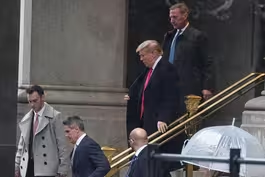
GEOFF BENNETT: We should note that Donald# Trump attended this hearing today.
It's## an indication of how his campaign strategy# is intertwined with You see a courtroom sketch of him there.# What was it like inside the courtroom?
CARRIE JOHNSON: Yes, Trump entered a few# minutes before the hearing began around 9:30.
He was relatively quiet.
He wrote some# notes to his attorneys.
The only thing## people could hear him say was "Should I# sit here or is this where I sit?"
to his## legal team.
And he held his fire until# after he left the courthouse.
He went## to a hotel and then raised concerns about# the political nature of his prosecution.
Of course, there's no evidence that# the current president, Joe Biden,## played any role in this case, none whatsoever.
GEOFF BENNETT: And a ruling could# come within days, as I understand from this three-judge panel.
What happens next?# The lo CARRIE JOHNSON: That's right.
matters how quickly the court directs him# to act to take up an appeal either with a## full D.C.
Circuit Appeals Court or at the Supreme# Court.
Remember, this trial was set to start March 4.
That seems unlikely now.
But prosecutors# do want to get it going before the election.
And how quickly the appeals court rules# and what they say Trump can and can't do## next could determine whether Trump# faces any trials before November.
GEOFF BENNETT: NPR's Carrie Johnson.
Always a pleasure to CARRIE JOHNSON: Thank you.
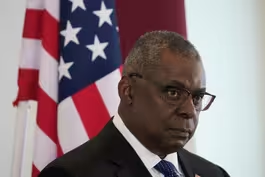
AMNA NAWAZ: The Pentagon and Walter# Reed medical center today revealed## that Defense Secretary Lloyd Austin# is suffering from prostate Au stin's doctors say it was detected early,# and his prognosis is -- quote -- "excellent.
"## But there remains a chorus of criticism# about why Austin withheld his diagnosis## and much of his treatment for so long# from the public and the president.
Nick Schifrin has been following this story.
Nick, let's start with the secretary's# doing?
And why are we just learning# about this cancer diagnosis now?
NICK SCHIFRIN: So, on your first question,# Austin's doctors say they expect a full recovery although they also said -- quote# -- "This can be a slow process."
But there is no real answer to the second# question, and that is why all of this criticism that you just# referenced.
And to understand that,## let's go through the timeline# again, as we did last night.
In early December -- that's one month# ago -- Austin learned he had ca ncer.
On December 22, he underwent a# prostatectomy, the removal of part or## all of the prostate under general anesthesia,# and transferred his authorities to his deputy.
On January 1, he was admitted to the ICU# at Walter Reed with what his doctors would## diagnose as a urinary tract infection# and fluid in his abdomen.
On January 2,## he again transferred his authorities to his# deputy, but didn't say why.
And on January 4,## he informed the National Security Council# and his deputy about the hospitalization.
And, finally, January 5, he makes his# first public statement, and at no point## during that entire process, Amna, did he say# or admit that he had prostate cancer.
Take listen to the spokespeople today of the Defense# Department and the National Security Council,## Major General Pat Ryder and John Kirby,# admitting how in the dark they have been.
MAJ. GEN. PATRICK RYDER, Pentagon# Press Secretary: As soon as we had## this it.
We got it this afternoon and provided it# literally minutes before JOHN KIRBY, NSC Coordinator For# Strategic Communications: Nobody## morning.
And the president was informed# immediately after we were informed.
NICK SCHIFRIN: The Pentagon has cited the# fact that Austin -- that Austin's chief## of staff had the flu for the reason why# some of the delay, but t an explanation for why Austin did not admit# he had cancer at any point in the last month.
AMNA NAWAZ: We're so glad he# has an excellent prognosis.
NICK SCHIFRIN: Yes.
there seems to beg a lot more questions.
What's been the response among lawmak NICK SCHIFRIN: Very, very House Armed Services Chairman Republican Mike# Rogers today launched a formal inquiry.
He accused## Austin of -- quote -- "concealing" the fact that# he was incapacitated.
Today, the top Senate Armed## Services Republican, Roger Wicker, accused Austin# of a -- quote -- "clear violation of the law."
Even Democratic Chairman of the# Senate Armed Services Committee## Jack Reed today called for transparency and# accountability from th AMNA NAWAZ: So, bipartisan criticism there.
What's the administration NI CK SCHIFRIN: The administration is releasing# of the concerns.
The White House released a memo# obtained by "PBS NewsHour" by the chief of staff## laying out requirements for any Cabinet secretary# to inform the chief of staff as -- if he or she,## those Cabinet secretaries, are# unable to perform their duties.
The Pentagon last night issued new# requirements expanding the list pe ople who have to be informed when the# secretary has to transfer his duties## and also requiring the disclosure of the# reason.
Those were not required before.
And## both the White House and the Pentagon are# launching reviews that will last 30 days.
But congressional officials I talked to# today said that that is not enough and## there is still no answer, as we said, for# why the second in the military chain of## command withheld the fact that he had# prostate cancer for the last month.
AMNA NAWAZ: Looks like we will# be following the story ahead.
Nick Schifrin, thanks, as al NICK SCHIFRIN: Thanks very AMNA NAWAZ: In the day's other headlines:# Winter storms battered much of the country,## with everything from tornadoes to blizzards.# One system killed at least three the south.
Heavy rain and several reported# twisters struck the floor at a Panhandle.
Hurricane-force winds peeled roofs off# homes, downed trees and knocked out## power to thousands.
In the Midwest, more than# half-a-foot of fresh snow fell in some areas,## disrupting travel.
Interstates and# schools were closed in several states.
Senate Republicans signaled today that Congress# will need to pass another short-term funding bill## to avoid a partial government shutdown.
They have# agreed on overall spending, but need more time## to pass 12 individual appropriations bills.# Senate Minority Leader Mitch McConnell said## a short-term continuing resolution would get# them passed the looming January 19 deadline.
SEN. MITCH MCCONNELL (R-KY): They have a top-line# agreement.
In the meantime, we need to prevent a## government shutdown.
And so the obvious question# is, how long does the C.R.
need to be?
And that## will be up to the majority leader and the# speaker to determine the length of the C.R.
AMNA NAWAZ: Republican House Speaker# Mike Johnson has said he would oppose any## further short-term funding bills.
He did not# immediately comment on today's develo The president of Ecuador says his nation# is in a state of internal armed conflict## tonight.
That comes after masked men broke# into a public television station with guns and## shouted they had bombs.
Police said later they'd# arrested all the intruders.
The president said## he's designating 20 drug gangs as terror groups# and ordering the military to neutralize them.
In Ukraine, the power grid operator reports# more than 1,000 towns have lost power## amid Russian attacks on the electrical# grid.
Scenes of damage are widespread,## and authorities say more than 500 drones and# missiles struck Ukraine just over New Year's## weekend.
A Ukraine air force official# says air defenses are stretched thin.
A new South Korean law will ban the# centuries-old practice of raising and## selling dogs for food.
Parliament voted today# to ban the production and sale of dog meat.## Animal rights groups pushed for the change, but# reactions among the general public were mixed.
LEE SOO-JIN, South Korea Resident: I'm# raising my children and a dog together.## The dog is my third child.
I'm so glad# the bill was dog meat should never happen again in the future.
KIM BONG-OK, South Korea Resident (through# translator): I don't eat dog meat,## but it's been It's not like everyone is consuming# it.
It's just a matter of preference.
AMNA NAWAZ: The law is set to take# effect after a three-year grace period.
NASA has decided to delay sending astronauts# to circle the moon until 2025.
That's a year## later than planned.
An attempt at a human# landing on the moon is also being pushed## back to 2026.
Meanwhile, a Pittsburgh# company gave up today on trying a moon## landing with a robotic craft.
It launched# Tuesday, but a fuel leak ended its chances.
On Wall Street, stocks lost Monday's momentum.# The Dow Jones industrial average shed nearly 158## points to close at 37525.
The Nasdaq rose# 14 points, but the S&P 500 slipped seven.
And Michigan is polishing its first college# football championship trophy since 1997.
The## Wolverines cemented an undefeated season last# night, beating the Washington Huskies 34-13.## Afterward, white and gold confetti showered# the field in Houston, as coach Jim Harbaugh## and his players celebrated.
Back in Ann Arbor,# bars filled with students erupted in cheers.
Still to come on the "NewsHour": the increasing# risk of criminal charges for women who experience## a miscarriage; a revelatory eyewitness account# of the Ukrainian resistance against Russia's## invasion; and how women's sports are# breaking into mainstream media coverage.
GEOFF BENNETT: Secretary of State Antony Blinken# is back in Israel for his fourth visit since the## war with Hamas started three months ago.
It's# part of a long regional tour that has Blinken## walking an increasingly narrow diplomatic line,# as he tries to keep the conflict from spreading.
William Brangham reports.
WILLIAM BRANGHAM: When he arrived in Israel,## the secretary of state bore a smile, b East are demanding an end to the fighting in# Gaza and a clearer focus on what comes next.
ANTONY BLINKEN, U.S. Secretary# of State: I have just come from,## a number of countries in the Sa udi Arabia, and I want to be able to share# some of what I heard from those leaders with## the president, as well as with the prime# minister and the Cabinet later today.
WILLIAM BRANGHAM: But in Tel Aviv, Israeli# leaders aren't ready t Defense secretary Yoav Gallant told Blinken# that while military strategies in the north of## Gaza have shifted, operations in the south and# center of the strip will intensify.
Displaced## Gazans in Khan Yunis, desperate to escape the# fighting, sent a plea to Blinken for help.
ENAAM IBRAHIM HIJAZI, Displaced Palestinian# (through translator): My message to the U.S.## secretary of state even if to a tent.
It's better than here.
WILLIAM BRANGHAM: Blinken received promises from# Middle E but only if an eventual Palestinian# state can exist alongside Israel,## something Prime Minister Netanyahu# has said he will not allow.
ANTONY BLINKEN: Israel must be# -- must stop taking steps that## undercut Palestinians' ability to govern# violence carried out with impunity,# settlement expansion, demolition,## evictions all make it harder, not easier, for# Israel to achieve lasting peace WI LLIAM BRANGHAM: Defending Israel# to the global community has become## an increasingly lonely position for the# U.S. Today, the U.K.'s for David Cameron, said Israel might# have committed war crimes in Gaza.
DAVID CAMERON, British Foreign# Secretary: If you're asking,## am this particular premises has been bombed or# whatever, yes, of course, I'm worried about## that.
And that's why I consult the Foreign Office# lawyers when giving this advice on arms expo WILLIAM BRANGHAM: As Israel continues# its assault on Southern and Central Gaza,## Palestinians seeking shelter# have nowhere left to go.
ABU YOUSSEF ABUEL-SOUD, Displaced Palestinian# (through translator): This is the fourth time## I have dismantled the tent children and my grandchildren.
We are# leaving.
We do not know what awaits us.
WILLIAM BRANGHAM: As fuel supplies dwindle, donkey## carts have become one of the only ways Gazans# can tr On a bench outside Central# Gaza's Al-Aqsa Hospital,## this aunt grieved the death of her 2-year-old# nephew, Ahmad Issa Shahin (ph).
The li boy was brought lifeless to the hospital.# The rest of her family's fate is unknown.
SUHAD, Displaced Palestinian (through translator):# I don't know if my sister, or her children or my## if my father is coming.
I'm waiting for them, but# DR .
JAMAAL NAIM, Lost Family in Airstrike# (through translator): We found only some## skin from my d We didn't find anything else.
May God# rest her soul.
She was a top WI LLIAM BRANGHAM: Dr. Jamaal Naim carried the# remains of his dead daughter here.
He's lost three## children, three grandchildren, and his mother, all# killed in their sleep when their home was bombed.
DR JAMAAL NAIM (through translator): We have# no one except Allah.
On the day of judgment,## we're going to hold the Israelis to account,## the Arabs and all the Muslims in front of# WI LLIAM BRANGHAM: Nearby, another# burial for another child.
Dr.## Mohammad Abu Jayyab's sister's home# was bombed, killing her 3-year-old son.
MOHAMMAD ABU JAYYAB, Displaced Palestinian# (through translator): They say leave midtown## and go to Deir.
People don't know where to go and what to do.
WILLIAM BRANGHAM: "Hand him to me, I# won't cry," his sister promised.
But## no amount of kisses are enough# for a mother's final farewell.
For the "PBS NewsHour," I'm William Brangham.
AMNA NAWAZ: 2023 was the hottest# year on record, by a long shot.
Europe's top climate agency released# data today showing global temperatures## averaged 1.48 degrees Celsius or 2.66# degrees Fahrenheit above preindustrial## levels.
Record high temperatures# are expected to continue this year.
For more on the implications of this record heat,## I'm joined by Radley Horton.
He's professor# Radley, welcome back.
So, the planet didn' shattered previous records.
Did we expect# to see that kind of increase this quickly?
RADLEY HORTON, Columbia University# Climate School: No, we did not.
At this point, w gotten used to hearing this is the ninth# straight, the nine last years have been the## nine warmest on record.
But what we had happen# this year is that, over the last six months,## we were half-a-degree Fahrenheit height# warmer than any of those previous years.
So you could think of it like all the# previous years were stacked pretty close## together.
And along comes a year in# 2023 where the last six months were a## full half-a-degree warmer than any of those# previous years.
So this was not expected.
AMNA NAWAZ: So how do we account for that?# What drove that increase this past year?
RADLEY HORTON: Yes, well, we have# to start -- there's a few factors,## but we have to start with human# activities, the We're putting so much more heat in the system,# and there's growing concern among scientists## that we may have underestimated# just how sensitive the climate,## the Earth's temperature is to greenhouse gases as# they increase.
Are models missing some pro But there are some other things going on# besides that -- those human activities.## We had a very -- a moderately strong# El Nino that's under way right now.## That can be responsible for some warming of the# planet, but not this much.
And then, simi we had a volcanic eruption under the ocean that# actually put water vapor up into the atmosphere,## which, unlike most volcanoes, is effective# to some degree at warming the planet, but,## again, couldn't anywhere come close to explaining# this degree of shattering of previous records.
AMNA NAWAZ: So we know global# warming doesn't just mean more## heat and hotter records.
We know it also# means more ext have we been seeing those?
Where is it# becoming real for these communities?
RADLEY HORTON: Yes, and there's so many examples.
I will highlight some of the ju st as the global average temperatures# did.
You look at the degree of so these heavy rain events, these tragic# floods in 2023, like we saw in Libya,## for example, in Greece, certainly# heat waves front and center, right?
We saw exceptional heat across# Southern Europe, across China,## across the Southern U.S.
So this is# hugely impactful for our economies,## for our ecosystems.
How about the forest fires# that we saw across Canada?
By some estimates,## four times more burned area than ever before# seen in Canada.
It's directly related to the## planet warming, more than we thought it could,# causing the air to dry out and essentially suck## moisture out of that vegetation, priming# the pump for these really extreme fires.
AMNA NAWAZ: And we should underscore,## we're ta I want to point out the U.S. alone had 28# weather disasters last year.
The combined## damage killed 492 people and caused# nearly $93 billion in damage.
In short,## can we afford to continue at this pace?
RADLEY HORTON: Well, no, we can't.
We have to urgently reduce our We can see it by looking at the damages# this past year, economic and loss of life## and some of those things that don't# get captured by metrics like GDP.
But the additional concern, as you note,# because this year was so much warmer tha prior years and because of growing evidence# that we may have underestimated how vulnerable## we as a society are to a little bit higher# temperatures, it's becoming clear that,## if we want to avert these worst-case scenarios# and possible really catastrophic outcomes that are## beyond what our climate models or our financial# models or our crop models tell us is possible, we## need to urgently reduce emissions and we have to# adapt to these climate changes that are under way.
AMNA NAWAZ: Radley, that 1.48 degree# increase is just barely below the## 1.5 degrees limit that the world agreed# upon as what they would like to avoid to,## as you mentioned, avoid those worst-case# scenarios and the most severe outcomes.
We talk about the tipping point a lot.
Is this it?
RADLEY HORTON: Well, I'd say we don't# need to focus exactly on Really, the key takeaway, I think, is that we# are failing terribly at reducing our emissions.## But you're right that it's becoming# more and more clear than it was just,## say, five years or so ago that getting to# 1.5 degrees is catastrophic for We have underestimated how vulnerable# our systems are.
We have underestimated## how quickly these extreme events like heat# waves and heavy rain are going to change.
So, in that sense, whether it's a tipping point or# not, we're way more vulnerable than we and it's even more urgent than we thought# that we dramatically reduce our emissions.
AMNA NAWAZ: Radley Horton, professor at# Columbia University's Climate School,## thank you so much for joining us.
RADLEY HORTON: Thank you.
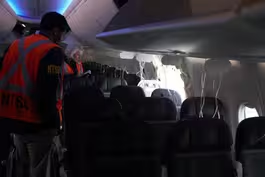
GEOFF BENNETT: We are learning more about# what went wrong when a door panel blew## off an Alaska Airlines flight midair.# Officials are looking into whether fo bolts that were supposed to hold the# panel in place were actually missing.
The investigation grounded at least 170# other planes from Alaska and United Airlines,## and it's leading to many questions# about Boeing and the role of the FAA.
Jon Ostrower covers this all closely as# the editor in chief of The Air Current.## That's a site with reporting on the# aerospace and aviation industries.
Thanks so much for being with us.
And, Jon, we should sa loose bolts during its early inspections# of the 737 MAX 9.
Alaska Airlines said it found what it called loose# hardware.
Based on your reporting,## what accounts for this, faulty# installations or poor design?
JON OSTROWER, Editor in Chief, The# Air Current: Well, I think you're## How did these bolts become loose?# Did it happen during flights?
Did## it happen during manufacturing?
Did it# happen during assembly?
And getting to## the bottom of that is really the key# question about what actually caused## this door on the Alaska Airlines flight# to depart the aircraft at 16,000 feet.
GEOFF BENNETT: The CEO of Boeing today# acknowledged the company's mistake.## This was during a company-wide town hall meeting.
What more can you tell us about that# and what all this means for Boeing,## which has come under fire for a series of# safety issues connected to this JON OSTROWER: Well, yes, today's -- the town# hall in the factory in Renton, Washington,## where Boeing builds the 737, was a moment# for Boeing to pause and talk to its employees## about what they know, what they don't know,# what they can say, and what they're doing to## make sure that any issues in the factory# don't become safety issues in the field.
And I think that's something# that they're going to continue## to reiterate publicly.
I thi as we look at this and look at the span of the# history that has befallen Boeing over not just## the last five years with the grounding of the 737# MAX and twin accidents in Ethiopia and Indonesia,## is that coming off of that and rolling through# the pandemic, there was really a major shift in## how Boeing was producing the airplane, which was# that production had halted during the grounding.
And then the pandemic caused a huge turnover# of staff.
And those are both discrete events.## But I think what's really important to put into# context is that Boeing has tried to move beyond## that -- the tragedies that befell Ethiopian# Airlines and Lion Air back in 2019 and 2020.
But what they -- keep what keeps recurring is a# series of quality missteps that are not nearly## as severe as what we saw in the crashes# in 2019 and 2020, but certainly have not## mitigated these quality escapes, so to speak,# that cause tremendous disruption for Boeing,## for the airlines, in this particular case, a# very cute safety situation, safety crisis for the## MAX -- for Alaska Airlines and the 171 people,# passengers that were on board that airplane.
I think when Boeing looks at# how they move forward from this,## I think it's important to put into context# that Boeing's strategy fundamentally as a## company has not changed.
They have# adopted new safety procedures,## an ombudsman and reemphasized various tactical# moves in terms of how they approach safety.
But I think, fundamentally, the company's# strategy in terms of its goals for its -- both## its shareholders and its customers has not# changed in the last 20 years.
And so that## strategy currently is not, by all accounts in# the conversations that we're having with senior## leaders all across the aviation industry,# whether it be it Boeing's best customers## or their suppliers or other stakeholders who are# interested in their success as a national asset,## are looking at a strategy that is producing# the opposite results that they want to achieve.
And so that's going to be really the legacy# of this immediate issue once the aircraft is## expected to reenter service when more is known# and the initial investigation takes place.
GEOFF BENNETT: And in the minute we have left,# there are also questions about what this all means## for the FAA, that United and Alaska, which are# the two ai that they have both found loose parts in their# early inspections of the grounded aircraft.
It leads to questions about the FAA's inspection# processes and its overall oversight.
I mean,## what does accountability look# like for the FAA right now?
JON OSTROWER: Well, certainly,# Congress is going to be asking## questions about that in the weeks to com It's really important to remember that while the# conversation has focused on Spirit Aer the supplier to Boeing, and Boeing itself,# when the MAX returned to service in the end## of 2020 following the grounding, the FAA took# back responsibility for key delegated tasks,## including the final inspection and airworthiness# ticketing of each and every delivery.
So the FAA has played a role and been integrally## involved in Boeing's factories and their# deliveries since then.
So, certainly, how they have approached this is going to# be an important question going forward.
GEOFF BENNETT: Jon Ostrower of The Air# Current, thanks so much for being with u JON OSTROWER: Thanks so much.
Appreciate it.
AMNA NAWAZ: The case of an Ohio woman has# garnered national attention after she had# a miscarriage and now faces criminal# charges; 34-year-old Brittany Watts was## 22 weeks pregnant, and her pregnancy had# been deemed nonviable just days earlier,## when she miscarried in the bathroom# of her home in September of 2023.
Two weeks later, she was arrested on# charges of felony abuse of a corpse## for how she handled the remains.
If found# guilty, she faces up to a year in prison.
Joining me now is Mary Ziegler, a law# professor at the University of California,## Davis.
Her most recent book is called# "Roe: The History of a National Obsession."
Mary, welcome back, and thanks for joining us.
Help us understand this charge,# abuse of a corpse.
What are prosecutors# accusing B MARY ZIEGLER, University of California,# Davis: Abuse of corpse charges are from## very old laws that almost never# apply in thi So, if you think about abuse of a corpse, you're# thinking of people mistr experimentation, or you're thinking of people,# after a homicide, dismembering bodies to hide## the crime.
This almost never would be a charge# you would see applied in a miscarriage case.
So, essentially, I think what prosecutors are# faulting Brittany Watts for is not grieving## in the way they thought was appropriate following# her miscarriage.
Essentially, they're faulting her## for the way she disposed of the fetal remains# and the way she behaved after she did that.
AMNA NAWAZ: We should note miscarriages this# late in a pregnancy are rare.
Most occur in## the first trimester, but up to 30 percent# of all pregnancies do end in a miscarriage.
In Ohio or anywhere else, are there laws# around this in terms of how you should## be handling that miscarriage# or reporting that miscarriage?
MARY ZIEGLER: No.
I me experience a miscarriage, the only information# you're likely to find is what you should do to## protect your own health, essentially,# when you should seek medical attention,## when you may be experiencing a complication versus# when you can handle whatever's Th ere's no kind of how-to guide about# what you should do if you experience## a miscarriage at home.
So it's also, I think,# unusual for prosecutors to be holding Brittany Watts to a standard that wasn't written down# anywhere when she made the choices she did.
AMNA NAWAZ: So critics have looked at# this case and said this represents a## criminalization of pregnancy we have# seen an increase in ov Do you agree with that?
Have# we been seeing that trend?
MARY ZIEGLER: We have.
group Pregnancy Justice has documented, of laws# criminalizing the actions of pregnant patients,## particularly usually actions that were# taken by low-income people, people of color,## particularly substance abuse, sometimes of illegal# drugs, sometimes of legal drugs like alcohol.
You almost never, or, to my knowledge, never see# a prosecution of someone like Brittany Watts.## Everyone has conceded that this pregnancy# was already nonviable when the actions she## took that have led to charges began.
So this# is, I think, both a continuation of a trend,## but also an acceleration of a trend.
This# is something we haven't seen much before.
AMNA NAWAZ: That group you mentioned is# an advocacy group, Pregnancy Justice.
In their last year's report, they found there# were more than including pregnancy loss, was used in a# criminal investigation or prosecution.## That was from 2006 to June of 2022, the# month that Roe v. Wade was overturned.
Tell me about what we have seen# since then.
Where do these kinds of## prosecutions fit into the larger effort# to further roll back abortion access MARY ZIEGLER: The U.S. anti-abortion# movement's goal from its -- really## since the 1960s onward has been not just# the undoing of a rig but the recognition of a fetus or an# unborn child as a rights-holding person.
And in pursuit of that goal, they have# sought to write this idea of a fetus## as a rights-holding person into as many# areas of law as possible.
The ultimate## goal here is essentially to make the law# of abortion, which doesn't treat a fetus## as a rights-holding person, or the law of# the Constitution, the interpretation of the## Constitution that doesn't treat a fetus as# a rights-holding person, an outlier, rig to make it weirder and weirder to say, well,# this fetus doesn't have constitutional rights,## but we treat it as a person for# the purposes of abusing a corpse.
We treat it as a person for the purposes of# fetal homicide law, or wrongful death law,## or intestacy law, to sort of put incremental# pressure on a conservative Supreme Court to## move toward the recognition of personhood.# So this is very much playing the long game.## This is not a movement that thinks it's# going to get the recognition of fetal## personhood through Congress or through# the Supreme Court in the near term.
But it's worth remembering, of course, that it# took 50 years to u this, in some ways, for the anti-abortion movement# is the new Roe v. Wade.
It's th AMNA NAWAZ: While we have you, I would like to ask## you about the la The Supreme Court late last week allowed Idaho to# continue to enforce its The court is going to hear the case in their April# session.
But from what you have seen in other## states in terms of women traveling out of state# or having to file legal case right to terminate pregnancies, what do you expect# to see?
What's the impact on the ground in Idaho?
MARY ZIEGLER: Well, what we're seeing, I# think, in Idaho is likely to be of the most## serious import for people experiencing# complications in wanted pregnancies,## people who may have been able to fit in# under the kind of understanding of a medical## emergency that the Biden administration# has championed under this federal law,## the Emergency Medical Treatment and Labor# Act, but who may not under Idaho's law.
I think it's also likely to have an effect# on physicians, who are not going to want to## risk the kind of criminal consequences that# Idaho's law authorizes for making t decision.
It's not unlikely that we will see# the Supreme Court maybe uphold this law or at## least reject the Biden administration's# interpretation of federal law and permit## Idaho's interpretation to take effect come# June, when the court renders a decision.
AMNA NAWAZ: That is Mary Ziegler,## law professor Mary, thank you.
Always good to see you.
MARY ZIEGLER: Thanks for having me.
GEOFF BENNETT: The all out war in Ukraine# will enter its third year next month,## the battle lines nearly as frozen as the# nation itself during this frigid winter, but, two years ago, there was concern# that Kyiv wouldn't even last a week.
Nick Schifrin brings us a book# that explores how Kyiv survived,## written by a foreign correspondent covering# the war in the country of his birth.
NICK SCHIFRIN: Ukraine's national anthem is# a dark, but determined call for freedom.
It## begins with the line, "Ukraine has# not yet perished."
But it continues,## "Fate shall smile on Ukraine# and our enemies will vanish."
"Our Enemies Will Vanish," that is the# title of a new book out today about## the war by Yaroslav Trofimov, The Wall Street# Journal's chief foreign affa whose reporting from Ukraine before and# since Russia's full-scale invasion has## been indispensable, helping define# our understanding of the war.
And Yaro joins me here in the studio.
It's such a pleasure to have you.
YAROSLAV TRO NI The book's extraordinary be specifics in a second.
But it's also extraordinary# because it is personal.
You Th is is actually a photo of you.
That's you in the# glasses right down there in art class as a kid.
And you write in the book: "It felt wrong# to wear on the streets of my hometown the## vest and helmet by the botanical garden where I# used to go on dates, by the museum where I used## to spend afternoons.
The Russians thought it was# theirs in a country they believed didn't exist,## part of a nation they told themselves had# been invented.
How dare they, I thought."
How personal is this story for you?
YAROSLAV TROFIMOV: Very much so And I have spent m in other countries.
And I always# prided myself of thinking of, oh,## you know, Ukraine is such a peaceful# place.
It will never happen there.
And then one day it did.
And# I was prepared for that.
But,## still, there's sort of this sense of# personal insult, like, why?
This is## a city that is being bombarded, destroyed.# And its people have done nothing to Russia.
NICK SCHIFRIN: Beginning with before the# war, something that you reveal is that## there was a difference between Ukrainian# and U.S. intelligence before the war.
The## Americans had intelligence of what senior# officials around Putin were telling Putin.
But the Ukrainians had lower-level intelligence.# And they knew that those generals, those senior## officials, were actually lying to Putin.# Explain that.
And how did that play out?
YAROSLAV TROFIMOV: Well, basically, the# U.S. had a very high-grade intelligence.## So they knew what the generals were telling P And the generals were telling Putin that# the Russian army with all the money that was poured into it in the# previous decades, has a capa very quickly.
And also they were telling him# the Ukrainians will not be resisting very much.
What the Ukrainians knew from contacts in lower# levels of the Russian military was that a lot## of that money had been stolen, that the Russian# forces were not really as strong as advertised,## and also a lot of the Russian spy network# in Ukraine that was meant to facilitate## this rapid takeover was actually# not going to work for the Russians.
NICK SCHIFRIN: You were there# before the full-scale invasion,## the day of, and, of course, for mont And you write extensively about how# close so to downtown Kyiv at one point.
You point out# the Russians had a 12-to-1 troop advantage right## outside of Kyiv.
How close did the Russians# come to their initial goals in the capital?
YAROSLAV TROFIMOV: Well, they got pretty close.
The main Russian p and it was a pretty small Ukrainian National# Guard detachment made up of co managed to prevent the Russians from# landing planes with the reinforcement## there.
That was a really pivotal moment# in the very first morning of the war.
And then the Russians were there.# They were there for almost a month.## They had crossed the river of Irpin# to the east -- to the we and established a foothold.
And it was a# tremendous effort by everyone, the police,## firefighters, volunteers, everyone who could# hold a gun, to repel them at a very high cost.
NICK SCHIFRIN: One of the success stories# that Ukrainians had by October 2022 is## outside of Kharkiv and specifically in Lyman.
What did you see when you were one# of the first reporters into these areas liberated by the Ukrainian soldiers?
YAROSLAV TROFIMOV: Me and Manu Brabo, the Spanish# photographer who was wit drove very early in the morning# into Lyman and were really among## the first to enter.
There were# a few Ukrainian special forces## just clearing the center of the city# that were burning Russian vehicles.
And so I'm driving on the road, and we# saw blown-up Russian armored vehicles,## one another, another, another.
And we stopped,# thinking, is it safe not to go there?
And we saw## a man crawling from behind one of his vehicles# without a leg bleeding.
He clearly was either## part of the Russian forces or one of the# looters trying to steal items from there.
NICK SCHIFRIN: You write about and# reported extensively from Bakhmut as well.
And even a year ago, you spoke to# soldiers who were criticizing the## Ukrainian focus on Bakhmut in Eastern# Ukraine as taking away some of the focus## from more strategic goals in the south.# Why do you think President Zelenskyy had## a sense that he could ignore some of# the military advice he was getting?
YAROSLAV TROFIMOV: I think,# for President Zelenskyy,## it was a polit And the whole idea was, Ukraine is going ahead,# it's not retreating.
And it was at a big cost to## the Ukrainian military, for sure.
But it was# also a big cost to Russia.
If you remember,## the main Russian force that was --# the only Russian force that was on## the ground in Bakhmut was Wagner,# which was the only Rus that was capable of offensive operations in# Ukraine in the -- since the An d Wagner was destroyed in Bakhmut.
NICK SCHIFRIN: The book's subh And you write, looking back on the one-year# anniversary of the full-scale invasion:## "It was clear Ukraine had won the# war for its independence.
Ukraine## wasn't going to disappear# from the map once again."
That is, of course, still true today,# two years almost after the full-scale## invasion.
But I wonder if you# think that it's good enough,## or whether Ukraine and Ukrainians who you# talk to think that that is YAROSLAV TROFIMOV: Well, it's# never good enough, obviously.
And Ukrainians do want to regain t rule.
There are many Ukrainians living there in# terrible conditions under occupation.
But the## country has survived.
And it is continuing# to survive at a tremendous cost, because,## though the front line hasn't# moved much in the last year,## there are battles every day,# and people are dying every day.
NICK SCHIFRIN: And so the war continues.
YAROSLAV TROFIMOV: So the wa NICK SCHIFRIN: Yaroslav Trof Thank you very much.
YAROSLAV AMNA NAWAZ: The NCAA announced a new# eight-year broadca last week for over $900 million, with women's# college sports making up the bulk of the deal.
While women's athletics have traditionally# been on the sidelines of sports media,## in recent years, they have scored some# big wins with mainstream audiences,## effectively tripling their# coverage in the process.
Stephanie Sy dives into the rise of women's# sports and the JILLIAN HISCOCK, Women's Sports Fan: So, yes,# like I was at this championship game 2017.
STEPHANIE SY: Minnesota resident Jillian# Hiscock is a die-hard fan of women's sports.
JILLIAN HISCOCK: I'm a huge WNBA fan# and women's basketball fan in general,## but I follow everything.
STEPHANIE SY: But catching JILLIAN HISCOCK: So many women's sports# fans' experience has been walking into a bar,## looking around at the 20-plus TVs and knowing## that it is very likely the game# you want to watch is not on TV.
STEPHANIE SY: That is, until she# took a trip to Portland Oregon and## walked into The Sports Bra, the# world's first women's sports bar.
JILLIAN HISCOCK: It was literally# transformative walking in and just## knowing that this is a place# where my fandom is celebrated.
JENNY NGUYEN, Owner, The Sports Bra: It's not a## sports bar for wom STEPHANIE SY: Owner Jenny Nguyen# opened the Bra in 2022.
There,## she maintains the sports bar aesthetics,# but keeps the TVs tuned only to women's## sports coverage.
But keeping those screens# filled with women's sports took a game plan.
JENNY NGUYEN: If it was just what# was on TV and what was on cable,## there would not be enough to open The Sports# Bra.
So I reached out to women's sports media brands that do their# own YouTube channels, that kind of thing.
WOMAN: Welcome to the "Just# Women's Sports Super Show."
STEPHANIE SY: While traditional# broadcast media has often treated## women's sports as a benchwarmer,# new media has given it SHELLEY PISARRA, Executive Vice President of# Global Insights, Wasserman: Streaming platforms## have completely ch STEPHANIE SY: By including all# the ways fans now consume sports,## media and marketing researcher Shelley# Pisarra says women's sports grew from## just 4 percent to 15 percent of all# sports coverage in the past four years.
SHELLEY PISARRA: It is amazing.
And,## yes, it's triple w CHRISTINE BRENNAN, USA Today: When we look back,## we will look at STEPHANIE SY: The rise in coverage# comes as no surprise to veteran sports## journalist Christine Brennan.
It's# the fruition of a landmark piece of## legislation known as Title IX signed by# Richard Nixon in 1972 giving women and## girls the right to equal opportunity# in sports in publicly funded schools.
CHRISTINE BRENNAN: We are now in the# beginning of the next 50 years of Title## IX.
It makes complete sense that we would# be seeing this explosion STEPHANIE SY: Brennan herself was a high# school athlete just after Title IX was passed,## but she didn't get to enjoy the benefits,# as the new rules took years to be enforced.
CHRISTINE BRENNAN: I'm honored to have# been kind of at the very beginning,## just getting that first glimpse of what# would come in STEPHANIE SY: And what followed are big# headline-stealing moments, like the showdown## between Iowa's Caitlin Clark and Louisiana State# University's Angel Reese in the NCAA basketball## final, Katie Ledecky beating Michael Phelps# for most individual world swimming titles,## and Simone Biles' comeback to become# the most decorated gymnast in history.
CHRISTINE BRENNAN: Today is the greatest# day to be a woman in sports until tomorrow,## but the mainstream sports media has not caught up.
STEPHANIE SY: While few women's# sports receive prime-time slot their ratings have continuously# exceeded expectations.
The 2023 WNBA Finals were the most watched in# 20 years.
The National Women's Soccer saw a 20 percent increase in TV ratings# this season.
Women's college volleyball## is continuously shattering its own viewership# ratings, and that NCAA women's basketball final,## it averaged 9.9 million viewers, more than the# five-game average for last year's World Series.
CHRISTINE BRENNAN: The rise of social media# has been a fabulous turn of events for women's## sports and women's sports fans, because, in# the old days, it just wouldn't be covered.
ELLIE CARSON, Women's Soccer Fan: Things that live## rent-free STEPHANIE SY: Eighteen-year-old# Ellie Carson is active on TikTok,## where she posts exclusively about# her favorite sport, wo ELLIE CARSON: I just posted a video, and then a# lot of people were commenting.
And I was, like,## blown away, because I really didn't have other# people in my life who liked women's soccer,## and I was like, oh, my God, there's other people?
STEPHANIE SY: Carson was first drawn# to the sport during the 2019 World Cu PROTESTERS: Equal pay!
Equal pay!
STEPHANIE SY: When the U.S. women's team was campaigning to earn as much# as their ELLIE CARSON: It definitely draws you to a team## when they stand for more than# JA QUINDA JACKSON, Women's Sports Fan: I love all## thin STEPHANIE SY: For South Carolina# resident Jaquinda Jackson,## watching female ballers is empowering,# and, for her sons, enlight JAQUINDA JACKSON: Showing two little# boys that women can and will compete,## it diminishes that whole stereotype# of women are like just one way.
BRENT ROWE, Women's Basketball Fan:# They're playing at such a high level,## it makes it really easy and# really entertain STEPHANIE SY: Brent Rowe has been a sports fan his# whole life, the men who make up roughly half the audience for# women's sports.
He's now a season ticket holder## for his local WNBA team, the Las Vegas Aces and# a fan of their championship-winn ng A'ja Wilson.
BRENT ROWE: The Aces were the first professional# sports team to bring a championship to the city,## and the first ones to have a parade on# the Las Vegas Strip.
How cool is that?
I'm rocking an A'ja Wilson Jersey# when I'm walking down the street.
STEPHANIE SY: Men like Rowe represent a sea change## for women's sports and are key# to its growth, CHRISTINE BRENNAN: These are Title IX males who# were raised very differently than t or grandfathers, and they will be fighting to# make sure there's advertising for women's sports.
STEPHANIE SY: While college sporting# events are, thanks to Title IX, split## evenly between men and women, professional# sports are dominated by men's leagues.
But Jillian Hiscock is banking on that changing.
JILLIAN HISCOCK: In here, we will have all# kinds of memorabilia, art on th STEPHANIE SY: Inspired by her visit to The# Sports Bra in Portland, she's getting ready## to open A Bar of Their Own, the Midwest's# first female sports bar in Minneapolis.
JILLIAN HISCOCK: I was that young girl athlete# that never really had representation in any## kind of professional sports, in sports# bars, and the ability to really expose## our younger generation to these women# athletes is really important to me.
STEPHANIE SY: A Bar of Their Own# will open its doors this March in## what is expected to be another# banner year for women's sports.
For the "PBS NewsHour," I'm Stephanie Sy.
GEOFF BENNETT: Later this evening on PBS,## "Independent Lens" presents a "B eyond Utopia" focuses on a pastor helping# families as they embark on a dangerous,## treacherous journey across China and Southeast# Asia, leaving their homelands behind.
SUE MI TERRY, Former CIA Analyst:# There is no freedom of religion,## there's no freedom of thought, there's no# freedom of one radio station.
There's one TV station.
BARBARA DEMICK, The Los Angeles Times:# North the world that completely bans outside broadcasts GWANG IL JUNG, No Chain USA:## GEOFF BENNETT: "Beyond Utopia" airs on PBS tonight## at 9:00 p.m. Eastern.
Check# your PBS station listings.
And that is the "NewsHour" for# tonight.
I'm Geoff Bennett.
AMNA NAWAZ: And I'm Amna Nawaz.
On behalf of the

2023 beats record for hottest year on record by wide margin
Video has Closed Captions
2023 beats record for hottest year on record by larger than expected margin (5m 30s)
Austin faces criticism for not disclosing hospitalization
Video has Closed Captions
Austin faces more criticism for delayed notification of cancer diagnosis, hospitalization (4m 4s)

Blinken tours Mideast in effort to keep war from spreading
Video has Closed Captions
Blinken tours Mideast in effort to keep Israel-Hamas war from spreading (4m 42s)
Boeing and FAA face scrutiny after door panel incident
Video has Closed Captions
Boeing and FAA face scrutiny over safety inspections after door panel incident (5m 39s)

How women's sports are breaking into mainstream coverage
Video has Closed Captions
How women's sports are breaking through and scoring big wins with mainstream audiences (7m 28s)

'Our Enemies Will Vanish' recounts Ukrainian resistance
Video has Closed Captions
New book 'Our Enemies Will Vanish' recounts Ukrainian resistance against Russian invasion (7m 15s)

The risk of criminal charges after experiencing miscarriage
Video has Closed Captions
The increasing risk of criminal charges for women who experience a miscarriage (6m 13s)
Trump's attorneys claim he's immune from Jan. 6 prosecution
Video has Closed Captions
The arguments Trump's attorneys are making to claim he's immune from Jan. 6 prosecution (5m 52s)
Providing Support for PBS.org
Learn Moreabout PBS online sponsorship
- News and Public Affairs

FRONTLINE is investigative journalism that questions, explains and changes our world.

- News and Public Affairs

Amanpour and Company features conversations with leaders and decision makers.












Support for PBS provided by:
Major corporate funding for the PBS News Hour is provided by BDO, BNSF, Consumer Cellular, American Cruise Lines, and Raymond James. Funding for the PBS NewsHour Weekend is provided by...