
January 2, 2024 - PBS NewsHour full episode
1/2/2024 | 56m 45sVideo has Closed Captions
January 2, 2024 - PBS NewsHour full episode
January 2, 2024 - PBS NewsHour full episode
Problems playing video? | Closed Captioning Feedback
Problems playing video? | Closed Captioning Feedback
Major corporate funding for the PBS News Hour is provided by BDO, BNSF, Consumer Cellular, American Cruise Lines, and Raymond James. Funding for the PBS NewsHour Weekend is provided by...
January 2, 2024 - PBS NewsHour full episode
1/2/2024 | 56m 45sVideo has Closed Captions
January 2, 2024 - PBS NewsHour full episode
Problems playing video? | Closed Captioning Feedback
How to Watch PBS News Hour
PBS News Hour is available to stream on pbs.org and the free PBS App, available on iPhone, Apple TV, Android TV, Android smartphones, Amazon Fire TV, Amazon Fire Tablet, Roku, Samsung Smart TV, and Vizio.
Providing Support for PBS.org
Learn Moreabout PBS online sponsorshipGEOFF BENNETT: Good evening.
I'm Geoff Be AMNA NAWAZ: On the "News in her first exclusive interview since being released by Hamas.
AVIVA SIEGEL, Released Israeli Hostage: For the 51 days that I was there, a minute that I thought that I'd ever come back alive.
GEOFF BENNETT: Harvard University's president resigns after accusations of plagiarism and criticisms of the university's response to the war the Israel-Hamas war.
AMNA NAWAZ: And big cities in the United States contend with an influx of migrants, includ thousands sent north by Republican governors.
They struggle to provide enough health care and housing.
(BREAK) AMNA NAWAZ: Welcome to the "NewsHour."
Hamas confirms tonight that one of its top leaders has been killed in Lebanon, possibly signaling an escalation of the Israel-Hamas war beyond Gaza.
He's identified as Saleh Arouri, who headed Hamas operations in the occupied West Bank.
GEOFF BENNETT: Hamas officials say he and six other militants died in an explosion today in Beirut.
Lebanon's st attack.
Hezbollah, a development and vowed to retaliate.
AMNA NAWAZ: News of the Arouri's death cam hostages will be released until there is a complete cease-fire in Gaza.
Meantime, the Palestinian Red Crescent reported an airstrike blasted its headquarters in the Gazan city of Khan Yunis, killing five people.
They were among thousands of refugees sheltering there.
ABED AL MALIK AL-MADHOON, Displaced Gazan (through trans the Red Crescent.
We are displaced We escaped with our children from death to They are liars.
There is no safe place GEOFF BENNETT: Overall, Gaza's Hamas-ru the latest 24-hour period, putting the overall death toll above 22,000.
AMNA NAWAZ: In the day's other headlines: Former President Trump formally appealed to the Supreme Court of Maine, asking to be restored to the state ballot.
The Democratic secretary of state had ruled that he violated a constitutiona ban on insurrection holding office.
The Colorado Supreme that to the U.S. Supreme Court.
Russia fired hypersonic missiles at Ukraine's two largest cities tod assault.
The attacks Both Kyiv and Kharkiv were targeted by missiles that can travel at 10 times the Ai r defenses shot down many of them, but falling debris caused widespread damage.
The death toll from powerful earthquakes in Western Japan has climbed to at least 55.
Aerial video showed the scope of the damage from the quakes and a fire in Ishikawa prefecture.
Tens of thousands of homes have been destroyed.
Japan's prime minister said it's a tremendous loss.
FUMIO KISHIDA, Japanese Prime Minister (through translat very large-scale damage has been confirmed so far, including numerous human casualties, building collapses and fires.
As for the power outages, water outages an occurring, workers have been on site and are in the process of restoring them.
AMNA NAWAZ: Rescue teams still haven't been able to reach some of the hardest-hit areas due to blocked or damaged roads.
In South Korea, the leader of the main opposition party, Lee Jae-myu he was stabbed in the neck today.
Police say an unidentified man asked for an be fore being tackled and arrested.
It happened in the city of Busa Authorities say they are still investigating He avy downpours have inundated parts of eastern Australia with two months' worth of rain just three days.
Queensland and New South Wales Officials there are urging people in low-lying areas to move to higher ground.
The relentless rains have cut off roads and flooded fields, and another 14 inches of rain is expected over the next 24 hours.
Back in this country, federal prosecutors have fleshed out their bribery allega against New Jersey Senator Bob Menendez.
A revised indictment filed today says Menendez ro yal family to invest millions in a real estate project.
The veteran Democrat has pleaded not guilty in the case.
On Wall Street, The Dow Jones industrial average nudged 25 points higher to close at 37715.
But the Nasdaq fell 245 points, or 1.6 percent, and the S&P 500 slipped 27 points.
And a passing of note.
Health care reformer Dr. Sidney Wolf For more than 40 years, he ran the Health Research Group for the consumer advocacy group Public Citizen.
During that time, he focused on Dr. Sidney Wolfe was 86 years old.
Still to come on the "NewsHour": a Japan Airlines plane bursts into flames a the price of buying versus renting changes the cost-benefit analysis for Americans; the son of renowned singer-songwriter John Prine on finding his own voice; plus much more.
For 40 years, Aviva Siegel and her husband, Keith, lived at Kibbutz Kfar Aza, not far from the Gaza Strip.
During the October 7 Hamas attack On November 26, after 51 days in Gaza, Aviva, a 62-year-old Israeli kindergarten teach who was born in South Africa, was released.
But her husband, Keith, who is an American and Israeli, is still bein In her first interview, Aviva Siegel tells the "NewsHour" about surviving October 7, her time in captivity and what she wants to happen next.
We spoke earlier today, and I began by asking her about the day of the Hamas atta AVIVA SIEGEL, Released Israeli Hostage: Well, the first alarm came at 6:35, and we ran into our shelter.
And we close We closed th And then there was explosions all ov We started hearing gunshotting, and we understood that something's happening.
And somebody wrote in the group of the kibbutz that there are Hamas in Israel on the kibbutz.
So I was very, very scared.
But Keith said: "Don't worry.
We locked.
We don't nee And they just opened the door, Th ey were like monsters.
AMNA NAWAZ: Aviva, in the AV IVA SIEGEL: I was hysterical.
And the beginning, when they I screamed.
I didn't even fe And then I was out of my body walking wi They asked where the keys of Keith's car was, and we took them to the car, and off we went.
AMNA NAWAZ: They drove you and your husband in your own car to Gaza?
Do you know where you were taken?
AVIVA SIEGEL: Ke And I told Keith: "Don't run away, because they're going to sho shoot us before we -- before we went int And they pushed Keith and they broke two of his ribs.
And it was terrible at the beginning.
He could hardly move and he could hardly He could hardly eat.
And I was very worried about hi And when they shot us, they shot his han AMNA NAWAZ: Were you kept in that same pl AVIVA SIEGEL: Keith and I were moved for 13 times.
We were up ground, down ground.
We were down ground, and we could not And we were sure that we're going to die.
And for the 51 days that I was there, there wasn't a minute that ever come back alive.
We were scared all the time.
AMNA NAWAZ: You said you were moved 13 times over your aboveground and underground.
Tell me about underground.
We have hear What was it like?
AVIVA SIEGEL until we got there.
And we could feel there wa So they left us there just like in a very, very small place, with a with hardly no food, no water.
And because there wasn't oxygen for them to breathe ther AMNA NAWAZ: Aviva, tell me about how you were treated by the men holding you hostage.
Did you witness any violence while you were there?
AVIVA SIEGEL: Lots of violence.
We could not understand Everything we were told to do, we did.
And they just turned over on us.
They were five minutes like, sort of, like people.
And then, two hours, they were like very mean and horrible to us and shouting at us and told us to keep quiet.
They, like, let us lie Most of the time, we couldn't even talk.
We had to whisper.
And most of the time, we We just had to sit or lie down, not move, and ju AMNA NAWAZ: You mentioned the cruelty of your captors.
And, as you have probably seen, there's been a lot of reporting and specifically the sexual violence perpetrated against women on the day of the attacks on October 7.
I'm sorry to ask it this way, but do y against women either on that day or during your time in captivity?
AVIVA SIEGEL: Yes, I'm lucky that I'm old.
I wasn't touched.
But I do know that it's I was there.
And it's true.
And it's terrible.
And I don't want to talk about it.
AMNA NAWAZ: When you say it's true, you're talk not on October 7?
Is that correct?
AVIVA SIEGEL AMNA NAWAZ: that Hamas may be reluctant to release women they're holding hostage is beca sexual violence perpetrated against those women during their time in captivity.
Do you believe that to be true?
AVIVA SIEGEL: I AMNA NAWAZ: Is the it's important for people to understand?
AVIVA SIEGEL: I think the world has to wake up.
Girls aren't to touch.
Nobody should touch anybody without permission.
And we need to get them out.
We need to get them out as an d that's enough.
AMNA NAWAZ: by Israel.
Did any of those bombs eve AVIVA SIEGEL: Very close.
One of the times, the that it fell 100 meters next to us.
And when we moved from there, we could see that the building that finished.
It was just It fell just next to us, and Th ey bombed all the town night, day, every minute.
AMNA NAWAZ: Did you ever think that you might actually lose your life in one of those bombs?
AVIVA SIEGEL: All the time.
AMNA NAWAZ: Av That was part of a temporary cease-fire with Hamas.
There was an exchange of dozens of hostages they h release of Palestinians that had been held in Israel.
At what moment did it hit you that you were finally free?
AVIVA SIEGEL: Only when the Red Cross moved me to the Israelis.
That's the only minute that I believed that that's going to happen.
The evening before I was out, he came and he said: "Tomorrow, you go to So I said: "I'm not going without Keith."
And he said: "But Keith can't come.
He needs to stay here.
And you are going."
And I said: "No, I want Keith to come AMNA NAWAZ: Were you and Keith being held AV IVA SIEGEL: Keith and I were together until nearly the end.
AMNA NAWAZ: So, you knew in advance that you would be How do you process that?
What did you talk about with him?
AVIVA SIEGEL: We didn't talk th at we will ever get out there.
We thought that we're goin We're going to stay there.
The Hamas people told You go to Europe, because there's no Israel anymore.
Israel has been destroyed.
The whole world has been bombing Isra Israel is finished.
So you have And I believed them.
AMNA NAWAZ: do you have to say goodbye to your husband in that moment?
AVIVA SIEGEL: They hardly let me.
I said: "Sor I'm going to say goo And I just pushed them and ran to Keith.
I gave him a big, huge hug.
And I said: "You be st I will be strong for you," becaus And I didn't know if it was the truth.
But that's what I did.
And then I walked out with my head up and I said, I'm going to b and that's what I did.
And I'm strong for Keith now, but I want He's 64 years old.
He has health problems.
And he needs to get out now with all the oth There's been a month that nobody has been released.
And if they did it once, that means they can do it again.
They need to get them out now, before it's too late.
We need Keith home for the family.
He needs to see his grandchildren.
I asked his granddaughter that's 8 t So she said: "He was the best grandfather in the world."
And that's Keith.
He's kind.
He's soft.
He's special.
He's such a giving person.
And everybody loves him.
We love him.
I love him.
The grandchildren ne His kids need him.
He needs to come back now.
AMNA NAWAZ: Aviva, that Keith is still held hostage there?
AVIVA SIEGEL: Terrible.
Terrible.
I am just so And I have to be strong because And I want to be strong for them.
And I promised Keith t I can't explain what a horrible feeling that is living in there.
AMNA NAWAZ: There have been a few exchanges, as you mentioned already, but it has been several weeks.
There's been Why do you think that is?
Why has it come to a standstill?
AVIVA SIEGEL: I to win the war.
But he can't kee He needs to keep -- he needs to go to a cease-fire and then get them out.
And he needs to get them out now, as quick as possible, because 88 days are enough.
AMNA NAWAZ: Are you worried that Prime Minister Netanyahu is prioritizing winning the war over bringing the hostages home?
AVIVA SIEGEL: I have got He wants to win the war.
AMNA NAWAZ: But do AVIVA SIEGEL: I am not a politician, and there's things that I don't understand.
But I do know that there needs to be a cease-fire for them to come out, and there isn't a cease- AMNA NAWAZ: At the same time, Aviva, the war does rage on, right?
And we are now at a point where some 21,000 Palestinians have been killed as a respo to that one attack, mostly women and children.
I just wonder how you are watching and processing all of that while your husband ho stage there.
AVIVA SIEGEL this world a better world for everybody, for every country, for every mother that has a child, for every grandfather and grandmother that has grandchildren.
AMNA NAWAZ: At the same -- it's not President Biden who has launched this campaign t right?
What would y 7 attack?
AVIVA SIEGEL and be strong enough to stop wars all over and to stop the war with Hamas, that people -- innocent people will be able to just live lives, like our life was before.
So I want to ask Biden to lead it, because he's the leader of the world, and to put pressure on Netanyahu to stop the war and bring them home.
We need to Keith home.
AMNA NAWAZ: Today marks 88 days If you could say anything to him right now, what would you say?
AVIVA SIEGEL: That I love him and that I want hi we can.
But we're no We're doing everything, the whole family, my daughters, my family.
We're all doing everything we can that Keith will come home, because we need him with us, and he needs us with him.
AMNA NAWAZ: Aviva Siegel, thank you so, so We are thinking of you and your family and of Keith.
And we hope to speak with you again soon.
Thank you.
AVIVA SIEGEL: Thank you, Amna.
GEOFF BENNETT: After weeks of intense scrutiny, Harvard University President Claudine Gay resigned today.
William Brangham has the latest.
WILLIAM BRANGHAM: She was heavily criticized for her testimony during a congressional hearing about rising antisemitism on college campuses and Harvard University's response to it.
Separately, critics alleged she plagiarized some of her academic writings and revealed examples where she borrowed some exact language from other scholars.
Gay denied plagiarizing anyone, but said she would add more citations to some of her previous works.
She was the Harvard president.
Harvard's provost and chief Hi lary Burns of The Boston Globe has been covering all this, and she joins me now.
Claudine Gay was under fire for weeks, but seemed to have kept her job until today, when new plagiarism revelations emerged.
Is that what finally broke the dam here?
HILARY BURNS, The Boston Globe: I think that's Cl audine Gay, as you said, has been stuck in a series of int October 7 Hamas attack on Israel.
She's been criticized for not doing enough to combat antisemitism protests.
And then the She survived that hearing largely because of support from faculty and students.
But, in recent weeks, there's been this near-constant drumbeat of plagiarism accusations, and support of Gay has withered.
WILLIAM BRANGHAM: On these to recognize that these were ideological opponents of Gay's who were bringing out these accusations, and they were against her and her push for diversity at Harvard.
But of the many plagiarism examples cited -- for instance, if I was a student at Harvard and had done some of the things she has been found to have done, what would have happened to me?
HILARY BURNS Students at Harvard face disciplinary proceedings when they are accused of It 's taken very seriously.
So many within the Har where students are held to this high bar, and here is the president of the university with dozens of accusations against her work.
WILLIAM BRANGHAM: I want to read an excerpt of Gay's resignation l She said: "It has been distressing to have doubt cast on my commitments to confronting hate and upholding scholarly rigor, two bedrock values that are fundamental to who I am, and frightening to be subjected to personal attacks and threats fueled by racial animus."
I mean, the Harvard Corporation alluded to the racist vitriol that had been directed towards Gay as well.
And many of her supporters s was subject to all of these attacks.
HILARY BURNS: That's right.
She -- many people that we have spoken with in these accusations and criticism of her at large.
I think that the fact that the plagiarism accusations were first reported by a conservative outlet and then pushed out by conservative activists, that definitely played a role in the feeling that there was a political agenda at play here.
And I think that that really confused members within the Harvard community, the one hand, some of these plagiarism accusations look serious, and, on the other hand we don't want politicians or anyone outside of the university meddling in our business and telling us what to do.
WILLIAM BRAN And, as you mentioned, there was this criticism of antisemitic incidents that were happening at Harvard and the university's response to it, as well as her congressional testimony, which, as you alluded to, she seemed to be making very lawyerly responses to questions over whether or not it was OK for anyone on campus to call for the genocide of Jews.
What does your reporting tell you about how central that really was to the attacks on her and to her eventual resignation?
HILARY BURNS: Well, we don't know exactly ca mel's back was, but we know that coming -- before the plagiarism accusations, Gay was coming from a damaged seat.
She was already facing so much backlash for that congressional hearing.
Donors, alumni were very unhappy with how things were going at Harvard.
They saw very frequent pro-Palestinian rallies, big rallies with hundreds or even over 1,000 students participating in a couple of instances, that were calling for a cease-fire.
And they were questioning how this pro-Palestinian point of view could be so mainstream at Harvard.
So it's been a really complicated and tumultuous path for her since October 7, and the scandals have really overlapped at this point.
WILLIAM BRANGHAM: All right, Hilary Bur helping us navigate all of this.
Thank you very much.
HILARY BURNS GEOFF BENNETT: A fiery runway collision at a Tokyo airport stunned the world today with dramatic imagery.
What's more stunning, hundreds Bu t five crew members on a Coast Guard plane involved in the accident were killed.
Neil Connery of Independent Television News starts our coverage with this report.
NEIL CONNERY: Japan Airlines Flight 516 bursts into flames as it lands at Tokyo's Haneda Airport.
It collides with a Japan Fire spreads along the Airbus A350 carrying 379 people, this the scene inside, panic as the flames get nearer.
The pilot manages to keep control, bringing the aircraft to a gradual halt, as smoke begins to fill the cabin.
As cabin crew respond, one child calls out: "Please get me out of here quickly."
As fire envelops the fuselage, the 367 passengers and 12 crew start fleeing the intense heat and smoke down emergency shoots, with just moments to spare.
It's a miraculous escape.
With everyone now off, fire crews battle flames so fierce they burn through the plane's structure.
Five people on board the Coast Guard aircraft, which collided with the Airbus, were killed.
Its pilot survived, but suffered severe injuries.
It was taking aid to victims of yesterday's powerful earthquak Japan's prime minister, Fumio Kishida, offered his condolences to the five people killed, who he said had lost their lives trying to help others.
He also praised the Japan Airlines crew and passengers for their calmness.
Investigations are now getting under way, as the remains of Japan Airlines Flight 516 lie smoldering.
The 379 people who were on board from this.
GEOFF BENNET Miles, thank you for being with us.
So we know that the in this collision, but that the 379 passengers, including eight children and the crew on board the commercial plane, were successfully evacuated.
Tell us how they pulled that off without further tragedy.
MILES O'BRIEN: Yes, Geoff, it is extraordinary.
And there's a lot of factors that come into play here.
There's a certain amount that is a technological story.
Some of it is crew training and execution.
And, ultimately, it was the passengers themselves who took that would save themselves.
Talking about the technology first, the avi airplane interiors less flammable, the upholstery and the inner walls, et cetera.
That bought time.
The crew, the flight cabin c They're not really there to serve us drinks and snacks.
They're there to get us out in this instanc They did that.
And ultimately, the They just did what they were told.
They turned around and they got And it proved what a lot of us were not so sure might happen in the r it can happen that a plane with upwards of 400 people on it in flames can yield an accident where no one gets hurt.
It's extraordinary.
GEOFF BENNET Tell us more about the design and the manufacturing Ho w exactly did it buy them time?
Because we saw how the cabin wa it off, that was when the plane was just enveloped by flames.
MILES O'BRIEN: Yes, there were -- years ago, there were a series of accidents, Geoff, that would have been otherwise survivable were it not for the fact that there was not much attention paid to the flammability of the interior.
The FAA and other entities spent a lot of time testing for alterna The airline industry responded, regulations changed, and that is a significant piece of this story.
It really is a matter of just providing a little bit of time they needed.
The fact that, in 90 work, but it did.
GEOFF BENNETT: Japanese authorities sa Based on what you know right now, what factors could have contributed MILES O'BRIEN: Well, it's clear someone was in the wrong here, whether it was air traffic control, the crew of the A350 airliner, or the Japanese Coast Guard crew.
We don't know.
But what is and all the air traffic control communications and the onboard conversations, at least on the Airbus A350.
And, of cour So we will figure out what happened.
I think some of the factors they will They were involved in trying to get relief supplies to the Niigata region, and subsequent to that earthquake and tsunami.
How fatigued were they?
Were they st Had they don That's a factor they might want to look at When you look at the crew of the Airbus A350, was were given?
You have one on the ground frequency talking to the ground -- the aircraft that is taxiing.
So confusion can arise there.
So there's any number of ways that can -- this And -- but I'm very certain they will figure this out.
GEOFF BENNETT: And, lastly, Miles, are there any take MILES O'BRIEN: Well, officially, this is not a U.S. accident.
These were -- this was a French-made aircraft landing in Japan with British-made engines.
So it's not as if the U.S. or its companies will be a party to this investigation.
But, as you and I have been talking about these past months, there have been several near-misses in the United States, for a lot of factors, including a lack of staffing among air traffic controllers.
And there are other factors as well.
And whatever comes out of this, I gu for the entire aviation industry.
When people say things happen miraculously in a It's hard work and, frankly, it's the hard lessons of incidents like this.
GEOFF BENNETT: Miles O'Brien, thanks so much for joining us.
MILES O'BRIEN: You're welcome, Geoff.
AMNA NAWAZ: Over the weekend, a number of buses carrying migrants who'd recently crossed the U.S. southern border were headed to New York, but they were diverted instead to New Jersey.
It's the most rece of migrants arrive in Northern cities, more than 160,000 to New York alone since the spring of 2022.
William Brangham is back now, and re handling these new arrivals.
He begins tonight in New York.
WILLIAM BRANGHAM: It's a modern-day The once grand Roosevelt Hotel is now the first stop for many newly arrived migrants to New York City.
DR. TED LONG, Se will be more WILLIAM BRANGHAM: Dr. Ted Long is an executive with the the arrival center and many of the city's shelters.
COVID shuttered the Roosevelt, but since opening to migrants last spring, more ha ve filed through here.
DR. TED LONG: We Every part of the arrival center, we're bringing up front how we can needs.
WILLIAM BRAN screenings and optional vaccinations.
Elsewhere, there's information about immigration and work And under a painting of band leader Guy Lombardo, who rang in New Year's Eve here for decades, migrants are offered passage to somewhere new.
DR. TED LONG: If buy you a ticket anywhere in the world.
WILLIAM BRANGHAM: Long say to leave within 24 hours.
But for those that stay, housing is the biggest single One of the reasons New York has been such a magnet for migrants is that this city has a longstanding tradition of offering shelter to anyone who requires it.
But now, after their after 40 years, that commitment may be in jeopardy.
Over the last 20 months, the shelter system in New York City has basically doubled.
More than 67,000 migrants are now housed in shelters, massive temporary tent camps, and hotels.
That includes people lik in a Bronx hotel with her husband and two children.
She takes her 11-year-old son to public school in Manhattan, an almost hour-long commute on two subways, early enough so he can eat the free breakfast school provides.
DAYANA, Asylum Seeker (through translator): The school has been a great help to us.
They have been like angels who've swooped down from the sky.
WILLIAM BRANGHAM: They fled home in 2022, after she says her husband re threats because of his work as a community organizer.
She says the school is a rare source of stability.
DAYANA (through translator): I don't want to continue disrupting their live The journey from Colombia to here has already been very tough on them.
WILLIAM BRANGHAM: Providing all this support has not been cheap.
City officials estimate this current migrant influx will cost more than $12 bi three years.
In November, Democratic ERIC ADAMS (D), Mayor of New York: I don't have deportation powers.
I don't have the power to turn buses around.
I don't have the power to say were not going to give I don't have any of that power.
And all I have the power to do is to balance the budget.
PROTESTER: Immigrants are not safe here.
WILLIAM BRANGHAM: In some ne JIMMY GILL, Staten Island, New York, Resident: They don't belong here on Staten Island.
They definitely don't belong here in this neighborhood.
WILLIAM BRANGHAM: Last week, Adams started requirin many sent from Texas, to give advance notice of their arrivals.
Like other mayors, Adams blames the federal government for not doing enough, but is also critical of border state officials like Republican Governor Greg Abbott of Texas.
ERIC ADAMS: This is a national problem.
This has only been exacerbated by Governor Ab GOV.
GREG ABBOTT It's Joe Biden.
WILLIAM BRAN Abbott is unapologetic about transporting some people north.
GOV.
GREG ABBOTT: every single day in the state of Texas.
It's a crisis.
It is chaotic.
And it must stop.
BRAD LANDER, To me, this is the next wave of people becoming New Yorkers.
WILLIAM BRANGHAM: Brad Lander is the city's comptroller, a chief financial and accountability officer.
BRAD LANDER: New York City lost 400,000 people duri WILLIAM BRANGHAM: People moving away.
BRAD LANDER: People move o That's just It is a short-term and from Albany.
But it's not the pri WILLIAM BRANGHAM: Given the level of services that you all a York City keep doing this at this capacity?
DR. TED LONG: We space.
Everybody that you them in the New York City system yet.
We need the resources to keep up with the day here.
WILLIAM BRANGHAM: for migrants.
This fall, officials asked right-to-shelter rule.
Officials argued that 1981 rule governing the ho cumbersome" in the face of the present migrant crisis.
BRAD LANDER: It is a struggle for the city to find new ho But it's a mistake to respond to that challenge by trying to end the right to shelter.
Folks will wind up sleeping on the street, instead of in shelter.
And for families especially -- I mean, this is what really breaks my h WILLIAM BRANGHAM: Starting as soon as this week, the city will enforce a families, making those like Dayana's reapply for shelter after 60 days, potentially moving them to any shelter in the city and even further from her kids' school.
DAYANA (through translator): We don't want to disrupt anything else for them.
We as adults try to make everything seem OK. We put on a brave face and try not to make things seem too negati WILLIAM BRANGHAM: With no agreement in Congress around border policies or additional funding, asylum seekers like Dayana and the cities supporting them remain in limbo.
For the "PBS NewsHour," I'm William Brangham in New York.
AMNA NAWAZ: And, tomorrow, William continues his reporting from Chicago, where Texas have been flying migrants in recent days.
GEOFF BENNETT: Is it better to buy or rent a home?
Buying has almost always been favored over renting when it comes to housing.
For generations, the prevailing wisdom has been that renting is wasting money.
But what about now, with a tough real estate market characterized by elevated listing prices and interest rates?
David Leonhardt has long covered th He's the author of the book on the economy called "Ours Was the Shini of the American Dream."
David Leonhardt, thanks so muc DAVID LEONHARDT, Autho Thanks for h GEOFF BENNET rates for a 30-year fixed somewhere between 6.5 and 7 percent, and a median U.S. home price of $420,000, what is a prospective homebuyer to do?
Is renting these days actually a better option?
DAVID LEONHARDT: For most people, it is a bett That is if you don't already own.
I'm not saying that If you own, you probably have a pretty good mortgage rate.
But for people who don't yet own a home and are trying to of renting have not looked this good in a long time.
And I think -- I understand why people have so long been down on renting.
There's even been some shame associated with renting.
And I think it's important to say, look, for most people right now, who are tryi out whether to buy or rent, renting is the smarter option financially.
You will save money.
And there's a reason the is, we have this huge industry, the real estate industry, that makes a lot more money from selling homes than renting them.
And it helps to get out this message in fact, many people should rent.
GEOFF BENNETT: On the other As of November, the national median for a one-bedroom apartment was mo nth.
In New York So isn't that throwing away money, in the sense that you're not you're paying that much money?
DAVID LEONHARDT: It's important by buying.
There is a very estate agent.
That's throw You're paying the bank huge that interest, but it doesn't eliminate it.
That's throwing away money.
It's giving You have to do rep value of the house.
Like, if your ro That's not a renovated kitchen.
It's just throwing money a And then, finally, there's the opportunity cost.
If you didn't buy a home, if you have invested it in the stock market.
You could have invested And so it's true that renting involves throwing GEOFF BENNETT: Well, why are home prices so high right now?
Because it strikes me that, with high interest rates, that would or should suggest that d would be lower and that sellers would then have to cut the price of the home in order to drive up demand.
But that's not happening.
DAVID LEONHA And, Geoff, It's just the housing market is a bizarre market in which psychology play big role.
And so what price for their home.
Maybe they think about the repairs and renovations they have done, or maybe it's a round number.
But we have all done this ourselves, or we have known family memb They have said, well, I'm just not willing to accept less than $350,000 or le $850,000 or whatever for their house.
And so what they do when they don't find the demand for housing that they want, don't get the offers that they want, they pull their house off the market and they think, I will put it back on later.
And so housing ends up having this r to meet reduced demand.
And that's where we are right now.
So, if you're a would-be Interest rates have gone way up, but prices haven't fallen.
And so you really have to pay a huge amount of money to buy a home.
And that's exactly why, for most people, again, not forever, but in the short or medium renting makes a lot of sense for a lot of people in the Northeast, on the West Coast, in major markets like Atlanta and Dallas and places like that.
GEOFF BENNETT: The worst of all worlds is a really good way to describe it, especi for would-be first-time millennial homebuyers.
Looking at the 2023 census data, it shows that 20 percent of men between the ages of 25 and 34 live with their parents, and that's a number that has ticked up since the 1980s.
What are some of the cultural costs of this country's housing crisis?
DAVID LEONHARDT: So, it is -- it does make it difficult for people to get launched into their lives.
I actually t Throughout much of human history and in many other places, multigeneration households let younger people take care of older people.
They allow families to spend more tim But, obviously, if younger people want to pr oblem because you want people to do what they want to do.
And so what we have seen is that we have a large amount of generational inequality in our country.
I understand had a lot of benefits of the American economy.
They got to buy into the housing market when it was cheap If they're in their 60s or 70s, they got to buy into the stock marke cheaper than it's been over the last several decades.
And it's really been much harder for younger people to get themse And high home prices are another example of generational inequality.
High home prices benefit older people, at the expense of younger people, and so they serve to aggravate generational inequality.
GEOFF BENNETT: David Leonhardt, always enjoy speaking Thanks so much for your insights.
DAVID LEONHARDT: Thanks for havi AMNA NAWAZ: Twenty-eight-year-ol singer-songwriter Tommy Prine made his debut at the Grand Ole Opry.
That his art Special correspondent Tom Casciato has that story for our arts and culture series, Canvas.
TOM CASCIATO: Listening on this night at Gold Diggers in Los Angeles, you might think Tommy Prine was born to the stage.
Did you always know that this was someth TOMMY PRINE, Musician: Well, when I was little, I thought that's just what the All my parents' friends were, like, musicians and songwriters.
And so I was just like, oh, OK, cool.
Like, Earth sounds rad.
Like, everyone plays music.
TOM CASCIATO: His debut albu makes his boyhood sound idyllic.
TOMMY PRINE: On the album art cover is me looking up at For the first, I mean, 10, 12 years of my life, me and my brother and my parents would go to Ireland in the summers.
And those trees that I'm looking at are the trees that me and my brother, Jack, used to climb when we were kids.
TOM CASCIATO: But then came adol TOMMY PRINE: Just the whole idea of becoming an artist and being able to, like, sing and play and write songs just sounded like an insurmountable feat.
And I think a lot of it is because my dad was always so honest about his jo how he's like, what happened to me was like stardust and a fragment of more stardust.
Like, it was just all luck, basically, you know?
And I think I let that... TOM CASCIATO: Well, ther TOMMY PRINE: I agree.
There is def TOM CASCIATO: Tommy's father, John Prine, was among the most renowned songwriters of his generation, a Grammy lifetime achievement winner.
His music cast a long artistic shadow.
TOMMY PRINE: I don't know.
I think it's TOM CASCIATO: Would you say that you were repressing s TOMMY PRINE: Oh, yes, to put it lightly, yes.
TOM CASCIATO: And was the thing you we TOMMY PRINE: I think so, I mean, because I was horrified to admit that to TO M CASCIATO: Even as he struggled with fears about expressing himself through music, tragedy struck in 2017.
He lost one of his best friends to addicti He wrote a song describing his downward spiral.
TOMMY PRINE: "This Far South," I wrote in my early 20s.
I was partying, like, really hard and doing a lot of stuff that And I was just turning into a man that I never wanted to be.
Like, I was ashamed of myself, essentially.
And just through a lot of really kind of gnarly, dark experiences, I woke up one day and think I recognized something in myself that nothing felt right.
TOM CASCIATO: He continued writing songs with no plan to release them, when tragedy struck again.
In 2020, Joh TOMMY PRINE: But on that day, I know that the world lost one of the best songwriters ever.
(CHEERING AN TOMMY PRINE: TOM CASCIATO: Tommy wrote a song for his father, but first this.
There's a picture of you and your brother and your father when you and your brother are in these bear suits.
(LAUGHTER) TOMMY PRINE: TOM CASCIATO TOMMY PRINE: I don't Me and my br TOM CASCIATO: Was it Halloween?
Was... TOMMY PRINE: (LAUGHTER) TOMMY PRINE: Like, he essentially waited all year for it to be We just thought it would make him smile, so we got that.
And it did.
He loved it.
TOM CASCIATO: Did you have a close relationship?
TOMMY PRINE: With my father?
Yes.
Yes.
I mean, everything got flipped on its head when I lost my friend and then when I lost my dad.
I think musi TOM CASCIATO: It was his music that led to a call from two friends and mu sician Ruston Kelly and engineer Gena Johnson.
TOMMY PRINE: And I was working at a gift shop at the time And they were like: "Hey, buddy.
We love you.
We think you And we will help you make a An d we both agree that this TOM CASCIATO: That wasn't the only love in his life.
In 2022, he married his wife, Savannah.
They'd been friends since they were 13.
TOMMY PRINE: She was with me through all of the ups and downs.
I say music saved my life, but I think we all know who really saved my life.
TOM CASCIATO: You might say friendship is what's kept Tommy Prine afloat.
He tours with another childhood friend on lead guitar, Josh Halper.
And he's got a song that sums up the whole journey, from self-doubt to self-expression.
He wrote it at the Virginia farm where Johnny Cash and June Carter once lived.
It's called "Cash Carter Hill."
TOMMY PRINE: The song it of being an artist and putting aside the preconceived notions that people may or may not have about me and the job that I chose, and just saying, like, I am going to get over everything that is thrown my way.
And I'm going to d that I can be.
TOM CASCIATO walking next to it.
For the "PBS NewsHour," I'm Tom Casciato in Los Angeles.
GEOFF BENNETT: And that is the "NewsHour" for tonight.
I'm Geoff Bennett.
AMNA NAWAZ: On behalf of the e

Freed Israeli hostage: 'Stop the war and bring them home'
Video has Closed Captions
Clip: 1/2/2024 | 13m 29s | Freed Israeli hostage pleads with Netanyahu and Biden: 'Stop the war and bring them home' (13m 29s)

Harvard president resigns amid testimony controversy
Video has Closed Captions
Clip: 1/2/2024 | 5m 57s | Harvard president resigns amid controversy over antisemitism testimony, plagiarism claims (5m 57s)

How airline passengers managed to survive fiery runway crash
Video has Closed Captions
Clip: 1/2/2024 | 8m 9s | How airline passengers managed to survive fiery runway collision in Japan (8m 9s)
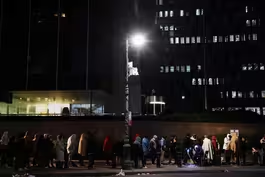
NYC looks to amend right to shelter rule amid migrant surge
Video has Closed Captions
Clip: 1/2/2024 | 7m 22s | New York City looks to amend 'right to shelter' rule as it struggles to house migrants (7m 22s)

Tommy Prine on finding his voice in the shadow of his father
Video has Closed Captions
Clip: 1/2/2024 | 6m 40s | Singer-songwriter Tommy Prine on finding his own voice in the shadow of his famous father (6m 40s)

Why renting might be the favored choice in today's market
Video has Closed Captions
Clip: 1/2/2024 | 6m 6s | Why renting over buying might be the favored choice in today's real estate landscape (6m 6s)
Providing Support for PBS.org
Learn Moreabout PBS online sponsorship
- News and Public Affairs

FRONTLINE is investigative journalism that questions, explains and changes our world.

- News and Public Affairs

Amanpour and Company features conversations with leaders and decision makers.












Support for PBS provided by:
Major corporate funding for the PBS News Hour is provided by BDO, BNSF, Consumer Cellular, American Cruise Lines, and Raymond James. Funding for the PBS NewsHour Weekend is provided by...