
February 4, 2024 - PBS News Weekend full episode
2/4/2024 | 26m 44sVideo has Closed Captions
February 4, 2024 - PBS News Weekend full episode
Sunday on PBS News Weekend, the U.S. promises further retaliation for the killing of American troops in Jordan. How upcoming elections in Pakistan and other South Asian countries are testing democracy in the region. After the release of the Epstein files, we examine the challenges in policing sex trafficking. Plus, a new category at the Grammy Awards highlights the global appeal of African music.
Problems playing video? | Closed Captioning Feedback
Problems playing video? | Closed Captioning Feedback
Major corporate funding for the PBS News Hour is provided by BDO, BNSF, Consumer Cellular, American Cruise Lines, and Raymond James. Funding for the PBS NewsHour Weekend is provided by...
Support provided by:

February 4, 2024 - PBS News Weekend full episode
2/4/2024 | 26m 44sVideo has Closed Captions
Sunday on PBS News Weekend, the U.S. promises further retaliation for the killing of American troops in Jordan. How upcoming elections in Pakistan and other South Asian countries are testing democracy in the region. After the release of the Epstein files, we examine the challenges in policing sex trafficking. Plus, a new category at the Grammy Awards highlights the global appeal of African music.
Problems playing video? | Closed Captioning Feedback
How to Watch PBS News Hour
PBS News Hour is available to stream on pbs.org and the free PBS App, available on iPhone, Apple TV, Android TV, Android smartphones, Amazon Fire TV, Amazon Fire Tablet, Roku, Samsung Smart TV, and Vizio.
Providing Support for PBS.org
Learn Moreabout PBS online sponsorshipJOHN YANG: Tonight on PBS News Weekend, the United States promises further retaliation for last week's killing of American troops in Jordan.
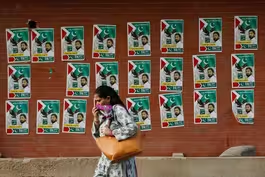
How upcoming elections in Pakistan and other south Asian nations are testing democracy in the region.
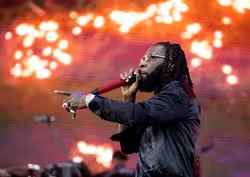
And a new category at tonight Grammy awards highlights the continent whose music has taken the world by storm.
MAN: Everyone's like, so what's popping in Ghana right now?
What's popping in Nigeria?
It's so weird to see it, but, I mean, it's great to finally see it.
(BREAK) JOHN YANG: Good evening.
I'm John Yang.
Top Biden administration officials said today they are not done yet with the dual military efforts to both retaliate for the killing of three U.S. troops in Jordan a week ago and to try to stop ongoing threats to commercial shipping in the Red Sea.
For the last three days, U.S. planes have struck sites in Iraq and Syria used by Iran-backed militia groups and enjoyed operations with British forces.
At least three dozen targets across six provinces in Yemen that Iran-backed Houthi rebels use to launch attacks on the Red Sea shipping national security Advisor Jake Sullivan on CBS's Face the Nation.
JAKE SULLIVAN, White House National Security Adviser: What happened on Friday was the beginning, not the end of our response, and that there will be more steps, some seen, some perhaps unseen.
We will respond, and we will respond forcefully, and we will respond in a sustained way.
I would not describe it as some open ended military campaign.
JOHN YANG: In a separate appearance, Sullivan would not rule out strikes inside Iran.
And in Israel's war in Gaza, Prime Minister Benjamin Netanyahu detailed what constitutes his goal of eliminating Hamas, destroying the group's battalions, and neutralizing its networks of tunnels beneath Gaza.
All this awaits secretary of State Anthony Blinken, who left today for his fifth trip to the region since the October 7th Hamas attacks.
He's expected to push for more aid to Gaza and to try to spur negotiations aimed at freeing the Israelis still held by Hamas.
A monster storm is bearing down on California, threatening flooding and mudslides.
It's the second so called atmospheric river to hit the state in a week.
Several communities in southern California, including Santa Barbara and Los Angeles have ordered or warned residents to evacuate.
Rain is expected to last for the next few days.
Moscow appointed officials say Ukrainian shelling has killed at least 28 people in a bakery in Russian occupied far eastern Ukraine.
Ten people were pulled from the rubble.
Both Ukrainian and Russian forces are increasingly relying on longer range attacks this winter as there's been little progress for either side on the front lines.
In El Salvador, voters cast ballots on a presidential election that's seen as a choice between democracy and security.
The incumbent is Nayib Bukele, the self-proclaimed world's coolest dictator.
He's expected to win reelection after Salvador's top court reinterpreted a constitutional ban on presidents serving consecutive terms.
Bukele gained fame for his two-year old brutal crackdown on gangs.
More than 76,000 people have been arrested, and the president of Namibia died today while being treated for cancer.
82-year-old Hage Geingob was antiaparte activist and was largely credited for making Namibia one of Africa's most stable democracies.
He was the nation's first prime minister when it gained independence in 1990 and had served as president since 2015.
Still to come on PBS News Weekend, after the release of the Epstein files, we examine the challenges in policing sex trafficking.
And a new category in tonight's Grammy Awards highlights the global appeal of African music.
(BREAK) JOHN YANG: In South Asia this year, more than a billion people are going to the polls to choose leaders in five countries, Bangladesh, Bhutan, Sri Lanka, India, and Pakistan.
It's a test of democratic values and human rights in the region.
Pakistan will hold its first general election since 2018 later this week.
The country's had to deal with disastrous floods, food insecurity and a crumbling economy.
And now its democratic system is being challenged.
Pakistan's former prime minister, Imran Khan, was thought to have a good chance of returning to power, but he's been convicted in a series of criminal cases that his supporters say is politically motivated.
One of his sentences includes a ban on holding public office.
Michael Kugelman is the director of the Wilson Center South Asia Institute.
Michael, let's start in Pakistan.
This prosecution of Imran Khan, which his supporters say is political, supporters -- members of his party have been arrested.
A candidate affiliated with his party was assassinated.
What does this say about the health of democracy in Pakistan right now?
MICHAEL KUGELMAN, South Asia Institute Director, Wilson Center: Well, the state of democracy is not good in Pakistan, and we have to look at what's been playing out in Pakistan over the last few months in a very broad context.
Indeed.
Khan has been sentenced to all these jail terms.
Leaders of the party have been arrested.
Other leaders of the party have been arrested.
The media has been pressured not to cover campaign rallies of Khan's party.
So this is not good for democracy.
But it goes further than that because this is not unusual.
This is not an outlier in the sense that in the past, in other elections in Pakistan, the same thing has happened where particular parties have faced crackdowns.
So the fact that this is not a one time thing, the fact that it's not a one off, the fact that this has happened so many times before, that is what I think is so troubling about this for democracy in Pakistan.
JOHN YANG: Well, on that point, I mean, Bangladesh had an elections in early January.
The prime minister won her fourth straight term.
The United States State Department said it was not free and fair, but they also said in the same statement they look forward to working with her.
How important is it, this is a very key region just because of where it is, how important is it that the United States have a good working relationship with these countries?
MICHAEL KUGELMAN: I think you have to look at this in the context of great power competition.
The U.S. increasingly looks at South Asia through the lens of its competition with China and with Russia.
China has been increasingly present in South Asia through infrastructure projects and also through naval power projection in the Indian Ocean region.
This is concerning for the US.
Also quietly Russia has been a key player in South Asia.
It has a close relationship with India, it has a growing relationship with Pakistan, and it also has energy cooperations set up with Bangladesh.
So I think that the U.S. feels a need to strengthen engagement with the countries of South Asia in order to push back against this growing influence of China and Russia.
JOHN YANG: And to do that, are they willing to sort of overlook the lack of democracy?
They talk about wanting to spread democracy around the world, encourage democracies.
MICHAEL KUGELMAN: I think that strategic imperatives end up carrying the day in the sense that the administration, the current administration has used this values based foreign policy where it sought to push for better, more rights, more democracy in the region.
But it's applied that very selectively.
It had been applying it quite vociferously and robustly in Bangladesh, much less so India, which is another country struggling with democratic backsliding.
It's been fairly quiet in Pakistan as well.
These are all different countries, different policies.
The U.S. has different interests.
The interesting thing is that even in Bangladesh, this just happened today we've learned that President Biden conveyed a letter to the Bangladesh prime minister in which he said that he looks forward to working with her.
JOHN YANG: And talk a little bit about -- you have been touching on it, but sort of the nature or the state of democracy in this whole region?
MICHAEL KUGELMAN: Well, I mean, the worst case is Afghanistan, where, of course, the Taliban has been back in power for a few years.
They don't do democracy.
But if you look at some other countries, Pakistan, Bangladesh, India, all countries with elections this year, repression, oppression, crackdowns on dissent, on the opposition has intensified.
Space for dissent has really shrunk and people will say, okay, well, you're talking about democratic backsliding in South Asia.
Five countries in the region have elections this year.
That's true.
But several of these elections, there's big concerns about them not being free and fair, including the ones in Bangladesh and Pakistan.
The silver lining here, Bhutan, a relatively recent democratic transition, and it had an election in January that was viewed as free and fair.
So there's the good news story.
JOHN YANG: Pakistan, of course, had a series of military leaders for about three decades.
What has that done to the democratic institutions there?
MICHAEL KUGELMAN: This has been one of the biggest challenges to Pakistan's democratic development and consolidation.
The military is.
There's a legacy of direct military rule.
It has been more than 15 years since the military was in direct control, but it's remained very active, influential, behind the scenes and especially right now.
In fact, I'd say it's more active now in policy and politics during a period of civilian rule than it has been for quite some time, to the point that you have senior military leaders, including the army chief, directly involved in economic policy, not foreign policy or security policy, which is the typical realms where the Pakistani military is during periods of civilian rule.
JOHN YANG: You talked about how the United States, for its other purposes, overlooked these shortcomings.
What could the United States or what could the world do to strengthen these democracies?
MICHAEL KUGELMAN: I think that it all comes down to trying to identify key democratic institutions and how to bring more support to them, and there are a number of ways of going about that.
But it's a very delicate issue because many of these countries are very sensitive to this idea of the U.S. or other western countries saying, well, look, you've got issues with democracy.
We can help you strengthen it.
You know, given that these countries feel that the U.S. has its own struggles with democracy and other countries in the west do as well.
So I think that there's a need to be very careful and very cautious about it.
There are things that can be done.
In many cases, they have not been done.
I mean, The U.S. theoretically has some leverage in some of these countries.
If you look at Bangladesh, for example, Bangladesh is heavily dependent on the U.S. as a trade partner.
The U.S. is the top export destination for Bangladesh.
So if the U.S. really wanted to try to pressure the government there to show more respect for human rights, it could impose trade sanctions on Bangladesh.
But it's not going to do that for the very strategic, interest based reasons that we discussed before.
JOHN YANG: Michael Kugelman of the Wilson Center's South Asia Institute, thank you very much.
MICHAEL KUGELMAN: Thank you.
JOHN YANG: Last month, thousands of court documents were released detailing the late financier and convicted sex offender Jeffrey Epstein's sexual abuse and trafficking of teenage girls.
It brought new attention to the problem of sex trafficking in the United States and why the crime so often goes undetected.
Ali Rogin has more on the barriers that survivors of trafficking must overcome in their search for justice.
ALI ROGIN: Human trafficking can take many forms.
It can range from sexual manipulation and coercion to the exploitation and forced labor of an individual.
In 2021, the National Human Trafficking Hotline reported more than 10,000 cases of trafficking and over 16,000 victims.
Experts warn that's likely an undercount.
Megan Cutter directs the National Human Trafficking Hotline at Polaris, an anti-trafficking nonprofit based in Washington, DC.
Megan, thank you so much for being here.
We wanted to talk about this in the context of the Jeffrey Epstein news.
We hear so much about the perpetrators of that abuse that was happening in the context of that case.
But what about the victims?
Are there characteristics that Epstein's victims share with other people who've experienced human trafficking?
MEGAN CUTTER, Director, National Human Trafficking Hotline: I actually think that sometimes in talking about the Epstein case, we get lost in the, you know, money and the power and the influence that Epstein and some of the people involved in that situation had.
But actually, it's really very typical of a trafficking situation for a trafficker to identify people who maybe are vulnerable in some way.
In the case of the people that Jeffrey Epstein victimized, often they were from a lower income community, people looking for some sort of way to earn some extra money.
Human trafficking in general is a abuse of power and control, using some form of force, fraud, or coercion to get someone to have sex for money, get someone to remain in a work situation that they no longer want to be in.
And so it's not that different from what we see day to day.
But I think some of that gets lost in the conversation.
ALI ROGIN: Are there misconceptions about trafficking that you spend time talking about debunking?
MEGAN CUTTER: The first one I would share is this idea that trafficking requires some form of movement or transportation, or that it doesn't happen here in the United States.
But trafficking can happen in someone's own community, in their own family.
Really any situation where there is that abuse of power and control to coerce someone to provide sex acts or to work.
Another misconception is really this idea that people are getting snatched off the street and forced into human trafficking situations.
So much more often, we see scenarios where people are in some form of longer term trusting relationship with their trafficker.
Whether it's they met them online, that person's an intimate partner, a family member, a friend, and they build trust through a grooming process.
And then once the victim isolated, they take advantage of that and begin to abuse and exploit them.
ALI ROGIN: How do conspiracy theories and disinformation play into some of these misconceptions that people have?
MEGAN CUTTER: I think often when there's some sort of conspiracy theory or misinformation about human trafficking, it plays up some of those elements that are really sensational.
And what that can often mean is that well intentioned people, members of the public, are so focused on that they're missing how trafficking really happens.
And that can overwhelm resources like the national human trafficking hotline.
And it can impede the way that victims and survivors, people experiencing trafficking, see themselves in those narratives and therefore identify themselves and reach out for help.
ALI ROGIN: Now, a lot of us have been to airports, rest stops that have signs advising you on spotting the signs of human trafficking.
I wonder what your organization sees as the efficacy of those public service announcements.
Are there ones that are more effective than others?
MEGAN CUTTER: I think we would really recommend that those types of awareness materials are geared towards people who might be in trafficking situations or who might be close to someone in a trafficking situation.
So using plain language that's easy to understand in the languages of people who live in that community, if it's English or another language, making sure that's available and just making it really easy for the layperson to read and say, oh, I might know someone in that situation, versus sometimes just using the word human trafficking over and over again, people might not see that and say, oh, that's me.
That's my experience.
ALI ROGIN: What do people who experience trafficking need?
How do they move forward once they're out of that situation?
MEGAN CUTTER: Polaris operates the national human trafficking hotline.
And part of the way that we operate, that is when someone reaches out to us who is a survivor of trafficking, we share with them what their options are and then allow them to make a choice about what they want to see happen next.
Because trafficking really removes that autonomy that many of us have in our lives to decide, do I want to access this type of service?
Do I want to live in this place?
Do I want to be in relationship with these people?
And so we're really starting that process by giving folks options and choices and then helping them connect with those types of resources.
So that's really that first step of recovering from a situation where control is removed from you.
ALI ROGIN: We often talk about human trafficking in terms of sexual exploitation, but there's also a strong labor component to this.
How does that work?
MEGAN CUTTER: Absolutely I think labor trafficking is defined as a situation where someone is forced to work and they're unable to leave their work situation without severe consequences to themselves or someone else.
So we see that in agriculture, domestic work, caregiving, restaurants, really any place where there is work happening, labor trafficking can happen.
But particularly industries where there are less protections for workers or where workers are more isolated in rural areas or individual homes, we see a higher risk for that type of abuse happening.
ALI ROGIN: The Trafficking Victims Protection act of 2000 was.
It was a landmark federal response to human trafficking.
What does it do, and are there areas in which it falls short?
MEGAN CUTTER: I think one of the great things about the Trafficking Victims Protection Act is that brought the federal government together and to build a response to human trafficking and to make sure that we're united in responding to it, that different agencies are making sure that there is a response in their agency, and we're really supportive of that.
The National Human Trafficking Hotline started operating in 2007, and we really feel like that establishment of that has been really helpful for people who need assistance, people who are looking for help, and also people who maybe have a friend or a family member who they are worried about, and they're wanting to contact the hotline and get that type of assistance.
ALI ROGIN: Megan Cutter, the director of the National Human Trafficking Hotline at the Anti-Trafficking Organization Polaris, thank you so much for joining us.
MEGAN CUTTER: Thank you for having me.
JOHN YANG: From samba to hip hop to reggae, so much of the music we enjoy has African roots.
As Stephanie Sy reports tonight, for the first time, the Grammy Awards recognizes music produced in Africa with a category of its own.
This report is part of our Arts and Culture series CANVAS.
STEPHANIE SY (voice-over): On a recent Friday night in Washington, D.C., DJ Duo Mathias Broohm and Chris Harris mixed tunes from across the world at layover, their monthly dance party.
CHRIS HARRIS, DJ Nativesun: You never know sometimes where your layover is going to be at.
So that's how we wanted the music to be.
You never know where we're going touch, know sonically.
STEPHANIE SY: And how big of a role does African music play in these jams?
CHRIS HARRIS: Plays a really big role.
STEPHANIE SY (voice-over): They sample sounds from across the continent, from Afrobeats, a fusion sound driven by West African rhythms, to Ama Piano, a sub-genre of house music from South Africa.
MATHIAS BROOHM, DJ: A grew up listening to hip life, which is like the old school Afro beat.
STEPHANIE SY (voice-over): Broohm was raised in a Ghanaian household in Maryland.
MATHIAS BROOHM: The African sound has always been in me.
I grew up loving these rhythms.
STEPHANIE SY (voice-over): In recent years, those familiar sounds have hit the global mainstream.
One seminal moment, Drake's 2016 mega hit One Dance, featuring vocals from Nigerian afrobeat star Wizkid.
Since then, some of the biggest names in pop, R&B and hip hop have collaborated with African artists and producers.
MATHIAS BROOHM: Now that like Beyonce or like Chris Brown or like your Selena Gomez being one of the biggest afrobeat songs from last year, it makes it so much easier to be able to tap into that pocket of stuff that I was afraid to play because I afraid it would clear the room out.
But now it all just goes hand in hand.
STEPHANIE SY (voice-over): African musicians have also become stars outside of the continent.
In 2022, Burna Boy became the first Nigerian artist to sell out New York's Madison Square Garden.
And last year, Tyla became the first South African to enter the Billboard 100 in more than half a century with her amapiano inspired single, Water.
TINA DAVIS, President, Empire: Once you hear it, you hear those drums, you hear the percussions.
It permeates in your body, you feel it.
You can't stop.
STEPHANIE SY (voice-over): Tina Davis is the president of Empire, a U.S. based record label and distribution company that has a roster of African artists.
TINA DAVIS: It started out being something that the dasper really loved, of course, but now it's grown to a worldwide phenomenon.
A lot of people all over the world love the music.
STEPHANIE SY (voice-over): Music that until now fell under the global music category at the Grammys.
TINA DAVIS: Every music that doesn't have a category goes into world music.
And I think it's unfair to all genres of music to just be clumped in one category.
STEPHANIE SY (voice-over): Last year, the Recording Academy announced a new category, best African Music Performance for songs that, quote, utilize unique local expressions from across the African continent.
JULS, Producer and Musician: It just shows how important our music has come and how influential we've been.
STEPHANIE SY (voice-over): Juls is a British Ghanaian Afrobeats producer and musician.
He's long pushed for African music to be recognized at the Grammys.
JULS: Grammy is the most ultimate musical award ceremony in the world, right?
So them giving us this category is kind of like a way of us kind of like getting into the mix and being able to be strategic and say, hey, tell our story properly.
STEPHANIE SY (voice-over): This year's nominees, all from Nigeria or South Africa, are mainly Afrobeats or Amapiano artists.
ANITA GONZALEZ, Georgetown University: I think the first class of nominees are just the tip of the iceberg.
STEPHANIE SY (voice-over): Anita Gonzalez is a professor of performing arts at Georgetown University.
ANITA GONZALEZ: There's such a huge amount of music that comes from the continent, from South African vocal chants to string music that has been performed by the Grios and others, to the Ethiopian music and North African music.
All of this is part of the vast panoplay of what we call African music.
STEPHANIE SY (voice-over): She hopes the new category will spotlight other African genres.
ANITA GONZALEZ: I'm hoping that with this Grammy recognition that people will also understand the vitality of each of the countries and the unique kind of ethnographic sounds that they're producing.
STEPHANIE SY (voice-over): That's a dream shared by many in the industry.
TINA DAVIS: And hopefully we'll have an African Grammy at some point, an actual award show like the Latin Grammys.
I think sky's the limit.
STEPHANIE SY (voice-over): Back in DC, Mathias Broohm says it's clear that regardless of where African music goes next, it's already had an impact.
MATHIAS BROOHM: I grew up in an African family.
We'd have our different lunches than the American kids.
We would look different.
We would dress different.
They're like, oh, you're not cool.
You're from Africa.
You're not from here, blah, blah.
And fast forward to this day and age, everyone's like, so what's popping in Ghana right now?
What's popping in?
Like, I saw the Nigerians wearing this.
Where can I get that?
And it's totally so weird to see it, but, I mean, it's great to finally see it.
STEPHANIE SY (voice-over): A cultural footprint that is sure to grow.
For PBS News Weekend, I'm Stephanie Sy.
JOHN YANG: Now online, the benefits of thinking twice before pouring yourself a drink and how many are turning dry January into a dry life.
All that and more is on our website, pbs.org/NewsHour.
And that is PBS News Weekend for this Sunday.
I'm John Yang.
For all of my colleagues, thanks for joining us.
Have a good week.
New Grammy category highlights African music’s global appeal
Video has Closed Captions
Clip: 2/4/2024 | 5m 45s | New Grammy category highlights the global appeal of African music (5m 45s)

Sex trafficking survivors face barriers to seeking justice
Video has Closed Captions
Clip: 2/4/2024 | 6m 40s | Survivors of sex trafficking face barriers in their search for justice (6m 40s)
Upcoming South Asian elections test democracy in the region
Video has Closed Captions
Clip: 2/4/2024 | 6m 57s | How upcoming elections in South Asia will test democracy in the region (6m 57s)
Providing Support for PBS.org
Learn Moreabout PBS online sponsorship
- News and Public Affairs

FRONTLINE is investigative journalism that questions, explains and changes our world.

- News and Public Affairs

Amanpour and Company features conversations with leaders and decision makers.












Support for PBS provided by:
Major corporate funding for the PBS News Hour is provided by BDO, BNSF, Consumer Cellular, American Cruise Lines, and Raymond James. Funding for the PBS NewsHour Weekend is provided by...