
December 2, 2024 - PBS News Hour full episode
12/2/2024 | 57m 46sVideo has Closed Captions
December 2, 2024 - PBS News Hour full episode
December 2, 2024 - PBS News Hour full episode
Problems playing video? | Closed Captioning Feedback
Problems playing video? | Closed Captioning Feedback
Major corporate funding for the PBS News Hour is provided by BDO, BNSF, Consumer Cellular, American Cruise Lines, and Raymond James. Funding for the PBS NewsHour Weekend is provided by...
December 2, 2024 - PBS News Hour full episode
12/2/2024 | 57m 46sVideo has Closed Captions
December 2, 2024 - PBS News Hour full episode
Problems playing video? | Closed Captioning Feedback
How to Watch PBS News Hour
PBS News Hour is available to stream on pbs.org and the free PBS App, available on iPhone, Apple TV, Android TV, Android smartphones, Amazon Fire TV, Amazon Fire Tablet, Roku, Samsung Smart TV, and Vizio.
Providing Support for PBS.org
Learn Moreabout PBS online sponsorshipGEOFF BENNETT: Good evening.
I'm Geoff Bennett.
AMNA NAWAZ: And I'm Amna Nawaz.
On the "News Hour" tonight: Trump's pick for defense secretary is under the spotlight after reports surface of alcohol abuse, toxic behavior and sexual assault allegations.
GEOFF BENNETT: President Biden pardons his son Hunter, despite repeated promises not to.
The precedent it could set for future presidential pardons.
AMNA NAWAZ: And Syrian rebels seize control of Aleppo, the country's second biggest city, reigniting the long-running civil war.
SAMER AL-QARBI, Returned Aleppo Resident (through translator): Our aspiration is to be a nation of respect, a nation of freedom, a nation with foundations and a nation of its citizens.
GEOFF BENNETT: Welcome to the "News Hour."
A buried whistle-blower report has come to light raising fresh concerns about the fitness of president-elect Donald Trump's pick to lead the Pentagon.
AMNA NAWAZ: Former FOX News host and defense secretary-delegate Pete Hegseth was on Capitol Hill today.
QUESTION: Misspent funds, mistreatment of women, intoxicated on the job, do you have any comment about that reporting at all?
AMNA NAWAZ: He refused to answer media questions while meeting with Alabama Republican Senator Tommy Tuberville ahead of a potential confirmation battle next year.
"The New Yorker"'s Jane Mayer investigated Hegseth's time leading two nonprofits for military veterans and uncovered allegations of financial mismanagement, sexual impropriety and personal misconduct.
She joins us now.
Jane, it's good to see you.
Thanks for being with us.
JANE MAYER, "The New Yorker": Thanks for having me.
AMNA NAWAZ: So, you reviewed documents.
You also spoke with Hegseth's former colleagues at these groups that he ran.
What kind of picture did they paint of Hegseth as a leader?
JANE MAYER: It really was a picture that was, I would say, increasingly alarming in some ways.
It was a picture of a leader who was pushed out of his leadership positions in two groups that were for veterans because there were so many concerns about his financial mismanagement and his personal conduct.
So -- and these were relatively small groups with relatively small budgets.
And the first group had only 10 people working at it, Veterans for Freedom.
And it raised a lot of questions about how he would manage the largest department in the federal government, the most lethal and largest military in the world.
AMNA NAWAZ: Jane, there's also specific allegations of alcohol abuse, some stories and anecdotes you relate people telling you about Hegseth getting so drunk he had to be restrained or carried back to his hotel room.
There's one incident from May of 2015, when he's on official business traveling in Ohio.
He and someone else from the organization gets so drunk, they're chanting and yelling at the hotel bar.
What happens there?
JANE MAYER: Yes, I mean, this comes from a letter that was written by a member of the organization, this veterans group called Concern Veterans for America, which Hegseth was leading at the time.
And this member of it wrote a letter to the managers there, saying that Hegseth's behavior was despicable and embarrassing, because what he did was, he ended up closing down the bar at 2:30 in the morning, chanting and screaming: "Kill all Muslims.
Kill all Muslims."
And it was just so completely beyond the pale really for the veterans that worked in this group.
And so -- and I think maybe alarming also to think about someone leading the Pentagon who has voiced such attitudes and been so out of control.
AMNA NAWAZ: In your piece, you also quote Democratic Senator Richard Blumenthal, who says: "Much as we might be sympathetic to people with continuing alcohol problems, they shouldn't be at the top of our national security structure."
Jane, from your reporting, do we know if any of Mr. Hegseth's reported issues with alcohol persist to this day?
JANE MAYER: I mean, I think it's a very good question you as.
And "The New Yorker" submitted many questions to Mr. Hegseth and to his lawyer and gave him two days to answer them.
And instead of answering any of the questions or refuting anything in the story, they just said they would have no comment.
So, obviously, this is of utmost importance.
We need to know whether someone who might be the top person in the Defense Department has a very serious alcohol problem.
AMNA NAWAZ: Jane, there's also now a body of reporting looking into Hegseth's personal story as well, multiple marriages and infidelities that have been documented, also troubling details from a police report related to a sexual assault allegation back in 2017.
This weekend, "The New York Times" also published an e-mail from his mother in 2018, in which she says in part: "On behalf of all the women, and I know it's many, you have abused in some way, I say get some help and take an honest look at yourself."
We should note that his mother has since disavowed those comments in speaking with "The New York Times."
But, Jane, what does your reporting show about any of this as a pattern of behavior and also that sexual assault allegation from 2017?
JANE MAYER: Well, I mean, we have to say, of course, that he has denied sexually assaulting this woman.
She's anonymous at this point.
But the thing that has brought much attention to this is that he failed to disclose to the transition staff that he had secretly struck up a settlement with this woman and has been paying her and that they also struck up a nondisclosure agreement to try to keep it secret.
And so the Trump administration has decided not to have the FBI investigate potential Cabinet officers.
So they didn't have the FBI doing a background check.
And Pete Hegseth never told the transition staff that this was in his background.
It just came up because a friend of the woman's actually went to the transition team and said, did you realize this about him?
So these tales from the past in his life just seem to be surfacing one by one by one.
AMNA NAWAZ: Jane, the Trump team was reportedly blindsided by some of the recent reporting about Hegseth.
From your sources, does it seem like all the potentially damaging allegations are now out in the open, that everything that senators need to weigh is out there and reported?
JANE MAYER: No, I actually don't think so, because, just today -- I mean, this story came out in "The New Yorker" just around midnight last night.
And, by today, people have been calling me all day long with more examples of this kind of behavior from Pete Hegseth.
So, I don't think we really, truly know the whole story yet.
AMNA NAWAZ: That is Jane Mayer of "The New Yorker" joining us tonight.
Jane, thank you.
Good to see you.
JANE MAYER: Thanks so much for having me.
GEOFF BENNETT: Last night, President Joe Biden issued a full and unconditional pardon of his son Hunter, who was just days away from a possible prison sentence in two federal felony cases against him.
It's a striking reversal of the president's promise that he would not use his authority to pardon his son or commute his sentence.
The president's son, Hunter Biden, receiving the most sweeping presidential pardon in generations, capping years of high-profile legal troubles and political scrutiny.
He faced possible prison time for his conviction on federal gun charges back in June, as well as for separate tax crimes, for which he pleaded guilty in September.
Hunter Biden was scheduled to be sentenced in both cases later this month.
His pardon goes even further, covering all federal offenses that Hunter Biden -- quote -- "has committed or may have committed or taken part in over the last decade, including but not limited to all offenses charged or prosecuted."
It's something President Biden has insisted repeatedly he would not do.
DAVID MUIR, "World News Tonight" Anchor And Managing Editor: Have you ruled out a pardon for your son?
JOE BIDEN, President of the United States: Yes.
I'm not going to do anything.
I said I'd abide by the jury decision and I will do that and I will not pardon him.
GEOFF BENNETT: Now President Biden is calling the prosecution politically motivated.
In a written statement, the president said his son was "selectively and unfairly prosecuted.
No reasonable person who looks at the facts of Hunter's cases can reach any other conclusion than Hunter was singled out only because he is my son.
And that is wrong."
Today, White House Press Secretary Karine Jean-Pierre defended President Biden's decision while speaking to reporters.
KARINE JEAN-PIERRE, White House Press Secretary: Two things could be true.
You can believe in the Department of Justice system and you could also believe that the process was infected politically.
And that's what the president says.
GEOFF BENNETT: It all comes less than two months before President Biden's term ends and president-elect Donald Trump's begins.
On social media, Mr. Trump slammed the move, calling it an abuse and miscarriage of justice.
The pardon cannot be rescinded once he takes office.
Mr. Trump has repeatedly said he'd use his second term to investigate and prosecute the Bidens.
Congressman James Comer, one of several Republicans leading the congressional investigations into the Biden family, wrote on X: "The charges Hunter faced were just the tip of the iceberg.
President Biden and his family continue to do everything they can to avoid accountability."
Even some Democrats join the chorus of criticism.
Colorado Governor Jared Polis expressed his disappointment in the president for putting his family ahead of the country.
And he called the decision a bad precedent that could be abused by later presidents and will sadly tarnish his reputation.
And we are joined now by Margaret Love.
She previously served as us pardon attorney under former Presidents George H.W.
Bush and Bill Clinton.
Thanks for being with us.
MARGARET LOVE, Former U.S.
Pardon Attorney: It's a pleasure.
GEOFF BENNETT: Put the sweeping nature of this pardon in context for us.
It not only spares Hunter Biden from doing possible prison time.
It also insulates him from ever facing criminal charges for any crimes he possibly could have committed over the past decade.
MARGARET LOVE: Yes, it's a little hard to compare this to anything in the recent past, certainly.
It's a very, very broad grant.
The only thing that I can compare it to is the pardon that President Ford gave President Nixon, which was also a preemptive pardon for a period of five years.
In this case, it's a period of 11 years.
So it's really quite unique, other than the Nixon pardon.
GEOFF BENNETT: And this pardon is a departure for President Biden, who has vowed not to interfere with the Justice Department's actions and who has mostly avoided weighing in on his son's legal issues.
There is this question, though, of the intervening events, the reelection of Donald Trump, the prospect of Hunter Biden being at the mercy of a Trump Justice Department, where Donald Trump has explicitly said that he intends to use the criminal justice system to exact revenge, and his nomination of someone, Kash Patel, who has promised to go after the Bidens if he is confirmed as FBI director.
Does any of that bolster the justification for this pardon?
MARGARET LOVE: Well, obviously, it was very important to President Biden.
I'm not going to comment on whether it justifies this kind of a grant or not.
I mean, I'm more interested in talking about the very unique, almost unique nature of the grant itself, which could be questionable, to tell you the truth.
There was a lot of conversation at the time of the Nixon grant.
Eminent constitutional scholars debated whether the president had the power, under the constitutional pardon power, to grant preemptive pardons.
I know there was conversation at the end of the Trump administration about preemptive pardons, and a decision was made, apparently, not to grant them.
So I think that the real interest for me here is the nature of that grant.
And I guess it will, in due course, be found whether it's at appropriate use of the president's power or not.
GEOFF BENNETT: How does this pardon for Hunter Biden fit into President Biden's overall clemency record?
MARGARET LOVE: Oh, gosh, well, he doesn't have a very lengthy record, to tell you the truth.
I have been hoping that he would grant a number of pardons that in many cases have been waiting in the backlog for years.
And it would be great if he took this opportunity to grant some of those pardons and sentence commutations that have been awaiting his action.
He has not had a great deal of interest, apparently, in pardoning to date.
This may jog things loose.
Hope so.
GEOFF BENNETT: What precedent does a pardon like this set, in your view?
MARGARET LOVE: Well, I mean, it certainly suggests that another president might try it if it's not challenged.
It's very interesting because President Trump himself was very adventuresome in his use of the pardon power, intervened in many pending cases, the way no president had done before.
But what was characteristics of President Trump's pardons were that he always pardoned a very specific offense, specific charges.
One exception to that is the Michael Flynn pardon, which got a little bit broader, pardoning anything that the special counsel might bring against him.
But that was a more defined jurisdiction than the Hunter Biden pardon or the Nixon pardon, for that matter.
So you never know what might happen in the future.
It's a power that has rarely been tested in the courts, but I expect perhaps that there may be some opportunity to do that going forward.
GEOFF BENNETT: Margaret Love, thank you for your time this evening.
MARGARET LOVE: You're most welcome.
Thank you.
GEOFF BENNETT: The day's other headlines begin with the winter storm in the Northern states that's lasted all weekend and still won't let up.
Nearly seven million people are under winter weather alerts today, as lake-effect snow coming off of the Great Lakes continues to pound parts of the Upper Midwest and Northeast.
Western Michigan could see another foot of snow today, while other parts of the state, as well as New York and Pennsylvania, are digging out from close to four feet of snow from this weekend.
MAN: This weather is Buffalo weather.
It's amazing weather.
It's great weather.
GEOFF BENNETT: That didn't stop tailgaters ahead of the Buffalo Bills' Sunday night game.
The team paid fans $20 an hour to help dig out the stadium before kickoff.
The snow wasn't enough to deter most air travelers either.
The TSA says more than three million people took post-Thanksgiving flights yesterday, and that set a new record.
Turning now to the Middle East, where for the first time since the cease-fire took effect last week, Hezbollah has fired projectiles into a disputed border region in Southern Lebanon.
The militant group says it was a warning shot for what it called repeated Israeli violations of the truce.
No one was reported hurt.
Israel responded with its own airstrikes in retaliation hours later.
A Lebanese official accused Israel today of breaching the cease-fire more than 50 times in recent days with strikes and other provocations.
Despite that, a State Department spokesperson said the cease-fire is working and that claims of violations are being investigated.
MATTHEW MILLER, State Department Spokesman: Broadly speaking, it has been successful in stopping the fighting.
Now, with respect to violations or potential violations of the cease-fire, we set a mechanism up to look into this very question, where the United States, along with France, will engage with the Israeli military, will engage with the Lebanese military to look at potential violations.
GEOFF BENNETT: Meantime, Israel's military says an Israeli-American soldier previously thought to be alive in Hamas captivity is now presumed dead.
The body of Omer Neutra of New York was taken by Hamas in Southern Israel during the October 7 attacks.
His parents had led a public campaign for his release, including an address to the Republican National Convention back in July.
He was one of seven American citizens held in Gaza.
Four, including Neutra, have been pronounced dead.
The Biden administration is preparing another $725 million in weapons assistance for Ukraine.
That's on top of more than $680 million in weapons that German Chancellor Olaf Scholz announced today during a surprise visit to Kyiv.
It was his first visit to the Ukrainian capital in more than two years.
The trip comes after Ukrainian President Volodymyr Zelenskyy recently criticized Scholz for speaking to Russian President Vladimir Putin back in November about opening negotiations to end the war.
In Kyiv today, Scholz emphasized solidarity.
OLAF SCHOLZ, German Chancellor (through translator): My very clear message from Kyiv to Putin, we're in this for the long haul, and we will stand by Ukraine for as long as it takes.
GEOFF BENNETT: Germany is Ukraine's second largest backer behind only the U.S.
The Biden administration has surged aid to Ukraine and eased weapons restrictions during the last months of the president's term.
The incoming Trump administration has signaled it will rethink U.S. aid to Ukraine.
More than 200 people have been detained in the country of Georgia amid demonstrations now going into their fifth night.
Tens of thousands of people gathered in the capital of Tbilisi this evening in protest of the pro-Russian government's decision to suspend negotiations to join the European Union.
More than 100 police officers have been injured in clashes with demonstrators.
It's all unfolding after October elections that were seen as a referendum on joining the E.U.
Georgia's opposition says the vote was rigged by Moscow.
There is turnover in the top jobs at two major companies tonight.
The world's fourth largest automaker, Stellantis, owner of brands like Jeep, Ram, Chrysler, and Dodge, is one of them.
CEO Carlos Tavares is stepping down after nearly four years in the role after trying to steer the company back to profitability.
But Stellantis has struggled with slumping sales and rising pressure from autoworkers at plants in the U.S. and abroad.
And the CEO of chipmaker Intel has retired in a surprise announcement.
Pat Gelsinger started at Intel more than 40 years ago before becoming chief executive in 2021.
The semiconductor manufacturer has struggled financially to keep up with rival Nvidia.
Both of those companies' stocks fell today as Wall Street saw mixed results.
The Dow Jones industrial average dipped lower by nearly 130 points, while the Nasdaq jumped up by nearly 1 percent, and the S&P 500 climbed higher into new record territory.
Still to come on the "News Hour": how the civil war in Syria has suddenly reignited; Tamara Keith and Leigh Ann Caldwell reflect on the latest political headlines; and mementos from a lost past, a memorial project that honors victims of gun violence.
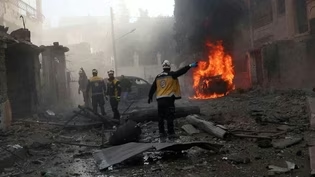
AMNA NAWAZ: In Syria today, Russian and Syrian warplanes targeted civilian areas held by opposition fighters.
And Turkey, which backs some of the multifaceted opposition, called on Syrian President Bashar al-Assad to negotiate.
It all comes days after rebels swept into parts of Northwest Syria that the regime had controlled for years and reignited a once-static war with broad implications for a region already embroiled in conflict.
Nick Schifrin reports.
And a warning: Some of the images in this story are disturbing.
NICK SCHIFRIN: In opposition-held Idlib today, Russian scorched earth, airstrikes on behalf of its Syrian ally against Syrian civilians inside a hospital.
Russia has long targeted Syrians who oppose the regime.
Today's strikes in Idlib and this weekend on Aleppo once again targeted victims who weren't even born when this 14-year-old war began.
They are terrifying and forced civilians to flee, but, today, it is government forces on the run.
On Friday, "News Hour" Syria producer Abdul Razzaq Al-Shami filmed as rebels prepared a surprise assault.
For the last nine years, the opposition in green has held most of Idlib province in Northwest Syria, the Kurds backed by the U.S. in yellow in the northeast, the regime and its allies in red, with pockets of land controlled by the Islamic State in purple.
Back in 2016, after five years of fighting, Syrian soldiers, with the help of Russian airstrikes and Iranian-backed militias, recaptured Aleppo, Syria's second largest city.
Last week, a patchwork of opposition groups, the Islamist Hay'at Tahrir al-Sham, designated by the U.S. as terrorists, and the Turkish-backed Syrian National Army took Aleppo back in days.
On Friday morning, we filmed his opposition fighters open fire on Aleppo's outskirts.
By 10:00 p.m. that night, fighters and civilians celebrated inside Aleppo after government forces melted away.
This war had forced half the country to flee their homes, and now some of the opposition reunited with family they'd been separated from for nearly a decade.
By day, rebels tore down their tormentor.
Regardless of their group, they're united in their hatred for the authoritarian leader who long ago chose to starve, slaughter and suffocate, rather than serve his people.
And they unfurled the flag of free Syria.
Samer Al-Qarbi is an attorney who returned to his hometown, Aleppo, for the first time in eight years.
SAMER AL-QARBI, Returned Aleppo Resident (through translator): Now is a good opportunity to return and build this country and get rid of the militias.
Our aspiration is to be a nation of respect, a nation of freedom, a nation with foundations and a nation of its citizens.
NICK SCHIFRIN: Opposition fighters reached Aleppo's military academy, a former base for Syria and its Iran-backed allies.
Abdul Razzaq Al-Shami was with them.
ABDUL RAZZAQ AL-SHAMI (through translator): These rocket launchers you see behind me were used by Hezbollah, Iran, and Assad forces to fire rockets that targeted civilians in the western countryside of Aleppo.
They caused the deaths and injuries of hundreds throughout the past few years.
NICK SCHIFRIN: The opposition's sweeping success in Aleppo is just the beginning, vowed political activist Muhammad Al Akhras.
MUHAMMAD AL AKHRAS, Political Activist (through translator): Now it started with the liberation of Aleppo.
Until we liberate all of Syria, all Syrian soil from this ruling regime that has sat on Syrian's chest for some 60 years.
NICK SCHIFRIN: Today, Syrian soldiers said they're regrouping and fighting back.
But the opposition expanded its fighting to nearby Hama province in Western Syria.
The Assad regime struggles come as ally Russia is bogged down in Ukraine and allies Hezbollah and Iran have been diminished by Israel.
The Biden administration has been cautious in its comments on Syria, but today called for de-escalation and a political process to end the decade-plus civil war.
To explain and explore these latest developments, I'm joined again by Charles Lister, a senior fellow who focuses on this conflict at the Middle East Institute here in Washington.
Charles Lister, thanks very much.
Welcome back to the "News Hour."
Why do you think the Syrian opposition has gone on the offensive now and why do you think it appears to have been so successful?
CHARLES LISTER, Middle East Institute: Well, I think, at the root of it, the crisis and the conflict inside Syria has been far from over for a very long time.
Yes, the lines of territorial control have been frozen for around four years, but conflict itself has been hot daily, 365 days a year, since 2020, when a major cease-fire was announced in 2020.
So the armed opposition has been preparing itself for exactly this scenario for the last four years, intensively training, adding to their capabilities, and, of course, waiting for the right kind of timing.
The regional crisis, of course, I think has added to that.
But, ultimately speaking, these armed groups believe that they could bring the fight to the regime, that they could defeat the regime on the battlefield.
And this offensive was meant to start in mid-October.
It was paused for a while due to Turkish pressure.
But then, of course, it began over the last week.
NICK SCHIFRIN: Most recently, we saw a cease-fire in Lebanon between Hezbollah and Israel.
But, perhaps more relevantly, we have seen Hezbollah and Iran get pushed back by Israel and we see Russia bogged down in Ukraine, as we mentioned before.
How does that play into the timing of this?
CHARLES LISTER: Well, I think all of those things are accurate.
But at the same time, what we have really seen on the ground in Syria over the last 18-plus months is that none of those actors have actually substantively changed their presence on Syrian soil.
Hezbollah remain on all of the same front lines that they have always been on.
The Russian troop levels remain exactly the same.
They have the same number of jets and air defense systems and everything else.
So, if there's any difference that all of those events have made, I would argue it's distraction.
It's not resources.
I think what's made the biggest difference is that the Syrian regime itself has stagnated over the last four-and-a-half years of so-called frozen conflict.
It has been increasingly kind of corrupted by organized crime that is rife within the Syrian military and within the intelligence apparatus that would traditionally have coordinated a response to this.
And I think, frankly speaking, that's why we have seen the collapse in regime front lines.
NICK SCHIFRIN: The opposition group Hay'at Tahrir al-Sham, or HTS, helped lead the offensive on Aleppo this weekend.
The U.S. calls them terrorists.
They are a former al-Qaida affiliate, but they say they have moderated.
Have they?
CHARLES LISTER: Yes, they have moderated, but they also remain similarly problematic.
They have done away with their global agenda.
They have genuinely broken away from al-Qaida, and that was a very combustible breakup back in 2016 and 2017.
They have turned inward to Syria.
They portray their actions and have done over the last five or so years in a more nationalist bent.
But, yes, their religious conservatism remains.
And I think, ultimately, the test will come three or six months down the line as to whether or not HTS ends up being as kind of welcoming and as inclusive as it's claiming to be today with it being in control of Aleppo city.
The early signs are positive, but this is very early days.
NICK SCHIFRIN: As we reported earlier, we have seen Russian airstrikes, as well as Russian and Iranian diplomatic support for Syria.
We are seeing Iranian-backed militias from Iraq entering Syria.
Do you believe that will be enough to save the regime?
CHARLES LISTER: All the manpower that the regime can get at this point will help.
One of the main problems is that some of the regime's most capable military units were not on the northwestern front lines when this offensive took place, the elite Fourth Division run by Bashar al-Assad's brother Maher, another unit known as the 25th Special Tasks Division.
So both of those have been deployed onto the front line in a province called Hama.
And that is where fighting has really intensified over the past 48 hours.
On the other hand, there is another side of the picture here, which is that the HTS and various other opposition groups only have so much manpower at their disposal.
If they continue to try to push too deep or further deeply into Syria, they risk overstretching themselves and making themselves very vulnerable to a counterattack.
NICK SCHIFRIN: The U.S. has more than 800 soldiers in Northeast Syria aligned with Kurdish forces known as the SDF.
And, in fact, we saw some of those Kurdish forces having to flee some of the territory they control over the last couple of days.
What's at stake for U.S. interests in this moment?
CHARLES LISTER: Well, for now, relatively little.
The U.S. has a very minimal stake in Northwestern Syria.
I suppose the U.S. has more to worry about in terms of the knock-on effect that this is likely to have on ISIS' resurgence that is taking place in Central and Eastern Syria right now totally in parallel to these developments.
The real risk here is that the Syrian regime's most capable units that have been deployed in the central desert to try to challenge -- frankly, incapably, but they have been trying to challenge ISIS, have all been removed.
So, suddenly, in Central Syria, where ISIS has been rebuilding, there is a total vacuum.
And that is likely to have a very significant positive knock-on effect for ISIS, which will inevitably have a knock-on effect into the Northeast of Syria, where U.S. troops are present and were already, frankly, struggling to challenge that resurgence.
And that will be all the more the case in the coming months.
NICK SCHIFRIN: Charles Lister of the Middle East Institute, thank you very much.
CHARLES LISTER: Thank you.
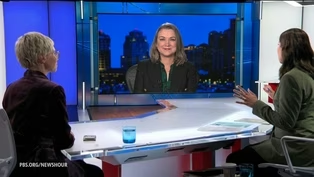
AMNA NAWAZ: Well, while many of us were taking a break this holiday weekend, Washington was still busy at work with everything from pardons to Cabinet picks.
Here to get us caught up is Tamara Keith of NPR and Leigh Ann Caldwell from The Washington Post.
Amy Walter is away.
It's great to have you both here.
So, Tamara, I want to start with you, because we have now seen in the aftermath of President Biden pardoning his son Hunter some backlash from his fellow Democrats.
We heard from Colorado Governor Jared Polis earlier.
Senator Bennet has weighed in saying he believes Biden put personal interest ahead of duty.
Senator Welch has said, while it's understandable, as a father, he said, as the nation's chief executive, it is unwise.
Does your reporting, Tam, showed that President Biden weighed these consequences, this potential backlash, and the precedent that it sets before making this decision?
TAMARA KEITH, National Public Radio: Certainly, several members of his own party have come out to say that they feel like President Biden, by doing this, is ceding the political high ground on an issue that Democrats have hit incoming President Trump on.
What I will say is that President Biden spent this last weekend with his family in Nantucket.
This is a family retreat.
They get together there everything Thanksgiving.
And President Biden has always had a political blind spot when it comes to his family, in particular his son Hunter, and the challenges that Hunter has presented to Biden over the years, the challenges that Hunter Biden's various issues have presented to Biden.
This has always been an area that has been a political blind spot, has been almost off-limits for Biden.
I think another issue that this raised was simply that the White House, President Biden himself and his spokesperson, Karine Jean-Pierre, repeatedly said that this wasn't going to happen.
A lot of people didn't believe that Biden really wouldn't ultimately pardon his son, but by then reversing course, that affects the credibility of this White House.
AMNA NAWAZ: Leigh Ann, what about on Capitol Hill?
What are your Democratic sources telling you about their reaction and how this complicates their path forward?
LEIGH ANN CALDWELL, The Washington Post: Yes.
Well, the Democrats who have come out in opposition to this, Senator Elizabeth Warren told reporters just a few moments before I got here that what's wrong is wrong and this is wrong.
And so there are some senators who think that the President Biden should not have stooped to Donald Trump's level and done what -- something that Donald Trump might have done in his presidency.
But then there are some Democrats who -- privately who aren't speaking out saying one thing or another say, you know what, this is what -- this is something that was important to President Biden and this might be something that hasn't been done in the scope in years, but it's his prerogative to do.
AMNA NAWAZ: Meanwhile, we know the Cabinet picks continue from president-elect Trump.
Over the weekend, he nominated Kash Patel to run the FBI.
Patel is a staunch loyalist, of course.
He's repeated the lie of the stolen 2020 election.
He called January 6 rioters patriots.
He's also spread a number of conspiracy theories.
Here, in fact, is Mr. Patel in his own words from earlier this year and last year about his plans.
KASH PATEL, Former Deputy Assistant to President Trump: I shut down the FBI Hoover Building on day one and reopening the next day as a museum of the deep state, and I take the 7,000 employees that work in that building and send them across America to chase down criminals.
We're going to come after the people in the media who lied about American citizens, who helped Joe Biden rig presidential elections.
We're going to come after you.
AMNA NAWAZ: Tam, he's a former federal prosecutor and public defender with little management or law enforcement experience.
What does this pick say about how Mr. Trump views the FBI?
TAMARA KEITH: So this pick is very much in line with president-elect Trump's many other Cabinet nominees, in that this is someone who is, first and foremost, loyal to Trump, who he did work in the first Trump administration in several acting roles toward the end.
And in those positions he was there essentially as Trump's eyes and ears in other agencies.
When it comes to the FBI, as you asked about, President Trump lost faith in the FBI within days of entering the White House, essentially.
As you remember, he fired the FBI director, put in place Christopher Wray, and now he's saying that the person that he appointed needs to be replaced with a loyalist, Kash Patel.
And Patel is someone who has echoed Trump's own words about the January 6 rioters and others being patriots, being politically persecuted.
Trump just fundamentally disagrees with the way the FBI has conducted law enforcement and approached the rule of law, which, incidentally, also affected him, because he was indicted after multiple investigations and including a search of his Mar-a-Lago estate.
AMNA NAWAZ: And, Leigh Ann, I know you have been tracking this.
A number of Republican senators have been asked about the selection of Kash Patel this weekend.
Here's what some of them had to say in response.
SEN. TED CRUZ (R-TX): One of the most tragic consequences of four years of Joe Biden and Kamala Harris is both DOJ and the FBI have been politicized and weaponized.
And I think Kash Patel is a very strong nominee to take on the partisan corruption in the FBI.
SEN. BILL HAGERTY (R-TN): I think Kash does have relevant experience, particularly when it comes to the mandate the American public have signed of turning these agencies around that have completely corrupted.
Kash has pointed it out.
He's probably the best at uncovering what's happened at the FBI, and I look forward to see him taking it apart.
AMNA NAWAZ: Senator Chuck Grassley, who is in line to chair the Judiciary Committee, also said this, that he believes the current director, Christopher Wray, failed in his role.
And he said that Kash Patel must prove to Congress he will reform and restore public trust in the FBI.
It's not exactly criticism there, some caution from Senator Grassley.
Are you hearing any concerns from Republican senators privately about Patel?
LEIGH ANN CALDWELL: Yes, and Chuck Grassley is likely to oversee these confirmation hearings of Kash Patel.
This is another tough choice for these Republican senators to have to move through.
This is very new for them.
They just got back into town tonight.
And so senators are still trying to digest.
And, to be clear, a lot of these senators actually didn't know who he was very much before this.
But this is going to be a nominee that Republicans are going to have to grapple with, and along the same lines of Matt Gaetz, where I heard a lot of, maybe he's just not going to make it through the process and he withdraws on his own, so it doesn't put them in a position to have to take a vote.
But it's still very early in this process.
And so a lot of senators are wanting to keep their powder dry and not put their -- put the cart before the horse.
AMNA NAWAZ: Well, Tam, this brings us to the point where there are concerns looming over a number of nominees.
We won't know for a few weeks now if they do move into confirmation hearings.
But we mentioned earlier, of course, the new reporting around Pete Hegseth, the nominee for secretary of defense.
There's concerns around Tulsi Gabbard as well.
How are senators looking at this right now in terms of this matrix of decisions that they're going to have to make?
TAMARA KEITH: We do expect that there will be confirmation hearings that begin in early January, as is traditional, once the new Congress is sworn in.
And a month is a very long time.
If you think about all of the reports and other issues that have come out with some of these nominees in a matter of a couple of weeks, it's possible that more of the sort of public vetting will occur before they ever get to a confirmation hearing.
But you're right, that senators have a lot to figure out.
They have to decide exactly what they're willing to tolerate.
And Republican senators are willing to tolerate a lot.
They're willing to give Trump a lot of leeway, in part because they -- some of them are in office because of Trump, because the Senate is now much more -- Senate Republicans are largely much more in line with Trump than they were when he came into office back in 2017.
And I will say one question that is looming for me is, there still has not been a memorandum of understanding signed between the Department of Justice and the Trump transition to begin the FBI background checks and vetting that are a traditional part of the confirmation process.
We also don't know whether the Trump administration, the incoming administration, is going to participate with the Office of Government Ethics and that sort of conflict of interest vetting that is normally a part of the process, and whether senators, Republican senators, will demand that.
Those are still really open questions about this process.
AMNA NAWAZ: Leigh Ann, about 30 seconds left.
What's your take on this?
LEIGH ANN CALDWELL: Yes, so senators are -- as Tam said, there's a lot of deference to the president to fill his Cabinet positions.
There's a lot of pressure from senators, voters, Republican base voters, to do what the president wants.
Everyone is going to have to take in their own political calculations and political capital, including if they are up for reelection in 2026.
And so it is going to be -- it could be a tough vote for Republicans.
AMNA NAWAZ: And a month is a long time, as Tam said.
LEIGH ANN CALDWELL: Yes.
Anything can happen.
AMNA NAWAZ: Leigh Ann Caldwell, Tamara Keith, always great to see you both.
Thank you so much.
LEIGH ANN CALDWELL: Thank you.
GEOFF BENNETT: And we will be back shortly with a look at a very personal memorial project for victims of gun violence.
AMNA NAWAZ: But, first, take a moment to hear from your local PBS station.
It's a chance to offer your support, which helps keeps programs like this one on the air.
GEOFF BENNETT: For those of you staying with us, this holiday travel season means a lot of flying, and the aviation sector is under pressure to reduce its carbon footprint.
In this encore report, science correspondent Miles O'Brien looks at efforts to create greener fuels for the skies.
MILES O'BRIEN: A half-mile outside the fence from Boston's Logan Airport, Carlos Flores is helping grease the skids for an ambitious goal, erasing the carbon footprint of airline travel.
He is at a Wingstop, harvesting used cooking oil, or UCO.
It contains hydrocarbons and can be refined into sustainable aviation fuel, or SAF.
UCO to SAF, from Wingstop to wing tank.
CARLOS FLORES, Mahoney Environmental: Every time I fly back home in Brazil, I think about it.
It's like, maybe I help put some fuel in here, you know?
MILES O'BRIEN: He drives for Mahoney Environmental, a subsidiary of Neste, a Finnish oil refiner that is now a global leader in renewable fuel production, including sustainable aviation fuel.
Dave Kimball is Mahoney's president and CEO.
DAVE KIMBALL, President and CEO, Mahoney Environmental: So the really cool thing about cooking oil is, it's already had one life, and now we're having a second life with it.
MILES O'BRIEN: Mahoney currently sucks about 400 million pounds of grease out of dumpsters nationwide.
It's cooking up plans to retrieve a billion by 2030.
Even though sustainable aviation fuel is two or three times more expensive than the fossil alternative, the airlines are demanding it.
Facing public backlash over its climate footprint, the industry has set an aggressive goal, net zero carbon emissions by 2050, and it has no other short-term alternative to fossil fuels.
DAVE KIMBALL: It's a drop-in fuel, so you don't have to modify anything to use it.
You don't have to build charging stations for airplanes and all those types of things.
So, to me, that's the logical next step.
MILES O'BRIEN: Globally, sustainable aviation fuel production will likely reach nearly a half-billion gallons in 2024, a six-fold increase since 2022, and yet still only one-half of 1 percent of the 99 billion gallon annual burn rate for jet fuel.
In 2021, the Biden administration launched a sustainable aviation fuel grand challenge.
The goal is to produce 35 billion gallons of SAF in the U.S. by 2050.
But to get there, grease is not the only word.
JERRY TUSKAN, Department of Energy Director, Center for Bioenergy Innovation at Oak Ridge National Laboratory: There won't be a silver bullet.
There won't be one commodity that will satisfy the 35 billion gallon target.
MILES O'BRIEN: Jerry Tuskan is director of the Center for Bioenergy Innovation at the Oak Ridge National Laboratory in Tennessee.
He says oil from fryer grease, soybeans and corn can produce a third of that goal, adding hydrocarbons to existing ethanol production can address another third, and the rest will have to come from new crops dedicated to energy.
He says 20 to 40 million acres of land will be needed.
There are about 900 million acres of farmland in the U.S. We can have it all and not have to make a choice between food and fuel?
JERRY TUSKAN: There is enough land potentially available to produce 35 billion gallons of aviation fuel.
It will take a portfolio or a mixture of species geared toward adaptive production in specific regions.
MILES O'BRIEN: The Oak Ridge team is partnered with 17 other institutions, including the University of University of Illinois, Urbana-Champaign, home of the Center for Advanced Bioenergy and Bioproducts Innovation.
Agronomist Emily Heaton is a professor in the Department of Crop Sciences.
EMILY HEATON, Department of Crop Sciences, University of Illinois, Urbana-Champaign: We are at the stage where we're testing the first iterations of making jet fuels from the bioenergy crops that we have today.
MILES O'BRIEN: She gave me a tour of their energy farm, where they grow, tweak and study so-called bioenergy crops.
When you say bioenergy crops, what are we -- what exactly are we talking about?
EMILY HEATON: We are talking about crops that are used to capture carbon out of the atmosphere and use in place of plants that captured carbon out of the atmosphere millions of years ago, which are fossil fuels.
MILES O'BRIEN: The carbon that renewable fuels emit when burned is offset by the CO2 absorbed as the feedstock grows in the field.
Because the cycle does not unearth any ancient carbon, it is called net zero.
One of the leading contenders for sustainable aviation fuel is miscanthus giganteus, a hardy, fast-growing perennial grass plant that thrives on marginal land in cold climates.
Oh, wow, a little -- it's doing well in here, huh?
EMILY HEATON: They're getting pretty big.
It's about time to cut them back.
MILES O'BRIEN: Did you bring the machete?
(LAUGHTER) EMILY HEATON: We actually have several.
MILES O'BRIEN: Inside this greenhouse, they are crossbreeding miscanthus with sugarcane, hoping to add fatty compounds known as lipids to it to make the conversion to aviation fuel cheaper and easier.
So how much growth is this?
How long did it take for them to get this big?
EMILY HEATON: So for a mature plant, this is a single growing season's worth of biomass.
MILES O'BRIEN: It can grow 14 feet high, but that's just half the picture.
EMILY HEATON: You can start to get a feel for what's below ground.
MILES O'BRIEN: There is an equal amount of biomass beneath the surface.
EMILY HEATON: And if you include the avoided fossil emissions, because we're not fertilizing very much, we're not tilling, and it's storing things below ground, it comes back carbon-negative.
MILES O'BRIEN: Not just zero, carbon-negative.
The energy farm is outfitted with a million-dollar network of air, water, soil, and weather sensors to verify the true carbon budget of these crops.
But, ultimately, it will be the budget of farmers that will determine the success of these ideas.
It's a chicken-and-egg problem, as I learned one morning when I visited Emily's parents' farm 20 miles west of Urbana.
JOHN CAVENY, Caveny Farm: So you're going to put a wire in here, here, and here.
MILES O'BRIEN: John and Connie Caveny are focused on pasture-raised beef and lamb.
They know a lot about growing grass.
But, right now, it's not a viable option for most farmers.
The streamlined infrastructure that makes this such a productive place to grow corn and soybeans does not exist for grass production.
If you're thinking about growing grass that ultimately might fuel an airplane, the system isn't set up for that, is it?
JOHN CAVENY: No.
It's a long way off.
MILES O'BRIEN: To entice farmers to grow energy crops, they will need new equipment, financing and crop insurance.
For now, it's a field of dreams, except, if you build it, the market may not come.
JOHN CAVENY: The best use for miscanthus right now is animal bedding.
MILES O'BRIEN: That's it?
JOHN CAVENY: That's it.
We plowed up a lot of it.
MILES O'BRIEN: But this family is undeterred.
Energy crops not only offer benefits for the climate.
They also improve the local environment, reducing run-off and improving soil health, adding diversity.
EMILY HEATON: Getting back to our roots using contemporary carbon to base our society, instead of fossil carbon, is a choice that we need to make if we are to persist on this planet.
MILES O'BRIEN: And still freely travel around it without carrying a lot of excess carbon baggage.
For the "PBS NewsHour," I'm Miles O'Brien in Boston.
GEOFF BENNETT: Over 125 people are killed by guns every day in the U.S. To address that epidemic through art, the Gun Violence Memorial Project shares intimate details of lives lost.
Special correspondent Jared Bowen of GBH Boston has the story for our arts and culture series, Canvas.
JARED BOWEN: They are the essence of home, proud structures with peaked roofs and smiling faces.
Within their glass bricks, the stuff of home, a treasured ball cap, a beloved comic book hero, a triangle of toy trucks, objects all left behind when their owners lost their lives to gun violence.
JHA D AMAZI, Principal, MASS Design Group: We're able to see a little bit more into the personalities, the interests, the passions of those folks who are no longer here who have been taken due to gun violence.
And so the Gun Violence Memorial Project is a living and participatory memorial to victims of gun violence.
JARED BOWEN: Architect Jha D Amazi is one of the designers of the Gun Violence Memorial Project, a traveling memorial.
Right now, it's in Boston, on view at City Hall, the Institute of Contemporary Art, and the architecture firm MASS Design Group.
It's comprised of four houses, each with 700 glass bricks.
That was the number of Americans killed by guns on a weekly basis in 2018, when the memorial was conceived.
JHA D AMAZI: My most heartwarming experience of this memorial is hearing families say, come look at my house.
Come look at my child.
Come see what I contributed.
That level of engagement, that level of love, it has really become, as it was intended to be, a vehicle for healing.
JARED BOWEN: The memorial has been populated by objects received at nationwide collection events, where the families of gun violence victims contribute personal belongings.
LYNNETTE ALAMEDDINE, Mother of Gun Violence Victim: Well, I chose the computer most because he was always on the computer.
JARED BOWEN: Lynnette Alameddine's only child, Ross, was killed in the 2007 Virginia Tech shooting, a nine-minute rampage that left 32 people dead and more than a dozen wounded.
Next to her son's computer mouse, the belongings of Brishell Jones, killed instantly in a 2010 drive-by shooting in Washington, D.C., that left four people dead.
The memorial has brought Alameddine and Jones' mother together.
LYNNETTE ALAMEDDINE: I can call anyone at any hour.
And I have met a lot of people from, like, mass shootings and things.
And I can just see if they're online and say, hey are you up?
Yes.
(LAUGHTER) LYNNETTE ALAMEDDINE: So that helps a lot.
JARED BOWEN: Do you do that a fair amount?
LYNNETTE ALAMEDDINE: Yes.
Oh, yes.
Since we lost Ross, I haven't slept.
RUTH ERICKSON, Chief Curator, Boston Institute of Contemporary Art: There's a natural path of walking through the doorways.
JARED BOWEN: Ruth Erickson is the chief curator of Boston's Institute of Contemporary Art.
The memorial, she says, is a way for visitors to understand gun violence victims as people, as more than the headlines and statistics that pile up annually in the United States.
RUTH ERICKSON: We talk with a family member about how they want those objects displayed, what they want them to convey.
And very often a jersey will be folded in such a way so that the team's logo can be shown, or a guitar pick will be angled in such a way so that one can see the make of the guitar.
So I really take each brick as a kind of portrait.
CLEMENTINA CHERY, Founder, Louis D. Brown Peace Institute: They can no longer speak, so we must speak for the dead.
JARED BOWEN: In 1993, Clementina Chery's 15-year-old son, Louis, was caught in fatal crossfire in Boston.
He'd been on his way to a Teens Against Gang Violence meeting.
A year later, Chery founded the Louis D. Brown Peace Institute in her son's name.
Louis' brick includes a Christmas hat and library card for both the holiday and books he loved.
What is the experience of interacting with these homes?
CLEMENTINA CHERY: It's a mixed emotion.
It's sadness.
It's anger that this has to happen.
At the same time, it's a sense of, I want to say celebration, celebration that they are not forgotten.
JARED BOWEN: Installations like this one mark an evolution in what public memorials can be.
The Gun Violence Memorial Project was a collaborative effort, including architects at MASS Design Group, the artist Hank Willis Thomas, and victims' family members.
JHA D AMAZI: We are responding to calls and responding to asks of how do we tell this story in a way that allows more of us to see ourselves represented in it.
JARED BOWEN: MASS Design Group is also the firm behind the National Memorial for Peace and Justice in Montgomery, Alabama, which immerses visitors in the country's history of lynchings.
It teamed with Hank Willis Thomas for The Embrace, Boston's memorial to Martin Luther King Jr. and Coretta Scott King, with a focus on their love.
And the firm is now working on memorials to both Emmett Till and the peaceful protesters attacked as they began a now historic march in Selma nearly 60 years ago.
Jha D Amazi, who leads the firm's Public Memory and Memorials Lab, says these sites should be galvanizing ones, especially for future generations, in this case wanting to see an end to gun violence.
JHA D AMAZI: We continue to insert these houses in the public sphere, so that we are having a conversation about the impact of gun violence, so that people just demand more.
JARED BOWEN: For the "PBS News Hour," I'm Jared Bowen in Boston.
GEOFF BENNETT: And that is the "News Hour" for tonight.
I'm Geoff Bennett.
AMNA NAWAZ: And I'm Amna Nawaz.
On behalf of the entire "News Hour" team, thank you for joining us.

Gun violence memorial filled with mementos of those lost
Video has Closed Captions
Clip: 12/2/2024 | 5m 34s | Gun violence memorial filled with mementos of those lost (5m 34s)

The precedent Biden's pardon of his son could set
Video has Closed Captions
Clip: 12/2/2024 | 8m 3s | The precedent Biden's pardon of his son could set for future presidents (8m 3s)
Tamara Keith and Leigh Ann Caldwell on Biden's pardon of son
Video has Closed Captions
Clip: 12/2/2024 | 10m 3s | Tamara Keith and Leigh Ann Caldwell on reaction and backlash to Biden's pardon of son (10m 3s)

Trump's defense pick under spotlight amid fresh concerns
Video has Closed Captions
Clip: 12/2/2024 | 6m 18s | Trump's defense secretary pick under spotlight amid fresh concerns about his past (6m 18s)
What's next for Middle East as Syrian civil war is reignited
Video has Closed Captions
Clip: 12/2/2024 | 10m 20s | What's next for the Middle East as Syria's civil war is suddenly reignited (10m 20s)
Providing Support for PBS.org
Learn Moreabout PBS online sponsorship
- News and Public Affairs

FRONTLINE is investigative journalism that questions, explains and changes our world.

- News and Public Affairs

Amanpour and Company features conversations with leaders and decision makers.












Support for PBS provided by:
Major corporate funding for the PBS News Hour is provided by BDO, BNSF, Consumer Cellular, American Cruise Lines, and Raymond James. Funding for the PBS NewsHour Weekend is provided by...