Chicago Stories
Beanie Baby Mania Began in Chicago
Clip: 10/9/2026 | 7m 45sVideo has Closed Captions
No toy inspired the level of obsession quite like Beanie Babies.
One of the biggest toy crazes of all time – Beanie Babies – has its origin story in Chicago. It all began with a Chicago-born man named Ty Warner.
Problems playing video? | Closed Captioning Feedback
Problems playing video? | Closed Captioning Feedback
Chicago Stories is a local public television program presented by WTTW
Lead support for CHICAGO STORIES is provided by The Negaunee Foundation. Major support is provided by the Abra Prentice Foundation, Inc. and the TAWANI Foundation.
Chicago Stories
Beanie Baby Mania Began in Chicago
Clip: 10/9/2026 | 7m 45sVideo has Closed Captions
One of the biggest toy crazes of all time – Beanie Babies – has its origin story in Chicago. It all began with a Chicago-born man named Ty Warner.
Problems playing video? | Closed Captioning Feedback
Where to Watch Chicago Stories
Chicago Stories is available to stream on pbs.org and the PBS app.
Chicago Stories - New Season!
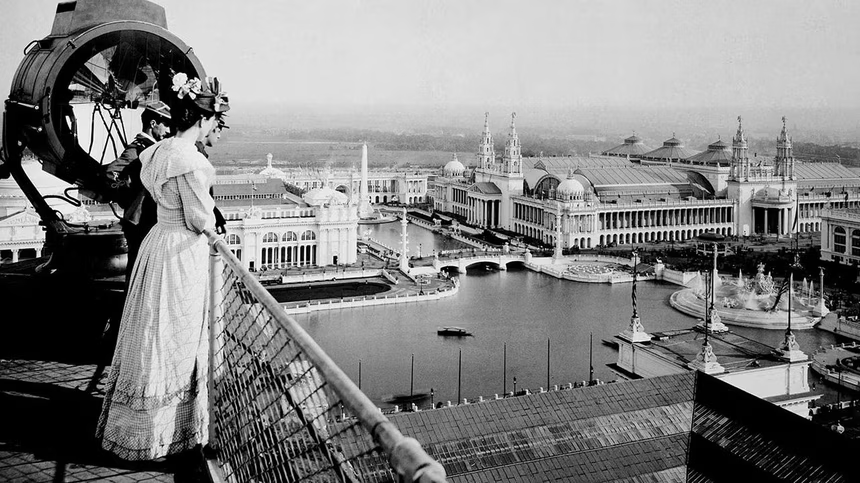
Season 6 includes: The World’s Fair of 1893, Toy Town, Skyscrapers, and Home of the Irish.Providing Support for PBS.org
Learn Moreabout PBS online sponsorship- [Narrator] But no other toy inspired the kind of obsession and cult following than this Chicago area product, Beanie Babies.
Chicago-born, Ty Warner, was a college dropout and failed actor who finally found his calling in sales.
After a decade selling stuffed animals for Dakin, Warner was fired for pushing his own designs on the side.
The 40-year-old went all in and put his life savings into Ty Inc.
creating a line of plush cats.
- Beautiful, rich looking, fluffy cats.
- [Narrator] In 1992, 19-year-old, college student, Lina Trivedi, took a part-time telemarketing job with Ty.
- I was the 12th employee, so it was a pretty small office.
- [Narrator] In November 1993, Warner launched a new product, Beanie Babies.
Nine styles of miniature beanbag animals featuring shiny eyes and cute names, like Legs the Frog and Patty the Platypus.
- He was very meticulous with how the plush looked, grooming them with hairdryers and brushes.
Every animal, he put his soul into creating.
- [Narrator] Ty Warner was unconventional in most respects, eccentric and reclusive.
A shrewd marketer, Warner sold only to mom and pop stores, creating the perception of scarcity.
- His sales reps would come in and align the products just right.
This is how Mr.
Ty wants it displayed.
- [Narrator] One day, Warner got word about an issue with his Asian fabric supplier for Lovey the Lamb.
In a stroke of marketing genius, he turned a supply problem into gold, announcing he would retire Lovey the Lamb.
In turn, creating a buying frenzy.
- Yeah, the retiring was brilliant.
Brilliant.
Ty gave that perception of scarcity when there was none.
People believed that they were rare even though everyone had them, and they were selling millions of them every year.
- [Narrator] As Warner rolled out dozens of new beanies in limited quantities, sales skyrocketed.
- They were flying off the shelves so quick, we had collectors that were calling our company wanting to know how many Beanie Babies are there.
- [Narrator] Trivedi had an idea to further the aura of collectibility.
On the Beanie's ear tags, they could add a playful poem and a birthday.
- Obviously, Beanie Babies were adorable.
How do we make that stand out, and make that connection with people?
And the poems were a way to build that connection.
Ty liked the idea, and he asked me if I would be able to write one for each of the Beanie Babies, which at that time there was like 85 of them.
- [Narrator] Drawing on the help of her brother Nikhil, still just a senior in high school, Trivedi wrote 85 poems in just a couple of days.
- She would throw out an animal and be like, "What do you think this poem's about?"
And then we would kind of like ad lib some poems.
(laughs) - Bongo the monkey lives in a tree.
He's the happiest monkey you'll ever see.
In his spare time, he plays the guitar.
One of these days, he's gonna be a big star.
(chuckles) It was adorable.
I loved writing these poems.
They were so fun to write.
- [Narrator] The poems made collectors fall even more in love with Beanie Babies, and now they could share that love on the website, which went live in late 1995 at a time when only 14% of Americans were online.
- We had this blank template.
There was no reference because there was no companies that were making websites.
- It was like a feedback loop between what collectors were wanting and needing and what we were producing.
- [Narrator] The brother-sister team helped fuel the frenzy online, driving the market to madness.
- Like I was a 19-year-old kid responsible for the online branding of the biggest toy company in the world.
(chuckles) That's a ton of freedom.
- [Narrator] Sales reached a staggering $280 million in 1996.
(cash register ringing) Once a $5 plushie, retired beanies were now seen as a way to make a pretty profit.
- There are people who bought, you know, Bones the Dog for $5 or Princess Di Bear and could sell them for $1,000, you know, two months later.
But a lot of them got addicted to that behavior.
- 150, 200, $300?
- [Collector] 600.
- [Reporter] $600?
- [Collector] Yes.
- [Collector] I would say over 5,000.
- [Reporter] $5,000?
- [Collector] Yes.
- [Narrator] The Beanie resale market really caught fire after the launch of eBay.
- The online resale market just took off, and that propelled them to the stratosphere.
Beanie Babies were a 10th of eBay revenue.
People thought they had to get in while the getting was good.
- [Reporter] Now, what sort of money do you have tied up in Beanie Babies?
- I would say I probably have tied up about $5,000.
- We could be millionaires.
- Yeah, it could be our college money that.
- There was a spillover on the interstate in Atlanta.
A semi was carrying mini Beanie Babies for a McDonald's promotion.
People would stop their cars on the freeway, run and just grab as many Beanie Babies, throw them in their car.
- [Reporter] Oh, my God, look at this.
- So, they really risk life and limb, so they could get a bunch of stuffed animals.
- [Narrator] At its 1998 peak, just five years after launching Beanie Babies, Ty Inc's revenue exceeded $1.4 billion, making Ty Warner one of the richest people in the world.
It seemed like nothing could stop the collector mania, but what goes up must come down.
- When you have tens of thousands of people filling up their basement with Beanie Babies and putting them in little glass cases, eventually, too many people are doing that, and too many people have this glut of Beanie Babies that they become worthless.
People have free will to make those choices.
It's not Ty's fault that there's a sucker born every minute.
- [Narrator] In 2013, Ty Warner was charged with tax evasion for hiding assets in an undisclosed Swiss bank account.
He pleaded guilty and was sentenced to probation and community service and agreed to pay back taxes and a $53 million civil penalty.
Today, Warner remains the CEO and sole owner of Ty Inc, continuing to evolve the brand with new lines.
 New
NewBuilding Magic with Tinkertoys and Lincoln Logs
Video has Closed Captions
Chicagoans created some of the most popular construction toys of all time. (6m 27s)
 New
NewHow Marvin Glass Shaped the Toy Industry
Video has Closed Captions
Marvin Glass invented iconic toys – and a new way to get them made. (7m 6s)
 New
NewVideo has Closed Captions
We asked kids to review three vintage toys created in Chicago. (5m 13s)
Providing Support for PBS.org
Learn Moreabout PBS online sponsorship









Support for PBS provided by:
Chicago Stories is a local public television program presented by WTTW
Lead support for CHICAGO STORIES is provided by The Negaunee Foundation. Major support is provided by the Abra Prentice Foundation, Inc. and the TAWANI Foundation.