
August 1, 2024 - PBS News Hour full episode
8/1/2024 | 57m 46sVideo has Closed Captions
August 1, 2024 - PBS News Hour full episode
Thursday on the News Hour, high-profile Americans held in Russia are released as part of the biggest East-West prisoner swap since the Cold War. Emergency crews struggle to contain rapidly spreading wildfires burning through large swaths of the western U.S. Plus, former President Trump doubles down on the remarks he made about Vice President Harris at a convention for Black journalists.
Problems playing video? | Closed Captioning Feedback
Problems playing video? | Closed Captioning Feedback
Major corporate funding for the PBS News Hour is provided by BDO, BNSF, Consumer Cellular, American Cruise Lines, and Raymond James. Funding for the PBS NewsHour Weekend is provided by...
Support provided by:

August 1, 2024 - PBS News Hour full episode
8/1/2024 | 57m 46sVideo has Closed Captions
Thursday on the News Hour, high-profile Americans held in Russia are released as part of the biggest East-West prisoner swap since the Cold War. Emergency crews struggle to contain rapidly spreading wildfires burning through large swaths of the western U.S. Plus, former President Trump doubles down on the remarks he made about Vice President Harris at a convention for Black journalists.
Problems playing video? | Closed Captioning Feedback
How to Watch PBS News Hour
PBS News Hour is available to stream on pbs.org and the free PBS App, available on iPhone, Apple TV, Android TV, Android smartphones, Amazon Fire TV, Amazon Fire Tablet, Roku, Samsung Smart TV, and Vizio.
Providing Support for PBS.org
Learn Moreabout PBS online sponsorshipGEOFF BENNETT: Good evening.
I'm# Geoff Bennett.
Amna Nawaz is away.
On the "NewsHour" tonight: JOE BIDEN, President of the United States:# Their brutal ordeal is over.
They're free.
GEOFF BENNETT: High-profile Americans held in## Russia are released as part of the biggest# East-West prisoner swap since the Cold W..
Emergency crews struggle to contain# rapidly spreading wildfires burning## through large swathes of the Western U.S. And former President Donald Trump# doubles down on the remarks he made## about Vice President Kamala Harris at# a convention for Black journalists.
(BREAK) GEOFF BENNETT: Welcome to the "News Hour."
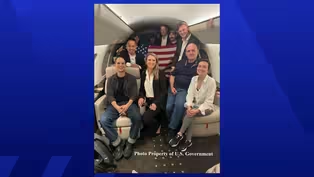
The waiting, the worrying, and the dreadful# wondering are over tonight for .. who were jailed in Russia and their families.# Journalists Evan Gershkovich, Alsu Kurmasheva,## and former U.S. Marine Paul Whelan# are heading home tonight after an## extraordinary deal struck among the U.S.,# its allies, and the Russian government.
A fourth person, a U.S. green card holder,# Vladimir Kara-Murza, was also released.
Nick Schifrin starts our coverage.
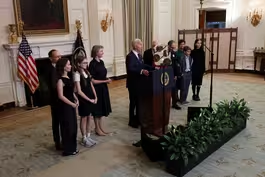
NICK SCHIFRIN: In 80 years of U.S.-Russia and U.S.# Soviet spy swaps, today's was the most complex,## two dozen people on one Ankara, Turkey, tarmac,# Russian dissidents, convicted Russian spies,## and detained Americans who will be coming# home and spoke to their family members in## the Oval Office on a day President# Biden called historic diplomacy.
JOE BIDEN, President of the United States:# This is an incredible relief for all the## family members gathered here.
It's a# relief to the friends and colleagues## all across the country who have been# praying for this day for a long time.
NICK SCHIFRIN: Among those released, 32-year-old# Wall Street Journal reporter Evan Gershkovich,## the first journalist since the Cold War# sentenced in a Russian court for spying.
PAUL WHELAN, Released From Russian Prison: I# got a medical condition that prohibits this.
NICK SCHIFRIN: Former American Marine Paul# Whelan detained by Russia six years ago.## Russian-American Radio Free Europe/Radio# Liberty correspondent Alsu Kurmasheva,## sentenced to six-and-a-half years# for spreading false information.
They posed for a photo with U.S. officials# as they flew home.
Also released, American## resident and Russian-British# activist Vladimir Kara-Murza.
VLADIMIR KARA-MURZA, Russian Opposition# Activist: This personal accountability## may well be the only thing that# will make them think twice.
NICK SCHIFRIN: He's a Pulitzer# Prize-winning journalist and## pro-democracy activist who lobbied Congress# to create the Magnitsky Act, the U.S.' most## well-known human rights sanctions.
He was# twice poisoned, but kept returning to Russia## to try and create the democratic future# he envisioned, as he told me back in 2016.
VLADIMIR KARA-MURZA: We believe in the rule# of law.
We believe in human rights.
We believe## that Russia should enjoy the same democratic# institutions that the rest of Europe enjoys.
NICK SCHIFRIN: To get them out, the U.S. worked# with Germany, Slovenia, Norway, and Poland that## held Russian intelligence agents convicted# of crimes, who are now handed back to Russia,## most notably Vadim Krasikov, who murdered# a Russian dissident in a German playground.
President Vladimir Putin lauded# his work to Tucker Carlson.
VLADIMIR PUTIN, Russian President# (through translator): That person,## due to patriotic sentime.. NICK SCHIFRIN: Slovenia is releasing Russian# sleeper agents Artem Dultsev and Anna Dultseva,## who posed as Argentineans.
The administration# says their part of today's deal was finally## secured in a phone call between President# Biden and Slovenian Prime Minister Robert## Golob on July 21, just hours before President# Biden withdrew from the presidential race.
The U.S. is releasing what a senior administration# official says are three Russian intelligence## officials, each convicted by U.S. courts for# cyber crimes, hacking or sanctions evasion.
JAKE SULLIVAN, U.S. National Security Adviser: It# is difficult to send back a convicted criminal to## secure the release of an innocent American.
And# yet, sometimes, the choice is between doing that## and consigning that person basically to live out# their days in prison in a hostile foreign country.
NICK SCHIFRIN: A U.S. official tells PBS "News# Hour" the Central Intelligence Agency tried to## secure earlier versions of this deal, in January# 2023, the Slovenian sleeper agents for Whelan, in## March 2023, the Slovenian sleeper agents and two# other Russian agents for Whelan and Gershkovich.
Each was rejected by Russian intelligence,## which each time demanded Krasikov.
Germany's# willingness to send Krasikov began as an attempt## to try and release former opposition# leader Alexei Navalny.
That deal was## initially agreed to by President Biden and# Chancellor Olaf Scholz in early February.
But before Navalny's name could be formally# offered to Russia, Navalny died in a Russian## penal colony.
U.S. officials say they negotiated# for months, including a letter from Biden to## Scholz, and Germany finally agreed to# release Krasikov in return for some of## Navalny's former allies in Russian detention,# including Lilia Chanysheva and Ksenia Fadeyeva.
Russia is also releasing well-known# Russian human rights defender Oleg Orlov## and political prisoners Sasha# Skochilenko and Ilya Yashin,## jailed for criticizing the war in Ukraine,# all of whom get new lives in Germany.
JOE BIDEN: They stood up for democracy# and human rights.
Their own leaders## threw them in prison.
The United States# helped secure their release as well.
NICK SCHIFRIN: But not all Americans got out.# Army Staff Sergeant Gordon Black,.
who's been## sentenced to nearly four years in prison# for theft, will remain in Russian detention,## as will American teacher Marc Fogel, convicted# and sentenced to 14 years in prison in 2022.
His mother, Malphine, met with former# President Donald Trump in Butler,## Pennsylvania, the same day of his failed# assassination attempt.
As for those released,## Putin welcomed the Russian spies and their# families home.
And the American families## felt relief.
They will soon see their# loved ones for the first time in years.
And Miriam, Alsu Kurmasheva's younger# daughter, will celebrate her 13th birthday.
JOE BIDEN: Now she gets to celebrate with# her mom.
That's what this is all about,## families able to be together again,# like they should have been all along.
NICK SCHIFRIN: For the PBS# "News Hour," I'm Nick Schifrin.
GEOFF BENNETT: Jon Finer is President# Biden's deputy national security adviser,## and I spoke with him about# the prisoner swap moments ago.
Jon Finer, welcome back to the "News Hour."
JON FINER, U.S.
Principal Deputy National# Security Adviser: Thanks.
Good to be here.
GEOFF BENNETT: All told, this was among the most# complex prisoner swaps.. War.
The deal was in the works for the last two# years, as I understand it, and ultimately came## together in the last two weeks.
What were the# key inflection points?
How did this all happen?
JON FINER: Look, I think there are# a few key aspects of this deal that## really speak to the approach that# our administration and President## Biden have taken to foreign policy# since we got here.
One is diplomacy.
We have said from the very beginning diplomacy# would be the hallmark of our foreign policy,## and that includes diplomacy at the level# of the president.
He made a call to## a fellow head of state, the prime minister of# Slovenia, one hour before telling the country## and the world that he was no longer going# to be running in this year's election to## try to free up one more aspect of this# deal that was ultimately successful.
It's that sort of face-to-face and# person-to-person diplomacy that's at## the core of our policy.
Second is allies and# partners.
The president has said his world## view was predicated on rebuilding, revitalizing# America's alliances, and you saw a half-dozen## allies come together today with different aspects# of this deal, which ultimately led to get it done.
And the third is execution.
As you said, this# was highly complex.
It involved a wide range## of countries, complicated logistics,# all coming together on the same day,## and it was executed without a# hitch.
And as a result of that,## a large number of people who would otherwise# be held captive are going to be coming home,## including three Americans and one legal# permanent resident of the United States.
GEOFF BENNETT: A question about the timing.
Why## now?
Why did Vladimir Putin view this# deal as being in his best intere.. JON FINER: Well, I'm the last# person who's going to speak## to the mind-set of Vladimir Putin.
That# would be a question better placed to others.
But one of the things that you realize, having# worked now on a number of these deals, even## though this one was the most complex, is that they# sort of move on their own speed.
They're a long,## very agonizing sometimes periods in which# it feels like not a lot is getting done.
You continue to beat your head against# it, continue to try to be creative,## come up with new solutions,# problem-solve, have conversations,## and then ultimately things can end up# moving much faster than anyone anticipates.
And that's what happened here.
We wish we# could have done this sooner.
Ultimately,## we got it done, we believe, in a timely# fashion that has led people to now be home## spending time with their families before too# much longer.
And we're quite happy about that.
GEOFF BENNETT: To what degree does# this signal any sort of breakthrough## of tensions between the U.S. and Russia,# and might any of this successful diplomacy## be put to use in helping bring an# end to Russia's war in Ukraine?
JON FINER: To be honest, I would caution# anybody against drawing too many broader## conclusions about the U.S.-Russia# relationship based on this deal.
That is not the course we're on, what# you just described.
We are obviously## in a very difficult place, completely on# opposite sides of the conflict in Ukraine,## and I don't see that changing any time# soon unless Russia makes a significant## set of changes to its approach and its# world view, and we don't anticipate that.
What we had here was a target of opportunity,# an opportunity to get some people home who## otherwise would be continued to be held# in a just unconscionable situation.
We## took that opportunity.
But, otherwise, we are# continuing with our approach, certainly with## the Ukraine war, into our broader approach to# the world, on its current course and speed.
GEOFF BENNETT: While this nightmare is certainly# over for those released, there were other## Americans, as you well know, who were left out# of this exchange, namely Marc Fogel, an American## sentenced to 14 years of hard labor in Russia,# and a U.S.-Russian citizen, Ksenia Karelina,## who's facing charges of treason for allegedly# donating $51 to a Ukrainian charity in the U.S. What is the administration doing to# secure their release at this point?
JON FINER: There continue to be# a number of Americans held under## very difficult circumstances, including the# two Americans you just mentioned in Russia,## including Americans in Syria and Afghanistan# and other places around the world.
And this administration has made an enormous# commitment from before the time we came into## this office, from the transition# to the Biden/Harris administration,## to do what we could to get these people home.# I think the president has now an extraordinary## track record of doing just that.
We're going# to continue to work on those cases and all## cases of Americans held who shouldn't# be until the end of this administration.
GEOFF BENNETT: Deputy National Security Adviser# Jon Finer, thanks for joining us this evening.
JON FINER: Thanks again.
GEOFF BENNETT: Now let's get some# additional perspective on the prisoner swap.
Nick Schifrin has that -- Nick.
NICK SCHIFRIN: Geoff, to discuss the# larger implications of today's events,## we turn to Andrew Weiss.
He's a former# State Department official who served in## the George H.W.
Bush and Clinton administrations,## and is now the vice president for studies at# the Carnegie Endowment for International Peace.
Thanks very much, Andrew Weiss.
Welcome back... ANDREW WEISS, Carnegie Endowment for# International Peace: Great to be here.
NICK SCHIFRIN: ... t.. As we just showed a few minu.. and time welcomed home all these Russian spies and# their families on a big red carpet, big flowers.
What messages is he sending?
ANDREW WEISS: So Vladimir Putin goes to# great lengths to wrap hi.. of the Russian security establishment, but# all of that covers up a pretty unpleasant## and embarrassing fact, which is that Russian# spies have been arrested all over the world## or caught red-handed doing bad stuff, including# the hit man in the Berlin case, Vadim Krasikov.
NICK SCHIFRIN: Krasikov, right.
ANDREW WEISS: So what Vladimir Putin is doi.. frankly, for the continued underperformance# of his security establishment and acting## like they're big heroes.
They're# screw-ups.
They're not heroes.
NICK SCHIFRIN: As I reported earlier, the U.S.# offered two different trades before today,## for Whelan by himself and then Whelan, Evan# Gershkovich, including those two Russian## so-called illegal sleeper agents that had been# caught in Slovenia, but both were rejected.
And the message that the U.S. got was,## call us back when we have Krasikov.
So# why is Krasikov so important to Putin?
ANDREW WEISS: So there's indications that they# know each other personally.
The Wall Street## Journal has a wonderful long piece that appeared# some time today that says they potentially worked## together back when Vladimir Putin was the# deputy mayor of St. Petersburg in the 1990s.
So this is a career Russian intelligence# operative who's presumably conducted a## variety of assassinations and targeted killings in# various parts of the world, including in Moscow,## and who claims to have gone to shooting ranges and# done other things with Vladimir Putin personally.
So there seems to be a connection between# the two men -- the two men, rather.
And you## saw when he came down the jetway today at the# airport of Moscow, Vladimir Putin hugged him.
NICK SCHIFRIN: And you and I have# talked multiple times about how## the different parts of the national security# apparatus in Russia often fight each other.
Could there also be a dispute within the# intelligence agencies inside of Russia over## who to release?
And would the FSB -- Putin being a# former KGB colonel, would the FSB win that fight?
ANDREW WEISS: So Russia has a sprawling# national security apparatus, which is## big by design.
It's intended to kind of# avoid power consolidating in any corner,## so that Vladimir Putin can# kind of divide and rule.
But what we have seen, rather than the# Russian security establishment backing## away from confrontation with the West, is# leaning in.
And so we have seen reports of## the Russian intelligence services trying# to assassinate the CEO of a senior German## defense manufacturer.
We have seen# them conduct sabotage operations.
When Vladimir Putin says he's at war with the# West, I think we need to take him at his word.
NICK SCHIFRIN: Why would# Putin agree to this deal now,## three months before the U.S.# election,instead of waiting.
ANDREW WEISS: Vladimir Putin is a cold-blooded## operator who is tactical and who# believes in being transactional.
So for him to get what he thinks is a pretty# good deal -- for ages, they have been pushing## to get the hit man in the Berlin case released.# This is a person who is serving a life sentence## for conducting a murder, a targeted killing, in# broad daylight.
So, for them, this is a good deal.
And if you look at the other Russians# who are coming out of detention,## these are people who Russians wanted back, who are# intelligence operatives that have been rolled up## in Poland and Norway and in Slovenia, as# well as people conducted in U.S. courts.
But what is -- all these debates about a deal come# down to are the numbers, and the counting game is## really complicated.
So U.S. officials today# are at pains to say we're getting 16 people## out and the Russians are getting eight back.# So it's not an apples-to-apples comparison.
NICK SCHIFRIN: And yet Putin# did not release other Americans,## as Geoff was just highlighting, Marc Fogel# included.
Why might he withhold some of them?
ANDREW WEISS: They're bargaining chips.# So there are other Russians that they want## back.
There are people that the Russians# will continue to take into attention.
Any American who's foolish enough to go# to visit Russia, even for family reasons,## is at risk.
President Biden today made a point of# that in saying the underlying message of today's## good news is also that people need to steer clear# of travel to dangerous destinations like Russia.
NICK SCHIFRIN: And quickly, in the moments we# have left, you have had an extensive career## in government.
How complicated would it# have been to coordinate all the European## countries and all the U.S. agencies and# Russian intelligence to get this deal?
ANDREW WEISS: I'm glad you brought that up.
That's# what's truly unprecedented about today's news.## It's a multidimensional problem that wasn't just# negotiated between the United States and Russia.
The German role was absolutely# critical because, as you pointed out,## that was the key demand from the Russian# side.
So without the German support,## this deal would not have come together.
And# then you had lesser roles played by our allies.
NICK SCHIFRIN: Andrew Weiss, thanks# very much -- Geoff, back to you.
GEOFF BENNETT: Well, thank you both.
And, Nick, as you mentio.. Marc Fogel, who was sentenced to 14 years in# a Russian penal colony back in 2022.
He was## arrested in 2021 at a Moscow airport for# carrying medically prescribed marijuana.
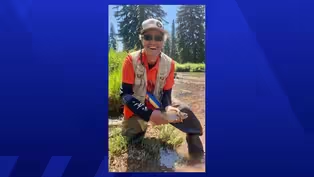
Earlier this evening, before I spoke with# the deputy national security adviser,## Marc Fogel's sister, Anne,# joined us from her Montana home.
Anne Fogel, thank you for being with us.
ANNE FOGEL, Sister of Marc# Fogel: Thank you for having## me.
It's really important# that I t.. GEOFF BENNETT: While some families are rejoicing# today as they have been reunited with their## loved ones, your family still has to wait.# How are you doing?
How are you holding up?
ANNE FOGEL: It's been a heart-wrenching 36# hours.
I spoke with Marc yesterday morning## on the phone.
And he -- when I realized# that he was still in Rybinsk and everyone## else had been pulled out of their penal# colonies, it was -- my heart really sank.
But it's really hard to give up hope.
And for# the entire day, I roller-coastered, around## thinking that Rybinsk is about# four-and-a-half-hours from Moscow.## And I thought that maybe they would be driving him# down or I -- it was just really hard to let it go.
GEOFF BENNETT: When you spoke with him, what did# he say?
What did he tell you?
How is he doing?
ANNE FOGEL: He was kind of in the dark.
He knew## that something was going on.
And then# he saw a little bit of news about Paul.
They're constantly playing the television and# news stations in the penal colony that he's## in.
And so he knew something was going on,# but he doesn't speak Russian.
So he wasn't## exactly sure.
And he called.
And I didn't# want to -- I know this is crushing him.
So I didn't want to tell him what I knew.
But# we -- at that point in time, we were calling## our senators and calling the ambassadors that we# have been in touch with.
And we were trying to## get something activated for him.
And so it was a# crazy day of phones and messaging and e-mailing.
And it's all for naught.
GEOFF BENNETT: The national# security adviser, Jake Sullivan,## said today that the administration is working# to secure your brother's release from Russia.
Have you heard anything from the administration?
ANNE FOGEL: No, we have never heard# from the administration.
I did ta.. to -- my sister-in-law and I did talk# to Jake Sullivan about two years ago.
But Marc has never been prioritized.
He# had -- he was convicted under the same## code as Brittney Griner, but he was never# designated as wrongfully detained.
And we## don't have the NBA behind us and we don't# have The Wall Street Journal behind us,## so it's been very difficult# for us to get our man out.
GEOFF BENNETT: Your mother, your 95-year-old# mother, filed a lawsuit in June against the## U.S. State Department over its failure to# declare Marc Fogel as wrongfully detained.
Why do you think he hasn't# received that designation## and how has it complicated efforts,# in your view, to secure his release?
ANNE FOGEL: I don't think he's been# designated because I don't think he's## important enough.
As I said, we just don't# have the notoriety, the celebrity status.
And, believe me, the worst part of# this process is being pitted against## other Americans.
I don't want that.
No# one wants that.
Marc doesn't want that.
GEOFF BENNETT: When we started our# conversation, you said you wanted## to get your brother's story out.
What do you# want folks to know about your brother Marc?
ANNE FOGEL: I want you to know that Marc# has had an outsized impact on the world,## essentially, because he has taught# internationally for so many years.
He has thousands of students that he has taught,# and he is -- there's not a hall of fame for## teaching, but he is the best of the best.
And# you have one of his students in your newsroom,## as we speak.
He has students all over the# world writing to him, praying for him,## making movies about him.
We need justice.
He needs# to come home.
He needs to be with his family.
His life and sons need him.
And this# is absolutely unfair that they did not## bring him home with the greatest historic# prisoner swap since the World War.
I wish I## could be more steady perhaps in saying these# things, but I feel very wronged for Marc.
And he needs to come home, and the# Biden administration has nothing## to lose.
They should have brought him home.
GEOFF BENNETT: Anne Fogel,# our thoughts are with you,## your family and your brother Marc.
Thanks again# for your time this evening.
We appreciate it.
ANNE FOGEL: Thank you for having me.
GEOFF BENNETT: Concerns about a growing conflict## in the Middle East start# our day's other headlines.
That's after Israel's military confirmed an# airstrike last month had killed the leader of## Hamas' military wing, Mohammed Deif.
Also# today, Iran's supreme leader attended the## funeral in Tehran for another Hamas leader,# Ismail Haniyeh, who was killed in an attack## this week.
Israel has not claimed responsibility,# while, in Beirut, mourners paid their respects for## Hezbollah commander Fuad Shukr, who was killed in# an Israeli strike in Lebanon's capital on Tuesday.
Addressing the crowd, Hezbollah's# leader threatened retaliation,## saying the conflict had entered# a new phase.
For his part,## Israeli Prime Minister Benjamin Netanyahu# said his country is ready for any response.
BENJAMIN NETANYAHU, Israeli Prime Minister# (through translator): Israel is highly## prepared for any scenario, both# defensively an.. will exact a very heavy price for any act# of aggression against us from any arena.
GEOFF BENNETT: In Tel Aviv, Israelis took# to the streets to mark 300 days since the## October 7 attack and called for an immediate# release of hostages still being held in Gaza.
The U.S. Air Force has concluded that a deadly# Osprey crash off the coast of Japan last year## was caused by a -- quote -- "catastrophic# failure" in a gearbox.
The investigation## also found that the pilot ignored warnings# to land the aircraft.
The crash killed eight## service members and led to a monthslong# grounding of all military Ospreys.
It## was one of several Osprey crashes in recent# years that killed 20 service members overall.
A New York appeals court has rejected# Donald Trump's attempt to have the gag## order in his hush money case lifted.
A# panel found that the judge in the trial,## Juan Merchan, was right to extend parts of the# order until Mr. Trump is sentenced in September.
Separately, Mr. Trump's defense team# has asked that Merchan be recused from## the case for a third time.
In a court# filing, they cited an alleged conflict## involving the judge's daughter and her# ties to Vice President Kamala Harris,## who is now likely to be Mr. Trump's# opponent in the November election.
Senate Republicans today blocked legislation# that would have expanded the child tax## credit for low-income families and extend# some corporate tax breaks.
In doing so,## they torpedoed a bipartisan $79# billion tax bill that the House## had overwhelmingly approved.
Republicans# are betting that they can push through a## more conservative tax bill next year if they# win control of Congress and the White House.
The U.S. Department of Transportation# proposed a rule today that would ban## airlines from charging parents to sit# with their children.
Under the proposal,## children 13 years or younger must be allowed# to sit with their parent or guardian for## free.
If adjacent seats aren't available# when booking, families can opt for a full## refund or wait for a seat to open up.
And# if one doesn't, they can rebook for free.
The Biden administration says the rule could# save a family of four up to $200 in seat fees.
On Wall Street today, stocks dropped after# recent data sparked worries of an economic## slowdown.
The Dow Jones industrial# average fell nearly 500 points,## or more than 1 percent.# The Nasdaq lost 400 points,## falling back toward the 17000-point level.
The# S&P 500 also ended sharply lower on the day.
And spoiler alert, we have more results# from the Paris Olympics.
The all-around## final for women's gymnastics was packed# with stellar performances, but, in the end,## gold went to the greatest of all time.# Simone Biles can now add a record sixth## Olympic gold to her resume.
Another# American, Suni Lee, got the bronze.
And swimmer Katie Ledecky made history by# capturing silver in the 4x200 freestyle## relay.
That's Ledecky's 13th Olympic medal, making# her the most decorated U.S. female Olympian ever.
Looking at the overall medal count, and Team# USA has solidified its lead with 37 medals,## including gold medals today in# swimming, rowing and fencing events.
Still to come on the "News Hour": we speak# with voters about how the shakeups in the## presidential race have shifted their# views; key conspirators of the 9/11## attacks now held at Guantanamo Bay are# set to plead guilty, what's in the deal;## and a new book on the international strongmen# who work together to end democracies.
An especially active fire season is exacting# a huge toll across several Western states.
A series of fires have turned deadly in# Colorado, where at least one person was## found dead.
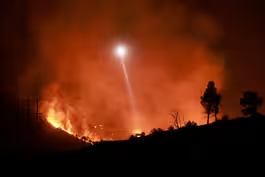
In California, more than 5,800# personnel, 500 fire trucks and 40 helicopters## are battling a fire that's larger than all# of Los Angeles.
The Park Fire, as it's known,## is the country's largest and has ballooned# to historic proportions in just over a week.
Stephanie Sy has the latest.
STEPHANIE SY: This is the view for# firefighters on the front lines of## California's Park Fire.
The blaze, believed# to be started by a local man's burning car,## is now the fifth largest in state history.
SERGIO ARELLANO, Cal Fire: I have not personally## seen a fire grow so fast in# such a short.. STEPHANIE SY: In just a week, nearly# 400,000 acres burned across four counties,## forcing thousands of evacuations and# destroying hundreds of structures.
In rural Cohasset, California, Dave Tehan and his# son Jonathan are both members of the county fire## department.
While they battle to protect their# town, their own homes were lost to the flames.
DAVE TEHAN, Volunteer Firefighter: I feel# luckier than some of the people here,## because we do have a few things, not very# much, but a few things to hold in our hands## that survived.
The friends from --# that I have known for so many years## have just stepped up and shown so# much support.
I feel rich in that.
STEPHANIE SY: Kristy Michael Daneau also# live in Cohasset.
They lost their house## to another fast-moving fire six years ago# in Paradise, California.
Now this is all## that remains of the home where they rebuilt# their lives.
They had no fire insurance.
KRISTY DANEAU, Wildfire Evacuee: The# most important things I grabbed was## me and my brother and sister have my mom's ashes,## along with my dad.
And so I was able to# grab a few little pictures and her ashes.
STEPHANIE SY: The Park Fire's explosive# expansion is nearly unprecedented,## says UCLA climate scientist Daniel SWAIN.
DANIEL SWAIN, Climate Scientist, UCLA: This# is definitely a top-tier event in terms of## how quickly it moved across the landscape in those# initial days, some of the vastest rates of spread## over that initial 24-to-48 hour period that we# have seen on a wildfire in this part of the world.
STEPHANIE SY: Nearly 100 fires are# currently burning across the West## and 4.5 million acres have already burned# this year, about a million above average.
This week, multiple blazes broke# out across Colorado's Front Range,## killing at least one person and forcing# residents to flee their homes near Denver.## Governor Jared Polis has now activated the# National Guard to assist with logistics.
Meanwhile, in Oregon, crews are stretched# thin, battling more than 30 separate fires.
DON CAPE, Oregon Resident: I have lived here# all my life and never, never seen it this way.
STEPHANIE SY: To make matters worse,## another brutal heat wave is forecast to# turn up the temperature this weekend,## a dynamic that Swain says continues to drive# the intensity of this year's fire season.
DANIEL SWAIN: It has become a very# active season.
And a big part of the## reason for this is that nearly the entire# western half of the country as well,## as the western half of Canada, have# experienced, much like California has,## record-breaking heat in recent weeks# over a very long and sustained period.
So all of that extra heat, even following what# was a relatively wet winter in some places,## has really dried out the vegetation, in# some cases to near-record dry levels.
STEPHANIE SY: And that means there's# plenty of fuel for the fires yet to burn.
For the PBS "News Hour," I'm Stephanie Sy.
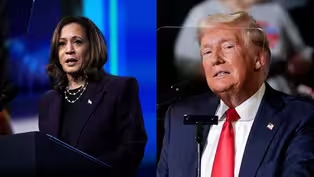
GEOFF BENNETT: Former President Donald# Trump is facing backlash for calling## Vice President Kamala Harris' racial identity into## question when he addressed a Black# journalists convention yesterday.
That's as the vice president# herself wrapped up a series of## events aimed at speaking directly to Black voters.
Our Laura Barron-Lopez has more.
LAURA BARRON-LOPEZ: Delivering the eulogy# before hundreds of mourners at Fallbrook## Church in North Houston today, Vice President# Kamala Harris bid farewell to a friend,## the late Texas Representative Sheila# Jackson Lee, who served in Congress## for nearly three decades and became one# of its most influential Black members.
KAMALA HARRIS, Vice President of the United States# (D) and U.S. Presidential Candidate: To honor## her memory, let us con.. a promise of freedom, opportunity and# justice, not just for some, but for all.
LAURA BARRON-LOPEZ: Harris remembering# a fellow Black woman trailblazer,## as her own racial identity is being# attacked by her rival, Donald Trump.
Speaking to a historically Black# sorority yesterday, Harris slammed## her opponent hours after the Republican# nominee questioned her racial identity.
KAMALA HARRIS: Donald Trump spoke at# the annual meeting of the National## Association of Black Journalists,# and it was the same old show,## the divisiveness and the disrespect.
And let me# just say, the American people deserve better.
LAURA BARRON-LOPEZ: Trump was asked if Harris,## who is poised to be the first Black and South# Asian woman to.. was a DEI or diversity hire, as some# of his Republican allies have said.
DONALD TRUMP, Former President of the#United States (R) ... promoting Indian heritage.
I didn't know# she was black until a number of years ago,## when she happened to turn black, and# now she wants to be known as black.
DONALD TRUMP: So, I don't know.# Is she Indian or is she black?
LAURA BARRON-LOPEZ: In spite of the backlash,## Trump is digging in, posting this# to his social media plat.. thanking Harris for the -- quote -- "nice picture"# that showed the "love of your Indian heritage."
And at a rally in Pennsylvania last# night, the Trump campaign displayed## news headlines that referred to her as# an Indian-American senator.
The former## president accused Harris of faking her identity.
DONALD TRUMP: In her speech in Atlanta last night,## Kamala Harris even tried to outbrand a new# Southern accent.
Did you hear a new accent?
LAURA BARRON-LOPEZ: Harris is biracial, the# daughter of an Indian mother and Jamaican father,## and her Black identity a key part of her# history as the member of a historically## Black sorority while a student# at a historically Black college.
Today, at the U.S. southern border, Trump's# running mate tried to put the spotlight back## on policy, namely, immigration.
Vice presidential# nominee J.D.
Vance toured an unfinished section## of border fence in Arizona and blamed Harris# for the Biden administration's border policies.
SEN. J.D.
VANCE (R-OH), Vice Presidential# Candidate: Has Kamala Harris done anything## you have asked her to do?
She is the# border czar.
Has your border czar done## anything you have asked her# to do?
And the answer is no.
LAURA BARRON-LOPEZ: Harris, however,## was never charged with overseeing bor.. addressing root causes of migration and# why people flee their countries of origin.
And with 96 days until Election Day, the breakneck# pace of campaigning for Harris and Trump is just## beginning.
The Trump campaign said today# it raised nearly $140 million last month,## trailing the $200 million Harris raised# in the first week of her campaign.
Harris could be the official Democratic# nominee by Monday and will hold her first## rally with her yet-to-be-named running# mate next Tuesday in Philadelphia.
For the PBS "News Hour," I'm Laura Barron-Lopez.
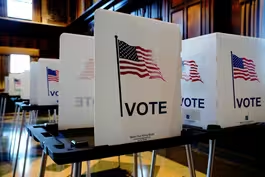
GEOFF BENNETT: And for those voters who# have not firmly decided which presidential## candidate to support, the events of the# last month, including an assassination## attempt and a new Democratic candidate,# have dramatically reshaped the race.
Lisa Desjardins connected with the type of voters## likely to decide the election# before and after those shakeups.
LISA DESJARDINS: We heard from thousands of# voters across the country, different ages,## politics and walks of life,# all dreading this election.
MAN: I'm wishing for something, like, normal.
MAN: I feel despondent.
I feel# that there is no good choice.
WOMAN: I just feel overall really# disappointed and really hopeless.
LISA DESJARDINS: We will highlight a# few now.
In June, they were unhappy.
CARLYN PINKINS, New Mexico Voter:# Frustrated, disappointed, let down.
ANA FERNANDEZ, Florida Voter: A little dejected.
LISA DESJARDINS: But just weeks later... LISA DESJARDINS: ... extraordinary events# changed the race.
An assassination attempt## raised a new image of Trump, followed# shortly by a new partner in the race,## with Trump choosing Ohio Senator# J.D.
Vance as his running mate.
And just days later: JOE BIDEN, President of the# United States: I have decided## the best way forward is th.. LISA DESJARDINS: Biden was out of the# race.
Vice President Kamala Harris was in.
But what did all this mean for voters?# From our deciders, we have a snapshot## of the change.
It was large for Ana Fernandez, a# 22-year-old in Miami, about to go to law school.
Here's how she felt over a month ago.
ANA FERNANDEZ: I have not a lot# of confidence that things are## going the way that they should in this# country, but trying to maintain hope.
LISA DESJARDINS: But her feelings now?
ANA FERNANDEZ: Like, I feel joyful,# excited, like so hopeful, so exci.. LISA DESJARDINS: Ana, who's finishing a gap year# before law school, is herself an immigrant from## Cuba.
She crossed the border as a 4-year-old and# sees her family as part of the American dream.## But she also sees immigration policy that is# failing both migrants and the border itself.
A Democrat, she trusts Harris more than Trump to# improve things.
She has questions about Harris,## but she's ready for a new generation and# all the memes that Harris has sparked.
KAMALA HARRIS, Vice President of the United#States (D) and U... ANA FERNANDEZ: She's definitely energizing me.# While I love to think that I'm a serious consumer## of news, I also love when Charli XCX tweeted that# Kamala is brat.
Like, that made me very happy.
CARLYN PINKINS: It was almost# like a cloud had lifted.
LISA DESJARDINS: In New Mexico, Carlyn Pinkins# has a sense of hope too, but it may not help## Harris.
Pinkins is a graduate student and# working multiple jobs.
She has a full life,## trivia nights and getting outdoors, but# rent is high and she barely gets by.
She believes both parties are failing people# like her.
She wants to vote third party,## but in June was worried about that# helping Trump.
This was her then.
CARLYN PINKINS: We have these two# candidates that don't care about## people in my situation.
And I'm# steadily year after year watching## things for me and my friends and# people in my community get worse.
LISA DESJARDINS: And now?
CARLYN PINKINS: I feel a lot better voting#.. are putting up a candidate that has a# good -- a really good chance, I think.
LISA DESJARDINS: What about a# group Trump especially needs,## unhappy and critical Republicans?
So a few things have happened# since we last talked.
ZACH HORN, Pennsylvania Voter: They# have.
It's been quite an experience## here so far.
I told you I wasn't too# excited for this election cycle.
And## I guess it's probably been the most# exciting one we have had in a while.
LISA DESJARDINS: Zach Horn is a teacher in# Western Pennsylvania, a family man and sports## fan with two kids.
He's highly tuned in to# the election.
In June, he was undecided.
ZACH HORN: This is the first year where# I'm just not as excited as I would have## been in the past.
So I think that's where# that disappointment feature comes in.
LISA DESJARDINS: But three weeks# later, the assassination attempt,## just an hour from his home, put# Trump in a more human light for him.
ZACH HORN: It just -- it helped to make him more# personable, I guess is what you would say.
So, in## a way, like, in terms of the vote and things like# that, it kind of moved me closer to a Trump vote.
LISA DESJARDINS: He watched the Republican## Convention thinking perhaps# Trump would be a unifier.
DONALD TRUMP, Former President of#the United States (R) ... LISA DESJARDINS: And for 25 minutes, Zach heard a## candidate he could support.
But then the# speech and Zach's thoughts changed again.
ZACH HORN: It became a stump speech.
And# it was a lengthy stump speech, at that.
And## that lost me, to be quite# honest.
I was going to say,## I was hoping for the call for unity.
It# didn't happen the way that I expected it## to.
And so that initial move closer kind of# got washed with some of those things later.
LISA DESJARDINS: Now he's looking at# Harris, considering her seriously,## and saying her V.P.
decision could make# the difference.
Zach's experience with## Pennsylvania Governor Josh Shapiro has been good.
ZACH HORN: If Josh Shapiro# gets selected as the V.P.,## I'd probably go from a lean-Trump# position currently to a lean-Harris## position at that point.
But I still# want to hear what everybody has to say.
Another unsure Republican.
STEVE BECK, Alabama Voter: If it was tomorrow, it# wo.. LISA DESJARDINS: Steve Beck runs his own travel# agency in Alabama.
In June, he had mixed feelings.
STEVE BECK: On one hand discouraged, but,# on the other hand, just encouraged because## we have a process that has been around a# while, and it still does a very good job.
LISA DESJARDINS: He remains disappointed,# but he's trying to move past it,## even as he still doesn't love the# candidates or how they got here.
STEVE BECK: I wish Kamala Harris had gone through# a process.
I wish there was someone other than## Trump.
But this is where we're at.
And it's up# to me as a voter to continue to look deeper.
LISA DESJARDINS: One more# decider in a swing state.## This was Georgia voter Lauren Capie in June.
LAUREN CAPIE, Georgia Voter: Frustrating.
LISA DESJARDINS: She felt neither Trump nor Biden## listens to voters.
And now# with Harris as a candidate?
LAUREN CAPIE: I feel differently.# I feel more positive.
I feel like## maybe she's more in touch than he is.
Of# course, she's younger, and she's female.
LISA DESJARDINS: Capie works for the Social# Security Administration and finds joy in## travel.
And while she had been more anti-Trump# before, she now sees reasons to like Harris.
LAUREN CAPIE: Something feels different.
I don't## know what that is.
But, yes,# I'm a little more hopeful.
LISA DESJARDINS: Something# feels different.
For voters,## for the deciders especially, the# race is not over.
It's restarting.
For the "PBS News Hour," I'm Lisa Desjardins.
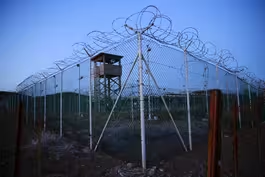
GEOFF BENNETT: The man accused as# the mastermind behind the September## 11 terrorist attacks and his# two accomplices have agreed## to plea -- have agreed to a plea deal in# exchange for avoiding the death penalty.
The development comes 16 years# after their prosecution started.
Ali Rogin has the latest.
ALI ROGIN: The three men, Khalid Sheikh Mohammed,## the alleged leader behind the attacks, and# Walid Muhammad Salih Mubarak Bin Attash and## Mustafa Ahmed Adam al Hawsawi, all agreed to# plead guilty in exchange for life sentences.
The men have been in custody since# 2003 and initially charged in 2008,## but there have been years of legal delays due## in part to the brutal torture the men# were subjected to while in detention.
In a letter, government prosecutors said# they recognize the deal would be met with## mixed reactions among thousands of# family members who lost loved ones,## but they called it the best path to# finality and justice in this case.
For a closer look, I'm joined by Wall# Street Journal reporter Jess Bravin.## He's the author of "The Terror Courts," an# account of military trials at Guantanamo Bay.
Jess, thank you so much for joining us.
How did this deal come to be# and why is it happening now?
JESS BRAVIN, The Wall Street Journal: Well,# this deal was under negotiation since 2022,## and it wasn't the first time a# deal like this was considered.
For years, prosecutors and officials in the# military commission apparatus thought that a## deal for life sentences in exchange for guilty# plays was -- pleas would be the only way out.## So an earlier effort was quashed by higher-ups in# the Pentagon.
This one began, as I said, in 2022## and has continued as some of the detainees, some# of the defendants, KSM, as we have called him,## and the other two decided they were ready to get# some finality for their own fate and move forward.
So it really accelerated in the last# two weeks.
There was a court session## at Guantanamo Bay.
Prosecutors and the defense## attorneys said they were ready to wrap# it up and try to get this case closed.
ALI ROGIN: Prosecutors had# sought the death penalty,## but the alleged torture that# the defendants underwent for## years complicated those proceedings.
How# did that all factor into this decision?
JESS BRAVIN: Well, it was# really essential, because,## right after 9/11, when reports began emerging# about brutal treatment of enemy prisoners,## torture, as in fact President# Obama called it at one point,## began to emerge, there were questions about# how would this affect any future trials?
And there were legal experts then who# warned that it would make it very difficult,## if not impossible, to prosecute people# if they were severely mistreated by the## government while in custody.
And# that is exactly what has happened.
These detainees wanted to bring in evidence# of how they were treated by the CIA.
Mohammed## had been water-boarded.
They'd been beaten.# All kinds of things had been done to them## that the United States would not tolerate for# its own citizens.
And they wanted to bring in## evidence saying that any statements# they made were infected by torture.
So a lot of the pretrial wrangling# over more than a decade has been over,## what can the defendants introduce about their# treatment?
And then there was a second factor,## which is that under a doctrine# sometimes called unclean hands,## the government is punished by courts# when it commits misconduct in a trial.
And abusing defendants in custody is# misconduct.
So it is possible that,## even if they were convicted and sentenced to# death, on appeal, a higher court might sanction## the government by taking the death penalty off the# table.
So the death penalty seemed to be really a## bridge too far, given the mistreatment of these# prisoners after they were captured by the U.S. ALI ROGIN: And what do we know about how the# families of 9/11 victims are responding to this?
JESS BRAVIN: It is a total mixed# bag.
There are thousands of families## of victims.
And as you would expect,# there are opinions across the gamut.
There are some who feel that nothing# short of death is appropriate for## these defendants.
And based on their# actions, it would be hard to say,## if the death penalty is appropriate for# anyone, it wouldn't be appropriate for## them.
Others simply oppose the death penalty.# Many Americans and people around the world## just philosophically are morally opposed# the death penalty period for anybody.
And some of those are among the victims' families.## And then there are those who really# take the prosecutor's point of view,## which is that, ideally, they could pursue# capital punishment for these defendants,## but it's just time for closure and it's time# to end this proceeding and move forward.
One of the features of the deal is that# there will be a sentencing hearing,## where the defendants can testify, but# they will have to answer questions## from the victim's families.
And for many of# those families who are looking for answers,## who are looking for some sense of these# accused perpetrators, that hearing will## be the substitution for a full trial on# what happened in the lead-up to 9/11.
ALI ROGIN: In the moments we have left,## what happens next?
Where do these# defendants spend.. JESS BRAVIN: Well, again, it hasn't fully been# approved by all the proceedings that have to## happen.
But the plan is that they will next enter# a plea probably within a week or a month of now.
Next year, there will be the sentencing# hearing.
And after their sentence is confirmed,## they likely will spend it right where# they are now at Guantanamo Bay.
The## technical status of their detention will# change.
They will be sentenced prisoners,## but in terms of their day-to-day lives, probably# not much will change.
They will be looking at## the same four walls that they are looking# at right now for the rest of their lives.
ALI ROGIN: Jess Bravin, covering this every step# of the way, thank you so much for joining us.
JESS BRAVIN: You bet.
Thank you.
GEOFF BENNETT: Today's historic prisoner release# from Russia was thanks to the diplomatic work of a## group of democracies, freeing over a dozen people# from the autocratic regime of Vladimir Putin.
But, as William Brangham reports,## a new book examines how autocracies are gaining# power and what they're doi.. WILLIAM BRANGHAM: In her new book,# Pulitzer Prize winner Anne Applebaum## punctures the commonly held image# of an isolated autocrat.
Instead,## she documents the often interconnected# ways these strongmen rise to power,## how they bolster each other, and then# work in tandem to undermine democracy.
The book is called "Autocracy, Inc.: The# Dictators Who Want to Run the World."
And Anne Applebaum joins us now.
Welcome back to the "News Hour."
ANNE APPLEBAUM, Author, "Autocracy, Inc.: The# Dictators Who Want t.. WILLIAM BRANGHAM: Can we start with a def.. communist, often without knowing# what those terms really mean.
What is an autocrat, and who are the# autocrats out there that we would know?
ANNE APPLEBAUM: An autocrat is someone who# seeks to rule with no checks and balances,## with no checks on his authority, with no judges,# no media, no intermediary figures or institutions,## who wants to control everything that happens# in the state and to make all of the decisions.
And I -- the autocrats who I'm most interested# in are the ones who not only want to have that## system at home, but who are interested# in protecting people who want to create## those systems abroad.
So, the book# is mostly about Russia, China, Iran,## North Korea, Venezuela, and a host of others,# Zimbabwe, Azerbaijan.
There's a list of them.
And, increasingly, they operate as a network.# They seek to protect each other and also## to disrupt the democratic world.
And that's# because the language of the democratic world,## meaning rights, laws, rule of law, justice... WILLIAM BRANGHAM: Accountability.
ANNE APPLEBAUM: ... accountabi.. that's the language of their# own internal oppositions.
And so they need to undermine the# people who use it and, if they can,## discredit it.
And that's part of what# we're seeing happen now around the world.
WILLIAM BRANGHAM: One of the stereotypes# that you try to puncture here is this idea## that they really don't have shared interests,# that they work individually to oppress and## terrorize their own citizens, but don't really# care so much about what happens elsewhere.
What is it that they do see as the value in# helping -- what does Xi see in helping Putin,## or Putin in North Korea, for instance?
ANNE APPLEBAUM: Well, some of it is pragmatic.# So Putin gets ammunition from North Korea,## and he gets drones from Iran, and he gets# components for his defense industry from Xi.
And some of it is a little bit more than that.
So# Xi may have an interest in not seeing Putin fail,## because, if Putin fails, that speaks badly# of autocratic systems.
It speaks badly of the## kinds of leaders who rule with absolute power.# And it might have a negative impact on him.
They worry a great deal about the# autocratic club and the fate of its members.
WILLIAM BRANGHAM: Your book is# dedicated to the optimists out there.
And I wonder, when you look at how the West and# NATO stood up to Putin's aggression in Ukraine,## does that give you a sense# of optimism that the forces## of democracy can be martialed against autocracy?
ANNE APPLEBAUM: It really did.
I mean, it was a# moment nobody was really sure what would happen## when Russia invaded Ukraine in full-scale# invasion in 2022, and the degree to which not## just the old West, Europe and America, not just# NATO, but the entire democratic world rallied.
There's something like 50 countries# who've participated in the defense of## Ukraine or the aid of Ukraine.
The# flip side is that I don't think we## fully understood at the beginning of# the war the degree to which there was## going to be an autocratic network# that was going to support Putin.
WILLIAM BRANGHAM: Supporting him... ... with arms# and money and al.. ANNE APPLEBAUM: Arms and money# and support of other kinds.
And we need to now begin thinking about how# to counter that.
And people are beginning to## think about it, but a little --# like everything, a little late.
WILLIAM BRANGHAM: This is not a# book about Donald Trump.
I mean,## he gets a few passing mentions and a# good chunk of the last page of your book.
But you do write that, if he were# reelected and uses the tools of## executive power against his perceived enemies,# that it would -- quote -- then it would be:## "The blending of the autocratic and# democratic worlds will be complete."
Do you think that Donald# Trump wants to be an autocrat?
ANNE APPLEBAUM: He certainly# says so.
I mean, sometimes,## he says so in a kind of jokey way:# I will be dictator for one day.
Sometimes, he says so in the language he uses# about -- whether it's about President Xi,## who he admires, or President Putin, who he# admires, or even the dictator of North Korea,## who's driven his country into poverty# and isolation, who he also admires.
So he's telling us what kinds of people# are around -- and he rarely -- he has## very few kind words for American# allies or for fellow democracies.## It's really the absolute -- people with# absolute power that he wants to be like.
And you can also hear in the language he uses,# whether it's about judges, or whether it's## about the media, or whether it's about American# institutions of other kind, about the electoral## system, that he has great disdain for the# institutions of democracy and the rules that## were set up to make sure that power is checked in# our country and that the executive isn't a king.
And those are disturbing traits.# And they would be -- they would be## disturbing at any time in history, but# they're particularly disturbing now,## when we have the rise of so many leaders# with absolute power around the world who## would love to have a transactional# American president to do deals with.
WILLIAM BRANGHAM: People who live# in democracies love to think that,## when pressed, that the system will be robust# and stand up to this.
I mean, that was what## many people thought of -- happened during the# first Trump administration, that the system held.
Do you think that that's naive?
ANNE APPLEBAUM: It can be naive.
I mean, there is a pattern.
You .. who lose elections, people like Donald Trump who# believe they are owed power, they deserve power,## who lose elections and who come back in a second# term and say, right, this time, I'm not going to## make that mistake again, and who then change their# electoral system, or, in Orban's case, change the## constitution, change the judicial system,# in order to make sure that they never lose.
The attention that's paid,# for example, to Project 2025,## which is a project of The Heritage Foundation,# which describes exactly how you would do that## and which sounds remarkably like what's# happened in other countries, including,## by the way, in Venezuela -- that# was how Hugo Chavez took over.
This isn't necessarily a right-wing# or a left-wing project.
It's just an## antidemocratic project.
And the fact that he will# be surrounded by people like that is disturbing.
WILLIAM BRANGHAM: The book is called "Autocracy,# Inc.: The Dictators Who Want to Run the World."
Anne Applebaum, great to# see you.
Thank you so much.
ANNE APPLEBAUM: Thank you.
GEOFF BENNETT: And that is the "News# Hour" for tonight.
I'm Geoff Bennett.
For all of us here at the "PBS# News Hour," thanks for joining us.

Analyzing the implications of U.S.-Russia prisoner trade
Video has Closed Captions
Clip: 8/1/2024 | 5m 10s | Former State Department official analyzes implications of U.S.-Russia prisoner trade (5m 10s)

'Autocracy, Inc.' explores attempts to end democracy
Video has Closed Captions
Clip: 8/1/2024 | 7m 18s | New book examines how autocracies are getting stronger and trying to end democracy (7m 18s)
Crews struggle to contain rapidly spreading Calif. wildfire
Video has Closed Captions
Clip: 8/1/2024 | 4m 3s | Crews struggle to contain rapidly spreading Park Fire in California (4m 3s)
Gershkovich among 3 Americans freed in prisoner swap
Video has Closed Captions
Clip: 8/1/2024 | 5m 40s | Gershkovich among 3 Americans freed in historic prisoner swap with Russia (5m 40s)
Sister of American still held in Russia discusses his case
Video has Closed Captions
Clip: 8/1/2024 | 5m 30s | Sister of American not part of Russian prisoner swap: 'We don't have the celebrity status' (5m 30s)
Trump digs in on attacking Harris' racial identity
Video has Closed Captions
Clip: 8/1/2024 | 3m 47s | Facing backlash, Trump digs in on attacks misrepresenting Harris' racial identity (3m 47s)
Undecided voters on election shakeups and shifting views
Video has Closed Captions
Clip: 8/1/2024 | 6m 44s | Undecided voters explain how the election shakeups have shifted their views (6m 44s)
What's in the plea deal for key 9/11 attack conspirators
Video has Closed Captions
Clip: 8/1/2024 | 5m 39s | What's in the plea deal reached with key 9/11 attack conspirators (5m 39s)
White House says prisoner swap took years of negotiations
Video has Closed Captions
Clip: 8/1/2024 | 4m 25s | Biden administration says prisoner exchange took years of complex negotiations with Russia (4m 25s)
Providing Support for PBS.org
Learn Moreabout PBS online sponsorship
- News and Public Affairs

FRONTLINE is investigative journalism that questions, explains and changes our world.

- News and Public Affairs

Amanpour and Company features conversations with leaders and decision makers.












Support for PBS provided by:
Major corporate funding for the PBS News Hour is provided by BDO, BNSF, Consumer Cellular, American Cruise Lines, and Raymond James. Funding for the PBS NewsHour Weekend is provided by...