NJ Spotlight News
NJ Spotlight News: February 19, 2026
2/19/2026 | 26m 46sVideo has Closed Captions
Watch as the NJ Spotlight News team breaks down today’s top stories.
We bring you what’s relevant and important in New Jersey news and our insight. Watch as the NJ Spotlight News team breaks down today’s top stories.
Problems playing video? | Closed Captioning Feedback
Problems playing video? | Closed Captioning Feedback
NJ Spotlight News is a local public television program presented by THIRTEEN PBS
NJ Spotlight News
NJ Spotlight News: February 19, 2026
2/19/2026 | 26m 46sVideo has Closed Captions
We bring you what’s relevant and important in New Jersey news and our insight. Watch as the NJ Spotlight News team breaks down today’s top stories.
Problems playing video? | Closed Captioning Feedback
How to Watch NJ Spotlight News
NJ Spotlight News is available to stream on pbs.org and the free PBS App, available on iPhone, Apple TV, Android TV, Android smartphones, Amazon Fire TV, Amazon Fire Tablet, Roku, Samsung Smart TV, and Vizio.
Providing Support for PBS.org
Learn Moreabout PBS online sponsorship>> From NJPBS Studios, this is "NJ Spotlight News" with Brianna Vannozzi.
>> Hello, and thanks for joining us tonight.
I'm Joanna Gagis, in for Brianna Vannozzi.
A few stories we'll get into later in the broadcast.
The funding has been restored but has work started back up at the Gateway Tunnel Project?
We'll talk to the head of the Gateway Development Commission.
And we get the latest from the Statehouse on a series of bills aimed at protecting immigrants' rights.
And later, a health checkup from vaccine rates to CDC changes and a possible new flu vaccine will get you what you need to know.
But first, a few of today's top headlines.
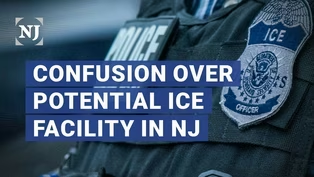
Is an immigration detention facility opening up in Roxbury?
There's been confusion among state and local leaders after conflicting reports came from the Department of Homeland Security as to whether they purchased a warehouse in Roxbury to turn it into a detention facility.
On Wednesday, Gothamist reported that DHS did in fact confirm it had purchased a warehouse to convert it into a detention facility.
But Roxbury Mayor Sean Petillo told us that DHS sent him a correction, saying the original statement was issued without proper approval and that no facility was purchased in the town.
The owner of a vacant warehouse on Route 46 that ICE scouted last month also told the town there's no contract in place with any prospective buyer.
The issue first came to light when the Morris County town showed up on a list of DHS potential locations in December.
Elected officials from both parties have raised concerns about warehouses being an inappropriate space to house detainees.
A DHS spokesperson told NJ Spotlight News in a statement, quote, "We have no new detention centers to announce at this time.
These will not be warehouses.
They will be very well-structured detention facilities meeting our regular detention standards."
Now, State Senate Minority Leader Anthony Bucco has said the township is not the only place where the warehouse is being used.
The township's council, which is made up of all Republicans, also passed an ordinance opposing any ICE facility within their borders, but it's unlikely they'll have the authority to stop such a move from the federal government.
Governor Sherrill's transition is coming to an end.
The transition team has released its recommendations for how the administration should address a number of key issues impacting the state.
One of those issues is a challenge that's been staring down this administration, the state health benefits plan, which is close to insolvency.
Over the last five years, the reserves for local government state health benefits plans have been depleted, and many municipalities have dropped out, leaving the costs higher for those still in the plan.
Well, the transition team recommended a number of changes to fix it.
One would be a change called reference-based pricing, which means health care providers get reimbursed based on a set price, regardless of what it costs to actually provide the health care service.
The transition team says it would, quote, "generate substantial savings for both workers and public employers."
But groups like the New Jersey Hospital Association have cautioned that reference-based pricing might actually have a negative impact on patients who could be charged the balance if providers aren't satisfied with their reimbursement rate.
The transition team also recommended setting out-of-network hospital price caps, as well as a host of other changes to improve the healthcare system overall.
The Sherrill administration says they are "actively reviewing their recommendations."
Also tonight, reports of dead birds are flooding into the state.
These images may be upsetting, but between Saturday and Monday, the Department of Environmental Protection says it's gotten more than 1,100 reports of dead or sick wild birds, most of them Canada geese.
It's still unclear what's to blame, but the DEP says it's very likely the result of the highly pathogenic avian influenza, also known as the bird flu.
Now, the bird deaths were reported in six counties in central and south Jersey.
The DEP is testing the birds, and results are expected in about a week, but they highly suspect avian flu given the time of year and the nature of the deaths.
But other causes could be to blame.
Earlier this month, brant geese were tested for avian flu, but those came back negative, suggesting their deaths could be linked to freezing temperatures and a lack of food.
The risk of transmitting avian flu from animals to humans is low, but officials are advising members of the public to limit contact with dead wildlife and to please keep your children and pets away.
The Department of Fish and Wildlife is asking residents to report any sick or dead wild birds, particularly in groups of five or more, to the DEP website at dep.nj.gov.
Coming up, we talk with the Gateway Development Commission CEO about when construction sites will be up and running after funding was restored this week.
That's next.
Funding for NJ Spotlight News, provided by the members of the New Jersey Education Association.
Making public schools great for every child.
And RWJBarnabas Health.
Let's be healthy together.
So is the Gateway Tunnel Project fully funded and will it move forward?
Lately, it feels like it depends on the day and who you ask.
The courts have required the federal government to release $205 million in funding, money that should get the project restarted sometime next week.
But there are still many larger questions at play, like will the Trump administration attempt to block the rest of the federal funding for the total $16 billion that the project costs?
Here to talk it all through is Tom Prendergast, CEO of the Gateway Development Commission, which is responsible for the project.
I want to start with the $205 million that the federal government did release this week.
That was sought in immediate relief.
Is that enough to start the work?
Restart the work?
It's definitely enough to stop the pause that we currently have and restart the work.
We heard Governor Cheryl and Governor Holkill for her part say many times that any work stoppage was going to increase the total costs for the project.
And so given the fact that we saw workers out of a job for more than a week, are there now additional costs to get those workers back onto the site?
Well, one of the things you do when you have a program this large is you have a contingency fund for unplanned events so that you have not only contingency in terms of the budget, but the schedule as well.
So what we need to do now is whenever we didn't plan for a stoppage of two weeks like we've experienced.
So we need to assess exactly what impact to this to the schedule and budget of the program.
This two week stoppage you'll have with the intent of trying to get it back on schedule and within budget.
I understand one of the challenges when there is a work stoppage like that is that workers go and they take other jobs.
Do you know right now if you're able to get these workers back onto the job site.
And if so do you have a date.
Well one of the things we have done is we've kept the contractors fully informed as to what's going on.
And we not only share information with us but they share information with us.
And the shorter the pause, the more likely they'll be able to bring back the same workers that were working on the site when we paused the work.
Because the level of effort, the knowledge about the uniqueness of the job are all embodied in those workers who work there every day.
So we're confident we're going to get the critical mass of those workers back that were working on it when we paused it.
Yeah, you raise an important point about the uniqueness of the job and having those workers on site who really understand that institutional knowledge.
I want to better understand there are two lawsuits right now.
One was filed by your organization, the Gateway Development Commission.
Another filed jointly by the states of New Jersey and New York.
It was the state's lawsuit that saw the immediate relief, the 205 million.
How, if at all, does that impact your lawsuit now that those funds have been received?
Well, first of all, we're exhausting all means short of the lawsuits to make sure we're communicating with our federal partners who are providing the lion's share of the money and answering any questions they have.
There are two lawsuits, one filed by the states of New York and New Jersey, and that's the one that actually prompted the action to get the federal government to make the payment that they made to us.
Our lawsuit is a summary judgment lawsuit that's tied to basically the facts as related to the full-front granting agreement.
the facts as related to the full-front granting agreement.
But the most immediate action that resulted in the workers coming back to work was the result of the state's lawsuit.
So to be clear, the state getting this immediate relief does not in any way impact your lawsuit.
You will not be retracting your lawsuit?
We're not going to retract our lawsuit.
We're going to keep pursuing it.
There may be some impacts.
I'm not a lawyer and there may be some details where there could be some impacts one to another.
But both both are pursuing for for the reason so that we can get clarity with respect to what the federal government is required to do and what our expectations are of what those requirements are.
I have to ask you and it's a question that we've raised before but since I'm talking directly to you and you are the head of this commission I want to ask do you believe in hindsight maybe you waited too long to take legal action at a point where there was just a few days before all funds had been exhausted and you were at the end of the financial rope so to speak.
I mean, it's a question that a number of people have asked and they've asked it even in other forms where I've had to pursue working at a public agency a lawsuit.
I think we always try to find a means short of a lawsuit to reach an agreement to have a dispute resolved and work continue.
And that's a given.
So people can ask the question like, "Could you and should you have filed earlier?"
That's a valid question.
And I think we wanted to make sure that we exhausted all means with respect to the concerns that our federal partner had with respect to this work going forward.
And that started with the DBE evaluation and then moved on into the issue of pausing of the funds.
So it's a matter of principle and it's a fair question, but we wanted to make sure that GDC, the Gateway Development Commission, wanted to make sure it was exhausting all means before it had to use legal remedies to get a solution.
We thank the states for the action they took.
Yeah, the states filed suit very shortly after your organization did.
The president said on Monday, and I want to quote him, that the project requires proper planning to avoid insurmountable cost overruns.
What's your reaction to that comment from the president?
It's a fair statement, and it's a fair statement in anyone who has to deliver a major infrastructure project that is in the billions of dollars.
It's all about scope, schedule, and budget.
My predecessor, Chris Calori, myself, we have committed and signed into a full funding grant agreement with the federal government stating that we're going to deliver this project in this time frame at this cost.
And so the statement the president made is fully in line with that.
We are held to task to deliver this project as agreed to in a contract document by scope, schedule, and budget.
>> Good morning, everyone.
I'm your host, Brianna Gagis.
I'm here with the president of the United States, John that statement that was part of a larger post that he put out on social media where he did call the project a boondoggle?
Do you have concerns that the funding will be a big question mark as the project goes forward?
Of course, too, his administration is still going through the appeals process.
>> Well, let's -- I mean, take that apart in pieces.
I don't agree that it's a boondoggle.
I've spent my entire career, over 50 years, in public transportation, whether it's in the private or public sector, and infrastructure, whether it's new infrastructure to provide an asset or the maintenance of an existing piece of infrastructure to extend its life.
And it's not a boondoggle.
There's widespread support.
This is the largest infrastructure project in the country for the need for these tunnels and the Gateway Tunnel Project.
So having that's the answer to the first part of the question.
The second part is you should be people that are delivering projects like the Gateway Development Commission is should be held to task to be able to deliver this project as efficiently and as quickly as possible.
Does that create challenges?
Absolutely.
It's an eight to 10 year project.
There will be issues that we need to manage effectively.
Anybody who tells you that you can manage a project with no problems isn't telling you the truth.
There will be problems on any project of this magnitude.
It's the timely identification of the problem and the implementation of an action to mitigate the effects of that problem.
All right, well, I appreciate your insight.
Appreciate you coming on and talking with us.
>> Good morning.
I'm joined by Tom Prendergast, CEO of the gateway development commission.
Thanks again.
>> Thank you very much.
>> The senate judiciary committee held a hearing today where they considered three of governor Sherrill's nominations for cabinet positions for the departments of human services, education, and veterans affairs.
They also moved forward a package of bills that would place restrictions on how federal immigration officials can carry out their duties.
Two of those bills were pocket vetoed by Governor Murphy before he left office.
Raven Santana is in the statehouse and has more on what transpired.
Raven what happened today.
Hi Joanna.
It was a long day here in Trenton for the Senate Judiciary Committee that voted in three new cabinet nominees in the Department of Human Services, Education and Veterans Affairs.
And that committee took more than three hours to hear testimony and ask questions of those nominees in their respective departments.
Take a listen.
Especially amid heightened uncertainty and fear created by federal immigration policies, it's essential that New Jersey remains a place where families know their rights and feel safe seeking help.
Where eligible residents can access services without intimidation and where dignity and conclusion remain core values of how we deliver human services.
We need to know where and how students have fallen behind and we need to be able to take specific action based on that data.
So depending on the questions I get from this group I'm happy to talk about assessment and literacy and all sorts of things at length but it's really important that we use tools like high impact tutoring to target exactly what the data says that student needs to catch up in terms of their learning and that can look really different from student to student.
As a state in our FY 26 budget and I hope in our FY 27 budget funds will remain in place to enable us to contract with private mental health providers as we have for a long time to deliver sessions at no cost to veterans and this is just an example in fiscal year 25 we provided 6,046 counseling sessions to veterans in addition if a veteran has trouble because transportation is often an issue we provided at no cost in FY 25 18,760 rides to those mental health providers the nominees now need to be confirmed by the full Senate later in the afternoon the focus shifted to immigration policy the committee took up for immigration related bills including two measures previously rejected by former governor Murphy just before he left office one bill would codify New Jersey's immigrant trust directive which restricts when state and local law enforcement can share information with federal immigration authorities the committee is also considering the Privacy Protection Act, a bill designed to limit when government agencies and health care facilities can collect and hold personal information.
A new bill titled the Transparency and Federal Law Enforcement Activities Act would establish identification requirements for law enforcement officers under certain circumstances and one of the most debated proposals would prohibit state local and federal law enforcement including ICE officers from wearing masks or otherwise concealing their identities while interacting with the public.
Ahead of the vote, Nnedi Amorosi of Make the Road New Jersey urged lawmakers to support greater transparency and accountability.
The Privacy Protection Act is a step in the right direction.
I think we have an incredible opportunity to address due process violations of the Immigrant Trust Directive and if that's sort of you know the biggest takeaway that we want to make sure that folks have are you know we have seen that ICE agents do not need judicial warrants that they can sort of go as they please but our Constitution says that you do need a judicial warrant and so at every measure that should be our hard line.
There still remains a lot of uncertainty as to what happens next but for now supporters I spoke with say momentum is on their side.
For NJ Spotlight News I'm Raven Santana.
Under the Dome is made possible in part by the Corporation for Public Broadcasting a private corporation funded by the American people.
Vaccination rates continue to drop in New Jersey.
The latest data from the State Department of Health looking at rates among school children shows that 91.3 percent of children were fully vaccinated last school year.
That number down from 95.4 percent who were fully vaccinated in the 2017 2018 school year.
That's because the number of parents claiming religious exemptions has more than doubled across the same time period.
So what's happening to change the rates and what will be the impact.
Here to talk about it is Perry Halkitis dean of the School of Public Health at Rutgers University.
Perry great to have you in the studio with us.
First why are we seeing this shift in rates plummeting and more parents claiming religious exemptions.
So I think there are lots of factors at play here and I think Covid sort of was a game changer.
We've had decades of skepticism around vaccination going back to the late 1990s with a published study by Wakefield.
But Covid made people hesitant.
Covid made people scared.
The vaccine caused people to have distress.
And I think that opened the doors for parents to begin to really question whether or not vaccines are truly safe for their children.
It's a not a new phenomenon.
It's just one that's accelerated.
Number two I think we're seeing right now and what we're seeing in New Jersey and across the United States is a reaction to a federal government that is raising doubts about the efficacy of vaccines and the importance of prevention.
So you put those two things together.
Plus you add to it what I believe is a huge factor that we don't talk about which is during COVID we all became very isolated and we forgot we were part of a civil society and we have to take care of each other.
And you get a situation where people are making decisions that don't really care for all of us.
What are the health impacts?
I know we've seen more and more reports across the country even here in New Jersey of measles outbreaks happening something we hadn't heard of.
What are the impacts when we see these rates dropping for measles to be controlled in the United States.
We need to be at 95 percent.
Right.
That's where we were.
That's no longer where we are.
What's going to end up happening is we're going to continue to see the spread of the disease.
We're going to see death related to measles because people can die from measles complications because of the effect on the brain.
And we're going to see sporadic outbreaks here and there across the country.
And it's not going to stay isolated because we have to remember that in the United States we travel.
And so we're going to have a generation of children who are going to grow up being exposed to a disease that they should not be exposed to and placing other children who are vaccinated who have some protection or a lot of protection but not 100 percent protection at risk for obtaining this disease.
Beyond measles what other diseases are you concerned about could make a reappearance.
I think all of them can make a reappearance when we talk about like you know polio for example you know which we have managed and we know has like you know made people's lives miserable throughout the early 1900s is one that we should be worrying about.
You know measles is the biggest one.
I think we think about chickenpox which we don't have a vaccination for but when you start to have one infectious disease happening you have many infectious diseases happening.
And so my concern is that we're creating a generation of children who are going to be susceptible to infectious disease including COVID including flu because their parents are making decisions for them that perhaps are not in these children's best interest.
We've seen you mentioned the federal government we've seen shifts in recommendations from the CDC under the guidance of Robert Kennedy Jr.
They have shifted away from the recommended dosage or the recommended number of vaccines.
What can you tell us about what they've downsized.
And then we're going to get into how the state's responding.
Yeah.
So they've downsized the number of vaccinations that they're recommending for children.
It's not based on anything scientific.
Right.
I think actually when that first happened I thought like well this is just a checkmark so that it can please a certain part of the population.
And so so there are still the majority of the vaccinations are still there.
There's just a smaller number of them.
The state if I could go to that you know is taking an approach that many of us in public health are taking which is garbage in garbage out.
That's what's happening at the CDC.
What do you mean by that.
By that I mean that the CDC is no longer the source of information of good guidance and clear scientific integrity that it was years ago.
So the recommendations that are coming out of the CDC right now are often fraught with politics.
with an agenda and they're not purely based on science.
So we who are working in public health are telling people watch what they're saying with caution.
Watch the data that they're putting forward because it is all being manipulated and massaged in a way to sort of appease a particular segment of the population.
Perry on the flip side of that there's a lot of people who say that that's what was happening previously before RFK came in and made these changes.
They say that there was a political agenda previous to this.
How do you respond to that.
I respond to it.
There's no evidence for that.
There's there's the political agenda prior to that was we want to keep people healthy and you want to keep people healthy by keeping them vaccinated.
The political politicization is always always an issue for sure.
This political approach that we are facing right now is an anti-scientific one.
And I think that if there were any politics in the reverse that happened in prior administrations it was a pro-scientist one.
So maybe things seem better than they actually were.
But certainly the country was healthier.
And if you look at morbidity and mortality rates people were not dying younger.
And now they're dying younger in the United States.
Let me ask you this.
We've seen a severe flu surge in the region this winter.
And the FDA has changed its own course on whether or not to consider the Moderna vaccine which is an mRNA vaccine.
What can you tell us about it and what happened there with that change up.
Yeah.
So H3N2 subclay K which is the version this year.
The vaccine that most of us got earlier in this year was not the most effective around this particular strain of virus but it worked.
So what you've seen in the last few months is a surge of flu because while the vaccine worked, it didn't work as well as it could have worked.
But we still prevented people from dying.
What the reversal that we saw in the last couple of days is actually fascinating because Moderna comes forward.
vaccine that's going to be used for flu.
The FDA says no.
And then I think they came to pressure and a lot of it is business pressure.
Absolutely.
We know Blackstone funded that vaccine.
Absolutely.
Blackstone funded that vaccine.
I think that the administration does not want to sideline big business.
And as a result of that I think the pressure that the Trump administration felt made them change their course on this.
And you know good for public health.
It's a win for public health in some ways.
back down to like a business forcing the government to take care of its people to be able to change a decision which is the right decision.
Very quickly do we have any sense of when it could be approved.
You know I mean I think that they've asked for some more testing.
They've certainly they've asked for a separation of people 65 and over versus younger than 65.
So I think at some point this year we will see an approval of the vaccine.
The mRNA vaccine holds potential not just for flu but for something that we've been fighting for over 40 years which is HIV.
Yeah yeah.
We're going to get that open a can of worms with that one.
But Perry Halkitis Dean of the School of Public Health at Rutgers University.
Thank you so much.
My pleasure.
And that's going to do it for us tonight.
I'm Joanna Gagas for the entire team here at NJ Spotlight News.
Thanks for being with us.
We'll see you next time.
We'll see you right back here tomorrow.
NJM Insurance Group, serving the insurance needs of residents and businesses for more than 100 years.
NJM Insurance Group has been serving New Jersey businesses for over a century.
As part of the Garden State, we help companies keep their vehicles on the road, employees on the job, and projects on track.
Working to protect employees from illness and injury, to keep goods and services moving across the state.
We're proud to be part of New Jersey.
NJM.
We've Got New Jersey Covered.
[music]
 New
NewImmigration officials erred on Roxbury warehouse claim, mayor says
Video has Closed Captions
Clip: 2/19/2026 | 1m 48s | DHS says no new detention centers to announce after 'purchase' was reported (1m 48s)
Providing Support for PBS.org
Learn Moreabout PBS online sponsorship
- News and Public Affairs

Top journalists deliver compelling original analysis of the hour's headlines.

- News and Public Affairs

FRONTLINE is investigative journalism that questions, explains and changes our world.












Support for PBS provided by:
NJ Spotlight News is a local public television program presented by THIRTEEN PBS